Sri Lanka: Left-Tamil alliance to contest elections
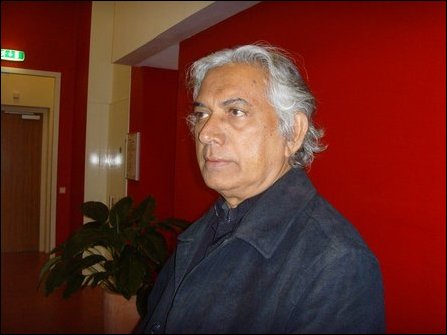
Vickramabahu Karunaratne, the presidential candidate for the NSSP.
By Chris Slee
March 20, 2010 – The Left Liberation Front (LFF) is contesting 19 seats in the April 8 parliamentary elections in Sri Lanka. The LLF, an electoral coalition comprising the Nava Sama Samaja Party (NSSP, New Socialist Party), the Tamil National Liberation Alliance (TNLA) and the Socialist Party, stands for the right of self-determination for the oppressed Tamil people of Sri Lanka, freedom for political prisoners and an end to the state of emergency.
The NSSP and the Socialist Party are Marxist parties based in the predominantly Sinhalese south of the island of Sri Lanka. The TNLA is a Tamil nationalist party based amongst the Tamil people of the north and east of the island.
March 1, 2010 – Vickramabahu Karunaratne announces that the Left Liberation Front is contesting 19 seats in the April 8 parliamentary elections in Sri Lanka.
Oppression and resistance
Tamils have faced discrimination and oppression since the independence of Sri Lanka in 1948. One of the new government's first acts was to deprive Tamil plantation workers, whose ancestors had come from India more than a hundred years before, of citizenship rights. Then in 1956 Sinhala was made the sole official language of Sri Lanka, putting all Tamils at a disadvantage, including those whose ancestors had lived on the island for thousands of years.
Peaceful protests against these and other discriminatory measures were violently repressed. This led to the growth of support for the idea that the predominantly Tamil-speaking north and east of the island should break away and form their own separate state. Some Tamil youth took up arms to achieve this goal, forming the Liberation Tigers of Tamil Eelam (LTTE), which fought a war of independence for nearly three decades.
Throughout the war the Sri Lankan government was backed by the imperialist powers. The United States, Britain, Israel and their allies supplied weapons, military training and advice. For example, Israel-supplied Kfir jets were used in attacks on LTTE-controlled areas, causing large numbers of civilian casualties. More recently China has also helped the Sri Lankan government's war effort.
The US and the European Union has banned the LTTE as a “terrorist” organisation and arrested Tamil activists alleged to be associated with it. In Australia, while the LTTE was not formally banned, three Tamil activists were arrested on charges of aiding the LTTE, due to their involvement in raising frunds to provide relief for people in LTTE-controlled areas affected by war and the December 2004 tsunami.
The LTTE was militarily defeated in May 2009. An estimated 30,000 Tamil civilians were killed in last five months of the war, as the Sri Lankan army and air force bombarded the diminishing LTTE-controlled areas. More than 150,000 Tamils were killed in the whole period of the war.
Three-hundred thousand survivors were imprisoned for months in concentration camps. While most are now supposedly free to leave, many are unable to return to their homes, either because they have been destroyed or because they are in areas designated by the Sri Lankan army as "high-security zones".
In some of these areas Sinhalese settlements are being established. This is a continuation of the Sri Lankan government's long-term policy of establishing Sinhalese settlements in Tamil areas. The aim is to make an independent Tamil state unviable, just as Jewish settlements in the West Bank are intended make a Palestinian state unviable.
While Tamils were the main victims of the war and repression, they were not the only ones. Sinhalese journalists and human rights activists have also been arrested or murdered.
While the war is now over, the repression continues. The state of emergency is continually renewed by the Sri Lankan government. Disappearances continue -- seventeen cases were reported to the Human Rights Commission of Sri Lanka in the first seven weeks of 2010.
Split among Sinhalese chauvinists
Recently the key perpetrators of the war on the Tamils have fallen out. General Sarath Fonseka, head of the army during the final onslaught, retired from the army and contested the January 26, 2010, presidential election against the incumbent Mahinda Rajapaksa.
Fonseka's campaign was supported by the United National Party (the main bourgeois opposition party), as well as by the JVP (Peoples Liberation Front), a party that claims to be Marxist but is in practice Sinhalese chauvinist. Rajapaksa won the election, partly due to fraud and intimidation, partly because of his control of the state media ensured he was more successful in appealing to Sinhala chauvinism.
Following the election Fonseka was arrested by military police. Initially the government accused him of plotting a coup. However it has now been announced that he will face two separate trials before military courts, on charges of carrying on political activities while still in the army, as well as alleged illicit business dealings.
Divisions among the Tamils
Divisions arose within the Tamil National Alliance over how to relate to the Fonseka campaign. The TNA, which won 22 seats in the 2004 parliamentary elections, has been the voice of the Tamils in Sri Lanka’s parliament. But following the defeat of the LTTE there has been disagreement in the TNA about perspectives and tactics.
Most TNA MPs called for a vote for Fonseka in the presidential election. A few supported Rajapaksa. Both these groups dismissed the idea of running a Tamil candidate as well as the option of supporting a Sinhalese leftist candidate, saying that only Rajapksa or Fonseka had a chance of winning, and it was necessary to choose the lesser evil amongst these two.
However a minority of TNA MPs refused to support either Rajapaksa or Fonseka. One of them, M.K. Sivajilingam, nominated as a candidate in the presidential election.
Most Tamils either boycotted the poll or were prevented from voting. In the Tamil city of Jaffna, the voter turnout was only 18 per cent. Those Tamils who did vote generally followed the advice of the TNA majority and supported Fonseka.
During the campaign Sivajilingam held joint election meetings with Vickramabahu Karunaratne, the presidential candidate for the NSSP. Sivajilingam and his supporters have now broken from the TNA and formed a new party, the Tamil National Liberation Alliance, which is continuing to work with the NSSP and other leftists as part of the LLF.
Another group which has broken away from the Tamil National Alliance and is contesting the coming parliamentary elections on a program of self-determination for Tamils is the All Ceylon Tamil Congress, led by Gajendrakumar Ponnambalam.
Other Tamils, while critical of the position taken by the TNA, still hope that it can be reformed and return to a principled position.
The elections are also being contested by two leftist parties that are not part of the Left Liberation Front, the United Socialist Party and the Socialist Equality Party.
The role of the Tamil diaspora
Around 1 million Tamils have fled Sri Lanka to escape racism, repression and war. These people have been active in solidarity with those Tamils who remain in Sri Lanka. Their protests have helped make people in the host countries aware of the plight of Sri Lankan Tamils.
As a result, politicians in the US, Europe and other Western countries sometimes express concern for human rights in Sri Lanka. While such statements are largely tokenistic, they annoy the Sri Lankan government, which sometimes denounces "outside interference". In reality, as Vickramabahu Karunaratne has said, "There was no foreign intervention except on the side of the government".
The Tamil diaspora is continuing to campaign for national self-determination, despite the military defeat of the LTTE. Referendums have been held among Tamils living in a number of countries, resulting in overwhelming majorities supporting national self-determination. The Global Tamil Forum recently called on the United Nations to conduct a UN-supervised referendum in the north-east region of Sri Lanka and among the displaced Tamils living in other countries, to determine if they want independence or to be part of a united Sri Lanka.
[Chris Slee is a member of the Socialist Alliance in Australia and a long-time activist in solidarity with the Tamil people of Sri Lanka. A shorter version of this article appeared in Green Left Weekly.]
Poem: A search that depressed me
I am Thiruvarangan, an Assistant Lecturer in English Literature attached to the University of Jaffna. I am sending herewith a poem I wrote recently. If you find it worthy of publication please include it in one of your issues. The poem is about the absence of Left wing politics and the consequent disunity among the oppressed communities.
Regards,
Thiruvarangan
A search that depressed me
Searching
in those semi-arid paddy fields,
the cleavages of the silent hills, no longer luscious,
the dried up river,
the never-ending rows on the ballot sheet.
No sickles, no hammers, the sky blackened without stars,
green, blue, yellow, white, brown -- all could paint our walls
with faces of new-born patriots and traitors,
the missing red,
gone with the wasted blood,
the Left,
left forever?
Bridges bombed and broken,
the tree long lost its roots,
the violent tsunamis,
patriotisms and nationalisms,
homelands and motherlands,
the ship is out of sight,
the crew all dead and missing,
sleeping in new camps,
with strange bedfellows who praise gods and demons.
The unhappy farmer of Tissamaharama,
the manacled Tamil prisoner from the thickets of the Wanni,
the withered tea-plucking woman in Talawakkele,
the homeless fisherman on the Eastern coast,
the evicted Jaffna Muslim,
the unspoken Malays, Burghers and Telugus,
disconnected,
throttling each other in battles misfought.
Cracks everywhere,
the wall crumbles.
Mahendran Thiruvarangan