* * * *
Finding this article thought-provoking and useful?
Please subscribe free at http://www.feedblitz.com/f/?Sub=343373
Help Links stay afloat. Donate what you can by clicking here.
* * * *
By Rob Rooke

No single commercial product in the history of capitalism has had a greater effect on the economy and politics than the automobile. No other product has been such a lever to increase consumption and increase markets in the developed world. It could be argued that the car, more than any other product, was at the very heart of the 20th century’s economic expansion. In US society, for over a century, the car has been raised on a cultural pedestal worshipping individuality and defining big business’ vision of freedom.
The car hastened the massive sprawl of suburbia and in itself shaped US urban planning like no other product. Today, in the United States, public transport plays a distant second fiddle to the car with nine out of ten workers using their cars to travel to work. In people’s everyday life, the car is now their second biggest household expense, next to housing. The car has reached its zenith.
This brief socialist history of the automobile will attempt to give some background and context to today’s car-dominated world. It will attempt to explain how the automobile and the mad chase for profits has shaped the world, and helped in turn lead humanity to its current fork, where one road indisputably will lead to global destruction.
This history is founded on Marxist materialism, which sets off from the idea that all social and cultural phenomena under capitalism are shaped by the continuous tug between the bosses and the working class. While this is not a history of autoworkers, it does attempt to show the role of working people’s struggles that have continuously been in the background to the birth and rise of the automobile.
One side of the auto industry that does not pervade its own advertising is the bloody road that brought it here. The industry itself has killed and maimed hundreds of thousands of workers as it arose and found its feet. This suffering was in turn surpassed by a century-long battle over resources to feed the car its oil; its rubber; its steel and glass. Many millions have been killed in many hundreds of wars and invasions by imperialism, some more directly connected to the automobile than others.
The place of petroleum in the current war in Iraq is self-evident. But it is not the first or last war for resources for the automobile. Over a hundred years ago US imperialism invaded Central America to establish its own rubber plantations for its booming auto industry; its brutality gave rise to Augusto Sandino, the grandfather of Nicaragua’s anti-imperialist resistance.
This article is dedicated to the thousands of workers who died fighting for auto unions and those millions who resisted the auto-industrial complex and were crushed in its wake.
A brief socialist history of the automobile
In 1799 Philippe Lebon registered his invention of a “gas powered engine with internal combustion’’ with the new revolutionary government of France. The new engine would be light, independent and powerful. It would be a hundred years before the steam engine had exhausted itself and the gas engine replace it. Together with the discovery of new sources of oil and the explosion of industry, particularly in the US, all the parts were in place for the invention of the horseless carriage.
During the 1890s the motorised bicycle and the electric car were eventually sidelined for the more utilitarian and more profitable motor car. The car began its life as a toy for the wealthy and an object that polarised the classes. It was widely known that Cornelius Vanderbilt, the railroad baron, had a 100-car garage. In 1906 Woodrow Wilson, then president of PrincetonUniversity, argued that “nothing has spread socialistic feeling in this country more than the use of automobiles…they are a picture of the arrogance of wealth’’. The Horseless Age magazine in 1904 documented widespread stone throwing at autos in working-class neighbourhoods of New York City.
The first cars were unaffordable to working people. The average annual income of a worker in 1900 was $450 and the average price of a car was $2000. Along with the price, the common notion was that horseless carriages were less pleasant and less reliable than the horse. Only 4192 cars were sold in 1900. But within 27 years the number of cars registered in the US ballooned to over 20 million. More than half of all US families either owned a new or used automobile.
Rise of the working class and the USA’s industrial impasse
By the end of the 19th century US capitalism was fighting off a mass movement for unionisation and socialism. American capitalism had won the civil war defeating the slave-owning class, which, along with wiping out the Native American peoples, enabled capitalism to complete its rule from coast to coast. The bosses had encouraged millions of immigrants to its shores in part to attempt to undermine rising wages, however this had not prevented the working class rising up and establishing skilled craft unions throughout many of the United States’ industries.
US manufacturers had begun to see a serious decline in its rate of profits. Employers had tried to lower wages and speed up production, but that had only provoked more strikes and more workers joining the new unions. Employers began to conclude that they needed to change the organisation of production to break the power of the craft unions.
At the turn of the century a massive wave of mergers had given more control of larger companies to the banks and financiers. The dominance of the banks enabled them to direct change in the productive process of manufacturing. Frederick Taylor’s “scientific’’ management methods were increasingly adopted throughout industry. Centralised planning, detailed time study, division of labour and incentive pay were implemented in attempts to reverse the decline in capitalism’s rate of profit and at the same time break the power of the skilled craft unions.
The automobile leapt from the sidelines into the centre of capitalist life in the first two decades of the 20th century. Increased technological improvements were able to utilise the internal combustion engine into a producer of energy unlike any previous invention. One gallon of gasoline, transformed through this engine could produce the equivalent energy of one month of human labour. The oil industry, which had grown through the widespread use of the oil lamp, had already been developed and was constantly searching for new sources globally. Unlike British, German and French imperialism, US Imperialism had the advantage of its own domestic oil industry.
Fordism: industrial saviour
The emerging automobile industry grew out of the large horse carriage manufacturers and small auto shops. Henry Ford exploited the latest manufacturing technologies and with massive investment from the big banks, transformed the plaything of the rich into a mass consumer product. Ford’s massive investment in machinery created high-speed production aimed at de-skilling the labour involved in production and assembly. Fordism aimed to destroy the clout of the craft unions: breaking down the productive process to its lowest denominator: to the simplest, most repetitive tasks. Then, to increase line speed, the industry introduced production-based pay incentives.
Henry Ford and the Model T
The mass investment into auto produced incredible results. In 1910, while a car in Europe took 3000 employee-days to produce, a Ford car was being produced in the US in 70 employee-days. In 1911 the Overland carriage company produced 20,000 cars. Their paint division employed 200 craftspeople and took two weeks to paint each vehicle. In 1915 with the introduction of spray painting and drying ovens this was reduced to three days per vehicle. The Ford Motor Company additionally stepped up production and cut costs by streamlining down to a single model. In 1914 it also discontinued all colours except black. The 1913 introduction of the conveyer belt reduced assembly of the Model T from 12.5 hours per vehicle to 1.5 hours, and by 1915, the number of skilled workers in the US automobile industry had fallen from 60% of the workforce to 15%.
One further advantage for US imperialism was that it had the world’s largest undivided potential market for any new product. In contrast, Europe was divided by dozens of national tariff walls. More than 100 million people lived within the US at this time and Ford’s River Rouge plant alone employed more than 100,000 workers. Ford developed and grew the market for the car by a combination of raising autoworkers’ wages and lowering automobile prices.
In 1913 Ford introduced the $5-a-day wage, when average daily pay in the US was under $2. In this way the Ford workforce became a part of the first mass market for cars. Ford also reduced the work-week to five days in his factories in 1926, helping raise his workers’ productivity.
By 1908 the Ford Model T was launched. It sold for $825, the cheapest car of its time. Ford had reduced costs by reducing his line to one basic affordable model. By 1925 regular price cuts had eventually brought the price of the Model T down to $260 per car, helping place an automobile outside the home of every second US family.
Over two decades the automobile had been transformed from an experimental plaything of the rich to a common, everyday product. The car no longer bore the stigma of being elitist. One of Ford’s followers was the rising star of German capitalism, Adolf Hitler. Hitler argued “the motor car instead of being a class dividing element can be the instrument for uniting different classes, just as it has done in America, thanks to Mr. Ford’s genius’’. While the $5-a-day wage was not copied in Hitler’s Volkswagen factories, most of Ford’s authoritarian management methods were. Ford’s US factories were well known for their severe discipline and instant firings. No-one was allowed to talk on the production line: workers called it the “Ford Silence’’. Ford’s fascist-style workplace regime was only broken by the victory of the United Auto Workers in organising Ford plants in 1941.
The booming ‘20s and the struggle for raw materials
The economic boom of the 1920s was led by the two newest and biggest consumer objects of 20th century US capitalism: the single family home and the automobile. The cinema, which replaced the saloon, became the lead advertising agent for the car. Radio advertising too promoted the new freedom of the road. The monotony and alienation of life in the workplace remained hidden in all but socialist literature. Capitalism offered increasingly meaningless jobs and an illusion of meaning off the clock: with the individualised car and picket fence.
The car and the airplane shortened distances, as did the telephone and the radio. The speed of life outside work increased, mirroring the increased speed at work. Sales promotion and marketing was born and boomed as capitalism frantically pushed to increase markets and feed its addiction to profits.
In France, the Citroen Corporation had 5000 travelling salespeople to promote the need for its car in every village and hamlet. Citroen paid for 150,000 road signs to be erected across France, where they previously hadn’t existed. The company also sold 400,000 toy cars to entice future buyers and beginning the long association of boys and cars. By 1927 the French automaker was producing 1000 cars a day in its French plants.
With the rise of the automobile, new sources of raw materials needed to be discovered and created. Capitalism can never stand still. As Karl Marx wrote in Capital, “Accumulate! Accumulate! Accumulate! That is the Moses and the Prophets!“ Capitalism, by its inherent nature, can never stop, but is forced to continuously create bigger and bigger markets, and more and more consumption. This is all that stands between itself and an economic slump of overproduction.
Relatively sleepy Brazil was the exclusive producer of rubber at the end of the 19th century. Rubber trees grew wild, but production was costly, because of the Amazon’s isolation and scarcity of labour. Waterproofed products, capitalism’s initial use for rubber, was soon surpassed by rubber’s value as car tyres. Each car demanded 45lbs [20.4 kgs] of rubber, which sold on international markets for up to £900 per ton.
Brazil closely guarded its rubber monopoly until British imperialism broke into the industry by robbing a shipment of rubber tree seeds. Britain then raised seedlings in its Ceylon [Sri Lanka] colony and eventually began mass production of rubber in Malaysia. By the 1910s the Dutch and British colonies were producing hundreds of tons of rubber. In 1913 Malaysian and Indonesian production first surpassed Brazilian production. Two years later British Imperialism’s plantations doubled Brazilian rubber production and by 1919 they produced 10-fold more rubber than Brazil. The US recognised the problem of depending on British colonies for its tyre industry and invaded Central America to develop its own rubber industry. The US mirrored the brutal methods of the rubber plantations in Asia, where it was not uncommon for half of all workers to be dead by the end of the rubber season. US rubber plantation methods, nearing slavery, provoked one of the first mass rebellions against US imperialism, as it began its role of stalking the planet for resources.
In the mid 1920s the introduction of the inflatable tyre increased average tyre mileage from 8000 miles to 15,000 miles. The price of rubber then soon collapsed. Rubber, which peaked at £900 per ton in 1910, fell to £20 per ton by the 1930s.
In 1928 the owners of the world’s three biggest oil companies, Anglo-Persian Oil (later to become British Petroleum), Royal Dutch Shell and Standard Oil, sat down and worked out a deal to share out the world’s oil wealth between them. The Red Line Agreement signed a year later would help avert the suffering of a new world war to re-divide oil resources. Nonetheless, the working classes and poor of the oil-producing countries continued to die in poverty, alongside billions of barrels of black gold.
‘Our big job is to hasten obsolescence’
The automobile helped lead the charge of the unprecedented boom of the 1920s. During this period the car market became saturated, and along with the growing sales of used cars, profits for the industry were falling. A shift in the industry was necessary and General Motors (GM) began to challenge Ford’s single model production.
As early as 1923 GM began selling cars with a similar basic frame, but with different bodies. In the boom of the 1920s GM designers argued that car sales had crossed a new threshold moving from the need for “better quality to better looking’’. Here begins the divergence of the car from its simple utilitarian role into the realm of being an expression of social mobility and wealth. Here begins the massive diversification of models and the road that eventually leads to annual model changes. Capitalism loves all things new and seeks to see all things old thrown away. This moment is the beginning of the massive diversity of models of US cars and all that went with it.
With every model change comes the need for auto plants to produce new dies and reset presses. By the early 1940s GM alone was spending up to $35 million a year on model changes. While costly, routine model changes were beneficial to the narrow interests of the biggest automakers. GM, Ford and Chrysler drove out the remaining small producers who could not keep up with the massive investment required to change models frequently. This emergence of style or appearance as a competitive factor may have been initially stumbled upon, but it soon became a fundamental requirement in the industry. General Motors’ top designer during this period, Harley Earl, argued that “our big job is to hasten obsolescence’’. He further argued that given the average new car ownership span in 1935 was five years and in 1955 it was reduced to two years, that “when it is one year we will have the perfect score’’.
The Great Depression saw all auto companies radically cut back on spending and production. From a high of 5.6 million cars sold in 1929 auto sales collapsed by 75% to 1.4 million vehicles in 1932. Luxury vehicle sales fared worse: peaking in 1929 at 150,000 sold, sales then continued to fall through the 1930s. The rich understood the shift in consciousness of the period and that ostentatious displays of wealth could cost them their lives. By 1937 annual sales of luxury cars had slumped to 10,000.
In 1928 the Ford Motor Company had 128,000 workers on its payroll, by August 1931 only 37,000 workers still had jobs and most of them worked only three days per week. Ford’s $5-a-day wage had risen in the 1920s to $8 and $9 a day. The depression buried the high wage policy. In 1931 wages were cut by 20%. Some male employees were reduced to 10c an-hour and some women labourers’ wages were cut to 4 cents an hour in Ford plants.
In 1942 private auto production stopped altogether as the auto industry turned production into building war machines for US government contracts. War has always been good for business and especially for the “auto-industrial complex’’. As far back as the outset of the US civil war oil was selling for 49c per barrel, but by the end of the World War II a barrel of oil was fetching $8. At the start of the Iraq war oil was $30 a barrel and has now risen to $110 a barrel. Similarly in World War I GM shares rocketed from 78c to $7.50. After World War II, as victor on the Western Front and in the Pacific, the US emerged as the dominant force for global capitalism. Its prestige and power was a crown shared with big auto, which set about building cars for the returning troops.
Post-war public spending for the car
The post-war revolutionary wave that swept the world was also seen in the US. The war’s hardships led to pent up anger and hope that exploded in the US workplace. The strike wave of 1946 was the widest industrial conflict in US history. More than 116 million person-days were lost in strike actions, more than four times the previous record of 1937. The strike issues were primarily for a shorter work-week, higher pay and to resist the loss of relative control over workplaces that were granted during wartime. The bosses conceded on the first two demands, adding also concessions for private insurance to undermine the global movement for nationalised healthcare. As for aspects of workplace control, once again, capitalism offered instead the myth of power and freedom of consumerism. Americans were offered the open road and a full tank of gas.
The US government, together with its close partners at the top of all the major industries began to take steps in shaping post-war USA more tightly in the interests of profit. Major support was given to promote private family home ownership in part through mortgage guarantees for returning troops. The federal government also subsidised the massive development of the suburbs. Between 1945 and 1960 some 30 million Americans moved to the suburbs, the growth of which was a huge boon to the auto industry.
* * * *
Please subscribe free at http://www.feedblitz.com/f/?Sub=343373
Help Links stay afloat. Donate what you can by clicking here.
* * * *
Where the railroads were built through private investment, the automobile roads were built for free though federal, state and local governments. Public and not auto industry money paid for the massive network of highways that were built and the roads were widened. Further billions in public money came in 1956 with the Interstate Highway Act providing a mass of freeways for automobiles across all states. The bill passed under the outrageous pretext that the US needed a freeway network in case of a possible invasion from the USSR.
No other industry in US history was so enormously subsidised as the auto industry. US governments, federal and local, essentially built the superstructure for the expansion of the car. The car became inseparable from almost every function of US life as a direct consequence of its partnership with the US political elite.
The ‘Auto-industrial complex’ conspiracy to destroy public transport
The booming post-war period saw the massive rise and peak of what US Marxist economist Paul Sweezy called the “automobile-industrial complex’’ –- the car, oil, steel, glass, rubber, highway construction, trucking and real estate industries connected to urban sprawl. One consequence of this vested interest in cars was the systematic smashing of public transport operations. General Motors, Standard Oil of California (Chevron), Phillips Petroleum and Firestone Tires formed National City Lines, as a part of an organised campaign to buy up and destroy electric rail systems operating in US towns and cities. After buses replaced trams and trains, then the bus systems too were often wound down.
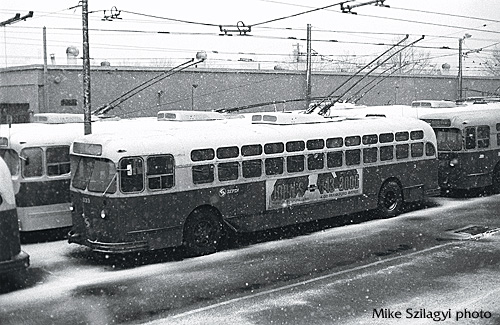
A National City Lines trolley bus
By the early 1950s the auto industry faced a crisis of falling unit demand, as most families now owned a car. At the same time working people’s discretionary spending was rising. Given these factors, the Big Three (GM, Ford and Crysler) moved to increase each car’s size and array of new gadgets, and at the same time increase the frequency of the introduction of new models.

Ford Edsel
Between 1946 and 1959 the cheapest Chevrolet sedan grew 13 inches [33 cms] in length, 7 inches [17.8 cms] in width and was over 400 lbs [181 kgs] heavier. The Ford Edsel, launched in 1957, was an incredible 18 feet [5.5 metres] long. Horsepower for the average model in 1946 was around 110, by 1956 it was grown to 180. Exhaust emissions, fuel efficiency and vehicle safety were placed a distant second to the need to continuously increase profits.
By 1950 the Big Three offered their customers 243 different new car models. During this period new model changes were brought forward from three years per model to two years. With a major body change costing upwards of $200 million, by 1955 the Big Three controlled 94% of the entire US market. They were no longer under any pressure to reduce prices and in the decade of the 1950s prices rose an unprecedented 36% to an average car price of $1822.
Patriotism has always been utilised by business for selling its products. With the Cold War in full swing the US auto industry and its representatives in government increasingly identified consumer choice with capitalism (so-called “democracy’’) and the lack of consumer choice with communism. In 1955 Chevrolet advertised its cars as “empowerment and escape’’ feeding on previous associations of the car and a very narrow concept of freedom.
The Cold War, the retreat from militancy of the labour leaders and the monopoly of big business’ two political parties, gave a green light to the bosses to gouge their customers, the working class. While average manufacturing profits between 1946 and 1967 rose a dramatic 9% per year, GM’s return on its investments were a stunning average of 21% per year over the same period.
The 1964 Senate hearings on auto safety marked the beginning of the end of the blank cheque for big auto. A GM spokesperson admitted that the company only spent $1.25 million on safety research and safety changes for its cars in 1963. When GM executives were then asked about their profit levels, they admitted they had hit $1.7 billion in the same year.
There was also a small backlash within the trend to super-sized cars. In 1955 only 60,000 European cars, which tended to be significantly smaller than their US counterparts, were sold in the US. By 1960 imports rose to 700,000 cars, slightly more than 10% of the market. The arrogance of the auto bosses towards the compact car and towards public pressure was best expressed by Henry Ford III who opposed making smaller models with his position that “mini-cars make mini-profits’’. Comments such as these increasingly irritated working people, leading the Wall Street Journal in the early 1970s to comment on “the growing rebellion against cars’’. The rebellion was as much against the car business as the product itself.
As pressure on the wages of working people increased, more women were returning to the work place. Given the deliberately weak public transportation sector, more families were forced to buy more than one car. In 1950 only 7% of households owned more than one car, by 1970 29% of all US families owned more than one car.
Beginning of the decline of the car
The massive proliferation of models exploded in the sixties. By 1970 the Big Three offered 370 different models each year a 55% increase in the number of models over 1960. Their obsession with perpetuating the myth of choice was beginning to undermine their own profits. In the early days of auto production, from 1919 through 1930, worker productivity increased on average 8.6% per year. Productivity gains collapsed in the 1960s to an average of 3% per year. The fall in productivity was in large part because of the vast multitude of models each of the three big automakers were producing and the massive investment this demanded.
The profit and productivity impasse of the early 1970s increased class tensions within the auto plants. As the corporations sought to further automate and increase line speed they faced the resistance of the rank and file. The bosses responded with harsh disciplinary measures and penalties against individuals. It was this offensive that created a rebellion among young UAW rank and file such as at Lordstown, Ohio. At Lordstown autoworkers were producing one car every 36 seconds. It was the fastest assembly line in the world.
In 1972 Lordstown GM workers walked out over the barrage of disciplinary actions by management. After the 22-day strike a vast majority of workers were reinstated and charges against most workers dropped. However, the fear of the rank and file and increasingly aggressive bosses helped push the UAW bureaucracy in the direction of its current class collaborationist policy of team work. Through the Team Concept the bosses were able to win increased cooperation from their workforce, which in turn increased job speed and alienation on the job.
The long lines outside gas stations during the 1973 oil crisis shifted working-class opinion further against the auto industry. This in turn led to increased regulations on cars, particularly for fuel efficiency. The phrase, “gas guzzler“ was born. As the auto corporations were increasingly perceived as socially irresponsible, they were forced to decrease the size of their monster cars. Detroit was forced to make a large foray into the compact car market. The industry then waited in the wings for the environmentalism and oil fears of the 1970s to die down.
The coming of the SUV
The economic boom of the 1980s, politically expressed through the election and re-election of US President Ronald Reagan, took the heat off corporations and the demand for government regulation. The Vietnam era was to be buried and an escapism not seen since the 1920s ensued. This was the background to the emergence of the world’s all time most wasteful and unsafe version of the motor car: the sports utility vehicle (SUV).
Once an obscure model, the SUV with its passenger car body and truck frame came into the mainstream, albeit the high end of the mainstream. The SUV became the savior for the Big Three. The vast majority of US auto profits in the 1990s were from their light truck and SUV models. Sports utility vehicles have increasingly come to symbolise all that is wrong and wasteful about the current economy. Like the boom of the 1950s the auto-industrial complex exploited the rise in disposable incomes that the housing equity boom created to sell more cars to each person. An average sedan in the last 10 years would typically weigh about 3000lbs [1360 kg]. The average SUV often weighs over 6000lbs [2700 kg]. The “green“ capitalists at Toyota sell hundreds of thousands of their Sequoia SUV, which weighs in at 6500lbs [2948 kgs].
The home equity crash has essentially ended the heyday of SUV sales. It is no coincidence that capitalism’s two most important consumer commodities: the privately owned house and the private car are going into a crisis at the same time. Both products represent a way of life that is individualised and wasteful and a social construct that cannot be sustained by the planet Earth.
When the Model T was launched 100 years ago, it could travel 20-22 miles per gallon [approx 9.3 km/litre]. Over a century of automaking later, the most popular car models were less fuel efficient. Hummers and Escalades of recent years have city gas mileage of around 10 miles per gallon [4.25 km/litre]. The waste of fuel energy and the pumping of polluting and global-warming emissions into the air would have been negligible at the turn of the last century when there were 8000 registered cars in the US. Today there are 231 million registered cars in the US. China has now surpassed Japan as the number two consumer of automobiles and there may be 100 million cars on China’s roads before the decade is out. Thirty-eight million cars were sold globally in 1995. Last year that increased to 49 million cars.
US automobiles are second only in carbon dioxide production to coal-burning power plants. US cars currently account for 1.5 billion tons of carbon dioxide emissions a year. No carbon-offsetting can remove this level of pollution. The US would have to plant 55 billion trees every year to undo this level of emissions. And with China attempting to mirror the road of US capitalism, tomorrow’s world resources will be stretched to unmanageable levels.
At the turn of the previous century the electric car was essentially abandoned because of its 50-mile [80-kilometre] limit on one charge, today it is making a small comeback. The rise in sales of electric cars and the more popular petrol-electric hybrids will certainly slow down the rate of damage to the planet. These sales still represent a negligible percentage of the car market. Any car, petrol or electric is still essentially about 3000lbs [1360 kgs] of automobile being moved around for often only one human being.
The hoopla around hybrid cars is a part of a wider increase in products of green capitalism. They are linked with the notion that individuals can opt out of a huge mass polluting system and that the huge consumption of the past can continue in an environmentally sustainable way. In this world, big capitalism continues to makes its profits, markets continue to expand and people feel better about the environment. Yet the pace of global warming is unimpeded.
In the last analysis, any mass-produced “green’’ car still stands in opposition to public transport and the fundamental social changes necessary to save the planet.
The car’s nemesis: public transportation
Aside from the social and environmental factors, there have been few products that have in themselves been more lethal than the automobile. While studies have proven that bus travel is 170 times safer than car travel, some 120 people a day in the US continue to die from traffic accidents involving private cars. The auto industry has continued to try and sell more safety to wealthier car buyers, but human error with 231 million individual drivers is impossible to remove.
The rise of the automobile was accompanied by the collapse of public transport. Public transport did not shrink because of its inability to economically compete with the car. There was a campaign by the auto-industrial complex to defeat and bury public transportation.
With the growth of industry and jobs, public transport in the United States increased alongside the increase in cars. Public transport peaked with an average of 166 passenger rides per year per head of population. By 1956, with compliant support of capitalist politicians, the number of riders was halved. Neighbourhoods were developed that had no public transport access, forcing more people to buy cars. By 1973 US public transport ridership hit its post-war low of 31 rides per year per person. Today that figure has only slightly recovered to about 35 rides per person per year.
At the beginning of the 1920s, 90% of travel was by rail, chiefly electric rail. Only one in 10 Americans owned a car. Virtually every city and town in the US with more than 2500 people had its own electric rail system. General Motors used its massive profits over a 30-year period to kill these light rail systems. GM bought up rail companies and ran them into the ground. They also introduced bus lines that would follow the same route as trains and trams, offering lower fares. The extensive light rail systems of New York, Los Angeles, Chicago, Philadelphia, Baltimore, WashingtonDC, St Louis, Salt Lake City, Sacramento, San Diego and Oakland were all smashed by GM money.

A Los Angeles Railway streetcar
Los Angeles, as the youngest of the US mega cities, may have fared the worst of all. The Los Angeles Railway operated the majority of the city’s 1500 streetcars. In May 1945, GM’s front organisation, American City Lines, bought 59% of LA Railway’s stock. In the same month LA Railway announced its plan to scrap most of its streetcar lines.
The destruction of public transport, particularly electric rail systems, was not only a massive waste of resources, but perhaps the biggest single contribution to increasing pollution and climate change in global history. General Motors, as the world’s biggest corporation, made the decision for this process, privately, on its board of directors. There was no popular vote for this policy. It was capitalist “democracy’’ in action. The reverberations from the destruction of public transport are many sided. The shrinking of public transport also contributed to the racially segregated poverty of urban areas. Professor Evelyn Blumenburg’s UCLA study of jobs and public transit in Los Angeles in the last decade shows that residents of Watts who have access to a private car are 59 times more likely to get a job than those dependent on public transport.
The future
Capitalism and its blind gallop for profits has brought the planet to where it is today. The private automobile was one of its greatest vehicles for profit. The current and future inhabitants have to deal with the world as it has been inherited. The past will continue on if it is not contested. Democrat and Republican politicians pay lip service to the environment, but being bought and paid for by big business they only offer small measures that will not save the planet.
The world is currently run by the wolves in the coop. The General Motors, the Chevrons, the Citibanks still continue to make the real decisions about world’s future. These companies will not put humanity or the planet ahead of the race for profits. To remove this obstacle to a sustainable future a social and political revolution is necessary. Working-class people need to take the wheel and re-organise society in the interests of the great majority.
A future of massive light rail expansion is one alternative. Every city, every region and nationally, travel by light electric rail would dramatically curb auto emissions. However, if this led to bigger and bigger coal-fired electricity power stations, then the gains for the environment could all be lost.
Some argue that nuclear power may need to be re-examined. In France, 75% of its electricity comes from nuclear power. This raises two issues: operational safety and waste storage. The Cherynobl nuclear disaster released an equivalent toxicity into the air of 200 Hiroshima bombs. And there still appears to be no long-term solutions to storing nuclear waste.
The big auto-industrial corporations along with the big banks need to be brought under public ownership. The industrial resources and productive capacity of big auto should be converted into socially useful production as a part of a democratic plan that working-class people should generate.
In the 13th century Roger Bacon, the social philosopher, predicted that “Man will we able to build a carriage that moves at miraculous speed without horses or other draft animals’’. Human society has moved past that stage now and should move forward toward its only possible future: a collective one, with a collective-oriented transport system.
[Rob Rooke, former recording secretary, Carpenters Local 713, Oakland, California. Written on March 29, 2008. Rooke is a member of Labor’s Militant Voice (http://www.laborsmilitantvoice.com/).]
Sources:
Ilya Ehrenburg, The Life of the Automobile (1929)
David Gartman, Auto Opium: A Social History of American Automobile Design
Roger Keeran, The Communist Party and the Auto Workers’ Unions
Historical Statistics of the United States, US Department of Commerce
Bradford Snell, How General Motors Deliberately Destroyed Public Transit
Appendix
A planned socialist economy based on immediate human needs rather than the senseless drive for profits, would solve many of today’s key environmental problems according to the following platform.
1. Mass integrated transit systems. A mass integrated public transit system linking urban, suburban and rural areas together through energy efficient and affordable transportation. [With such] an integrated transportation system, controlled by working people today, market pressures would be eliminated in order to provide safe and efficient travel for the inhabitants of the region. In times of natural disaster and emergency, such a transit system would respond more effectively and responsively to human needs, as during a major earthquake or tsunami.
2. Energy. A program to develop and further investigate renewable and alternative energy sources. Research into technologies which promote hydrogen, solar, wind and hyrdo-electric power sources. A rational plan of energy use and production would call for an overall decrease in the use of stored energy of any kind to meet the general needs of society. The generation of energy for public consumption by industrial plants under private ownership, which today contribute greatly to carbon emissions, as well as airborne, water and soil toxicity, would be eliminated and replaced with power generation facilities under community control. In order to further reduce public energy consumption and waste, a program of socialised domestic food production, and sanitation could be implemented through organisations of community control.
3. Agriculture and food production. Growing food crops and cattle raising without the use of induced pesticides, artificial hormones or genetically modified organisms foreign to a particular environment. The natural fertility of the soil and ground water could be sustained through methods of crop rotation and stepped irrigation, as practiced in agricultural societies for thousands of years. Modern-day methods of geological survey and research, now largely in the service of private corporations, could be used to more efficiently and rationally plan usage of natural resources. The necessity of chemical preservatives to keep food fresh for transport and storage, would be eliminated by having food produced locally and according to the immediate needs of the population.
4. Housing and urban development. Population centres which are appropriate to the needs and resources of the human inhabitants could be democratically planned along with transportation, energy and food production. Development of new housing would be according to the immediate circumstances of society, and not on market speculation. The necessity of long-distance travel, and traffic between home and work, would be eliminated through the conversion of available materials and building construction into a program of affordable housing for all workers and their families.
Some classic pro car corporate propaganda
For those interesting in this topic, here is film footage of the
General Motors sponsored "Futurama" from the 1939 World's Fair. It
protrays GM's vision of what the US should have been like in 1960.
God Pave America!
http://www.archive.org/details/ToNewHor1940
The Wikipedia entry:
http://en.wikipedia.org/wiki/Futurama_(New_York_World's_Fair)
What about bicycles?
Why no mention of the bicycle in your section on the future?
The rise of Consumerism
This article on the impact of the automobile on western society is strongly linked to the study of 'consumerism' - consumption beyond physical need, and its rise over the last century.
The motor car is blamed for numerous environmental problems. To me, the technology is not to blame - its irresponsible use, is.
The social 'clamour' to possess the newest & best, the most gratifying to ones ego, is the issue. And this is not to deny the role of commercialism & consumerism in technological progress.
Cheers
Scott
A brief socialist history of the automobile
I think this approach is quite interesting. I agree about importance of automobile issue. Please if there is more on this issue send information to me.
Congratulations for the article
Alejandro (Mexico)
Great post about the history of automobiles
Great post about the history of automobiles. It will be interesting to see what effect these gas prices will have on driving and the automobile. Will it make cars a luxury item and something only for the very rich? I would have to agree that is had shaped out society greatly, and will have an effect on the developing countries as well.
Environmentally Friendly Transport
This is such a fantastic post, I found it to be a great resource for explaining the history of the automobile to my kids in a succinct manner. While big business has shot the automobile arrow and inadvertantly struck environmental disaster, the insatiable greed of consumers has surely been the bow from which this arrow was shot. I don't believe it's too late for change. Each and every consumer can play a part in supporting environmentally friendly transport. At the ground level you can use your own legs to ride a bicycle or just walk or even car pool. If you do own a vehicle as a necessity then choose to support more environmentally fuel options. If you are in the market to buy a vehicle as a necessity then look to hybrids, natural gas engines and other more sustainable options. There has been some great developments in H2O fuel as well that I think we should all support. And of course lobby your government to spend the resources we do have on coming up with the sustainable solutions that may still be out there!
Thanks for a great post!
Nationalizing banks & auto-industry
I totally agree with the conclusion that we should be nationalizing banks (and if we can, the big auto-companies). This is the only long term feasible solution I can see. In fact, this Google video clearly shows how money supply is created.Today, money is created by private banks through debt. As long as banks remain private, the power of deciding which industry goes up and which ones go down is in the hands of a few capitalist individuals - those who will not stand up for the environment.
Mass Transit
Americans who have not travelled outside their own country do not realize just how much mass transit is available in other parts of the world.Even within the USA, the meager mass transit funding that is available is squandered for the major population areas of the East and West coasts, leaving the rest of the country not much choice.
GM must re-make the mass transit system it murdered
http://www.freepress.org/columns/display/7/2008/1696
GM must re-make the mass transit system it murdered
by Harvey Wasserman
Bail out General Motors? The people who murdered our mass transit system?
First let them remake what they destroyed.
GM responded to the 1970s gas crisis by handing over the American
market to energy-efficient Toyota and Honda.
GM met the rise of the hybrids with "light trucks."
GM built a small electric car, leased a pilot fleet to consumers who
loved it, and then forcibly confiscated and trashed them all.
GM now wants to market a $40,000 electric Volt that looks like a cross
between a Hummer and a Cadillac and will do nothing to meet the
Solartopian needs of a green-powered Earth.
For this alone, GM's managers should never be allowed to make another
car, let alone take our tax money to stay in business.
But there is also a trillion-dollar skeleton in GM's closet.
This is the company that murdered our mass transit system.
The assertion comes from Bradford Snell, a government researcher whose
definitive report damning GM has been a vehicular lightening rod since
its 1974 debut. Its attackers and defenders are legion. But some facts
are irrefutable:
In a 1922 memo that will live in infamy, GM President Alfred P. Sloan
established a unit aimed at dumping electrified mass transit in favor
of gas-burning cars, trucks and buses.
Just one American family in 10 then owned an automobile. Instead, we
loved our 44,000 miles of passenger rail routes managed by 1,200
companies employing 300,000 Americans who ran 15 billion annual trips
generating an income of $1 billion. According to Snell, "virtually
every city and town in America of more than 2,500 people had its own
electric rail system."
But GM lost $65 million in 1921. So Sloan enlisted Standard Oil (now
Exxon), Philips Petroleum, glass and rubber companies and an army of
financiers and politicians to kill mass transit.
The campaigns varied, as did the economic and technical health of many
of the systems themselves. Some now argue that buses would have
transcended many of the rail lines anyway. More likely, they would
have hybridized and complemented each other.
But with a varied arsenal of political and financial subterfuges, GM
helped gut the core of America's train and trolley systems. It was the
murder of our rail systems that made our "love affair" with the car a
tragedy of necessity.
In 1949 a complex federal prosecution for related crimes resulted in
an anti-trust fine against GM of a whopping $5000. For years
thereafter GM continued to bury electric rail systems by "bustituting"
gas-fired vehicles.
Then came the interstates. After driving his Allied forces into Berlin
on Hitler's Autobahn, Dwight Eisenhower brought home a passion for
America's biggest public works project. Some 40,000 miles of vital
eco-systems were eventually paved under.
In habitat destruction, oil addiction, global warming, outright
traffic deaths (some 40,000/year and more), ancillary ailments and
wars for oil, the automobile embodies the worst ecological catastrophe
in human history.
Should current General Motors management be made to pay for the
ancient sins of Alfred Sloan?
Since the 1880s, American corporations have claimed human rights under
the law. Tasking one now with human responsibilities could set a great
precedent.
GM has certainly proved itself unable to make cars that can compete
while healing a global-warmed planet.
So let's convert the company's infrastructure to churn out trolley
cars, monorails, passenger trains, truly green buses.
FDR forced Detroit to manufacture the tanks, planes and guns that won
World War 2 (try buying a 1944 Chevrolet!). Now let a reinvented GM
make the "weapons" to win the climate war and energy independence.
It demands re-tooling and re-training. But GM's special role in
history must now evolve into using its infrastructure to restore the
mass transit system---and ecological balance---it has helped destroy.
--
Harvey Wasserman's SOLARTOPIA! OUR GREEN-POWERED EARTH is at
www.harveywasserman.com, along with HARVEY WASSERMAN'S HISTORY OF THE
US and A GLIMPSE OF THE BIG LIGHT. His "Solartopia Show" airs at
WVKO-AM/1580, the Air America affiliate in Columbus, Ohio.
I agree
Very informative article , and I agree , the effects of the automobile in the course of the world's societal and economic development is very significant.Though it undeniable that it has several positive contributions to the development of the world societies it's existence did also bring forth massive negative effects as well.
I agree with your observation that many wars and armed conflicts have been waged because of access for petroleum and car raw materials. The middle east a massive hot spot because of it's crude oil resources.
The most disturbing negative effect in my opinion is the worldwide decline of the global ecosystem. Thanks to global warming the oceans are losing it's biodiversity , typhoons and hurricanes are getting stronger and more frequent.if we don't do something major soon we'll end up with a world that's very hostile to humans.
Automakers will live on only in the history books
Well, with the current economic crisis, some of these automakers will live on only in the history books. It still is annoying that our taxpayer dollars are going to support these people but at least they will soon be gone. Our environment will be better off too.
Irony
It is a shame that the railway cars and busses were discontinued during their prime. It is a turning point in the history of US growth. Although it greatly affected profits of big car manufacturing companies and the popularity of driving automobiles in the US, it also has greatly affected the environment from this day forth. A big city like Los Angeles needed to keep its railway system in order to control harmful emmissions. Unfortunately, today these things are relatively obsolete, the car is popular, and the big 3 car companies are bankrupt. Irony anyone?
Too many cars
You can't blame the automobile, you have to blame a society that obsesses over consumption. In the United States there are 1,022 automobiles for ever 1,000 people. That is over 300 million autos. People don't take care of them, then they just dump them for a newer car. But they have to go somewhere.
It's time to MANDATE that automobile manufacturers make cars recyclable. It can be done. And the cost of not doing so is further destruction of the planet.
Los Angeles Rapid Transit District Bus System in the 1960s
I recall riding a Los Angeles Rapid Transit District ( RTD ) bus in 1968 from Sherman Oaks to Santa Monica. This would hvae been a 20 minute drive by car, it took nearly three hours by bus with three transfers. It was a horrible day trip to the beach by any standard, much less that of a high school junior. This is why people own cars. Now having said that, I recall back then, the city of Los Angeles was looking into a high speed monorail system to make commuting easier and faster, as well as a way to clean out the valley's smog.
This was immediately squashed by non other than the folks backing the RTD ssystem - General Motors who built the buses, Standard Oil who sold the diesel fuel to the city, and Firestone Rubber where the rubber meets the road. I say this from my best recollection of the news article to which it appeared. So really, in the last 40 years, nothing much has changed.