* * * *
Finding this article thought-provoking and useful?
Please subscribe free at http://www.feedblitz.com/f/?Sub=343373
Help Links stay afloat. Donate what you can by clicking HERE.
* * * *
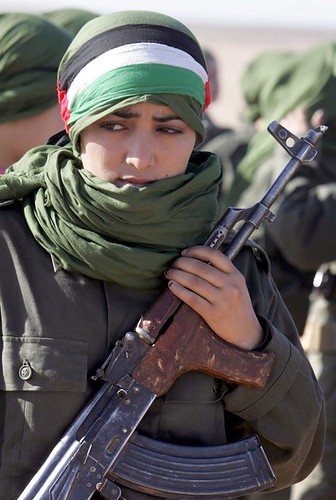
By Margarita Windisch
[Read more on the Western Saharan people's struggle HERE.]
Spain colonised Western Sahara and its mostly nomadic people in 1884 claiming it as a protectorate of the Spanish Crown. Spanish rule over Western Sahara was codified in Berlin in 1885, where Africa was carved up among the European powers. The period of Spanish rule was marked by ongoing resistance, revolts and armed clashes with the indigenous population, with its liberation movements being brutally repressed by the Spanish authorities.
A 1966 UN resolution called for Saharawi people’s right to self-determination to be exercised via a referendum which never eventuated. The lack of political developments led to the formation of Popular Front for the Liberation of Saguia el Hamra and Rio de Oro (the Polisario Front) in 1973. Polisario was conceived as a nationalist front with the aim of achieving independence, and encompassed all Saharawi political trends.
Polisario launched a guerrilla war against Spanish rule, fought Mauritania’s occupation of part of Western Sahara (from 1975 to 1979) and Morocco’s occupation from its invasion in 1975 until 1991.
In 1975 Spain relinquished its control of Western Sahara and, contrary to 1966 UN resolution for self-determination, handed Western Sahara over to Mauritania and Morocco (the Madrid Accords). The same year, the Morocco regime organised the “Green March’’, in which 350,000 Moroccans, brandishing flags and pictures of King Hassan II, invaded Western Sahara in order to settle and “reclaim the territory’’. This strategic march was supported by 20,000 Moroccan troops, who were met with some armed resistance from Polisario. November 6, the day of the “Green March”, has become a national holiday in Morocco.
Morocco and Mauritania’s war against Polisario was financially supported by the US, France and Spain to the tune of billions of dollars.
Apart from engaging in aerial bombardment, which included napalm and cluster bombs, Morocco started to build a 2500-kilometre-long, heavily mined wall through Western Sahara, dividing almost every Saharawi family. (For a detailed map of Western Sahara and the Moroccan wall, visit http://awsa.org.au/wp-content/uploads/2006/12/wsahara.pdf.)
On February 27, 1976, Polisario proclaimed the Saharawi Arab Democratic Republic (SADR), which is a full member state of the African Union.
While Morocco’s occupation is not officially recognised by any other country in the world, around 50 governments recognise the SADR and its government-in-exile, led by the Polisario Front; 13 have suspended relations with Morocco and 22 have cancelled recognition. The SADR was the first country to establish relations with East Timor. The SADR and Polisario currently control 32% of Western Sahara’s territory; the remaining 68% are resource rich and occupied by Morocco.
Ceasefire, referendum and international abandonment
A 1991 ceasefire, overseen by a UN peacekeeping mission, ended the armed conflict but the Saharawi people are still waiting for a UN-sponsored referendum on self-determination that was supposed to take place in 1992. The frustration at the lack of progress and lack of support from the international community for a political solution to the conflict is palpable, especially among Saharawi youth. As SADR health minister Sid'Ahmed Tayeb told the Australian delegation to the October 2008 International Trade Union Conference in Solidarity with the Western Saharan Workers (see http://links.org.au/node/750), “we are living between existence and non-existence”.
* * * *
Please subscribe free at http://www.feedblitz.com/f/?Sub=343373
Help Links stay afloat. Donate what you can by clicking HERE.
* * * *
The Saharawi people have been left to their own devices, due to the fact that Morocco has very powerful allies, such as the US, Spain and France. The Spanish king regularly spends his vacations with the Moroccan king. A landmark advisory ruling by the International Court of Justice in 1975, recognising the right of self-determination by the Saharawi people, was rendered useless because France and the United States blocked the Security Council from enforcing its resolutions. Both governments sought to undermine growing communist and radical Arab nationalist movements during the Cold War by strengthening the reactionary Moroccan monarchy.
In more recent years Morocco has become the darling of the West and is friends with Israel, due to its status as a “moderate Muslim nation’’ and an important ally in the struggle against Islamist extremism.
In 2006 Morocco proposed an autonomy plan for Western Sahara based on the assumption that Western Sahara was part of Morocco, an assertion that has been rejected on numerous occasions by the UN, the World Court and the African Union (see http://www.gees.org/articulo/2772).
The European Union is currently in negotiations with Morocco on granting it “Advanced Status’’ relations with its 27-member bloc. Western Sahara has appealed to the European Union not to grant Advanced Status to Morocco unless the occupied part of Western Sahara is excluded from cooperation agreement (see http://www.wsrw.org/index.php?parse_news=single&cat=105&art=924). Granting such status to Morocco while it continues to occupy Western Sahara will give legitimacy to the Moroccan military occupation and its claims over the territory.
Theft of Saharawi natural resources
Many Western governments and companies, including Australia’s, are knowingly engaged in the theft of the Saharawi people’s natural resources, through lucrative trade deals with Morocco. Western Sahara has high-grade phosphate mineral rock, excellent fishing grounds and offshore oil exploration is being conducted (for more information see www.awsa.org or www.wsrw.org).
As a matter of fact, under the 1975 Madrid Accords, Spain was given a 35 per cent stake in the Western Saharan Bu Craa phosphate mine, which is continuing to deliver a profit bonanza to the former colonial power until 2003.
In the game of “Realpolitik’’ it is of no relevance to Western governments that Morocco has been condemned many times for its torture, disappearance and arrest of Saharawis in Morocco proper and in the occupied territories, as well as for its repression against its own population and trade union activists.
Refugees
Approximately half the Saharawi people live in refugee camps, which have now existed for 33 years, in the Hamada desert near the Algerian military town of Tindouf. Nearly all Saharawi men participated in the resistance war. Apart from some women who joined their menfolk in armed combat, most Saharawi women walked hundreds of kilometres with their children through the desert to escape Morocco’s bombardment and napalm, to reach safe haven in south-west Algeria. There the women miraculously built refugee camps with social institutions out of virtually nothing. The mainly nomadic Saharawi society had to undergo a rapid and massive transformation to adapt to incredibly inhumane conditions and to develop new ways of organising their society in order to survive (for more detailed information, visit http://www.arso.org/05-0.htm#Anchore).
Saharawi refugees have lived on emergency food and humanitarian aid for 33 years, which has resulted in high levels of malnutrition and anaemia. A 2007 UN-funded report found that more than 76% of pregnant women and 68% of children under the age of five suffered from anemia. The 2003 report, Forgotten People: The Saharawis of Western Sahara, by Refugees International states that nearly half of Saharawi kids suffer from anemia, many have stunted growth with 13 per cent are acutely malnourished (http://www.arso.org/01-e03-07.htm).
Due to the harsh terrain of the camp locations, combined with shrinking financial support from donor governments and organisations, supplementing the current food aid with necessary nutrition for a balanced diet is nearly impossible.
At the same time the situation in Saharawi camps is uniquely positive and a testimony to human capabilities in the face of adversity. The Saharawi government, together with foreign specialists, is trying to address these problems to the best of its ability. The SADR government and Polisario run the camps through social and political institutions, giving control, cohesiveness, dignity and hope to its people. The four camps are organised into districts (wilayas) named after towns in Western Sahara: El Aaiun, Smara, Dahkla and Aousserd. Each camp is further divided into villages (daira). There are also two administrative camps (Rabouni and 27 February) that house the government in exile, with police stations, courts and schools.
Health and education are the top priority in the camps, achieving amazing results. There is a national hospital in the 27 February camp; Saharawis have not suffered a major health epidemic for more than 20 years. The literacy rate is over 90 per cent, a complete turnaround from 1975 when 95% of Saharawis could neither read nor write. At the same time, the director the national hospital told us during our visit, they still have not received the allocation of medications for 2008, which has dangerously depleting important stocks. There was no anti-diarrhea medication available at the time for children under five years of age.
Even though temperatures can reach a searing 58 degrees Celsius in summer and fall to minus 6 degrees C in winter, there is no mass exodus from the camps to migrate to Europe, instead an incredibly strong sentiment is expressed about being able to return to their occupied country. Every week young people arrive in the camps, fleeing Morocco’s repression in the occupied territories. Saharawis are excluded from many jobs and educational opportunities and face relentless discrimination and harassment by the Moroccan state. Morocco’s security forces especially target young people, who are spearheading the resistance (intifada). Torture and detention, even of 14-year-old women, is common, as is the disappearance of journalists and other activists. It is just about impossible to be granted entry to the occupied territories, unless you pretend to be a tourist, keen to do a bit of surfing (see http://www.upes.org).
International solidarity
The Saharawi people in the camps, their brothers and sisters in the occupied territories and in the diaspora are desperately hoping for an end to the conflict so they can return to their beloved homeland. Our solidarity is crucial for their right to live as a nation and continue their existence as a distinct people with thousands of years of history.
[This backgrounder was complied thanks to resources provided by ARSO (http://www.arso.org), the Australia Western Sahara Association (http://awsa.org.au) and Western Sahara Resource Watch (http://www.wsrw.org). Margarita Windisch was a member the three-person delegation of Australian trade unionists who attended the 6th Congress of the Western Sahara General Union of Saguia El Hamra and Rio de Oro Workers (UGTSARIO) and the International Trade Union Conference in Solidarity with the Western Saharan Workers, in October 2008, in El Aaiun, one of four Saharawi refugee camps in the Hamada desert in south-west Algeria. Windisch is also a leading member of the Democratic Socialist Perspective, a Marxist organisation affiliated to the Socialist Alliance of Australia.]
426 orgs demand exclusion of W. Sahara from EU-Morocco deal
426 organisations demand exclusion of Western Sahara from EU-Moroccan cooperation
PRESS RELEASE
Western Sahara Resource Watch (www.wsrw.org )
Melbourne, Brussels, Madrid,
December 5th 2008No less than 426 organisations signed a petition letter, demanding from the EU Commission that occupied Western Sahara be kept clearly outside of the so- called Advanced Status cooperation that Morocco currently is being granted. The petition was sent to the EU Commission this morning.
The larger part of Western Sahara has been illegally occupied by Morocco since 1975. Morocco tries to integrate the occupied country into its own economy, and through the new “EU membership light”, the EU risks lending further legitimacy to that process.
The EU-Moroccan talks have to this day not stated that the occupied Western Sahara be kept outside of the cooperation.
“If the EU does not clearly exclude Western Sahara from the Advanced Status cooperation, it could end up supporting Morocco’s illegal occupation of its neighbouring country”, said Cate Lewis, International Coordinator of Western Sahara Resource Watch (WSRW), the organisers behind the petition.
“If the EU has lost this fundamental perspective on ethics and on international law, it is up to the international civil society to point them to their responsibilities”, Lewis said.
All the main Sahrawi organisations and networks working in the occupied country and in exile have joined the campaign named “Say no to Advanced Status for Occupied Country”. The letter was sent to Benita Ferrero-Waldner, EU Commissioner for Foreign Affairs.
“In the mere 4 weeks since we opened this petition we’ve seen an avalanche of organisations joining the appeal. This massive global support also reflects the real preoccupation by the Sahrawi people over the EU’s intentions”, stated Lewis.
Among the other signatories, one finds prominent international organisations such as Solidar, the Rafto Foundation, Unrepresented Nations and Peoples Organisation and War on Want, shoulder to shoulder with individual trade unions such as the South African COSATU, the Spanish CCOO Comisiones Obreras and Unión Sindical Obrera (USO), as well as the umbrella organisation The World Federation of Trade Unions.
The petition also drew support from political parties, such as the Norwegian Liberal Party, the South African Communist Party, the Australian Socialist Alliance and the Spanish Unión Progreso y Democracia. The demand to exclude Western Sahara from the Moroccan Advanced Status was even backed up from within the European Institutions, through the signature of the European Parliament’s Intergroup for Western Sahara.
See a list of the 426 signatories here: http://www.wsrw.org/index.php?cat=132&art=920
Find the petition text here: http://www.wsrw.org/index.php?cat=105&art=801
For questions and comments:
Sara Eyckmans, Brussels, WSRW EU Coordinator, mob (+32) 475-458695
Cate Lewis, Melbourne, WSRW International Coordinator, mob (+61) 407 288 358
Javier García Lachica, Madrid, WSRW Spain, (+34) 615-917-339
www.wsrw.org
———————-
Over 100 UN Resolutions call for the Western Sahara’s people’s right to self-determination. The UN treats Western Sahara as a decolonisation issue, and has labelled it both “occupied” and “annexed”. Furthermore, Morocco’s unfounded claim on the territory has been rejected by the International Court of Justice.
WSRW is a global network with member organisations in more than 30 countries worldwide, working to protect the Sahrawi people’s natural resources against Moroccan and foreign business interests in occupied Western Sahara.
Western Sahara: Phosphate bandits unload loot in Tasmania
Western Sahara Resource Watch has received more photos documenting the vessel that arrived Tasmania, Australia, end of October, carrying phosphates from occupied Western Sahara.
The photos show the vessel Port Phillip discharging phosphates for the fertiliser producer Impact. The phopshate rock originates from occupied Western Sahara, and has been shipped to Australia in violation of international law. Read a UN opinion on the illegality of such industries here.
As far as Western Sahara Resource Watch understands, the phosphate from the occupied country is transported from the harbour to the Impact factory by a firm called Jenkins Hire.
See photos here of the vessel arriving Tasmania on the 23rd of October, and more info on the ownership of the Port Phillip.