socialism
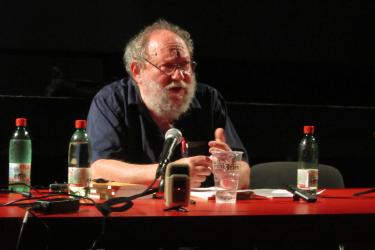
Michael Lebowitz: The spectre of socialism for the 21st century
The following is the keynote address to the annual meeting of the Society for Socialist Studies, Vancouver, June 5, 2008. It was originally titled ``Building socialism for the 21st century''. To hear an audio recording of the speech, click HERE.
By Michael A. Lebowitz
A spectre is haunting capitalism. It is the spectre of socialism for the 21st century. Increasingly, the characteristics of this spectre are becoming clear, and we are able to see enough to understand what it is not. The only thing that is not clear at this point is whether the spectre is real – i.e., whether it is actually an earthly presence.
Friedrich Engels: the Che Guevara of his day
Engels: A
Revolutionary Life
By
John Green
Artery
Publications
Paperback
2008
347
pages, £10
Che Guevara's final verdict on the Soviet economy
By John Riddell
June 8, 2008 -- One of the most important developments in Cuban Marxism in recent years has been increased attention to the writings of Ernesto Che Guevara on the economics and politics of the transition to socialism.
A milestone in this process was the publication in 2006 by Ocean Press and Cuba's Centro de Estudios Che Guevara of Apuntes criticos a la economía política [Critical Notes on Political Economy], a collection of Che's writings from the years 1962 to 1965, many of them previously unpublished. The book includes a lengthy excerpt from a letter to Fidel Castro, entitled ``Some Thoughts on the Transition to Socialism''. In it, in extremely condensed comments, Che presented his views on economic development in the Soviet Union.[1]
In 1965, the Soviet economy stood at the end of a period of rapid growth that had brought improvements to the still very low living standards of working people. Soviet prestige had been enhanced by engineering successes in defence production and space exploration. Most Western observers then considered that it showed more dynamism than its US counterpart.
Michael A. Lebowitz: Socialism is the future -- Build it now
By
Michael A. Lebowitz
Ideas
become a material force when they grasp the minds of masses. This is true not
only of ideas which can support revolutionary change. It is also true of those
ideas which prevent change. An obvious example is the concept of TINA -- the
idea that there is no alternative, no alternative to neoliberalism, no
alternative to capitalism.
Videos: Cuba's green revolution
A clip from the BBC's Around the World in 80 Gardens (2008) introduces the urban organic food gardening revolution in Havana, Cuba. Click HERE for a three-part talk by Cuban permaculturist Roberto Perez that delves deeper into Cuba's green revolution, and an interview with the makers of The Power of Community: How Cuba Survived Peak Oil, the film in which Perez featured.
So there’s nothing to stop us from emulating the Cuban farming revolution.
Three books on the life and thought of the `red terror doctor’
Karl Marx: A Biography
By
David McLellan, Palgrave Macmillan
4th
Edition 2006
487
pages, paperback
Are livable cities just a dream?
By Dave Holmes
When one sees a modern city from the air, especially at night, it is a truly awe-inspiring spectacle. What always strikes me is the immensity of the project, a testimony to the power and creativity of human beings. However, on the ground and actually living and working in this wonder, things are quite different and the social and ecological problems crowd in and fill one’s view. The truth is that our cities have always been dominated by the rich and powerful and built and operated to serve their needs — not those of the mass of working people who live and toil in them.
* * *
This article is based on a talk presented at the Climate Change | Social Change Conference in Sydney, April 2008. The conference was organised by Green Left Weekly. For more articles, audio and video from the conference, click here.
* * *
Michael A. Lebowitz: La jornada laboral capitalista y la jornada laboral socialista
By Michael A. Lebowitz
[Translation by J. Duckworth]
A medida que el primero de mayo se acerca, vale la pena recordar cuatro aspectos sobre ese día:
1. Para l@s trabajador@s el primero de mayo no es la celebración de un
día feriado estatal, ni un regalo de él, sino que conmemorara es la
lucha —desde abajo— de l@s trabajador@s.
2. Inicialmente, el primero de mayo se centraba en la lucha por una jornada laboral mas corta.
3. La lucha para una jornada laboral mas corta no es una lucha aislada sino la lucha contra la explotación capitalista.
4. La lucha contra la explotación capitalista es una parte esencial
pero no es la única parte de la lucha general contra el capitalismo.
Hoy quiero exponer algunas ideas que se refieren tanto a la jornada
laboral capitalista como a la socialista y espero que ellas puedan ser
útiles en la lucha actual en Venezuela y que sirvan, de manera más
inmediata, a los debates de hoy.
Michael A. Lebowitz: May Day -- The capitalist workday, the socialist workday
By
Michael A. Lebowitz
1.
For workers, May Day does not celebrate a state holiday or gifts from the state
but commemorates the struggle of workers from below.
2.
The initial focus of May Day was a struggle for the shorter workday.
3.
The struggle for the shorter workday is not an isolated struggle but is the
struggle against capitalist exploitation.
Cuba: The challenge of fossil fuels and climate change
Roberto Perez, Cuban biologist and permaculturalist, Antonio Núñez Jimenez Foundation for Nature and Humanity, a Cuban NGO. Feature talk at the Climate Change Social Change Conference, Sydney, April 12, 2008. The conference was organised by Green Left Weekly.
Climate action now! Socialist Climate Change Charter
It happens to be an emergency...Climate action now!
SUMMARY:Warnings that can’t be ignoredClimate scientists have been warning us about global warming for A revolutionary response to the climate change crisis``We need an emergency mobilisation of society, a five- or 10-year plan to achieve a drastic reorientation of our economy and use of energy. Anything else is simply not serious.'' Venezuela: Draft program and principles of the United Socialist Party of Venezuela (PSUV)[Below, Links provides translations of the draft program and principles of the provisionally named United Socialist Party of Venezuela, which are currently being discussed at its founding congress. The documents were drafted by the provisional leadership of the PSUV. New pamphlet: Comintern: Revolutionary Internationalism in Lenin's Time[The following is the introduction to a new pamphlet, Comintern: Revolutionary Internationalism in Lenin's Time, produced by the Canadian Socialist Voice collective. The full text is available at http://www.socialistvoice.ca/wp-content/uploads/2007/12/comintern-riddell.pdf] 'Without worker-management, there is no socialism'[A talk given at the two-day seminar “Workers Management: Theory and Practise”, held on October 26 and 27, 2007, organised by the Human Development and Transformative Praxis Program at the Caracas-based Miranda International `Socialisms' in the 21st CenturyHaiman El Troudi has occupied many
positions in The prospects for socialism (or barbarism)
By Boris Kagarlitsky
Not long before the European elections, in which the social democratic vote collapsed, two of the most authoritative social democratic leaders, Tony Blair and Gerhard Schröder, published a letter in which they formulated the principles of the so-called "new centre" (neue Mitte). These principles could be summed up as arguing that the traditional ideas of social democracy (redistribution, a mixed economy and state regulation in the spirit of Keynes) needed to be replaced by new approaches in the spirit of neo-liberalism. True, the authors of the letter took their distance from neo-liberalism itself, stating that they did not share its illusions that all problems could be solved through market methods. At the same time, they proposed to solve the problems of world trade by liberalising it further. Instead of solidarity, they called for increased competition, and instead of job creation, for preparing young people better for life under the conditions of a constantly changing market conjuncture. Women's liberation and the fight for socialism
By Lisa Macdonald
Lisa Macdonald is a member of the Political Committee of the Democratic Socialist Party in Australia. With the advent of the long economic downturn in the mid-1970s, capitalism launched the most concerted worldwide offensive against women's rights in 40 years. In the neo-colonial countries, women are bearing the brunt of IMF and World Bank-imposed economic structural adjustment programs, the rise of religious fundamentalism in many countries is pushing women back into the dark ages, and women are the largely invisible victims in the increasing number of localised wars over the ever shrinking resources not in the hands of the imperialists. In the former Soviet bloc countries, as the restoration of capitalism removes most of the protections for workers that accompanied the planned economy, it is women who are thrown first onto the scrap heap as privatisation creates skyrocketing unemployment and public welfare spending is slashed. The Brazilian Workers Party and the participatory budget in Rio Grande do SulBy Ben Reid CONTENTS 'Socialism in one country' and the Cuban RevolutionBy Celia Hart Celia Hart is the daughter of two veterans of the Cuban revolution: Haydée Santamaría, who participated in the July 26,1953, assault on the Moncada Barracks, and Armando Hart, the former minister of culture. Reprinted from Tricontinental Magazine.
CONTENTS The Cuban Revolution, paradigm of a socialist revolution Internationalism in the development of the Cuban revolution Social justice: the other cornerstone of the Cuban nation
"Homeland is humanity."—José Martí The Venezuelan revolution and the need for solidarityBy Stuart Munckton Stuart Munckton is the national coordinator of the Australian socialist youth organisation Resistance. This the text of a talk presented to a Democratic Socialist Perspective (DSP) educational conference in January 2005. ContentsFrom anti-imperialism to anti-capitalism Socialism and the market - China and Vietnam comparedby Michael Karadjis
Michael Karadjis is an Australian socialist currently living and researching in Vietnam.
ContentsDifferences in collectivisation and de-collectivisation Roles of state sectors change in opposite directions Massive privatisation in China and slowdown in Vietnam Party, bureaucracy and capitalist business Mass lay-offs in Chinese privatisation Differences within the ruling parties |


Recent comments
19 hours 54 min ago
20 hours 16 min ago
1 day 17 hours ago
2 days 7 hours ago
2 days 15 hours ago
2 days 15 hours ago
2 days 15 hours ago
2 days 15 hours ago
2 days 16 hours ago
2 days 18 hours ago