South Africa
Cyril Ramaphosa relaunches neo-liberalism: After Jacob Zuma’s firing, South Africa risks budget austerity

By Patrick Bond
February 28, 2018 — Links International Journal of Socialist Renewal — Cyril Ramaphosa’s soft-coup firing of Jacob Zuma from the South African presidency on February 14, after nearly nine years in power and a humiliating struggle to avoid resigning, has contradictory local and geopolitical implications. Society’s general applause at seeing Zuma’s rear end resonates loudly, but concerns immediately arise about the new president’s neo-liberal, pro-corporate tendencies, and indeed his legacy of financial corruption and class war against workers. There is still a lack of closure on the 2012 Marikana Massacre, in spite of his February 20 speech to parliament pledging atonement. New legislation Ramaphosa supports will limit the right to strike, while the new budget has cuts and tax increases that hurt the poorest.
Change in South Africa's president: Out with the old, in with the not so new

By Shawn Hattingh
February 18, 2018 — Links International Journal of Socialist Renewal reposted from Pambazuka — For white and international capital in South Africa, the last few weeks have been a period of rejoicing due to Cyril Ramaphosa being elected as African National Congress (ANC) president. His subsequent appointment as the country's president following Jacob Zuma's resignation on February 14 has lead the business elite to feel an even greater sense of smugness.
The bitter faction fights within the ANC, therefore, have seen Zuma defeated and his erstwhile supporters placed squarely on the back foot.
BRICS Xiamen Summit: Capitalist ‘deglobalisation’ could crack the bloc even if internal geopolitical strife eases

By Patrick Bond
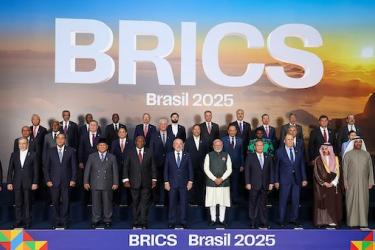
August 31, 2017 — Links International Journal of Socialist Renewal — The Brazil-Russia-India-China-South Africa summit in Xiamen from September 3-5 is already inscribed with high tension thanks to Sino-Indian border conflicts. But regardless of a welcome new peace deal, centrifugal forces within the fast-whirling world economy threaten to divide the BRICS. South Africa, which plays host to the BRICS in 2018, is already a victim of these trends – even as President Jacob Zuma continues to use the bloc as a primary crutch in his so-called “anti-imperialist” (talk-left walk-right) political survival kit.
Falling BRICS endanger their citizens’ health, starting with South Africa’s Jacob Zuma

By Patrick Bond
August 21, 2017 — Links International Journal of Socialist Renewal — As he launched the African Regional Centre of the New Development Bank (NDB) in Johannesburg on Thursday, nearly 18 months behind schedule, South African President Jacob Zuma must have had mixed feelings. Strife-riven Brazil, Russia, India and China are more risky allies than Zuma reckoned when in 2010 he accepted Beijing’s invitation to join the club.
“Zuma Must Fall” and the Left: Lessons from Zimbabwe

By Munyaradzi Gwisai
June 8, 2017 — Links International Journal of Socialist Renewal reposted from Review of African Political Economy — South Africa is at crossroads, facing its biggest upheavals since independence in 1994. Globally, since the 2008 Great Recession there are growing explosive class and social conflicts due to the deepening crisis of capitalism.
South Africa's ANC: Mistaking consequence for cause

By Dale T. McKinley
May 12, 2017 — Links International Journal of Socialist Renewal reposted from Pambazuka News — President Jacob Zuma’s recent Cabinet reshuffle is nothing more and nothing less than the latest instalment of a long-running story of the capture of the ANC and the post-1994 democratic state it has politically run. It is but a component consequence of a political, economic and social crisis that has been forged and fed by the ANC (and its Alliance partners) as a whole, in conjunction with capital. That crisis is not the result of actions taken by a small collection of conspirators, a select group of bad people or an individual.
Julius Nyerere: Legacy and defeated dreams in Tanzania

By Alan Broughton
May 8, 2017 –– Links International Journal of Socialist Renewal –– Julius Nyerere is regarded as one of the greatest African political leaders. He was a visionary for African unity, socialist development and self-reliance in the aftermath of colonialism, and still commands great respect. Though much of his vision failed to materialise he leaves a legacy of ethnic and religious tolerance and peace in his East African country, Tanzania.
South Africa: World Economic Forum-Africa hosts a turf battle between Jacob Zuma and ‘white monopoly capital’

By Patrick Bond
May 3, 2017 –– Links International Journal of Socialist Renewal –– At a time when US and South African presidents Donald Trump and Jacob Zuma personify controversies over crony capitalism, corruption, populist rhetoric and self-serving economic strategies, will big business calm down the politicians – or just egg them on?
South Africa: Mass protests follow cabinet reshuffle as Zuma impeachment vote looms
By Patrick Bond
April 28, 2017 — Links International Journal of Socialist Renewal — On South Africa’s political left, the Economic Freedom Fighters (EFF) party dominated recent news by leading a mass march on President Jacob Zuma’s office in Pretoria, following a government power shift seen as amplifying corruption. The move also catalysed a ‘junk’ rating by two neoliberal credit ratings agencies. And an impeachment process on the immediate horizon represents the first real parliamentary threat to Zuma’s eight-year reign.
South Africa’s corporatised liberation: A critical analysis of the ANC in power

By Dale McKinley
March 31, 2017 — Links International Journal of Socialist Renewal reposted from Pambazuka News — The ANC has become the key political vehicle, both in party and state form, of corporate capital; both domestic and international, both black and white, both local and national, and constitutive of a range of different ‘fractions’ of capital.
The BRICS New Development Bank meets in Delhi to dash green-developmental hopes?

By Patrick Bond
March 30, 2017 – Links International Journal of Socialist Renewal – Will the Brazil-Russia-India-China-South Africa (BRICS) bloc ever really challenge the world financial order?
In South Africa, enter stage left: Jacob Zuma’s ‘Radical Economic Transformation’ alternative factoids

February 14, 2017 — Links International Journal of Socialist Renewal — South Africa’s two main warring political blocs – the forces of Fiscal Patronage (‘Zuptas!’ in local parlance, referring to the immigrant Gupta family’s curious influence over the president’s family and government) versus the forces of Fiscal Prudence (‘Treasury neoliberals!’ to critics) – are still represented by two men who have begun to stumble on terrain potholed by what a Donald Trump aid terms ‘alternative facts.’
In conversation: Studs Terkel interviews Joe Slovo

By Alan Wieder
January 16, 2017 – Links International Journal of Socialist Renewal – The twelfth anniversary of Joe Slovo’s death is upon us this month. When I traveled in South Africa between 2013 and 2016, I was often asked what Joe Slovo would say about the state of the country. Then, this past fall, people wanted to know what the world’s greatest interviewer, Studs Terkel, would opine about American politics today. I can’t help but think that it would have been Studs who might have best nurtured Joe talking about South Africa today. After all, they both were the men in the RED socks. Thus, the ‘fictional’ 2017 Terkel-Slovo conversation.
South Africa’s junk credit rating was avoided, but at the cost of junk analysis

By Patrick Bond
December 9, 2016 — Links International Journal of Socialist Renewal — Standard&Poors (S&P) gave South Africa a fearful few hours of anticipation last Friday, just after dust from the political windstorm of the prior week settled. The agency downgraded the government’s securities that are denominated in the local currency (the rand) although refrained from the feared junk status on international securities. It was a moment for the ruling business and political party elites’ introspection, but in heaving a sigh of relief they are not looking far enough.
Sudáfrica: Las privaciones y depravaciones de Jacob Zuma

[Original in English here]
Por Patrick Bond
November 14, 2016 — Traducido por Enrique García para Sin Permiso — Esta semana quizás sea recordada como el punto de inflexión política de Sudáfrica más importante desde que en septiembre de 2008 su propio partido, el ANC, obligase a dimitir al presidente Thabo Mbeki. Su torturador principal era en aquella época Jacob Zuma, que - después de un breve período transitorio - ha gobernado el país de una manera cada vez menos convincente desde mayo de 2009.
South Africa’s deprivations and depravations revealed in Jacob Zuma’s meltdown

By Patrick Bond
November 3, 2016 — Links International Journal of Socialist Renewal — This week could well be remembered as South Africa’s most important political inflection point since the September 2008 ousting of sitting President Thabo Mbeki by his own party, the African National Congress (ANC). His main tormenter then was Jacob Zuma, who – following a brief handover period – has ruled the country in an increasingly dubious manner since May 2009.
But several contradictions have exploded in Zuma’s face. Political opponents from across the spectrum, radical university students and his own party’s establishment smell the blood, as Zuma’s fabled patronage system is now in the spotlight, apparently in tatters.
Zuma just suffered two major legal defeats: a fumbled state attack on Finance Minister Pravin Gordhan which was humiliatingly withdrawn by an incompetent prosecutor on Monday following a national outcry; and Wednesday’s release of the public protector’s State of Capture report on the Zuma family’s corrupt relationships, a report the president and two cabinet colleagues unsuccessfully attempt to quash.
BRICS fantasies and unintended revelations: the wages of sub-imperial assimilation

By Patrick Bond
October 14, 2016 — Links International Journal of Socialist Renewal — A Brazilian leader’s faux pas spoke volumes about the Brazil-Russia-India-China-South Africa (BRICS) heads of state summit underway in Goa this weekend. The country’s foreign minister (and occasional presidential candidate) José Serra told an interviewer last month that the BRICS included Argentina. And as he stumbled while spelling out the acronym, Serra also had to be prompted to recall that South Africa is a member (because in English it is the “S” in BRICS, but in Portuguese the country is “Africa do Sul”).
CITES comes to South Africa: Militarizing game parks and marketing wildlife are unsustainable strategies

By Libby Lunstrum and Patrick Bond
September 23, 2016 — Links International Journal of Socialist Renewal — A potentially momentous summit of environmental officials takes place in Johannesburg starting this weekend, through October 4: the 17th Conference of the Parties of the Convention on International Trade in Endangered Species of Wild Fauna and Flora, better known as CITES. Based on an agreement between 182 countries, CITES’ aim is to “ensure that international trade in specimens of wild animals and plants does not threaten their survival.”
South African workers mobilize to challenge neoliberal policies

By Irvin Jim
September 25 — Links International Journal of Socialist Renewal reposted from Socialist Project — The National Union of Metalworkers of South Africa (Numsa) Special National Congress in December 2013 resolved: “There is no chance of winning back the Alliance to what it was originally formed for, which was to drive a revolutionary programme for fundamental transformation of the country, with the Freedom Charter as the minimum platform to transform the South African economy.”
Recent events have fully vindicated this view.
Bill Gates’ silver-bullet misfiring at the Nelson Mandela Memorial Lecture

By Patrick Bond
July 14, 2016 – Links International Journal of Socialist Renewal – On July 17, Bill Gates will deliver the annual Mandela Lecture in Johannesburg, justifying his philosophy of market-oriented, technology-centric philanthropy.