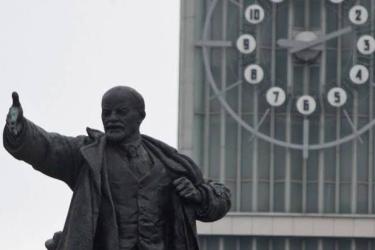
Russian Revolution
¿La Unión Soviética, estado sin partido?
Reseña crítica de Alex Miller
El siglo soviético
por Moshe Lewin
Verso 2005
416 páginas
Los medios comerciales y las élites intelectuales capitalistas han promulgado un estereotipo sobre la Unión Soviética: una línea ideológica directa y sin interrupciones lleva del bolchevismo de la revolución de 1917 al totalitarismo del período stalinista (1920-1953), pasa por el período post-stalinista desde 1953 y termina en el colapso del régimen soviético en 1991. Normalmente, se esgrime el estereotipo contra el bolchevismo, y en realidad contra cualquier forma de marxismo revolucionario: se usa el estancamiento y la declinación post-stalinistas, así como las masacres y purgas del período stalinista, para elaborar una reducción al absurdo de las aspiraciones originales de la revolución de 1917.
The Soviet Union: a no-party state?
Review
by Alex Miller
The Soviet
Century
By
Moshe Lewin
Verso
2005
416
pages
Our history: John Reed’s `Ten days that shook the world’
By
John Reed
Penguin
Books 351 pages
Paperback
Review by
Alex Miller
Orwell’s Animal Farm and Nineteen Eighty-Four: Critiques of Stalinism `from the left’?
This essay is the result of a re-reading of George Orwell’s two most
famous novels. Both Animal Farm and Nineteen Eighty-Four have acquired the
status of textbooks, and are routinely used in schools to demonstrate to
children the inherent dangers of social revolution. It is time for a
reappraisal.
The ``Centenary Edition’’ of George Orwell’s Animal Farm contains a preface written by Orwell for the first edition (Secker and Warburg, 1945) but never published, together with a preface that he wrote specially for a translation for displaced Ukrainians living under British and US administration after World War II.
* * *
Armando Hart on the 90th anniversary of the October Revolution
The Russian Revolution and national freedom
By John Riddell
When Bolivian President Evo Morales formally opened his country's constituent assembly on August 6, 2006, he highlighted the aspirations of Bolivia's indigenous majority as the central challenge before the gathering. The convening of the assembly, he said, represented a ``historic moment to refound our dearly beloved homeland Bolivia''. When Bolivia was created, in 1825-26, ``the originary indigenous movements†who had fought for independence “were excluded†and subsequently discriminated against and looked down upon. But the “great day has arrived today … for the originary indigenous peoplesâ€.1
During the preceding weeks, indigenous organisations had proposed sweeping measures to assure their rights, including guarantees for their languages, autonomy for indigenous regions and respect for indigenous culture and political traditions.
Women's liberation and the fight for socialism
Lisa Macdonald is a member of the Political Committee of the Democratic Socialist Party in Australia.
With the advent of the long economic downturn in the mid-1970s, capitalism launched the most concerted worldwide offensive against women's rights in 40 years. In the neo-colonial countries, women are bearing the brunt of IMF and World Bank-imposed economic structural adjustment programs, the rise of religious fundamentalism in many countries is pushing women back into the dark ages, and women are the largely invisible victims in the increasing number of localised wars over the ever shrinking resources not in the hands of the imperialists.
In the former Soviet bloc countries, as the restoration of capitalism removes most of the protections for workers that accompanied the planned economy, it is women who are thrown first onto the scrap heap as privatisation creates skyrocketing unemployment and public welfare spending is slashed.
In Defence of Lenin's Marxist Policy of a Two-Stage, Uninterrupted Revolution
- Transformation of the democratic revolution into a socialist revolution
- Bolshevik policy and Two Tactics
- What is the socialist revolution?
- 'Logical contradiction' and Lenin's conception
- The democratic dictatorship: bourgeois republic or special form of proletarian dictatorship?
- The Commune state and the democratic dictatorship
- Phil Hearse's 'DSP theory'
Phil Hearse's polemic against my pamphlet proceeds from a fundamentally false assumption, i.e., that it "attempts [to give] a general strategic view" of revolution in "the semi-colonial and dependent semi-industrialised countries". He alleges that my pamphlet presents Lenin's policy of carrying out the proletarian revolution in semi-feudal Russia in two stages (a bourgeois democratic and then a socialist stage) "as a general schema for the 'Third World' today". Nowhere in the pamphlet do I make such a
Either A 'Socialist Revolution Or A Make-Believe Revolution': A Rejoinder to Doug Lorimer
By Phil Hearse
- The DSP's position on revolutions in the dominated countries
- The socialist revolution, Russia and Spain
- Russia: how the revolution opened the way for capitalism and bourgeois rule (according to Lorimer)
- Spain
- Conclusion: agreement and differences between the DSP and permanent revolution
"The International of Crime and Treason [i.e., the counter-revolutionary coordination of imperialism—PH] has in fact been organised. On the other hand, the indigenous bourgeoisies have lost all their capacity to oppose imperialism—if they ever had it—and they have become the last card in the pack. There are no other alternatives: either a socialist revolution or a make-believe revolution."—Ernesto Che Guevara, Message to the Tricontinental 1967 (emphasis added).
The Bolshevik Party and 'Zinovievism': Comments on a caricature of Leninism
By Doug Lorimer
- 1921 Comintern resolution
- Public debate
- Party discipline
- Ideological heterogeneity
- Lenin's struggle for a Marxist party
- Notes
The disintegration of the Stalinist regimes in Eastern Europe and the Soviet Union opened an important debate within the Marxist movement about how to evaluate the history of the socialist movement, and especially of the Bolshevik Party, the party that led the world's first successful socialist revolution. One of the central aims of Links has been to provide a forum for such debate.
Joseph Stalin
By Armando Hart
Armando Hart is the former minister of culture of Cuba. Our translation largely relies on a CubaNews translation by Ana Portela.
These thoughts are intended as a tribute to all revolutionaries, without exception, who suffered the great historical drama of seeing the socialist ideas of October 1917 frustrated. We write this with admiration and respect for the Russian people, who were the protagonists of the first socialist revolution in history and who defeated fascism decades later under the leadership of Stalin. The same Russian people, 130 years before, defeated the military offensive of Napoleon Bonaparte.
Fundamentally, I have the experience of fifty years of working for socialist ideas in the beautiful trenches of the Fidel and Martí-inspired Cuban Revolution, that is to say, the first revolution of Marxist orientation that triumphed in what has become known as the West.
The 1905 revolution and its lessons
by Doug Lorimer
Doug Lorimer is a member of the National Executive of the Democratic Socialist Perspective in Australia. This is a talk presented to the DSP's January 2005 Marxism Summer School.


Recent comments
19 hours 53 min ago
20 hours 16 min ago
1 day 17 hours ago
2 days 7 hours ago
2 days 15 hours ago
2 days 15 hours ago
2 days 15 hours ago
2 days 15 hours ago
2 days 16 hours ago
2 days 18 hours ago