Donate to Links
Click on Links masthead to clear previous query from search box
PSUV
Venezuela: Reaffirmation, warning and encouragement for the revolution

On April 3, Nicolas Maduro visited Merida state. Crowds filled the central city bridge, equalling crowd sizes when Hugo Chavez spoke in Merida in September in the lead-up to last year’s election. Photo by Ryan Mallett-Outtrim/Venezuelanalysis.
By Luis Bilbao, Caracas; translated by Jacqueline Reinel and Fernando Torres
Venezuela: Imperialism prepares fascist movement to defeat revolution

A PSUV office in Anzoategui torched on March 15, part of a coordinated campaign of violence, murder and arson.
By Luis Bilbao, Caracas
April 22, 2013 – Links International Journal of Socialist Renewal -- With cold calculation, the counter-revolutionary command ordered the murder of nine people and numerous acts of violence and destruction since early April 15. The United States is testing out a new way to defeat the Bolivarian Revolution: the creation of a classic fascist movement.
A week before the election victory of Nicolás Maduro on April 14, referring to the attack on artists committed to the revolution, I pointed out the differences between McCarthyism and Nazism-fascism in an article published in the Correo del Orinoco.
Venezuela: Nicolas Maduro promises 'revolution of the revolution', advance to `socialist mode of living'
Solidarity protest in Sydney, April 19, 2013, organised by the Australia-Venezuela Solidarity Network. Photos by Peter Boyle.
By Ewan Robertson, Mérida, Venezuela
April 19 2013 -- Venezuelanalysis.com –- Nicolas Maduro was sworn in as Venezuela's president for the constitutional period 2013–2019 today, promising to continue Hugo Chavez’s legacy and spearhead “a revolution of the revolution”.
In the National Assembly in Caracas, Maduro took his presidential oath before assembly president Diosdado Cabello.
“I swear by the whole people of Venezuela, by the supreme commander [Hugo Chavez], that I will abide by and make respected the constitution of the laws of the republic ... to construct an independent, free and socialist nation for all”, Maduro declared.
Australia-Venezuela Solidarity Network: The Venezuelan people have spoken! Respect the democratic process!

PSUV election rally. Photo by Tamara Pearson/Venezuelanalysis.
The Venezuelan people have spoken: Nicolas Maduro is president
End the opposition violence! Respect the democratic process!
No US-backed intervention in Venezuela!
The Venezuelan people have spoken: Nicolas Maduro is president
End the opposition violence! Respect the democratic process!
No US-backed intervention in Venezuela!
April 17, 2013 -- The Australia-Venezuela Solidarity Network joins with all those voices for democracy and peace to call for an immediate end to the opposition-initiated violence now occurring in Venezuela.
On April 14, a majority of Venezuelans voted for the United Socialist Party of Venezuela’s (PSUV) presidential candidate Nicolas Maduro. In doing so, they voted to continue the Bolivarian revolution previously led by Hugo Chávez.
Venezuela has one of the most transparent and secure voting systems in the world and the presidential elections were, according to all independent observers, free, fair and constitutional. The election result must be respected.
Understanding Venezuela's election result: 'This time it was up to us to do it alone, and we won'

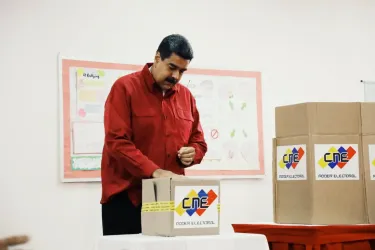
Election day, April 14, 2013.
By Tamara Pearson, Merida
April 15, 2013 -- Venezuelanalysis.com -- Things are chaotic here, as we recover from the surprise, disappointment and a bit of hurt from the election results, but also go out in the street to express our support for those results, and to defend the national electoral system, one of the best and most secure voting systems in the world in a country which just loves to vote.
We move quickly from being sad last night to concerned and determined today, as the caceroles [right-wing protests involving banging pots and pans] sound around the neighbourhoods and the opposition hangs outside the National Electoral Council (CNE) here in Merida, hundreds of them walking around with rocks and glass bottles in their hands, itching to have something to react to.
Still, as the pan-clanging sounds around my neighbourhood and people shout “Out! Out!” (referring to the government), making it just a little hard to think, it is important to understand yesterday’s results, as that helps us to understand the situation we’re in now, and plan for the future.
Eyewitness Venezuela: Maduro wins close victory; Right wing reacts violently

By Ryan Mallett-Outtrim, Merida
April 16, 2013 -- Green Left Weekly -- The room erupted into cheers when the election result was announced. For hours, the city of Merida's most ardent supporters of socialist presidential candidate Nicolas Maduro had gathered in the local offices of the United Socialist Party of Venezuela (PSUV). However, after a few moments, the closeness of the numbers sank in.
At the time of writing, the National Electoral Council (CNE) had announced that with 99% of votes counted, the PSUV's Maduro won with 50.6%. His closest rival, Henrique Capriles, received 49.1%; giving Maduro a slim 1.5% victory.
In the last presidential elections, Maduro's predecessor Hugo Chavez defeated Capriles – the candidate of the US-backed right wing hostile to the Chavez-led Boliviaran revolution -- by just over 10%,. Many supporters of the revolution were expecting a similar result.
Last month, a joint Barclays/Datanalisis report gave Maduro a 14.4% lead, while pollster Hinterlaces predicted his victory would be 18%.
Venezuela: Nicolas Maduro, driving the revolution forward

Nicolas Maduro drove a bus to the National Electoral Council to register his candidacy for president.
By Luis Hernández Navarro, translated by Ewan Robertson for Venezuelanalysis.com
March 29, 2013 -- La Jornada -- Nicolas Maduro is a robust, burly man, 1.9 metres tall with a thick black moustache. He drove a metro bus in Caracas for seven years, was foreign minister for six more and is now interim president and candidate for the country’s top office. He is part of the a generation of Latin American leaders like metal worker Lula da Silva and coco-leaf unionist Evo Morales, who entered politics from the trenches of opposition social struggles [translator: in opposition to the neoliberal administrations that governed Latin America before the continent’s "pink tide", which began in the late 1990s].
Venezuela's April 14 presidential election campaign: start of a new era

"We are all Chavez"
By Tamara Pearson, Merida
March 27, 2013 -- Venezuelanalysis.com -- Although the results of the presidential elections on April 14, 2013, are quite predictable, Venezuela is are going through a fragile, vulnerable period, with a future that is less predictable. These elections, because of their place in history -- the start of the era of the Bolivarian revolution without Hugo Chavez – have some special characteristics and factors. The significance of these factors, of these weaknesses, opportunities, relationships of power, and so on, goes beyond the voting on April 14.
Chávez, geoestrategia y revolución

[English at http://links.org.au/node/3264]
Por Luis Bilbao
09/03/13 -- America XXI -- No fue a causa del accionar de un individuo que en la última década el damero internacional sufrió un drástico vuelco. Fuerzas desatadas por la lógica interna del capital movilizaron cambios de tal magnitud que, en el fugaz lapso de una década, dibujaron un nuevo mapa geopolítico, todavía no cabalmente interpretado, en el cual Estados Unidos ha perdido su antiguo lugar de centro del equilibrio planetario y jefe inapelable en las cuestiones esenciales de la economía, la política y la guerra.
Luis Bilbao: Hugo Chavez, internationalism and revolution

By Luis Bilbao
March 19, 2013 – Links International journal of Socialist Renewal -- It takes more than an individual to upset the international chessboard as dramatically as in the last decade. Forces unleashed by the internal logic of capitalism have drawn a new geopolitical map, not yet fully understood, in which the United States has lost its former place as the planetary centre of gravity and the ultimate arbiter of the key issues of the economy, politics and war.
Yet, though changes of such magnitude were obviously not the work of one person, Hugo Chavez’s hallmark was a profound intuition of this impending change, combined with the will to intervene with a program and a strategy to shift the historical juncture towards consolidating a world suited to human needs.
And, assuredly, his role not only carried decisive weight in the early course of these changes, but will go on to transcend them. No one foresaw as Chavez did the dynamics that were breaking apart imperial power and even imperialism itself, nor acted with such lucidity and courage to position himself as a force leading this dynamic. This is why Venezuela is now in the centre of the world stage.
Venezuela: Chavez’s socialist party wins 20 of 23 states in regional elections; PSUV activists debate party's role

Supporters rally for PSUV candidate for Merida, Alexis Ramirez. Photo from YVKE Mundial.
By Tamara Pearson, Merida
December 16, 2012 -- VenezuelAnalysis -- With all votes counted to the point of results being irreversible, the United Socialist Party of Venezuela (PSUV) has won 20 states, and the opposition Democratic Unity Roundtable (MUD) coalition, three states in the December 16 regional elections.
The opposition lost control of Zulia, Tachira, Carabobo, Monagas and Nueva Esparta, but retained Amazonas and Miranda and Lara states.
In Miranda, one of the key states at stake, contested by PSUV ex-vice-president Elias Jaua, and the opposition presidential candidate and current governor of Miranda, Henrique Capriles, the opposition won with 50% to Jaua’s 46%.
In Bolivar state, where the results were very close, the opposition candidate Andres Velasquez is refusing to recognise his defeat and has called on locals to “defend” his “victory”.
Venezuelans and residents chose 23 state governors and 237 state legislators. The results of the state legislative voting have yet to be announced.
In the 2008 regional elections the PSUV won 17 of the 22 states being contested.
For state by state results see below.
El futuro del 'socialismo del siglo XXI' tras las elecciones

[In English at Venezuela: The future of ‘21st century socialism’ after Chavez's victory.]
Por Federico Fuentes, traducido para
La reelección del presidente venezolano Hugo Chávez el pasado 7 de octubre con más del 55 % de los votos fue vital por dos razones.
En primer lugar, el pueblo venezolano impidió el retorno de la derecha neoliberal al poder. De haber ganado ésta, hubiera intentado dado marcha atrás, con el apoyo de Estados Unidos, a los importantes avances conseguidos por la mayoría pobre desde el primer triunfo de Chávez en 1998. Entre estas mejoras se incluye un enorme aumento de los servicios básicos prestados por el gobierno (como educación, sanidad y vivienda), la nacionalización de sectores estratégicos anteriormente privatizados y la promoción de la participación popular en las comunidades y lugares de trabajo.
Paul Kellogg on Chavez: Are the Venezuelan people's gains `solely because of oil'?

Click HERE for more coverage and analysis of the Venezuelan revolutionary process.
November 1, 2012 – PolEcon.net, posted at Links International Journal of Socialist Renewal with author's permission -- While most eyes in North America have been on the presidential election in the United States, for people in the South America another election last month was actually of more interest. In the Bolivarian Republic of Venezuela, incumbent president Hugo Chávez was up against a strong challenge, from a – for once – united opposition.
Gwynne Dyer (2012) was not alone when he speculated, days before the vote, that this could be “Hugo Chávez’s swan song”. However, when the vote came, it wasn’t really close, with Chávez winning a third term as president with 55.08% of the vote, far ahead of the 44.3% obtained by his challenger Henrique Capriles Radonski (CNE 2012). Neither candidate in that other presidential election in the Americas can even dream about this kind of a victory margin.
Venezuela: Michael Lebowitz on what we can expect from Chavez's fourth term
Michael Lebowitz in Zagreb. Photo by Jovica Drobnjak.
Click HERE for more articles by or about Michael Lebowitz.
Click HERE for more coverage and analysis of the Venezuelan revolutionary process.
November 1, 2012 – Links International Journal of Socialist Renewal – The following interview with Michael Lebowitz was recently published in Novosti, a left-wing newspaper in Zagreb, Croatia.
Venezuela: The future of ‘21st century socialism’ after Chavez's victory

Supporters celebrate the president's re-election on October 7 outside the Miraflores presidential palace in Caracas. Photo by Tamara Pearson/Venezuelanalysis.com.
Click HERE for more coverage and analysis of the Venezuelan revolutionary process.
By Federico Fuentes
[En espanol @ http://links.org.au/node/3085]
October 28, 2012 -- Green Left Weekly -- Venezuela's President Hugo Chavez’s re-election on October 7 with more than 55% of the vote was vital for two reasons. First, the Venezuelan people blocked the return to power of the neoliberal right. Had they won, these US-backed forces would have worked to roll back important advances for the poor majority won since Chavez was first elected in 1998.
These include a huge expansion in government providing basic services (such as education, health and housing), the nationalisation of previous privatised strategic industries, and the promotion of popular participation in communities and workplaces.
Grassroots interviews from Venezuela: Developing the power of the community

Ana Marin talks about her revolutionary activity.
October 21, 2012 -- The British Revolutionary Communist Group, publishers of the newspaper Fight Racism! Fight Imperialism!, sent a delegation to Venezuela to cover the October 7, 2012, presidential election. The following interviews, published at Links International Journal of Socialist Renewal with permission, were conducted in the lead-up and the aftermath of the poll. More interviews and articles can be found at the delegation's website. The delegation collaborated with the Australia-Venezuela Solidarity Network brigade that was visiting Venezuela at the same time.
* * *
Ana Marin interviewed by Sam McGill
Richard Seymour: Venezuela in the 21st century

With the announcement of Hugo Chavez’s reelection as president by 55% of the Venezuelan electorate, spontaneous crowds across the country gathered to celebrate the victory. More photos at http://venezuelanalysis.com/image.
By Richard Seymour
October 8, 2012 -- Lenin's Tomb, posted at Links International Journal of Socialist Renewal with Richard Seymour's permission -- Chavez lives. He has survived cancer, thus far, and will most likely survive the presidential election with a comfortable majority (update: yep). And what if he did not? Would not Venezuela still have a popular mass socialist party, a thriving democracy, an expanding union movement, a politically emasculated ruling class, a greatly enhanced welfare state which incorporates elements of grassroots participation, and probably one of the few societies in the world today where it's almost impossible to impose a vicious austerity project? Jealous much?
Venezuela’s presidential elections: an imperfect victory

People celebrate the Hugo Chavez's victory outside the Miraflores Palace. Photo by Tamara Pearson/Venezuelanalysis.com.
By Tamara Pearson
October 8, 2012 – Venezuelanalysis.com -- Last night, we were squashed and pushed as the crowd surged into the Miraflores Palace to hear Hugo Chavez’s victory speech. People were so happy, they didn’t mind their feet being trodden on, the humidity of the air and the sweat of bodies and all the standing up, they were exuberant and they shouted and danced and jumped up and down and yelled out to strangers and threw beer up in the air, and even a few shoes.
Yet, among them, I felt a bit down, because the results were quite close, because more than 6 million people supported, by voting for the opposition led by Henrique Capriles, selfishness (he had focused his campaign on Venezuela ending its solidarity with other countries) and the destruction and sale of their country.
Venezuela: Chavez re-elected on platform to deepen revolution; 3 million people mobilise in support
Green Left TV -- Coral Wynter, an organiser of the 2012 Australia-Venezuela Solidarity Network brigade, gives her impression of the massive October 4 final rally in support of Hugo Chavez in the October 7 presidential elections. For more eyewitness accounts from AVSN members, join the AVSN Facebook page.
Click HERE for more coverage and analysis of the Venezuelan revolutionary process.
October 9, 2012 -- Green Left Weekly/Venezuelanalysis.com -- Venezuela's socialist President Hugo Chavez has won the October 7 Venezuelan elections with over 54% of the vote against 45% of the vote for right-wing opposition candidate Henrique Capriles. The National Electoral Council's Tibisay Lucena announced more than 80% of the 19,119,809 registered voters in Venezuela participated in the election.
Venezuelanalysis' Ewen Robertson reports from Merida:
Venezuela's election: Participatory, passionate democracy vs. Western democratic decline; Eyewitness reports
October 3, 2012 -- Green Left TV -- Australia-Venezuela Solidarity Network (AVSN) "brigadista" Ryan Mallett-Outrim reports on a Chavista rally which the brigade members attended in Maracay, Aragua, on October 3, just four days before the 2012 Venezuelan presidential election. The Australian solidarity activists were warmly welcomed in the massive crowd. For more eyewitness reports, photos and videos from the AVSN brigade visit the AVSN Facebook page and the AVSN website.
Click HERE for more coverage and analysis of the Venezuelan revolutionary process.
By Ewan Robertson, Venezuela
September 28, 2012 -- Venezuelanalysis.com -- I’ve witnessed the self-assured superiority of Paris, the imperial arrogance of Washington, the capitalist decadence of New York’s Manhattan, parliamentary elections in Germany and my fair share of elections in Britain. In none of them have I encountered a democratic political culture as profound as Venezuela’s.


Recent comments
5 days 8 hours ago
1 week 2 days ago
1 week 4 days ago
1 week 4 days ago
2 weeks 2 days ago
2 weeks 6 days ago
3 weeks 10 hours ago
3 weeks 2 days ago
3 weeks 2 days ago
3 weeks 3 days ago