* * * *
Finding this article thought-provoking and useful?
Please subscribe free at http://www.feedblitz.com/f/?Sub=343373
Help Links stay afloat. Donate what you can by clicking here.
* * * *
See also “Xenophobia tears apart South Africa's working class'' by Thandokuhle Manzi and Patrick Bond.
Watch South Africa: The New Apartheid, on the South African government's treatment of migrant workers and refugees and the involvement of racist white farmers.
* * *
May 21, 2008 – According to the UN Integrated Regional Information Networks, as of May 19, 2008, the death toll in a wave of attacks targeting foreigners around South Africa's main city of Johannesburg has risen to at least 32, with an estimated 6000 people seeking shelter in police stations, churches and community halls. The violence has spread to Zandspruit, northwest of Johannesburg, and Tembisa, Primrose, Reiger Park and Thokoza, on the eastern perimeter of the city, as well as other working-class communities.


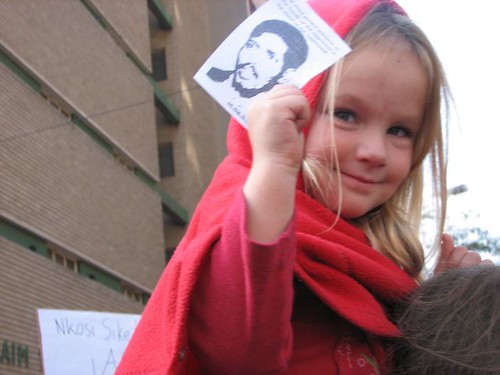
Thousands in Johannesburg protest against xenophobia, May 24, 2008 (more here and here and here). More coverage in Comments below.
South African newspapers ran horrific images of people set alight by angry mobs, who roamed townships during the weekend looking for foreigners and looting their shops and homes. In the Troyville area, just east of the central business district and historically a migrant enclave, shops were closed and the usually busy streets were quiet. An estimated 2000 people had taken refuge in the nearby Jeppe Street police station after violence at the weekend.
President Thabo Mbeki announced on May 18 that a panel had been set up to investigate the attacks, but the South African Human Rights Commission (SAHRC), a constitutionally mandated watchdog, accused the government of failing to take the threat of xenophobia seriously.
Below are some of the responses by South Africa's left organisations and trade unions. More will be posted as they become available.
* * *
Anti-Privatisation Forum:
AWAY WITH HATRED AND FEAR!
DOWN WITH XENOPHOBIA!
THE ENEMIES OF THE POOR IN SOUTH AFRICA ARE NOT THE POOR FROM OTHER COUNTRIES.
LET US FIGHT TOGETHER AGAINST A CAPITALIST SYSTEM THAT KEEPS US ALL IN POVERTY.
|
MARCH AGAINST XENOPHOBIA AND HATE SATURDAY 24TH MAY GATHERING FROM 9AM VENUE: PIETER ROOS PARK (Empire and Hospital Road) March will proceed through Hillbrow and stop at the Departments of Home Affairs and Housing before ending at the Library Gardens. The message marchers will be conveying is that our struggle is common and knows no borders. CALLED BY THE SOCIAL MOVEMENTS INDABA |
It is a sad day for South Africa when we see our brothers and sisters from other countries being attacked, killed and injured in our communities and streets. This is not the kind of South Africa we want. We want a country where everyone can enjoy our hard-won freedoms, where everyone has a job, a decent place to live and where we do not have to struggle for the basic necessities of life. That is the kind of South Africa we fought so hard for and we must continue to fight for. We must not allow ourselves to become full of hatred and anger against those from other countries who live in our communities and who are also poor and fighting for the same things. They are not to blame for our problems.
The poverty that we continue to experience 14 years after our independence is caused by a capitalist system that wants to keep us poor. The reason why so many of us have no jobs is because our government has adopted policies that favour the rich. It is not our brothers and sisters from Zimbabwe, or Mozambique or anywhere else that are responsible for us living in shacks, that are responsible for our lack of adequate water and electricity. It is the policies of GEAR [neoliberal macroeconomic policy of the African National Congress – ANC], corrupt councillors, greedy capitalists and an ANC government that has forgotten the poor. The poor from other countries that now live with us here in South Africa are escaping the same kind of oppression, corruption and greed. The poor, wherever they are, are being exploited and oppressed by the same capitalist class.
Blaming and attacking immigrants will not solve anything – it will only create further anger and conflict within poor communities. The only ones who will benefit are those who continue to feed off the desperation and poverty of the poor. It is clear that the recent attacks are the work of a small minority who want to take advantage of the anger and frustration is our communities to help themselves and make enemies out of those who are our fellow brothers and sisters in struggle. We must come together as communities and put a stop to this NOW!
We cannot, and must not, allow ourselves to be manipulated to support actions which make our communities to live in fear. We must organise and defend our communities and everyone who lives in them from those who want to tear us apart through hatred and greed. We cannot rely on the government and police to serve us and protect the poor – whether South African or immigrant - as they should be doing. We must come together as communities - whether we are ANC members, workers, civic activists, church-goers, youth – and show that we have the collective will and power to defeat those who would make us all live in fear and create division and hatred amongst ourselves. Let us all stand up together and fight the real enemies of poverty and desperation.
For further information/comment contact
APF Organiser – Silumko Radebe on 072 173-7268 or at the APF office on
011 333-8334
FORWARD TO THE UNITY OF THE OPPRESSED!
* * *

Johannesburg, May 24, 2008.
By Blade Nzimande, South African Communist Party general secretary
May 21, 2008 – The current wave of xenophobic attacks must be strongly condemned by all South Africans. So has the SACP expressed its strongest condemnation of these attacks. Not only are these attacks barbaric and inhumane, but this is a hugely embarrassing spectacle for South Africans, both domestically and internationally. This is especially so for those of us who have been such a huge beneficiary of international solidarity. Perhaps that is one of the aims of the clearly planned barbaric attacks on our African working class and poor brothers and sisters, to undermine the international prestige of South Africa and its peoples.
It is not enough merely to express our strongest possible condemnations; we need to take strong and visible action both in the short and medium term. One of the immediate short-term measures must be strong law enforcement as well as preventative legal measures in order to urgently contain the situation.
However, safety and security measures on their own are not adequate.
Our organisations, especially alliance and progressive community formations, need to urgently engage communities in affected areas and beyond in order to isolate and deal with those behind these barbaric actions. Indeed, the SACP has instructed its provincial structures to do just that. Our senior leadership will join forces with provincial structures to ensure this engagement is effective.
We should treat these developments as a wakeup call for all our formations, including the state security structures. These developments call for very serious self-reflection, criticism and self-criticism. How does it happen that none of our political or community structures knew about such serious plans to attack “foreigners”? How come the state intelligence structures were also caught unaware? Not only that, even after the eruptions in Alexandra, and the prior events in Tshwane and parts of the Western Cape, why were we not able to prevent these xenophobic acts, and then stop them spreading to Ekurhuleni and other parts of Johannesburg?
To answer these questions, we have to look at some of the underlying causes for xenophobia and its current violent expressions.
Intra-poor struggles:
The failures of structural adjustment programmes and predatory capitalism
As we have argued in previous editions, the Economic Structural Adjustment Programmes (ESAPs) imposed on virtually the whole of the Southern African region by the IMF since the 1980s, have been an unmitigated failure. Not only did they fail in their promise to improve the lives of the people of our country, but in many instances they even rolled back some of the positive gains that a lot of our countries had made since independence (including gains around access to food and basic services, education and health).
Since 1994, many of the displaced workers and peasants of our region, as well as professionals, have been migrating (legally and illegally) to a democratic South Africa, mostly as economic refugees seeking better opportunities for sustainable livelihoods.
Despite the many modest gains that our own democracy has made since the 1994 democratic breakthrough, our own self-imposed structural adjustment programme, GEAR, failed to make a dent in unemployment (unemployment actually increased dramatically between 1996 and 2006), and eroded the capacity to build a developmental state. It instead became welfarist, with now more than 12 million people relying on social grants of some sort.
The political and economic meltdown in Zimbabwe has put more pressure on South Africa to absorb even more economic refugees from that country, as well as from many other countries.
The net effect of the above developments has been that it has been the poor of South Africa who have had to absorb the poor from our region.
This has happened in two ways. Firstly, it is the poor communities in the informal settlements that have had to share their space and minimal resources with the poor from our region. The bourgeoisie and the middle classes have been shielded from the responsibility of carrying the burden of the failure of the ESAPs in our region and the crisis particularly in Zimbabwe, and they are literally shielded behind their high walls in the leafy suburbs. Elites from other countries in our region are also not bearing the brunt of this economic (and political) meltdown.
Secondly, there has been a rapid regionalisation of South Africa‘s labour force, especially over the last 8 to 10 years, with an increasing transformation of the division of labour in some of the key sectors of our economy. South Africa’s capitalist class has fully exploited the vulnerability of workers from the rest of our SADC region, more often at the direct expense of South African workers, by paying them slave wages and subjecting them to working conditions that are at variance with South Africa’s labour market regime.
These realities have also not been helped - in fact, they may have been worsened - by the predatory rather than development role of South African private capital in our region. Many South African companies investing in the rest of the continent have fully exploited weak labour market regimes in the region to maximise their profits and are contributing very little to the broader developmental agenda in the region.
It is therefore not the poor from our Southern African region who are stealing the jobs and sustainable livelihoods of South Africa’s workers and the poor, but the predatory practices of the capitalist class, both in South Africa and in the African continent.
The lesson from this is that any notion of an “African renaissance” not accompanied by radical economic policies to change the conditions of the workers and the poor, including challenging the predatory practices of capitalism in the continent, is nothing else but the new and modern opium for the people - a “feel-good” attitude, with no accompanying transformatory measures!
The political economy of our local state
The current violence is also a reflection of the contradictory reality of advances and setbacks in our own local government system. Since the 1994 democratic breakthrough, our government has indeed provided many crucial local services and transformed the undemocratic nature of local government that we inherited from apartheid.
However, these advances have been mediated, and threatened, by the simultaneous new patronage and corrupt practices that have not only engulfed local government, but also the national and provincial government levels.
Whilst most of our councillors are doing great work in their service to our communities, a significant section of our ANC councillors have become so corrupt that their behaviour seriously threatens to undo the many gains we have made since our 1994 democratic breakthrough. For instance, why are housing allocations done by councillors instead of being collectively approved by our municipal councils and management?
How come in some areas, councillors directly select people to be employed in municipal infrastructural projects? In many of our areas, such councillors are not accounting to the ward committees and municipal councils, and are thus not representing the interests of our people. They have become nothing more than “indunas” in their wards, with many of the ward committees being nothing but “induna-controlled committees”. We have to confront the fact that many such practices take place in ANC-controlled wards. Some of our own councillors illegally take bribes and allocate ‘RDP houses‘ to undeserving people who are both South African and non-South African citizens! These corrupt practices create fertile ground for intra-community conflict and xenophobia, exploited by reactionary and anti-ANC local elites bent on achieving their own narrow political goals.

Johannesburg, May 24, 2008.
* * * *
Please subscribe free at http://www.feedblitz.com/f/?Sub=343373
Help Links stay afloat. Donate what you can by clicking here.
* * * *
Our main criticism of the ANC prior to the ANC‘s 52nd Polokwane Conference has been that it has been captured by what we have called the “1996 Class Project”, which is an alliance between sections of domestic and global capital, emergent black sections of the (petty) bourgeoisie, mediated by sections of our own cadres occupying key positions within the state. One of the critical outcomes of this has been the demobilisation of the ANC branches and the “colonisation” of the ANC by state structures. This has turned the ANC into nothing more than an electoral party, divorced from the day-to-day struggles of the overwhelming majority of its members and various constituencies.
The current violence against “foreigners” is one particular expression of the weakening and “near-decay” of the structures of the ANC on the ground, and their inability to lead progressive community struggles and failure to detect reactionary plans against our African brothers and sisters.
These events do not only expose an ANC that is incapable of mobilising communities outside of election campaigns, but also a seriously weak SACP. The weakness of the SACP on the ground is a reflection of the combined effect of the extent to which the 1996 class project marginalised SACP and alliance structures in general and the extent to which a number of our SACP structures were actually co-opted by, and actively collaborated with, the 1996 class project dominant within the ANC and the state. This happened in a number of areas in the country.
All these features of the politics and economics of South Africa’s locality have contributed significantly towards the weakening of our organisational structures.
Counter-revolution
It is clear that given the pattern, planning and timing of these violent attacks, there is a counter-revolutionary agenda, with an eye towards discrediting the ANC and influencing next year’s national elections. This is a well-orchestrated campaign, exploiting the very real frustrations of the poor in our country.
It is indeed possible that these counter-revolutionary forces are exploiting what they see as “divisions” within the ANC and the relative uncertainty of this transitional period between the ANC’s Polokwane Conference and the 2009 elections. It might also be a test of the strength, resilience and capacity of both the ANC and the state to withstand such pressure.
A fundamental question that we have to answer is to what extent we have succeeded in demobilising the counter-revolutionary forces of the 1980s into the early 1990s, and in changing the social conditions of our people that were exploited by these forces at the time? The current wave of violence has all the hallmarks of the violence of the early 1990s, particularly in Gauteng.
Like in the early 1990s, hostels seem to be the main platform from which the current violence is being planned and unleashed.
The urgency of dealing with this situation should also be informed by the fact that there is a real danger that this violence can quickly be transformed into ethnic violence amongst South Africans themselves.
It may therefore be appropriate to consider this violence not just as xenophobia, but as a counter-revolutionary offensive aimed at our movement and at undermining all we have achieved through our democracy.
What is to be done?
Immediate action is required by the security forces to clamp down hard on the violence, with a particular focus on arresting and punishing the perpetrators. It is also of utmost importance for our communities to co-operate with the police in apprehending the perpetrators.
Of particular importance is that out of this tragedy there is perhaps an opportunity to frankly and honestly assess the state of our organisations, identifying some of the decay that was beginning to creep in, and begin a serious process of rebuilding our branch structures throughout the country.
In rebuilding our organisations, it is important also to pose the question of what kind of community structures and organisations we want to foster in our communities. For instance, is the task to rebuild SANCO or to build strong street committees as the new revolutionary nucleus for community organisation, or both?
Whichever way we answer this question, it is important to focus on the building of street committees as a new opportunity to organise and mobilise our communities to fight crime and for these also to be the new revolutionary nuclei around which to pursue our developmental agenda in the locality.
It is also important that organisation of casual and other vulnerable workers is intensified. This must include a deliberate strategy to ensure that all workers from the region are organised into unions.
This will lay a stronger basis for fighting against those employers exploiting the vulnerability of those workers from the rest of our region, and will help to build working class solidarity in the workplace and beyond.
Asikhulume!!
From Umsebenzi Online, Volume 7, No. 8, 21 May 2008
* * *
Everybody in our country knows, the Congress of South African Trade Unions has been at the forefront of the campaign to create jobs and eradicate poverty. For years we have fought to ensure that this struggle is
taken seriously and remains at the centre of the national agenda. COSATU has done everything in its power to give a voice to the voiceless and speak out against the intolerable levels of unemployment and poverty in
South Africa, and to explain the historical reasons for them and the policies we need to deal with the problem.
It is therefore shocking and disturbing to see that some workers and residents of poor communities believe that these problems are caused by foreign nationals and that they are attacking, robbing and killing those
foreigners they believe to be responsible, who are themselves victims of the same unemployment, poverty and crime.
They are totally wrong. The problems they face are rooted in years of apartheid which kept the majority of South Africans in desperate poverty and denied them any democratic means to improve their plight. Those problems persist today. The real level of unemployment, including those who have given up the attempt to find work is still over 35%. This means that around eight million are jobless. There are certainly not that
number of employed foreign immigrants. Even if they were all to leave tomorrow, the levels of unemployment would remain about the same, and so would the extent of poverty which afflicts at least half our population.
The same applies to crime. Criminals have been at work in South Africa for years – robbing, murdering and raping – not just since the recent influx of immigrants. There can be no possible excuse for people who claim to be fighting crime to use exactly the same methods as the criminals against foreign immigrants.
Many of the pioneers of the South African trade unions were migrant workers from all over Southern Africa. Many of them led our movement in its early days. We have always insisted that human rights are not just for South Africans but for all people, regardless of where they have come from. We must stand together to defend the rights that our constitution and laws give to all those living within our boundaries.
If people are made scapegoats simply on the basis of their country of origin we will be on a slippery slope towards regionalism and tribalism and the destruction of the unity we have built in the trade unions and civil society organisations.
The only people who will gain from such disunity will be the people we should be blaming for our problems – unscrupulous employers on the farms, in security firms and other sectors, who are exploiting desperate foreign workers by employing them on lower wages and benefits than they could get away with paying South African workers.
COSATU and its affiliates are fighting a daily battle to force such employers to comply with fair labour standards. We must place the blame on their shoulders, not those of their desperate, exploited workers, and
present a united front in the battle to win minimum standards of pay, benefits and health and safety protection for all workers.
The same applies in the communities. To achieve faster delivery of services we need strong, united civic movements. Attacking foreigners will not build new houses, but working together as communities is essential if we want to transform the environment where we live.
We must also unite to solve the problems of poverty and underdevelopment here in South Africa and throughout the region, so that workers are no longer driven to other countries to find work and food.
An injury to one is an injury to all!
Workers of the world unite!
* * *
Our struggle and every real struggle is to put the human being at the centre of society, starting with the worst off.
An action can be illegal. A person cannot be illegal. A person is a person where ever they may find themselves.
If you live in a settlement you are from that settlement and you are a neighbour and a comrade in that settlement.
We condemn the attacks, the beatings, rape and murder, in Johannesburg on people born in other countries. We will fight left and right to ensure that this does not happen here in KwaZulu-Natal.
We have been warning for years that the anger of the poor can go in many directions. That warning, like our warnings about the rats and the fires and the lack of toilets, the human dumping grounds called relocation sites, the new concentration camps called transit camps and corrupt, cruel, violent and racist police, has gone unheeded.
Let us be clear. Neither poverty nor oppression justify one poor person turning on another. A poor man who turns on his wife or a poor family that turn on their neighbours must be opposed, stopped and brought to justice. But the reason why this happens in Alex and not Sandton is because people in Alex are suffering and scared for the future of their lives. They are living under the kind of stress that can damage a person. The perpetrators of these attacks must be held responsible but the people who have crowded the poor onto tiny bits of land, threatened their hold on that land with evictions and forced removals, treated them all like criminals, exploited them, repressed their struggles, pushed up the price of food and built too few houses, that are too small and too far away and then corruptly sold them must also be held responsible.
There are other truths that also need to be faced up to.
We need to be clear that the Department of Home Affairs does not treat refugees or migrants as human beings. Our members who were born in other countries tell us terrible stories about very long queues that lead only to more queues and then to disrespect, cruelty and corruption. They tell us terrible stories about police who demand bribes, tear up their papers, steal their money and send them to Lindela – a place that is even worse than a transit camp. A place that is not fit for a human being. We know that you can even be sent to Lindela if you were born in South Africa but you look ‘too dark’ to the police or you come from Giyani and so you don’t know the word for elbow in isiZulu.
We need to be clear that in every relocation all the people without ID books are left homeless. This affects some people born in South Africa but it mostly affects people born in other countries.
We need to be clear that many politicians, and the police and the media, talk about ‘illegal immigrants’ as if they are all criminals. We know the damage that this does and the pain that this causes. We are also spoken about as if we are all criminals when in fact we suffer the most from crime because we have no gates or guards to protect our homes.
We need to be clear about the role of the South African government and South African companies in other countries. We need to be clear about NEPAD. We all know what Anglo-American is doing in the Congo and what our government is doing in Zimbabwe. They must also be held responsible.
We all know that South Africans were welcomed in Zimbabwe and in Zambia, even as far away as England, when they were fleeing the oppression of apartheid. In our own movement we have people who were in exile. We must welcome those who are fleeing oppression now. This obligation is doubled by the fact that our government and big companies here are supporting oppression in other countries.
People say that people born in other countries are selling mandrax. Oppose mandrax and its sellers but don’t lie to yourself and say that people born in South African do not also sell mandrax or that our police do not take money from mandrax sellers. Fight for a police service that serves the people. Don’t turn your suffering neighbours into enemies.
People say that people born in other countries are amagundane (rats, meaning scabs). Oppose amagundane but don’t lie to yourself and say that people born in South Africa are not also amagundane. People also say that people born in other countries are willing to work for very little money bringing everyone’s wages down. But we know that people are desperate and struggling to survive everywhere. Fight for strong unions that cover all sectors, even informal work. Don’t turn your suffering neighbours into enemies.
People say that people born in other countries don’t stand up to struggle and always run away from the police. Oppose cowardice but don’t lie to yourself and say that people born in South Africa are not also cowards. Don’t lie to yourself and pretend that it is the same for someone born here and someone not born here to stand up to the corrupt, violent and racist police. Fight for ID books for your neighbours so that we can all stand together for the rights of the poor. Don’t turn your suffering neighbours into enemies.
People say that people born in other countries are getting houses by corruption. Oppose corruption but don’t lie to yourself and say that people born in South Africa are not also buying houses from the councillors and officials in the housing department. Fight against corruption. Don’t turn your suffering neighbours into enemies.
People say that people born in other countries are more successful in love because they don’t have to send money home to rural areas. Oppose a poverty so bad that it even strangles love. Live for a life outside of money by fighting for an income for everyone. Don’t turn your suffering neighbours into enemies.
People say that there are too many sellers on the streets and that the ones from outside must go. We need to ask ourselves why only a few companies can own so many big shops, why the police harass and steal from street traders and why the traders are being driven out of the cities. The poor man cutting hair and the poor woman selling fruit are not our enemies. Don’t turn your suffering neighbours into enemies.
We all know that if this thing is not stopped a war against the Mozambicans will become a war against all the amaShangaan. A war against the Zimbabweans will become a war against the amaShona that will become a war against the amaVenda. Then people will be asking why the amaXhosa are in Durban, why the Chinese and Pakistanis are here. If this thing is not stopped what will happen to a place like Clare Estate where the people are amaXhosa, amaMpondo, amaZulu and abeSuthu; Indian and African; Muslim, Hindu and Christian; born in South Africa, Mozambique, Zimbabwe, Malawai, Pakistan, Namibia, the Congo and India.
Yesterday we heard that this thing started in Warwick and in the City centre. We heard that traders had their goods stolen and that people were being checked for their complexion, a man from Ntuzuma was stopped and for being ‘too black’. Tensions are high in the City centre. Last night people were running in the streets in Umbilo looking for ‘amakwerkwere’. People in the tall flats were shouting down to them saying ‘There are Congelese here, come up!” This thing has started in Durban. We don’t know what will happen tonight.
We will do everything that we can to make sure that it goes no further. We have already decided on the following actions:
1. We will resuscitate our relations with the street traders’ organisations and meet to discuss this thing with them and stay in daily contact with them.
2. We have made contact with refugee organisations and will stay in day to day contact with them. We will invite them to all our meetings and events.
3. We have made contact with senior police officers who we can trust, who are not corrupt and who wish to serve the people. They have given us their cell numbers and have promised to work with us to stop this immediately if it starts in Durban. We will ask all our people to watch for this thing and if it happens we’ll be able to contact the police that we can trust immediately. They have promised to come straight away.
4. We will put this threat on the agenda of all of our meetings and events.
5. We will discuss this in every branch and in every settlement in our movement.
6. We will discuss this with our allied movements like the Western Cape Anti-Eviction Campaign and the Landless People’s Movement so that we can develop a national strategy.
7. In the coming days our members are travelling to the Northern Cape, the North West, Johannesburg and Cape Town to meet shack dwellers struggling against forced removal, corruption and lack of services. In each of these meetings we will discuss this issue.
8. We are asking all radio stations to make space for us and others to discuss this issue.
9. In the past we have not put our members born in other countries to the front because we were scared that the police would send them to Lindela. From now on we will put our members born in other countries in the front, but not with their fulll names because we still cannot trust all the police.
10. If the need arises here we will ask all our members to defend and shelter their comrades from other countries.
We hear that the political analysts are saying that the poor must be educated about xenophobia. Always the solution is to ‘educate the poor’. When we get cholera we must be educated about washing our hands when in fact we need clear water. When we get burnt we must be educated about fire when in fact we need electricity. This is just a way of blaming the poor for our suffering. We want land and housing in the cities, we want to go to university, we want water and electricity – we don’t want to be educated to be good at surviving poverty on our own. The solution is not to educate the poor about xenophobia. The solution is to give the poor what they need to survive so that it becomes easier to be welcoming and generous. The solution is to stop the xenophobia at all levels of our society. Arrest the poor man who has become a murderer. But also arrest the corrupt policeman and the corrupt officials in Home Affairs. Close down Lindela and apologise for the suffering it has caused. Give papers to all the people sheltering in the police stations in Johannesburg.
It is time to ask serious questions about why it is that money and rich people can move freely around the world while everywhere the poor must confront razor wire, corrupt and violent police, queues and relocation or deportation. In South Africa some of us are moved out of the cities to rural human dumping grounds called relocation sites while others are moved all the way out of the country. Some of us are taken to transit camps and some of us are taken to Lindela. The destinations might be different but it is the same kind of oppression. Let us all educate ourselves on these questions so that we can all take action.
We want, with humility, to suggest that the people in Jo’burg move beyond making statements condemning these attacks. We suggest, with humility, that now that we are in this terrible crisis we need a living solidarity, a solidarity in action. It is time for each community and family to take in the refugees from this violence. They cannot be left in the police stations where they risk deportation. It is time for the church leaders and the political leaders and the trade union leaders to be with and live with the comrades born in other countries every day until this danger passes. Here in Durban our comrades to stand with us when the Land Invasions Unit comes to evict us or the police come to beat us. Even the priests are beaten. Now we must all stand with our comrades when their neighbours come to attack them. If this happens in the settlements here in Durban this is what we must do and what we will do.
We make the following demands to the government of South Africa:
1. Close down Lindela today. Set the people free.
2. Announce, today, that there will be papers for every person sheltering in your police stations.
3. Ban the sale of land in the cities until all the people are housed.
4. Stop all evictions and forced removals immediately.
5. Do not build one more golf course estate until everyone has a house.
6. Support the people of Zimbabwe, not an oppressive government that destroys the homes of the poor and uses rape and torture to control opposition.
7. Arrest all corrupt people working in the police and Home Affairs.
8. Announce, today, a summit between all refugee organisations and the police and Home Affairs to plan how they can be changed radically so that they begin to serve all the people living in South Africa.
For further information of comment please contact:
S’bu Zikode: 0835470474
Zodwa Nsibande: 0828302707
Mnikelo Ndabankulu: 0797450653
Mashumi Figlan: 0795843995
Senzo (surname not given, he has no papers): 031 2691822
sekwanele
* * *
May 21, 2008 – The Social Movements Indaba (SMI) is mobilising social movements, immigrant communities, NGOs, unions, concerned residents from poor areas around the province for a march this Saturday, 24th of May. The march will gather at Pieter Roos Park (Empire and Hospital Road) from 9 am, proceed through Hillbrow and stop at the Departments of Home Affairs and Housing before ending at the Library Gardens. The message marchers will be conveying is that our struggle is common and knows no borders. Everyone who wants to make their voices heard should join us – our struggle knows no borders.
The Social Movements Indaba -– a co-ordinating national body of social movements, civil society and activist organisations –- is organising with its affiliated organisations and immigrant communities to roll back the groundswell of xenophobia. In the years since its formation in 2002, the SMI has linked organisations of the poor in struggle for basic services, international solidarity and against police repression. At its last national meeting in December in Cape Town, the SMI identified xenophobia as a pervasive problem in communities and undertook to campaign against hatred of foreigners. Now that the crisis of hate crime is no longer foreboding and is terrifyingly HERE, there is no time to stall and wish we were better prepared. We are without hesitation committed to the struggles for social justice, internationalism and solidarity with all repressed people.
While the police have been deployed to try keep a lid on the pressure that has boiled over, this is no solution to the safety and security of all. As a xenophobic force in Johannesburg pre-existing the outbreak of violence, the police cannot be trusted to be more than the brute barrier between perpetrators and their targeted victims. The South African Police Services and Johannesburg Metro Police harass immigrants to solicit bribes as a matter of practice. Calling on the police to “do their work'' as President Thabo Mbeki and his [African National Congress] government have done does not, therefore, address the issues of safety and security amongst immigrant communities. The refugee communities do not trust the police as impartial arbiters of the conflict. The police conducted a brutal raid on the Central Methodist Church on the 31st of January 2008 under the pretext of crime prevention. Criminalisation of immigrants is a smokescreen for deportation and bribery that the police has not cleared.
Long-lasting safety and security for all does not include deportation of foreign nationals, whether voluntary or not. Xenophobia's origins lie within the conditions of poverty in which the majority of South Africans live. Immigrants have been targeted for their ethnic difference and for their very similarity with their persecutors. Seen as competitors for scarce jobs and housing, South Africans have misdirected their anger at conditions of poverty that are unchanging. Their fellow brothers and sisters who are enduring the same cannot be responsible for what the economic and political system has created.
While we struggle for a change to the neoliberal capitalist system that has created this reality, rearguard struggles for safety and security of immigrants in the country must continue. The SMI gives thanks for those humanitarian organisations, emergency services and churches that are trying to stem the tide of bloodletting and forced removals. We will organise against the creation of refugee camps and work towards the reintegration of immigrants in our communities. In working to recover our common humanity and restore calm, delegations from the SMI are meeting with community-based organisations in Alexandra and the inner city, and as the programme of action to roll-back the hate unfolds, the SMI will be going further afield to speak to affected communities.
For directions or other enquiries, please contact the Anti Privatisation Forum on 011 333 8334.
For comment, please contact: Silumko Radebe (APF) 0721737268; Mhlobo Gunguluzi (Khanya College) 0843773013; Brian Burayai (Refugee Fellowship) 0732865667
The Social Movements Indaba includes amongst other organisations: the Anti Privatisation Forum, Jubilee South Africa, Imbawula Trust, Sounds of Edutainment, Umzabalazo we Jubilee, Lesbian and Gay Equality Project, Inner City Resource Centre, Kliptown Concerned Residents, Khanya College, Earthlife Africa (Johannesburg), Palestinian Solidarity Committee, Golden Triangle Crisis Committee, Samancor Retrenched Workers Crisis Committee, African Renaissance Civic Movement, Group of Refugees Without Voice
* * *
The Thokoza branch of SANCO [South African National Civics Organisation], with allied community organisations, is inviting you to a press conference to announce its planned march to express disgust at inhuman xenophobic attacks on Africans from the North.
We are marching because these diabolic xenophobic attacks reverse all revolutionary gains we made since 1994. It reverses the internationalist role of, and impact of, our struggle against apartheid.
The Cubans in Cuito Cuinavale, Angola, laid down their lives for no
economic gain but to express solidarity with South Africans, Angolans, Namibians and love for humanity. The South African revolution and our new democracy is the product of sacrifices by ordinary people of Lesotho, Swaziland, Zimbabwe, Angola, Zambia and Tanzania. These countries were attacked by the South African apartheid army because South Africans stayed and lived amongst their people. Therefore we condemn the attacks on our African brothers and sisters merely because they are not South Africans.
As far back as the 1950s and 1960s, Africans from all these countries, including Malawi and Kenya, died in South African mines. Others went back to their countries sick and poor; while on the other hand our economy, though under apartheid, grew in leaps and bounds.
For more information please contact: Moloantoa Molaba 082 455 3070, or e-mail moloantoa@nehawu.org.za
Nzipho 084 880 4725
Bongani 083 352 6920
* * *
As at today, May 20, more than 20 people are dead, hundreds have been injured and thousands are homeless after the latest xenophobic attacks in the Gauteng province. Those that attacked these people say they were getting
rid of aliens and criminals who are stealing their jobs, their wives and their possessions.
But those that attacked
* gave victims no chance to defend themselves
* in some cases raped those they attacked
* in some cases stole from those they attacked
* burnt homes of those they attacked
* killed South Africans as well as “aliens''.
Let's ask ourselves, who are the real criminals in these attacks?
Even if every so-called “amakwerekwere'' left this country, we would still have unemployment. You just need to look at your workplace to see why. Capitalists are always trying to find ways of reducing their costs – they outsource certain jobs, they put people on short term contracts, they close down certain sections of the company. And sometimes the company can't compete anymore and it closes down, forcing everyone onto the streets.
Fighting against our fellow workers is no way to change this. Only strong organisation can change the system that we currently live in.
First let's help the police root out criminals:
* work with the police and your community policing forum to restore law and order
* report criminals who cause instability
* protect women and children from assault and rape
* prevent armed gangs from looting and burning shops and homes.
And let's unite with our class, regardless of what language they speak or where they come from.
Let's unite against those who exploit us. We all want liberation from economic exploitation and a better life!
Stop the violence! Stop the looting!
Stop the raping! Stop the killing!
Build a caring society!
Issued by Numsa PO Box 260483 Excom 2023; May 20 2008
The National Union of Mineworkers (NUM) calls on the state to urgently intervene in the deteriorating and escalating levels of xenophobic attacks in the country.
“The state should deploy the army to curb the terrible situation in which poor immigrants and local residents to some extent find themselves'', says Oupa Komane, the NUM's Deputy General Secretary.
“We believe the situation is characterized by high levels of criminality and hooliganism and therefore calls for the state to be
high handed'', says Komane. “Many members of the NUM come from neighboring countries such as Lesotho, Zimbabwe, Malawi, Zambia, Swaziland and others. We therefore cannot allow the situation to be polarised further'', he says.
The NUM is disturbed that immigrants continue to be attacked, their belongings looted with little action from the security authorities. “The government must send a strong unambiguous message to the hooligans who perpetrate this action by deploying the army to deal with them. We cannot beat about the bush when foreigners find themselves between a rock and a hard place'', says Komane.
The NUM has already lost two members at ERPM in Primrose with three having been admitted in hospital. “We fear that this situation will deteriorate into ethnic clashes as our local people from Venda have also received threats'', he says.
Oupa Komane (NUM Deputy General Secretary)- 082 883 7292
Lesiba Seshoka (NUM spokesperson) – 082 803 6719
* * *
May 19, 2008
Issued by TAC National Council:
Treatment Action Campaign
http://www.tac.org.za
The Treatment Action Campaign
condemns the wave of xenophobic violence sweeping through communities
in Gauteng. We call on Government to take action to halt the violence;
to put in place a national strategy to protect the safety, health and
well being of victims of xenophobic attacks and to take steps to
prevent the violence from spreading further. With the violence now
having spread to almost a dozen communities in and around Johannesburg
and threats of violence issued elsewhere across the country, including
Cape Town, we demand more effective action from Government to deal with
the crisis.
Specifically we ask government to:
* Call together all political parties, President Mbeki and all political party leaders to
visit sites of violence and to condemn it in the strongest terms.
* Draft contingency plans, in consultation with relevant stakeholders, to manage
the violence and its after-effects should it spread to other areas of the country.
While we sincerely hope that the violence will be contained and halted in
Gauteng, we urge every municipality to put in place coherent strategies for
dealing with possible outbreaks of xenophobic violence.
* Designate and make available places of sanctuary for victims of xenophobic
attacks. The current system whereby victims take shelter at police stations is
unsustainable; Government must identify sites where large numbers of people
can be comfortably accommodated and easily protected.
* Distribute emergency social assistance packages to all displaced persons.
* Initiate a sustained media campaign condemning the violence. We ask for our
political leaders to be more visible and to go on radio and television condemning
the attacks.
TAC reluctantly calls for the deployment of the South African National Defence Force
(SANDF) to assist the police services in curbing the violence. Although
this brings back terrible memories of the Apartheid era, the police
services do not have the capacity to stop the violence without the
support of the SANDF. Ending violence and restoring dignity to
refugees, immigrants and undocumented migrants is not only the task of
government. All civil society organizations, charities, humanitarian
bodies and NGOs must establish a unified and coordinated response to
this national humanitarian emergency. TAC is working with the AIDS Law project, Lawyers for Human Rights, Legal Resources Centre, and other organisations to address the crisis.
Equal Treatment Issue 25
(June 2008) has been published. This edition of ET focuses specifically
on the needs of refugees in Souh Africa, you can download an electronic
copy at: http://www.tac.org.za/community/files/file/et25.pdf
Xenophobia is rife in South Africa. However, repression of immigrants, refugees and undocumented people goes beyond naked violence in poor communities. Earlier this year, police raided the Central Methodist Church in Johannesburg, beating up and arresting immigrants, mainly from Zimbabwe. The state systematically abuses the rights of immigrants: health workers deny treatment, home affairs officials demand bribes and police assault immigrants regularly. Then there are institutions like Lindela, where people are incarcerated in ghastly conditions before being deported despite not having committed any crime. This all goes on while the South African government refuses to recognise that people fleeing from Zimbabwe are refugees.
This issue of Equal Treatment contains a special report on the systematic abuse of the rights of immigrants. We hope that it galvanises South Africans to stand up against xenophobia, both by the state and in our communities.
* * *
ONGOING XENOPHOBIC ATTACKS
Nehawu joins all progressive minded South Africans and ordinary people in expressing their disgust at the current attacks against African brothers and sisters from the North. What is happening in Alexandra is completely unjustifiable, immoral and short sighted.
POVERTY UNEMPLOYMENT AND SLOW SERVICE DELIVERY
More than 40% of South Africans are unemployed. With the rise of food prices, petrol and the unending waiting list for RDP houses, more and more South Africans, particularly the working poor, are getting frustrated and angry. Given this anger and frustration it is easy for both legal and illegal immigrants to be used as scapegoats to explain some of the problems in our local communities. What's happening in Alexandra, previously happened in Attredgville, Khayaletsha and some of the Eastern Cape Townships. Attacks on immigrants reflect the frustration and misdirected anger we have referred to.
INTERNATIONALISM AND NEW SOUTH AFRICA
South African liberation is primarily a product of struggles led by South Africans to liberate themselves from the Apartheid system. However, international solidarity is one central pillar in our victory against Apartheid. Cubans flew 1000s of kilometers from their home to contribute to the liberation of Namibia and South Africa. They contributed to defending Angola and Mozambique.
Chris Hani stayed in Lesotho at some point during struggle against Apartheid. ANC Head quarters and Umkhonto We Sizwe camps were in Tanzania, Zambia and Angola. Many cadres stayed and studied in almost all African countries, particularly in the Southern African Countries.
In a nutshell, the victory of South African liberation is owed to Cubans, Namibians Zimbabweans, Angolans, people from Lesotho, and other Africans. Therefore there is no way we can justify the current attacks of other Africans.
As we speak today we have more than 100 Cuban doctors working in South African rural areas where South African doctors are unwilling to serve. We have hundreds of South Africa students studying in Cuba.
We call on ANC Alliance and all democratic forces in Alexandra and other affected communities to go on a massive visible and urgent campaign to educate our people that their misery is in part caused by capitalism, the impact of neo-liberal GEAR and the growing inequalities in society -- not Africans from the north. Our people must be made to understand sacrifices Cubans and other Africans made to our liberation. We unreservedly apologies to the victims of these xenophobic attacks and for the pain and damaged caused to their lives.
This statement was issued by the National Education Health and Allied Workers Union (NEHAWU) Communications Department on 15 May 2008. For further information, visit NEHAWU website: www.nehawu.org.za.


Cape Town protest against xenophobic violence
STOP XENOPHOBIC VIOLENCE
PROTEST VIGIL AGAINST XENOPHOBIC VIOLENCE.
Please attend a protest vigil outside Parliament, Plein Street corner of Roeland Street on Friday 23 May 2008 from 5pm to 6pm.
We need to make the biggest statement that we can. We need to get the message out that we are against xenophobic violence.
Please bring your partner, child, work-mate, friend, whomever you can think of bringing along. We need to lift the atmosphere of fear! We need to persuade ourselves that poor turning against poor is not the answer. The poor need to be united to collectively solve their porblems.
Please print out this e-mail and make posters to place up where you work, learn or live for the benefit of those without e-mail. Place this advert on or in any forums you are aware of. A copy of this is up on capetown.gumtree.co.za (go to community, then activities and hobbies).
AbaForeigners AbaRefugees Sawubona iSouth Africa ! Foreigners and Refugees are Welcome in South Africa !
Called by Cape Town Action Forum
Affiliates: - COSATU, SA Municipal Workers Union, National Mineworkers SA, Walmer Estate Civic, Delft Anti-Eviction Campaign, Right to Food Campaign, Keep Left, APDUSA and others
Verwoed is Black: Biko is on holiday (apologies to Mpho Ramaano)
Alexandra is up in flames
Black flesh is the fuel
Voices celebrating
The cheapness of black life
Belt out not the erstwhile notorious die stem
But the now in\famous mshini wam
Hands baying for Kaffir blood
Raise not the swastika & the fier kleur
But the clenched fist & the rainbow flag
This time the K word is not
An Afrikaans version
Of the Arabic heathen
But our own African
Fervent articulation
Of negrophobia
A raging hatred
Of any reminder
Of how Black our continent is
Not to mention our deliberate choice
To forget to remember
How our ancestors hailed
From the Centre of Africa
And found the First People of Azania
The men among men
Moving rocks to speak the language of art
It was only yesterday
When the whole world
The greens and the reds and the pink
All shades of convictions and ethics
In a literal and symbolic exposition
Of the existence of three worlds in one nation
And the yawning chasm in the quality of life
Of the poors and the rich in this great country
Distinguished for its penchant for mix-masala
Marched to opulent Sandton
Via muddy terraces & falling shacks
Academic lenses, activist eyes
Tourist cameras and researchers videos
Zooming on children licking dry fingers for lollipop
& Yuskei River humming a distressed
Elegy to people who
Fear summer for torrents
Of rain filtering in
Like water through a sieve
And cringe at the approach
Of the winter that adds coldness to the long list
Of the natural and nurtured
Hostilities against the poorest of the poor
But now the poors of Alexandra
Bay for the blood of the poors of Zimbabwe\ Nigeria\ Congo \ Somalia
Little urchins are verbal assassins
The target of their obnoxious vitriol is not the system
As we tremble in worship of the establishment
That forever quarantines us on the periphery
And shudder to confront the demons within us
We scrape our mother's wombs for new soft targets
To turn our rage against our newly found national scapegoat
.......AMAKWEREKWERE
South Africans United Against Xenophobia Facebook group
Comrades and Friends,
There are many initiatives that are being proposed to try and rally support across the country to stem the xenophobic violence that is gripping our nation, There is now a facebook group that has been set up, which has over the last few days become a space for people to share ideas and organise around this issue. While it is just 1 attempt amongst many others, it may become a useful tool to bring people together online (despite the recent concerns about privacy issues on facebook). The link is below.
South Africans United Against Xenophobia
http://www.facebook.com/group.php?gid=13340729443
South Africa: A drive through a Xenophobic landscape
http://www.pambazuka.org/en/category/features/48319
In this vivid and personal account, Stephen Faulkner drives through the unfolding xenophobic attacks in South Africa.
Friends, this is simply an account of what I saw and experienced in a twenty four period. It might be incomplete. It is not an analytical piece as such, but I hope a small step towards trying to understand what had taken place in this city, in this country that I have come to love.
Last night as we drove from the centre of Joburg to the eastern suburb of Kensington, we wondered why the police helicopter was circling over Jeppes Town, the historic centre of this city built on gold. The area is now mostly an industrial relic and has seen far better times, part wasteland, part small enterprises and a big part, home of one of the largest mens hostels in the City.
We had been discussing earlier the violence in Alex, the eruptions in other parts, and what we felt was the cause, and the inadequate response of the State. We had participated earlier in the day in a demonstration called by our Union Federation to protest against rising food prices, and against xenophobia, an issue that had been tagged on after foreigners had been brutally attacked in Alexandria township and other places. We had taken our son and his friend, and their enthusiasm had helped to minimise the disappointingly low numbers who had turned up.
We slept that night within earshot of police sirens and the whirring of helicopters and wondered what we would wake to.
At 9.00am Lesego rang the bell. A small boy for his sixteen years, wirey but capable of dribbling a football as if his feet had magnetic powers. I let him in, and he looked terrified. He had traveled from Soweto, as he did every fortnight, to come and do odd jobs to earn an allowance that he depends on to survive. We would normally have a talk about his schooling, the continuing absence of contact with his mother, and his living conditions. We hoped this might help him be capable of getting through the next hurdles he inevitably faced.
But this morning, it was fear that was etched on his face. Scrunched up in his pocket was the small round hat favoured by members of the Moslem community. Getting off the taxi at Jeppe Station, he noticed a crowd of men beating two people on the ground with knobkerries. One of those doing the beating looked up, saw him and shouted, ‘Hey you, alien, come here’. He didn’t wait to answer. Snatching the hat from his head, he sprinted like a springbok, and ran the kilometre to our house in sheer terror.
A quiet and reserved young man, we somehow managed to calm him down with sweet tea and reassurances. He was thinking hard before he finally spoke.
‘These people have not been educated’ he said. ‘They think it is the foreigners who are to blame. I fear them, but I also feel sorry for them. They think that killing poor people like themselves is going to make it better for them’.
Later I dropped him in town to connect with his taxi to Soweto, and the shack where he lived alone without electricity to read his homework and prepare for his exams the next day. Without the means to cook himself even a simple supper.
As I circled town to return home I came across hundreds and hundreds of bedraggled people, milling around an infamous taxi rank area. I pulled up next to a police woman on duty. I asked her what was going on. ‘It’s the Zimbabweans’ she said matter of factly, ‘They have come out of the Methodist Centre because there is trouble there’ And when I asked her what sort of trouble she simply said ‘Something to do with Bishop Verrayn’.
Some months earlier, the Methodist centre managed by the Bishop as a makeshift refuge for hundreds of destitute Zimbabweans, had been raided by the police in a military style operation that belonged to another era. Purportedly looking for ‘illegals’ the police had unceremoniously thrown the destitute and their few possessions into the street, had publicly assaulted perfectly innocent people, and then arrested many of them on completely spurious grounds. Bishop Paul and others were later to respond by having the entire action severely criticized by a court of law, and declared completely illegal. But the damage had been done.
The leadership of the police had given a very public indication that they regarded ‘aliens’ as unworthy of fair treatment under the law. Refugees, wherever they were from, were to be treated as if they were less than human, and therefore human rights guarantees under the famed South African Constitution, were not to apply.
Worse, they sent a clear message to the persecuted Zimbabwean community. Do not look to the police for protection. These thoughts returned many times over the next few hours.
By now, radio news reports had started to tell what had happened the previous night, but not before my partner had phoned them and reminded them of their duty to report what was happening on our doorsteps. When approached, the public broadcaster listened carefully and promised to increase reportage, and did by the time of the next hourly bulletin. The commercial station was less receptive, and continued to air a truncated and inaccurate report for three more hours.
As I drove up Main Street in Jeppes Town, events of the previous night were clear to see. Buildings, once occupied by tens of families were still smouldering, a fire engine stood nearby, several police cars with lights flashing had blocked roads leading to the Jeppe Hostel.
Jeppe Hostel, as it is known locally, had been at the centre of other storms in the past. In the tumultuous eighties and nineties it had been the centre for Inkatha Freedom Party activity in the area. ANC and COSATU activists who ventured there took their life in their hands. So called ‘black on black’ violence that resulted in dozens of deaths were centred on the train station in Jeppes Town.
The hostel itself is now chronically overcrowded, squalid and seriously unfit for habitation, it houses thousands of poor working class men and some of their partners. It is surrounded by an urban squatter camp, made up of once busy outlets, workshops and factories that are now lived in by those who cannot or who are unable to live in the hostel. Adjoining factory floor space is divided by makeshift curtains to mark the living spaces of the working and unemployed poor. Sanitation, electricity, clean water, privacy, safety are all luxuries in this community.
As I continued up the road I noticed that despite the police presence, large groups of men carrying ‘cultural weapons’ (various clubs, machetes, bottles) are standing on the corners, watching, waiting. Many others, mostly family groups, are standing in their doorways looking anxiously out.
Further up the road still, I slowed to pass the building where Lesego had witnessed the beatings and from where his pursuers had emerged. A miserable building of perhaps ten electricity deprived flats. A large group of men, some middle aged, others in their early twenties were standing and watching passers by, their weapons visible for all to see. The police it seemed were keeping a safe distance.
Back at home, we listen to the news reports, and start to receive anxious calls from friends. One comrade, Paul, who worked for the trade unions in Zimbabwe for many years is here to receive treatment and staying with his brother in Cleveland, a working class suburb close by. He and his brothers family have sought refuge in the local catholic church. He describes how he witnessed mobs of drunken men from the large Denver Hostel moving from house to house asking the occupants questions in Zulu. If the reply is made in Zulu, then the visitors ask for money and move to the next house. If not, the house is looted, the occupants assaulted, and thrown out onto the street to make a hasty escape as best they can. In between these raids, dozens of people are ‘arrested’ by the same mobs walking in the street, and are interrogated, systematically robbed and assaulted. Calls to the police for protection produce nothing.
‘Are you safe in the church’ I enquire. ‘Well we have nothing’ he replies, ‘and we have heard that our place was raided for a second time an hour ago, and so we don’t expect to find anything left, if and when we return. Right now we are at the mercy of the Salvation Army and the Red Cross. They are bringing food and blankets’.
I think to myself, the Red Cross are saving people in suburban Johannesburg.
Later in the morning I pull into a garage to buy newspapers and see almost fifty men in groups talking on phones and to each other in a very excited manner. I strike up a conversation and discover that these are all displaced Nigerians who live in the Malvern suburb of Johannesburg. They mostly left their homes last night. Some slept at friends, and others in their cars. One had his car burned out when trying to escape, and managed to run into the back of a supermarket and hide. They describe how the night before, hundreds of hostel dwellers chanting ‘Zula Nation’ surged into their neighbourhoods and started breaking into houses and cars, and assaulting those walking the streets.
One older man tells me of a South African neighbour who climbed over the garden fence and provided an escape route through a broken fence into a park. For most of the men, their anxieties centre on the plight of their families who they had left behind. Many had South African partners and their children stayed behind in the hope that they would be able to ‘pass the Zulu test’, make a cash ‘contribution’ and be left in peace.
One middle aged man who works in the local hospital as a radiographers assistant told me that his wife speaks Zulu and his children too. He left them behind last night as the neighbourhood shop was being ransacked and destroyed. In a distressed state he said, ‘I couldn’t take them with me. If we had been caught they would have been treated like foreigners, and who knows what would have happened. This is truly horrible. This would never happen to you people in Nigeria’ he said.
This is certainly an instance of cell phone technology being a life line. I notice that a pump attendant has run an extension cord around the back of the garage to the place where the Nigerians are huddled, and they are busy recharging their phones.
I ask a small group if they have plans to somehow try and organize to protect one another and their communities, to ensure that they do not become victims. A young man of around thirty takes his time to reply. ‘Can you imagine the reaction of the police, the media and the government if we organised a self defense or community safety organization? We would become the target, not those who are attacking us. The police hate us already, the newspapers call us drug barons and pimps, and who do you think ordinary South Africans are going to believe?’
Everyone was silent. A phone rang. The same young man answered, listened carefully and then said, ‘The Nigerian High Commissioner has told us all to stay calm’.
As I return home I pass another group outside a local church. They have the look of North or East Africans, and I pull up and ask if they are OK. ‘The priest is coming to meet us here’ says one. I ask where they have come from, and they point towards Bez Valley, another working class suburb near by. They are Somali’s and I ask if they have experienced any trouble. No, they say, but rumours are making them afraid. Last night there was gun fire close by, and they know they will be targets if the situation worsens. We look like foreigners says one.
Later in the afternoon I receive more calls from Paul and his Zimbabwean family from inside the church haven in Cleveland. They have had news that a neighbour tried to resist a forced entry, and has been murdered. Stabbed repeatedly and left in the front garden of his house.
At four thirty, I travel with a friend to Malvern to help evacuate a Rwandan family who settled in South Africa after the genocide in that country. Small groups of young men are walking up and down the surrounding streets. Police sirens and shouting can be heard nearby. The family gather up a few belongings and are resettled in a local hotel courtesy of the NGO who employ the mother. We take the children, and the parents follow closely behind in their own car. It’s a solemn drive for the three children and our attempts at humour are politely tolerated.
I have a conversation with another Rwandan and he tells me that some people might think that evacuation is an over reaction, but he says, ‘We have learnt to smell danger of this type. The marauding gangs, the inability of the police to keep control, the under-reporting on the radio, the pent up frustrations, the absence of neighbours ready to help or warn. All of these things we have seen before, and now we can smell them’.
At five thirty I make my way back towards Jeppes Town to collect my son from his friends house where he had spent the night. He had heard shooting earlier, and the police sirens and had seen the helicopter circling. They had stayed within the grounds of the closed estate, and played football. On the way home, I fielded dozens of questions from him about what had been happening, and as if on cue he said ‘If you are poor, how can you blame others who are also as poor as you, it doesn’t make sense Dad?’
Later that night, we drove down Jules Street and saw municipal workers starting to clear up the mess left behind from shop burnouts and looting. A row of ten shops was completely destroyed, and small groups of men carrying clubs were still to be seen in full view of the police. We came away from the scene feeling that this was not over. There was more and possibly worse to come.
On the news late last night, the police said they had restored law and order in most parts, and that arrests of suspects had been made, and serious charges would be made against them.
This morning, my Zimbabwean friend called to say that two more people had been killed a short way from the church where he was hiding, and that gunshots and screams had kept everyone awake all night.
The newspapers carry a front page photograph of a man who was set alight by a mob. It reminds me of the Buddhist monks who campaigned against the war in Vietnam.
Meanwhile the politicians and media commentators proffer explanations and condemnations, and it suddenly dawns on me that the only people I have not spoken to or have heard from are the perpetrators. And I wonder, what on earth do they think they are hoping to achieve?
19th May 2008
Three days later, and it seems everyone is aware of the gravity of the crisis. The President of the country has sanctioned the use of the army though they are not yet deployed to keep the peace.
Two days I ago I went to visit my comrade Paul from Zimbabwe, who had been sleeping in Germiston Town Hall for the past two nights. He is a born organiser and has been serving on the committee that manages the food, sanitation, facilities for children, and security.
He takes me on a tour of the Town Hall, a place we have used in the past for May Day rallies. It’s a little run down but still maintains some of its former glory. Now it is one massive bedroom. More than three thousand people are staying here, and most are very afraid. I speak to many others, and hear very similar stories of extreme bullying, violence, theft, and a sense that they have been abandoned to their fate. My friend has been sleeping on a chair because floor space is limited, and its getting cold. Not everyone has a charity blanket, and there is not enough food to feed all. In the absence of proper communications, rumours ripple like Mexican waves across the multitude that are assembled outside, and generate fear.
One large room has been reserved for women, and many are carrying small children and receiving baby food and nappies. It’s clear that many are in a traumatized state, and barely smile when greeted. One can only shudder when thinking about what they have gone through.
I have a brief conversation with a couple of municipal workers inside the building who are members of my union, and am struck by their sympathy towards the refugees despite the increased workload, and near impossible conditions. The toilets have limited capacity, and the kitchen has never had to be put to use to feed such numbers, but union members are working hard, being decent and helpful. One of the shop stewards tells me ‘Everyone here is so grateful for the little that we can do, but I cant stop feeling ashamed that this is happening in my locality. No one deserves to be treated like this’
Paul collects his few possessions and we leave for him where he will stay for the foreseeable, but not before he says a tearful farewell to his committee members, and is reassured that his relatives and others are in relatively safe hands.
This morning the news reports of attacks on communities seem to be more sporadic, although they do appear to be spreading into other Provinces.
Another demonstration has been called for Saturday, by a conglomeration of left groups and community campaigns. I am hoping that there can be a united response, that is inclusive, and non sectarian. I hope the unions will support it despite difficulties that exist between the left groups and the trade union movement.
There is a great deal of speculation about the ‘troubles’ being started by a ‘third force’, some form of underground organization bent on subverting the peace and creating disharmony. It’s mostly speculative. It is clear however that many of the attacks have been coordinated, and especially at a local level. Similar sized groups have been moving from house to house on assigned streets for example, and of course, chanting and demanding the same things. But there are also attacks that appear more opportunistic, and often following a rally or large gathering.
Much of the commentary and analysis from both left and right seems to me to be very simplistic, as if the analysts are not talking to people on the ground, are not asking questions like for example, why in the gatherings of the xenophobic there are so few women? What does this tell you about the men of this country? Why for example, there has been virtually no action against white people? What does this tell you about what is happening in communities that experience grinding poverty? So many questions. So much to be done.
*Steve Faulkner is affiliated with the South African Municipal Workers Union.
Video: S Africa -- In the refugee camps
The makeshift camps where displaced foreigners seek shelter (after the bank ad!)
South Africa: Coalition Being Built For March Against Xenophobia
Coalition Being Built In Preparation For March Against Xenophobia
Since planning for a march against xenophobia was announced by the Social Movements Indaba (SMI) last week, a number of other concerned organisations and individuals have joined the initiative to help demonstrate a united force in the city of Johannesburg, organised in struggle against the terror and fear that have been sown amongst all of us -- South African and non-South African -- over the last few weeks.
A loose coalition - of organisations affiliated to the SMI; refugee and immigrant communities and organisations from the inner city, Hillbrow and Yeoville; trade unions; groups of artists; and so on - has emerged to reclaim the spaces of our city and townships from the hatred, anger, and violence that have come to occupy them.
*On Saturday, the 24^th of May, this coalition will be marching, at 9am, from the Pieter Roos Park in Hillbrow (cnr Queens & Empire rds) through Hillbrow and the inner city, past the Gauteng legislature, to the library gardens.*
We will deliver a memorandum to government to demand that it takes responsibility for the xenophobia that has resulted in the current state of emergency in Gauteng, and we will hand over a message of solidarity and support to our fellow African brothers and sisters, represented by various organisations and groups.
Hillbrow and the inner city are places in which a large number of immigrants reside. They have also been the sites of much of the violent xenophobia experienced over the last few weeks. We believe that by marching through these areas we will be reclaiming them as spaces in which all of us are able to live free from the threat of xenophobic harassment, and that we will be showing our solidarity and support for those who have been hurt and humiliated in this period. When a minority of people has sown fear and terror amongst all of us in such a manner that division and hatred are easily encouraged and entrenched, we believe that this is even more important.
A cultural programme will follow the march on Saturday, at the library gardens. A programme of events beyond Saturday is also unfolding, and the coalition seems set to continue for some time to come. We believe that it is important to build such a coalition to ensure that the struggle against xenophobia continues, and, that we understand that xenophobia is a manifestation of the legitimate frustrations of the poor and working class in a capitalist society designed to pit one oppressed and exploited group against another. Through the coalition, we hope to bring our different struggles together as we understand their common source in the capitalist system, and direct our anger at this source.
For further information & interview about the march, contact:
Silumko Radebe (Anti Privatisation Forum) 0731737268
Mhlobo Gunguluzi (Khanya College) 0843773013
Makoma Lekalakala (Social movements Indaba) 082 682 9177
Fear & Loathing in Jozi
Fear & Loathing in Jozi
This past week’s violence in Johannesburg is very un-African behaviour; it is contrary to Ubuntu and the inclusiveness we agreed to follow in building our rainbow nation. It reeks of the kind of madness that the apartheid government was fond of and undermines Mzansi’s status as a leading democracy in the world.
Unemployment is not a reason, it is an excuse. Our racial or ethnic group is not a reason, it is an excuse and our nationality is not a reason to behave like this. In fact our nationality should be a reason NOT to behave like this against other people, African or not. We have the privilege of being part of the most credible transition to democracy on this continent and in the world. We shame ourselves and tarnish our reputation when we take up arms against other Africans. We show disrespect for the people who gave their lives for our freedom. Is this how we celebrate our freedom, by taking away the freedoms of our neighbours?
This is this not how we honour the legacy of Madiba, Tutu, Biko and countless others. There is no point to saying we honour Madiba then acting in a way that shames all of us. We must honour those who made our freedoms a reality by our actions. Actions that keep the flames of freedom, respect and dignity burning, not actions that snuff it out. It is our recent legacy of being a (relatively) peaceful democracy that attracts immigrants from all over the world to this city and the rest of the country. It is our duty as citizens of Mzansi to welcome immigrants to our home and to lead by example in the way we live. Has apartheid done such a good job that we have forgotten the practice of ubuntu? And since when is ubuntu only for “us?”
When he delivered the Steve Biko memorial lecture at University of Cape Town, last year, Nobel Laureate, Desmond Tutu, lamented our lack of basic respect for each other, "The fact of the matter is we still depressingly do not respect one another. I have often said black consciousness did not finish the work it set out to do," he said.
When we choose to differentiate ourselves from the “other” because of class, race, nationality or various other imposed labels, we choose to differentiate ourselves from our common humanity. History is replete with this differentiation from the “other” in most parts of the world, with the Holocaust and Rwanda showing the effects most drastically. Are we going to soil the entire struggle for liberation with this unholy practice of taking up arms against the “other”? In this case the “other African”?
Unemployment is not a reason, it is an excuse. An excuse that is all too real for too many people. We need to use this opportunity to properly examine where our priorities lie and if we need to, we must shift them to address the needs of millions of poor and marginalised people in Mzansi, citizens or not.
It has been suggested that Einstein said, “The significant problems we have cannot be solved at the same level of thinking with which we created them”. Maybe the time has come for fresh thinking on ways to make freedom a reality for the majority of people in Mzansi. Our current approach is not sustainable. We need to develop a model that will work for us.
For millions of people in Mzansi, the daily struggle to survive is not over, nor is it likely to be over for the foreseeable future. We lack a comprehensive social programme for skilling and employing people. We lack the political will to create and implement such a programme possibly because it flies in the face of established practice, vested interests and the rules set down by the IMF, World Bank and large foreign donors. Yet, this is what we need more than anything if we are to truly enjoy our freedom from apartheid.
Rajesh Latchman
Rajesh Latchman is the National Coordinator of The Forum.
He writes in his personal capacity. The views and opinions expressed in this article do not necessarily reflect the views of The Forum; it’s members, staff, management and partners.
South Africa: Thousands march against xenophobia and racism
The Struggle Continues. Well done comrades. Especially the following groups:
Religious Society of Friends (Quakers) Johannesburg, Black Sash, Amnesty International (South Africa), Action Aid International, Social Movements Indaba, Anti-Privatisation Forum, Jubilee South Africa, Imbawula Trust, Sounds of Edutainment, Umzabalazo we Jubilee, Lesbian and Gay Equality Project, Inner City Resource Centre, Kliptown Concerned Residents, Khanya College, Earthlife Africa (Johannesburg), Palestinian Solidarity Committee, Golden Triangle Crisis Committee, Samancor Retrenched Workers Crisis Committee, African Renaissance Civic Movement, Group of Refugees Without Voice, Pacifique Sukisa Foundation, Somali Association of South Africa (SASA), NEHAWU Johannesburg, Keep Left, Yeoville Stakeholders Forum, Ethiopian Community of South Africa (ECSA), Alternative Media Productions, Masibambane Unemployment Project, General Industrial Workers Union
By Marius Bosch May 24, 2008
JOHANNESBURG (Reuters) - Thousands of people marched through South Africa's biggest city on Saturday, calling for an end to xenophobic violence that has killed over 40 African migrants and displaced tens of thousands.
Thousands of people, carrying placards saying "Xenophobia hurts like apartheid," and "We stand against xenophobia" brought traffic to a standstill in Johannesburg's business district.
People in the Hillbrow flatland district, home to many African immigrants, cheered the march, organized by church organizations and labor unions.
Police said townships around Johannesburg were quiet but shops were looted and burnt outside Cape Town late on Friday.
The South African government has been criticized for its slow reaction to the violence, the worst since apartheid ended 14 years ago, and for not adequately addressing poverty widely blamed for the bloodshed.
The conflict started in Johannesburg's Alexandra township on May 11, and has spread to Cape Town and the eastern port city of Durban.
At least 42 people have been killed and more than 25,000 driven from their homes in 13 days of attacks by mobs who have stabbed, clubbed and burnt migrants from other parts of Africa they accuse of taking jobs and fuelling crime.
Police said townships around Johannesburg were quiet on Saturday and in South Africa's premier tourism destination of Cape Town, security forces were monitoring several flashpoints after anti-foreigner violence continued during the night.
Superintendent Andre Traut said shops were looted and burnt in Du Noon squatter settlement and in Kraaifontein outside Cape Town, as well as the city's largest township, Khayelitsha where an estimated 1-million people stay.
"Most of the incidents (on Friday night) occurred in Khayelitsha where we had our hands full to protect the community," Traut said. Most foreigners left the area voluntarily or were escorted by police.
South Africa's foreign minister said on Friday the violence was embarrassing for the government and created a "very bad image" for the country. Nkosazana Dlamini-Zuma told Reuters in Moscow that the government would deal decisively with it.
Manala Manzini, head of the National Intelligence Agency, said on Friday people linked to former apartheid security forces were stoking the violence.
Earlier this week President Thabo Mbeki authorized the army to help quell the violence.
The violence comes amid power shortages and growing discontent which have rattled investors in Africa's biggest economy.
Officials in the tourism industry are worried overseas visitors will stay away. The country hopes to draw half a million extra tourists for the 2010 soccer World Cup.
(Reporting by Marius Bosch; Editing by Elizabeth Piper)
* * *
For those who cannot attend other events or otherwise would like to be
with us, we are holding two events in the coming week to deal with the
current situation, on Saturday May 25 and Tuesday May 27. The purpose is
to get artists, students, and culturati of all genres and backgrounds
together to create solutions and actions to doctor this infection.
MAY 25: "WE'RE ALL NIGERIANS" Party, headlined by DINA KEY AND THE BLUE DOTZ
MAY 27: Screening of film "Zimbabwe" followed by Imbizo Diskashin on
topic "Asylum??? SO WHAT NOW?"
PLEASE BRING canned goods, clothes, or other useful items to donate to
victims of xenophobia
AND PLEASE FORWARD TO EVERYONE YOU CAN
INFO BELOW
RE MAY 25, from NsAkO Creative Director Sifiso Ntuli:
Dear Fellow South African...
This madness must stop! No, we're not talking like a bunch of hopelessly
apologetic liberals here, this has to stop... Nuff Said!
At the House of NsAkO in Brixton this Saturday we have decided to join
the rest of progressive humanity to say "Enough Is Enuff", besides,
"We're ALL Nigerians!" Afrika Lives!!
With one of the best Afro-Jazz bands in a very long time, DINAKEYZ & THE
BLUE DOTS blessing the House of NsAkO stage this Saturday, following the
anti-xenophobia march, we will gather at the House for the biggest
celebration of all, the "WE'RE ALL NIGERIANS PARTY" - a people's
gathering to celebrate our Africaness which is currently under attack!
To quite a number of us who have been on this road for a mighty long
time, it is not surprising to find one slave attacking another, we're
not surprised in the least bit... Just like we stopped Apartheid dead on
His tracks, HATRED FOR ANYTHING AFRICAN SHALL BE STOPPED AS WELL, even
if it means...
Please take time to read the letter from Sistah Christiana below for the
details of what is going to happen, and then FOLLOW ORDERS, or better
still, CALL HER DIRECTLY, then follow the rest to the NuBrixton on
SATADAY to say ENUFF IS ENUFF!!!!
PS: PLEASE PASS THIS MESSAGE ON...
RE MAY 27:
DARKIEMENTARY FILIM NITE
@ THE HOUSE OF NSAKO
101 HIGH STREET BRIXTON
TUESDAY 27 MAY 2008
749 PM SHARP!
Further info attached.
Thank you
Michael Lee
US TransAfrica Forum: Statement on xeno violence in South Africa
TransAfrica Forum
Statement on violence in South Africa
Media contact: Joia Jefferson Nuri
Cell 240-603-7905/ inthepubliceye@rcn.com
Thursday, May 22, 2008
TransAfrica Policy Experts available for interviews
TransAfrica Forum Condemns Xenophobic Violence in South Africa
TransAfrica Forum condemns the xenophobic violence that has erupted in South Africa, which so far has claimed the lives of at least 40 people and displaced an estimated 16,000 immigrants and nationals.
Nicole Lee, TransAfrica Forum’s Executive Director provides the following assessment: “The violence represents the intersection of two major unresolved issues. First, there is the case of Zimbabwe’s economic and political crises, which has resulted in the creation of millions of economic refugees, many of whom have fled to South Africa. Secondly, despite the early promise of South Africa’s majority government, it has been unable to adequately resolve the economic legacy of apartheid. Millions of South Africans are unemployed, impoverished, and live without access to clean water, electricity, or health care. Migrants are seen as further threats to their ability to achieve an adequate standard of living.”
“This violence, in many ways was just waiting to erupt given the tense conditions that all poor South Africans face whether they are indigenous, naturalized or undocumented,” states Roxanne Lawson, TransAfrica Forum’s Africa Policy Director.
The violence, which began as mob attacks against immigrants in the Alexandra Township, north of Johannesburg in the Gauteng Province, has shocked most South Africans. The African National Congress identified the attacks as “not only [on] foreigners,” but also as “an assault on the values of our democratic society.” The Congress of South African Trade Unions has condemned the violence and is working with the NGO Doctors without Borders to identify hotspots and to provide staff to accompany doctors.
The violence quickly spread throughout Gauteng to the provinces of Mpumalanga and KwaZulu-Natal. At the request of the South African Police Service (SAPS) President Thabo Mbeki has approved the engagement of the South African National Defence Force (SANDF) to help quell the violence. The fighting is the worst unrest since the end of the apartheid era.
TransAfrica Forum’s contacts in South Africa report a ‘surreal’ and frightening scenario: ‘Four million Zimbabweans are here not to mention the Mozambicans, Nigerians, Somalians…essentially we have poor people fighting other poor people’. Analysts also point out that in addition to spontaneous episodes of mob violence, and coordinated criminal gang activity, that some attacks have been systematic and well organized. Deputy Foreign Affairs minister Aziz Pahad, speaking to AFP reporters likened the violence “… to the third forced of the apartheid government operatives which he said was found to be responsible for much of the apparently black-on-black violence before the first democratic elections in 1994.” A government inter-departmental task team has been established to determine the genesis of the violence. According to Pahad the team will report its findings to President Mbeki. Pahad also noted that: “The only time that South Africa has experienced this form of violence was pre-1994 and we all know this was politically motivated…Since then all reports have indicated that the black-on-black violence was not a spontaneous occurrence but was politically motivated. The symptoms are very much the same.”
Zimbabweans, the largest immigrant group, have born the brunt of the recent violence. Horrific attacks have seen victims burnt, hacked, and stoned. Many victims have been injured and there are widespread reports of rape. Migrants from other African countries as well as some South African nationals have been caught up in the violence. Thousands have now fled their homes and sought sanctuary in police stations, churches and premises used by aid groups.
In Durban a Nigerian-owned tavern was attacked by a mob of 150 men who in addition to beating patrons also ransacked the tavern and stole cash, liquor, cell phones and jewelry, pointing to the criminal element engaged in the riots as well.
To date, at least four “community leaders” have been arrested for inciting the xenophobic attacks. A total of 400 people have been arrested country-wide for participating in the attacks.
TransAfrica Forum applauds South Africa’s leading organizations, including the African National Congress, the Congress of South African Trade Unions and its affiliates, the social movements, and faith-based organizations that have quickly mobilized to condemn the violence and to offer shelter to the victims.
Background
Migrant workers from the countries surrounding South Africa were actively imported into the country to work in the minefields. This was a convenient relationship of the business community, the British government—who had colonies in countries such as Bechuanaland (Botswana), Basutoland (Lesotho), Northern Rhodesia (Zambia), Southern Rhodesia (Zimbabwe) and Nyasaland (Malawi)—and the South African government. The workers were processed through what was called the Witwatersrand Native Labour Association (popularly known as WENELA). Workers were given one year (or 11 months) contracts to work in the mines.
This system ensured that the labor was cheap and controlled, and indirectly served as a divide and rule mechanism of apartheid South Africa. And this served the segregated system well.
Migration and the impact of undocumented workers in South Africa continue to be an issue in the post-apartheid period. In 1997 a report coauthored by the Human Sciences Research Council and the Institute for Security Studies reported that 65 percent of South Africans supported forced repatriation of undocumented migrants. South Africa civil society and religious leaders have called for an end to the violence and have maintained that the root of the conflict is neither xenophobia nor criminality rather a growing sense of dissatisfaction among the poor. Some prominent clergy have called for a national dialogue in South Africa to discuss the issue as violence spreads to other regions of South Africa in the Zulu heartland of KwaZulu Natal.
TransAfrica Forum is the leading U.S. advocacy organization for Africa and the African Diaspora in U.S. foreign policy. TransAfrica Forum helped lead the world protest against apartheid in South Africa. In March of this year, TransAfrica sent two policy analysts to observe the election in Zimbabwe.
Anti-War coordinator arrested at anti-xenophobia vigil
23 May 2008
11pm
CAPE TOWN - Some very disturbing events have unfolded in Central Cape Town this evening. A peaceful vigil was held in front of Parliament from 5pm onwards. The Cape Town Anti-War Coalition, Zille Raine Heights community, Cape Town Action Forum against High Prices, ILRIG, student groups and refugee organisations participated in relatively small numbers. We were shocked to see six police cars and vans at our protest. We would have thought that the police would have been very busy clamping down on xenophobic attacks around the city. It was also disturbing to see a number of what appeared to be National Intelligence Agency personnel at the march, monitoring the speeches closely.
Several speakers spoke out against xenophobia. Immediately after the speeches finished, at about 7pm, protestors started dispersing. The police moved in on Shaheed Mahomed of the Cape Town Anti-War Coalition, arresting him alone. The rest of the protestors then went to Cape Town police station. The police denied for about 2 hours that Mahomed had been detained. It was only after PASSOP refugee organisation located an advocate to assist that the police admitted that Mahomed was in custody.
It is very strange that activists connected to the anti-xenophobia or refugee rights issues, face regular arrest. Braam Hanekom from PASSOP has been arrested about 4 times in the last few months and has also been the only person targetted each time. It seems that the state has a very low tolerance level for any critique that links xenopobia with capitalist oppression, and that blames the state for the problems refugees find themselves in.
It was also disturbing to see that a few hundred refugees had also made their way to the police station, seeking refuge, but being left to sleep outside on the pavement. They are in urgent need of blankets, food and nappies and baby formula. The refugees say they have either been attacked or threatened today. The TAC was there trying to arrange alternative accommodation.
ANC Youth League involved in attacks?
Youth League Warns Members
Business Day (Johannesburg)
NEWS
22 May 2008
Posted to the web 22 May 2008
By Hajra Omarjee
Johannesburg
AS THE xenophobia-related violence spread to other parts of the country yesterday, the African National Congress Youth League came out strongly against the attacks warning that action would be taken if any of its members were involved.
The youth league also condemned using the ANC's name or singing "revolutionary songs" while perpetrating attacks against foreign nationals.
"These incidents must be condemned in the strongest possible manner and no effort must be spared to bring the perpetrators to book," it said.
"We are under no illusion that opportunist criminal elements and agent provocateurs have found fertile ground to advance their criminal and counterrevolutionary agendas."
At least 42 people have been killed and thousands of others have been displaced in more than a week of violence by armed mobs in townships throughout Gauteng.
The youth league statement is of particular significance as the violence in the townships is seemingly being driven by scores of young men singing Awuleth' Umshini Wami -- the anthem sung by ANC president Jacob Zuma.
The Umkhonto we Sizwe Military Veterans Association also said attacks were politically motivated.
"Some parties do not have methods, because historically they have campaigned on a tribal basis ... (so the) only way to maintain some basis is to wage tensions in society," secretary Peter Ngubeni said.
The South African Communist Party (SACP) said yesterday that it was not enough to "merely express" their strongest possible condemnations but the party also outlined short- and medium-term measures to solve the crisis.
"One of the immediate short-term measures must be strong law enforcement as well as preventative legal measures in order to urgently contain the situation.
"However, safety and security measures on their own are not adequate," the SACP said in its online newsletter.
"Our organisations, especially alliance and progressive community formations, need to engage communities in affected areas and beyond in order to isolate and deal with those behind these barbaric actions."
The party called for political and intelligence structures in the country to account for the mayhem.
South Africa: ANC, ANC Youth League condemn xenophobia
Volume 8, No. 20 • 23 —29 May 2008
THIS WEEK:
Africa Day
Xenophobia is a crime
May 25th is Africa Day. This marks the day that we, as Africans celebrate the formation of the Organisation of African Unity, the predecessor of the African Union. Today the African Union is an instrument to unite all the people of Africa both politically and economically.
On Sunday we will wake up in this country and celebrate the victories our forebears have had over colonialism and Apartheid.
Many of us, including myself, will think of the kindness we received in the poorest communities of Angola, Mozambique, Zimbabwe, Zambia, Tanzania, Nigeria and many other African States. We will recall that our neighbours were collectively punished by the Apartheid regime for harbouring the cadres of the ANC. We will remember that our children were given spaces in overcrowded schools in remote rural villages, and when we were injured and ill, the hospitals of many African countries nursed us back to health.
Above all, when we wake up on Sunday morning we will remember that we are Africans. We will celebrate the fact that the African continent entrusted its Parliament, the Pan-African Parliament, to South Africa, which is located in Midrand, not far from one of the scenes of the horrendous attacks on South Africans and Foreign Nationals, which are our brothers and sisters from this continent.
It is on Sunday that we will go to church and bow our heads in prayer and many of us will pray for those who have been murdered, raped, injured, possessions looted, homes destroyed and displaced. Many of us will have taken from our own meagre resources to assist the people who fled to police stations for safety. We cannot but conclude that an injustice and crimes of a serious nature have been committed against fellow Africans, here in South Africa. To date 42 souls have been lost. Somewhere out there, somebody's mother, father, sister, brother, husband, wife, son or daughter will no longer come out to greet them.
In Alexandra, Tembisa, Thokoza, Reiger Park, along Jules Street in Johannesburg and in the city itself, homes and businesses have been looted and burnt. A shameful pogrom, ill informed and angry with people whom they perceive to be robbing them of their right to services. Is this the truth? The same mob that accused people of being criminals acted in the most obscene of criminal ways.
There is no room for this behaviour in our country ever; there is no reason that compels us to behave in this atrocious manner. For this reason we support the deployment of the SANDF to the effected areas, to do no more than support the police in rooting out the criminals who inspired these acts of barbarism.
We call on all anc members to:
There is no doubt that overcrowding and poverty has a hand to play in how people will react when they feel hard done by.
We have work to do comrades and friends.
We have to work hard to ensure that we root out corruption of the nature that robs us of our humanity. Many people have taken occupation of more than one RDP house and sell their houses instead of living in them. We must put a stop to this practice and expose all who are corrupt.
Our policies are not at fault, the policies of the ANC seek to fight poverty and to provide services to the people. We have to ensure that we do the job that needs to be done to make delivery efficient and effective.
We call on all public representatives and civil servants, to make our country work for all who live in it.
Let us fight crime and corruption and work together to build this unique nation.
On sunday 25 may, let us take the lead wherever we are to ensure that we celebrate africa day as fellow africans and condemn xenophobia for the henious crime that it is.
Let us support the police in their work they must do to rid our streets, hostels and informal settlements of criminals
** Gwede Mantashe is Secretary General of the ANC.
Xenophobia
Youth must rise against thuggery and hooliganism
South Africa is a thriving democracy brought about by the sweat and blood of our forebears anchored on the liberation struggle that placed human rights and human dignity at its pinnacle. Ours is a society that is an integral part of the African continent and our destiny is intrinsically linked to that of our fellow comrades across Africa. We therefore have a responsibility to ensure that those who come to our shores seeking refuge for whatever reason are treated humanely.
Those who believe they have an unfettered right to murder, loot and destroy the property of others because they are not South African are not deserving of our hard-won freedom, and have no place in our society. We have noted with dismay that young people seem to be at the forefront of these despicable attacks. We call on our youth to defend our hard-won freedom and our democracy with everything they have. They must rise against this thuggery and hoologanism and claim back their communities. All ANC Youth League branches must assume leadership in this regard working closely with ANC branches and other organs of civil society to ensure that order prevails in our communities and that our people are educated on the kind of society we espouse.
We further condemn with contempt those who participate in these criminal activities using the name of the ANC and singing revolutionary songs like "Umshini wami" while perpetrating crime. If any of our members are found to be participating in these activities, we expect our structures to take the harshest possible action against them.
While we acknowledge that service delivery challenges loom large in our townships, our people must not be hoodwinked by criminal elements who claim to have a solution to their plight. Killing others and burning their homes does nothing for our society, and may cloud genuine concerns they may have. We call on government to unleash every resource at its disposal to nip this anarchy in the bud, including the deployment of the military if the need arises.
We do not believe the government has done enough to arrest this anarchy and we expect swift and decisive action from the law enforcement agencies and other relevant organs of state. Those who quell this anarchy must be apprehended and the criminal justice system must ensure that they rot in jail. We call on our communities to work with the law enforcement agencies to identify these thugs and ensure that they are removed from our communities as they have no place in our society.
** Julius Malema is President of the ANC Youth League.
Memorandum & pledge of solidarity delivered by May 24 Jhb march
Pledge of Solidarity
Anti Privatisation Forum
Statement on the Anti Xenophobia March in Johannesburg which took place on Saturday, 24 March 2008
Monday 26th May 2008
The Anti Privatisation Forum with the Social Movements Indaba and a large coalition of organisations marched on Saturday 24 May 2008 against xenophobia and hate, through the inner city of Johannesburg to the Gauteng Legislature to submit a memorandum to government. The public responded to the call from the Coalition Against Xenophobia in a colourful demonstration for the inclusion of foreigners in our communities. Over 5000 people marched despite SMS messages circulated in ANC circles discouraging participation in a march organised by the 'ultra left'. Well, thanks then to the ultra left for mobilising communities and concerned residents of Johannesburg against the insidious hatred bred by poverty, developing links with immigrant communities and being clear about why we are poor.
Fears are patrolling our freedom and already determine with who or what South Africans associate with. It is regrettable that the APF can report that the buses from its affiliates in Atteridgeville and Shoshanguve had to be cancelled for threatened reprisals. Buses and taxis from other townships did otherwise arrive for the march unhindered. For APF comrades, this was a march unlike any other – at its start at the Pieter Roos Park below Constitutional Hill, the Minister of Public Service and Administration, assumed the platform to number herself among the 'we Africans united against the scourge of hatred'; one demonstrator at the march held a placard professing – ‘Free markets/Free Immigration/Free South Africa’. Nonetheless, the vast majority of the marchers were agreed that the government’s consistent failure to deliver adequate basic services to poor communities, combined with macro-economic policies that have benefited corporate capital/the rich, are a large part of what is behind the explosion of xenophobia and hatred amongst the poor who live in this country. The memorandum addressed to Premier Mbazima Shilowa as well as the Departments of Housing and Home Affairs calls on the "South African government to acknowledge its role in the crisis, and to assume responsibility for providing solutions to the problems that speak to the root causes of the problem." This would include, the memorandum stated, the suspension of "the neo-liberal macro-economic policy approach."
While the government will be hard-headed in its insistence on finding a criminal motivation to the xenophobic attacks, the demands submitted to government are unlikely to be met. What the demonstration did achieve was an affirmation of African working class unity and to break the spell of tension that has been stalking Johannesburg streets for the last two weeks. Residents of Hillbrow and the inner city cheered the march from their balconies as is it proceeded down Claim and Pritchard streets. The loudest cheer en route to the Gauteng legislature came from the predominately Zimbabwean refugees at the Central Methodist Church. Immigrants taking refuge at the church had prepared to come to the march but their busses to the starting point had been delayed. Banners they had prepared the evening before were as critical of government's policies as the Coalition's memorandum: 'Mr Mbeki: is this what you call quiet diplomacy.' Incensed by the xenophobic coverage in the South African press, particularly the Daily Sun tabloid, another wit declared, 'Aliens are what you find on Pluto'.
Amongst the speakers on the march was a representative from the Refugee Fellowship based at the Central Methodist Church. Representatives of the Zimbabwean, Congolese, Cameroonian, Ethiopian, Mozambican, Somali and Nigerian immigrant communities also had opportunities to speak, all welcoming the solidarity demonstration. As government continues to treat the xenophobia as a criminal phenomenon, they have very little faith that the police will do anything to solve the problem. The South African police violently raided the Central Methodist Church in January this year, brutalising the desperate people sleeping on floors there. How can the police be trusted to find a solution to xenophobia when so many of them are confirmed xenophobes, relating to foreigners as cash machines? When the Remmoho Women's Group visited Alexandra police station on Tuesday, 20th May, refugees there spoke of harassment by members of the police force.
The solution to xenophobia is for 'the enemy at home' to be targeted by our organisation and our action. These enemies are not foreign immigrants but the corporate and government elites who commodify our basic resources, retrench workers, casualise employment, profit-gouge on basic necessities most crucial to the poor and engage in double-speak when it comes to treating all who live in South Africa with fairness, equality, and humanness. Treating xenophobic South Africans only as criminals reminds the APF of government's criminalisation of our members who protest for basic services. Both xenophobia and service delivery protests will not go away unless those with political and socio-economic power listen to the poor, unless social development involves people and is not conceived as a benefit trickling down from investments. With the upsurge in violence, the ANC government must, with all urgency, acknowledge that the time to start back-pedalling on its failed policies and arrogant political ‘rule’ is NOW!.
Pictures of the march can be found at:
http://www.flickr.com/photos/26992164@N08/
http://picasaweb.google.com/nicolas.red/AntiXenophobiaCoalitionMarch
No-one is illegal!
For comment, please contact Silumko Radebe on 0721737268
Terry Bell: the week South Africa turned to barbarism
The week proudly SA turned to barbarism
May 23, 2008
By Terry Bell
But our week of tears had been particularly bitter in that the poor, dispossessed and exploited, who suffered, did so at the hands of their fellows.
And the government cannot escape its share of responsibility, despite the frankly silly protestations of the Pahad brothers, deputy foreign minister Aziz and minister in the presidency, Essop, with their imputations about the media, third force and right wing responsibility.
Poverty, bureaucratic inefficiencies, arrogance and corruption all played a part in creating the conditions in which frustration and hopelessness could turn to blind rage. And the social and economic environment of a country is largely created by the government, encouraged always by those who profit most from the status quo.
So it was that our government, in alliance with business and most opposition parties, promoted the virus of nationalism which, in the right conditions, could mutate into rabid xenophobia.
In July, seven years ago, when the Proudly South African campaign was launched, this column noted: "Proudly South African or proudly xenophobic. That is the question facing the more class-conscious elements of the trade union movement." The column added that this use of nationalism contained "the whiff of a Shakespearean tragedy", where "forces beyond the the control of the well-meaning players conspire to guarantee grief".
The union federations did at least express some "ideological and practical" reservations. Their initial demand had been that South Africa should not import goods from countries that did not adhere to labour standards at least on a par with those in South Africa. This was the practical application of an injury to one being an injury to all, of internationalism.
Still, they capitulated although Gwede Mantashe, then general secretary of the National Union of Mineworkers, warned that "xenophobia is a risk in a campaign like this". But Cunningham Ngcukana, then president of the National Council of Trade Unions, noted that it was "better to be inside than out".
This stress on "South Africaness" was further exacerbated by the tendency of the government and home affairs officials to refer to migrants by the dehumanising term, "aliens".
A section of the media played its part, echoing such terms and the perceptions they convey. From such seeds of nationalism the virulent poison of xenophobia seeped quickly into a culture already steeped in sexism and violence.
But most unions, although to the forefront in protests against the recent barbarism, have failed to address the fundamental issue of nationalism: they have failed to acknowledge that it was lines drawn on maps by imperialists in Europe that made aliens, foreigners and makwere-kwere of fellow Africans.
The union federations also continue to accept the "imagined communities" of nations in blatant contradiction to their professed adherence to the slogan: workers of all countries, unite.
This seems particularly sad on the eve of Africa Day and on the 137th anniversary of the first "week of tears", the crushing of the Paris commune of 1871, when workers and the poor, seized control, for just two months, of their destiny.
Workers International Vanguard League (South Africa) on Xenophob
The capitalists have long used ‘divide and rule’ tactics against the working class. If they have workers fighting one another then they lose sight of the main struggle against the enemy, the capitalist class. The groundwork for the Nakba (the mass expulsion of over 750 000 Palestinians from their homes in 1948), was laid over a period of many years before this. The British imperialists deliberately instigated attacks between Jewish villages and Muslim and Christian Palestinians. The media spread rumours of supposed imminent attacks on Jews by Muslims and vice versa. The result of such divisions is that monopoly capital dominate and exploit both Jewish and Arab workers (with the one section having significant privileges, but exploited nonetheless).
The giant companies and banks, and the imperialist states that represent them, have similarly promoted divisions between Tutsis and Hutus in Rwanda so that they can exploit them both; in Iraq, artificial divisions have been created between Sunni and Shia. Similar divisions have been created and instigated by imperialism, the world over, as a tool of control. In South Africa, big capital has financially backed the fighting of the IFP against the UDF during the period of the uprising that started in the mid-1980’s. The aim was to weaken the resistance so that imperialism would continue to control- indeed this meant still exploiting the working class, including those who were from IFP or UDF. The post-1994 Constitution not only guarantees property rights to who monopolies who were in control, but also entrenched tribalism (through provisions through tribal councils, etc). The country was even divided up along the lines similar to the previous Bantustans, now called provinces. The TRC (Truth and Reconciliation Commission) took no steps against big capital for their role in the violence against the masses. The thousands of apartheid-era operatives, who were involved in promoting xenophobic/tribal violence either received large packages (many are now mercenaries in Iraq), or are still part of the new security apparatus. They have been on standby for big capital, when the need arises.
World capitalism is in deep crisis; this has driven them to implement measures that carry risks for them, such as massively raising food prices. They do this because of the weakness of the working class opposition in the world. The big companies have seized the major part of the world food resources. They have over the past 2 years, launched a speculative drive to increase their profits from food. They know that their policies will mean more starvation and that many more will die from hunger. But they also know that there will be greater working class resistance, even possible revolutionary uprisings. At the very time that they are accelerating higher prices of energy, food, of public services, the big capitalists have various ways to divert people’s attention from the enemy. One of the mechanisms that has reared its ugly head in South Africa is to fan the flames of xenophobic violence. The capitalist media has launched a campaign of directly and indirectly promoting xenophobic violence (through photographs of smiling policemen while people are killed, to ‘analyses’ that invent tribal or ethnic tensions where none exist). Several of the early reports show that initial attacks started from meetings of the IFP. But there are also reports of community meetings where the local, small middle class, some of them ANC, (local shopkeepers, etc) have opportunistically agitated for action against their local petty competitor (such as Somali traders). Is it coincidental that the xenophobic attacks have occurred just before the Eskom price hikes are made public, and that the masses are gearing up to fight high prices (Cosatu leaders had threatened a general strike but has since gone silent)?
The state’s ill-treatment of refugees, as well as the mass drive against ‘illegal immigrants’, spearheaded by SACP leader Nqakula, in his capacity of the Minister of the Police, have contributed over time to a climate conducive for xenophobia to thrive.
Big capital promotes the use of ‘illegal immigrants’ as they can pay much less than the going rate (won by workers over long struggles). At the same time the capitalists and their parties stoke up the local working class against fellow worker immigrants. The capitalists win both ways: lower wages to workers and diversion of worker resistance away from the capitalist to xenophobic/tribal/ethnic violence. The experience of the working class in Turkey, France, the USA etc shows exactly this trend.
We condemn the opportunism of Tshivangerai (the MDC leader from Zimbabwe), who openly called for the millions of Zimbabweans to go home to support him in the elections. Tshivangerai and the MDC have already given assurances to the IMF, World Bank and other imperialist representatives that ‘nothing will change’. In other words he will merely be the new manager for them in Zimbabwe (better than the current manager for imperialism, Mugabe). Tshivangerai’s statements openly promote xenophobia, as if by implication, all foreign nationals should go back to Mozambique, DRC, Nigeria, etc. If even one Zimbabwean leaves, it does not mean that a job is created here. In any case, the same imperialists that exploit the working class in SA are the same who are exploiting the working class across Africa.
The Way Forward
Mozambicans, Zimbabweans, etc are all affected by the increased burden of higher energy and food prices. We call for the intensification of the struggle against high prices. We call for the further setting up of Action Committees against high prices, which include refugee organizations. We need an end to tokenism. Let us carry forward the fight for immediate price controls; for an immediate general increase of 30%+ in wages (more if there are further increases) and for shorter working hours so that all unemployed, irrespective of origin, have work. By uniting for our common demands, against the real enemy, the capitalist class and its state, we will be making a real step forward against xenophobia. Workers of the world unite! We have nothing to lose, but our chains!
Workers International Vanguard League, 1st Floor, Community House, 41 Salt River rd, Salt River, 7925, ph 021 4476777 or 0822020617 or 0781297797 (Gauteng) email: wivl@sn.apc.org or workersinternational@gmail.com website www.workersinternational.org.za issued 24.05.08
Cape Town Mayor condemned for promoting internment camps
Health and Human Rights Groups Condemn Cape Town Mayor Helen Zille for
Promotion of Internment Camps in Current Xenophobic Crisis
(Cape Town, South Africa, 27 May 2008)—the Treatment Action Campaign
(TAC), AIDS Law Project (ALP) and the AIDS and Rights Alliance for
Southern Africa (ARASA) jointly condemn Helen Zille, the Mayor of Cape
Town, for her continued insistence on setting up internment camps in
remote locations throughout the Cape Town Metro area to deal with the
thousands of people displaced by xenophobic violence and harassment
over the past two weeks.
Based on sound principles of public health and human rights as well as
accepted procedures for the management of displaced persons, we are
calling for all individuals to be sheltered as close to where they
originally resided, so that they can be near their regular health
facilities, schools and places of employment. Furthermore, we believe
that seeking local solutions for displaced persons can foster
voluntary reintegration into communities, which exile to internment
camps far from their original homes will simply make more difficult.
Additionally, filling up camps with thousands of people in close
proximity is a severe infectious disease risk for diarrhoea,
tuberculosis, and other serious infection. Finally, setting up a
parallel system of public services in the internment camps, including
health and sanitation, is inefficient and will create further stress
on normal provision of these services around the city and the
province.
We call on Cape Town Mayor Helen Zille and Western Cape Premier
Ebrahim Rasool to work together to ensure that displaced persons find
shelter as close to their original homes as possible, by opening all
public facilities under the jurisdiction of the city and the province
to temporarily house these individuals as the first step towards
community reintegration. The groups are also calling for additional
resources to be made available to promote reintegration of displaced
persons and their access to essential services as well as to protect
their health, safety and well-being. If these demands are not met
TAC, ALP and ARASA will consider legal action to ensure that the
internment camps are shut down and their inhabitants reintegrated into
their local communities of origin in a timeous manner.
South Africa: Filmmakers Against Racism
http://united-filmmakers.blogspot.com/
In May 2008, a group of South African filmmakers and producers joined forces to create documentaries and Public Service Announcements to address the recent xenophobic violence in our country. This organisation is called Filmmakers Against Racism (FAR).
We proudly declare ourselves as Africans first, and South Africans second. This campaign is a statement of solidarity towards a more tolerant and unified continent.
* * *
6 x 24 MINUTE DOCUMENTARIES SO FAR:
As the events and stories are unfolding, we have not yet locked off the narratives of form for all six films, however underway at this stage are the following films:
1) The Cleveland/Jeppestown temp refugee camp – the story of 3 men (Uhuru Films)
2) The story of 3 women (Born Free Media & Xoliswa Sithole)
3) The burning man "Ernesto Nhamuave" (Bomb & Catherine Muller)
4) The Alex Story (Luna Films)
There will be a film in Cape Province and possibly in Kwa-Zulu Natal.
We also envisage that some of the films may well comprise of 2 x 12 minute stories and are actively seeking out stories of individuals – both stories of South Africans as well as those of refugees – that will be moving and effective.
We have already shot substantial amounts of footage in refugee camps around Johannesburg and have people filming in CPT.
If you would like to participate by offering your time, filmmaking skills or resources, please contact:
unitedfilmmakers@gmail.com
desiree@thebomb.co.za
rehad@icon.co.za
Statement on xenophobia in Portuguese and IsiZulu
Quarta-feira, 21 de maio de 2008
Abahlali baseMjondolo - Comunicado de imprensa
Unyawo Alunampumulo
Comunicado de Abahlali baseMjondolo sobre os ataques xenofóbicos em Joanesburgo
Há apenas uma raça humana.
Nossa luta - e toda luta verdadeira - consiste em colocar o ser humano no centro da sociedade, começando por aqueles que estão em pior situação.
Uma ação pode ser ilegal; uma pessoa não pode ser ilegal. Uma pessoa é uma pessoa onde quer que ela se encontre.
Se você mora em uma assentamento, você é membro daquele assentamento e é um vizinho e um camarada daquele assentamento.
Nós condenamos os ataques, os espancamentos, os estupros e assassinatos cometidos em Joanesburgo contra pessoas nascidas em outros países. Nós lutaremos à esquerda e à direita para garantir que isso não aconteça aqui em KwaZulu-Natal.
Estamos alertando há muitos anos que a raiva dos pobres pode tomar vários rumos. Esse alerta, assim como outros, foi negligenciado: por exemplo, aqueles sobre as ratazanas, os incêndios e a falta de sanitários, sobre os pardieiros chamados de “relocation sites”, sobre os novos campos de concentração chamados de “campos de triagem” e sobre a polícia corrupta, cruel, violenta e racista.
Falemos claramente. Nem a pobreza nem a opressão justificam que uma pessoa pobre ataque outra. Um homem pobre que ataca a sua esposa ou uma família pobre que ataca seus vizinhos precisa ser abordado(a), detido(a) e levado(a) à justiça. Mas a razão pela qual isso ocorre em Alex e não em Sandton se deve ao fato de que as pessoas em Alex sofrem e temem pelo futuro de suas vidas. Elas estão vivendo sob o tipo de estresse que pode afetar seriamente um indivíduo. Os perpetradores desses ataques precisam ser responsabilizados, mas aqueles que amontoaram os pobres em minúsculas parcelas de terra, trataram seus possuidores na base dos despejos e das remoções forçadas, trataram-nos a todos como criminosos, exploraram-nos, reprimiram suas lutas, elevaram os preços dos alimentos e construíram pouquíssimas casas (que ainda por cima são tão pequenas e tão distantes) e, então, de maneira corrupta, as venderam - esses também precisam ser responsabilizados!
Há outras verdades que precisam igualmente ser encaradas.
Nós precisamos ter clareza de que o Department of Home Affairs (Ministério de Assuntos Internos) não trata os refugiados ou os migrantes como seres humanos. Nossos irmãos que nasceram em outros países contam-nos histórias terríveis sobre longuíssimas filas que levaram apenas a mais filas e a partir daí ao desrespeito, à crueldade e à corrupção. Eles nos contam histórias horríveis sobre policiais que cobram suborno, confiscam seus documentos, roubam seu dinheiro e enviam-nos a Lindela – um local que é ainda pior que um campo de triagem. Um local que não é feito para um ser humano. Nós sabemos que você pode até ser enviado a Lindela se você é nascido na África do Sul ou se você parece “escuro demais” aos olhos da polícia; ou, então, se você vem de Givani e não conhece a palavra para “cotovelo” em isiZulu.
Nós precisamos ter clareza de que em todas as relocalizações as pessoas sem passe são deixadas desabrigadas. Isto afeta algumas pessoas nascidas na África do Sul, mas afeta principalmente as pessoas nascidas em outros países.
Nós precisamos ter clareza de que muitos políticos, a polícia e a mídia falam sobre “imigrantes ilegais” como se eles fossem todos criminosos. Sabemos o mal que isto causa e a dor que acarreta. Também falam sobre nós como se fôssemos todos criminosos quando, na verdade, nós é que sofremos a maior parte dos crimes por não termos portões ou guardas para proteger as nossas casas.
Nós precisamos ter clareza sobre o papel do governo da África do Sul e das empresas sul-africanas em outros países. Precisamos ter clareza sobre o NEPAD. Todos sabemos o que os anglo-americanos estão fazendo no Congo e o que o nosso governo está fazendo no Zimbábue. Eles também precisam ser responsabilizados.
Nós todos sabemos que os sul-africanos foram bem recebidos no Zimbábue e na Zâmbia, bem como em um país tão distante quanto a Inglaterra, quando eles estavam fugindo da opressão do Apartheid. No nosso próprio movimento tivemos pessoas que estiveram no exílio. Precisamos receber bem os que estão fugindo da opressão agora. Essa obrigação é amplificada pelo fato de o nosso governo e grandes companhias daqui estarem apoiando a opressão em outros países.
As pessoas dizem que aqueles nascidos em outros países estão vendendo mandrax. Oponham-se, sim, ao mandrax e aos seus vendedores, mas não mintam para vocês mesmos dizendo que as pessoas nascidas na África do Sul também não vendem mandrax, ou que a nossa polícia não toma dinheiro de vendedores de mandrax. Lutem por uma polícia que atenda à população. Não transformem os seus vizinhos sofredores em seus inimigos!
As pessoas dizem que aqueles nascidos em outros países são amagundane (“ratazanas”, ou seja, indivíduos desprezíveis). Oponham-se, sim, aos amagundane, mas não mintam para vocês mesmos dizendo que não há sul-africanos que sejam amagundane. As pessoas também dizem que aqueles nascidos em outros países aceitam trabalhar por muito pouco dinheiro, com isso rebaixando os salários de todos. Mas nós sabemos que as pessoas estão desesperadas e lutando para sobreviver em toda parte. Lutem por sindicatos fortes e que cubram todos os setores, inclusive o trabalho informal. Não transformem os seus vizinhos sofredores em seus inimigos!
As pessoas dizem que os nascidos em outros países não se levantam para lutar e sempre correm da polícia. Oponham-se, sim, à covardia, mas não mintam para vocês mesmos dizendo que não há pessoas nascidas na África do Sul que não sejam também covardes. Não mintam para vocês mesmos fingindo que levantar-se contra a corrupção, a violência e a polícia racista é um desafio de mesma intensidade para quem nasceu e para quem não nasceu aqui. Lutem por passes para os seus vizinhos para que possamos todos nos levantar juntos pelos direitos dos pobres. Não transformem os seus vizinhos sofredores em seus inimigos!
As pessoas dizem que os nascidos em outros países estão recebendo casas por meios corruptos. Oponham-se, sim, à corrupção, mas não mintam para vocês mesmos dizendo que não há pessoas nascidas na África do Sul que não estejam comprando casas dos funcionários do Housing Department (Ministério da Habitação). Lutem contra a corrupção. Não transformem os seus vizinhos sofredores em seus inimigos!
As pessoas dizem que aqueles nascidos em outros países são mais bem sucedidos no amor porque eles não precisam enviar dinheiro para casa, nas áreas rurais. Pois bem: oponham-se àquela terrível pobreza que, de tão ruim, até mesmo asfixia o amor! Vivam por uma vida sem obsessão pelo dinheiro, lutando, isso sim, por um rendimento para todos. Não transformem os seus vizinhos sofredores em seus inimigos!
As pessoas dizem haver muitíssimos vendedores nas ruas e que aqueles de fora precisam partir. Nós precisamos perguntar a nós mesmos: por que apenas algumas poucas empresas podem possuir estabelecimentos comerciais tão grandes, por que a polícia assedia e rouba os comerciantes de rua, e por que os comerciantes estão sendo empurrados para fora das cidades? Os homens pobres que cortam cabelo e as mulheres pobres que vendem frutas não são nossos inimigos. Não transformem os seus vizinhos sofredores em seus inimigos!
Nós todos sabemos que, se essa coisa não for detida, uma guerra contra os moçambicanos irá se tornar uma guerra contra todos os amaShangaan. Uma guerra contra os zimbabuenses irá se tornar uma guerra contra os amaShona, a qual, por sua vez, irá se tornar uma guerra contra os amaVenda. As pessoas então perguntarão: por que os amaXhosa estão em Durban? Por que os chineses e paquistaneses estão aqui? Se essa coisa não for detida, o que irá acontecer com um local como Clare Estate, onde as pessoas são amaXhosa, amaMpondo, amaZulu e abeSuthu, indianos e africanos, muçulmanos, hindus e cristãos, nascidos na África do Sul, em Moçambique, no Zimbábue, na Malásia, no Paquistão, na Namíbia, no Congo e na Índia?...
Ontem nós escutamos que essa coisa começou em Warwick e no Centro da cidade. Nós escutamos que os comerciantes tiveram seus bens roubados e que as pessoas estavam sendo paradas e examinadas por causa de sua aparência; um homem de Ntuzuma foi detido e agredido por ser “muito escuro”. As tensões são grandes no Centro da cidade. Na noite passada havia gente correndo nas ruas de Umbilo procurando por “amakwerkwere”. As pessoas nos edifícios dirigiam-se a eles lá embaixo, dizendo “há congoleses aqui, venham pegá-los!” Essa coisa começou em Durban. Nós não sabemos o que acontecerá esta noite.
Nós faremos tudo o que pudermos para ter certeza de que isso não irá adiante e que não se alastrará até os assentamentos.
Já decidimos realizar as seguintes ações:
1. Nós iremos reavivar as nossas relações com as organizações dos comerciantes de rua e nos encontrar com eles para discutir os incidentes e permanecer em contato diariamente com eles.
2. Temos estabelecido contato com organizações de refugiados e ficaremos em contato diariamente com eles. Iremos convidá-los para todos os nossos encontros e eventos.
3. Temos feito contato com experientes oficiais de polícia, nos quais nós podemos confiar, que não são corruptos e que desejam atender à população. Eles nos deram seus números de telefone celular e prometeram trabalhar conosco com a finalidade de parar essa coisa imediatamente, caso isso comece em Durban. Pediremos a toda a nossa gente para que se mantenham atentos, de modo que, se problemas ocorrerem, seremos então capazes de contatar imediatamente os policiais nos quais confiamos. Eles prometeram atender prontamente o nosso chamado.
4. Colocaremos esta ameaça na agenda de todos os nossos encontros e eventos.
5. Discutiremos isso em todo segmento e em todo assentamento do nosso movimento.
6. Discutiremos isso com os nossos movimentos aliados, como o Western Cape Anti-Eviction Campaign (Campanha Anti-remoções do Cabo Ocidental) e o Landless People’s Movement (Movimento das Pessoas Sem Terra), para que possamos desenvolver uma estratégia nacional.
7. Nos próximos dias nossos membros viajarão para a região do Norte do Cabo, para o Noroeste, para Joanesburgo e para a Cidade do Cabo, a fim de se encontrar com os moradores de “favelas”/ “bairros da lata” que estão em luta contra as remoções forçadas, a corrupção e a falta de serviços públicos. Em cada um desses encontros debateremos os incidentes.
8. Estamos pedindo a todas as estações de rádio que abram espaço para nós e para outros com o objetivo de discutir este assunto.
9. No passado nós não pusemos os nossos membros nascidos em outros países no front porque receávamos que a polícia os enviasse a Lindela. A partir de agora colocaremos nossos membros nascidos em outros países no front, mas não com os seus nomes completos, porque ainda não podemos confiar em toda a polícia.
10. Se houver necessidade aqui, pediremos a todos os nossos membros para defenderem e abrigarem os seus camaradas de outros países.
Ouvimos que os analistas políticos estão dizendo que os pobres devem ser educados sobre a xenofobia. Sempre a solução é “educar os pobres”. Quando pegamos cólera, devemos ser educados a lavar as mãos quando, na verdade, precisamos é de água limpa. Quando nos queimamos, devemos ser educados a respeito do fogo, quando, na verdade, precisamos é de eletricidade. Isso é apenas uma maneira de culpar os pobres pelos nossos sofrimentos. Queremos terra e moradias nas nossas cidades, queremos ir à universidade, queremos água e eletricidade – não queremos ser educados para sermos bons em sobreviver na pobreza por nossa própria conta. A solução não é educar os pobres sobre xenofobia. A solução é dar aos pobres o que eles precisam para sobreviver, de maneira a tornar mais fácil ser receptivo e generoso. A solução é parar com a xenofobia em todos os níveis da nossa sociedade. Prendam, sim, o homem pobre que se tornou um assassino. Mas também prendam os policiais e os funcionários corruptos do Home Affairs! Interditem Lindela e peçam desculpas pelos sofrimentos que ela causou! Dêem documentos para todas as pessoas abrigadas nas delegacias de polícia em Joanesburgo!
É tempo de levantar sérias questões sobre o porquê de o dinheiro e as pessoas ricas poderem se movimentar livremente pelo mundo, enquanto por toda parte os pobres precisam se ver confrontados com cercas de arame farpado, com a corrupção e com policiais violentos, com filas e realocações ou deportações. Na África do Sul, alguns de nós são removidos das cidades para pardieiros rurais chamados “relocation sites”, enquanto outros são expelidos para fora do país. Alguns de nós são levados para campos de triagem e outros de nós são levados para Lindela. As destinações podem ser diferentes, mas trata-se do mesmo tipo de opressão. Eduquemo-nos todos nessas questões de modo a podermos todos agir.
Queremos, humildemente, sugerir que as pessoas em Joanesburgo vão além de condenações verbais contra esses ataques. Sugerimos, humildemente, que agora que nos encontramos nesta terrível crise, precisamos de uma vívida solidariedade, de uma solidariedade na ação. É tempo para cada comunidade e cada família abrigar os refugiados dessa violência. Eles não podem ser deixados nas delegacias de polícia, onde correm o risco de deportação. É tempo de os líderes das igrejas, os líderes políticos e os líderes dos sindicatos se fazerem presentes e viverem todos os dias com os camaradas nascidos em outros países, até cessarem os perigos. Aqui em Durban os nossos camaradas ficam ao nosso lado quando a Land Invasions Unit (Unidade Anti-Invasão de Terras) chega com o objetivo de nos despejar ou quando a polícia vem nos agredir. Até os sacerdotes são agredidos. Agora precisamos todos resistir com os nossos camaradas quando os seus vizinhos vierem atacá-los. Se isto acontecer nos assentamentos daqui de Durban, é o que devemos e iremos fazer.
Fazemos as seguintes exigências ao governo da África do Sul:
1. Interditar Lindela hoje. Libertar as pessoas!
2. Anunciar, hoje, que haverá documentos para todas as pessoas abrigadas nas delegacias de polícia.
3. Proibir a venda de terras na cidade até que todas as pessoas tenham moradia.
4. Parar com todos os despejos e remoções forçadas imediatamente.
5. Não construir nem mais um campo de golfe sequer, até que todos tenham uma casa.
6. Apoiar o povo do Zimbábue, não um governo opressivo que destrói as casas dos pobres e se vale do estupro e da tortura para controlar a oposição.
7. Prender todas as pessoas corruptas que trabalham na polícia e no Home Affairs.
8. Anunciar, hoje, uma cimeira com todas as organizações de refugiados e a polícia e o Home Affairs, para planejar como estes podem ser radicalmente transformados para que comecem a servir a todas as pessoas que vivem na África do Sul.
Para mais informações ou comentários, favor contatar:
S’bu Zikode: 0835470474
Zodwa Nsibande: 0828302707
Mnikelo Ndabankulu: 0797450653
Mashumi Figlan: 0795843995
Senzo (o sobrenome não foi informado, ele não tem documentos): 031 2691822
***
**Ukuhlasela abezizwe ngenxa yenzondo.**
There is only one human race.
Umuntu ngumuntu noma ngabe izithola ekuyiphi indawo. Uma ngabe uhlala endaweni, ungowalapho endaweni futhi ungumakhelwane nomngani kuleyo ndawo. Simelana nokuhlaselwa, ukushaywa, ukudlwengula kanye nokubulawa kwabantu eGoli kwabantu abaqhamuka kwamanye amazwe. Sizokwenza isiqiniseko sokuthi lokhu akwenzeki lapha Kwa-Zulu Natali.
Asikucacise lokhu. Akukho nokukodwa phakathi kobumpofu noma ucindezelo okunika umuntu ohluphekayo ilungelo lophendukela omunye. Indoda ophendukela umkayo noma umndeni ompofu ophendukela umakhelwane udinga ukuvinjwa nokulethwa emthethweni.
Kodwa isizathu sokuthi lokhu kwenzeke e-Alexander hayi e-Santoni ukuthi abantu base Alex bayahlupheka, banokwesaba ngekusasa labo. Baphila ngaphansi kocindezelo olungalimaza impilo yomuntu. Abaphehli baloludlame kumele bajeziswe. Kodwa nalobo abagxishele abantu abampofu ezindaweni, babuye babasongele ngokubasusa ezindaweni ngendluzula, babaphathe njengezigelekeqe, babahlukumeze, babuye benyuse amanani okudla babakhele nezindlu ezinganele, ezincane, ezikude babuye babadayisele zona ngokungemthetho kumele bajeziswe.
Siyazi sonke ukuthi amaqabane akuleli amukeleka kahle koZimbabwe, Zambia nakoNgilandi ngezikhathi zempi yobandlululo. Nathi isikhathi sokuthi samukele labo ababalekela ucindezelo manje. Abantu bathi abantu abasuka kwamanye amazwe badayisa (ama-mandrax) izidakamizwa. Melana nezidakamizwa nabadayisi bazo kodwa ungazikhohlisi ngokuthi abantu abazalwa kuleli abawadayisi ama-mandrax.
Abantu bathi abantu abavela kwamanye abazwe bangamagundane. Melana namagundane kodwa ungazikhohlisi ngokuthi abantu abazalwa kuleli abawona amagundane. Abantu babuye bathi abantu abazalwa kwamanye amazwe bamukela amaholo amancane, behlise amaholo awo wonke umuntu. Kodwa siyazi sonke ukuthi abantu bahluphekile nokuthi bazama ukuziphilisa. Owesilisa ohluphekile ogunda amakhanda abantu noma owesifazane odayisa izithelo akasona isitha. Ungaguquli umakhelwane wakho ohluphekile umenze isitha.
Siyazi sonke ukuthi uma loludlame olwenziwa kwaqhamuka eMozambiki lungavinjwa luzobhebhetheka luye kuMashangane. Udlame kwabase Zimbabwe lube yimpi ebhebhethekela amaShona kulandele amaVenda. Bese abantu bebuza ukuthi afunani amaXhosa eThekwini. Babuze ukuthi afunani amChayina nama Pakistanis kuleli. Uma lokhu kungapheliswa kuzokwenzekani endaweni enjenge Clare Estate lapho abantu abangamaXhosa, amaMpondo, amaZulu and abeSuthu; amaNdiya and ama-Afrika; amaMuslim, amaHindu kanye nama kholwa; azalelwe kuleli, eMozambique, eZimbabwe, eMalawai, ePakistan, eNamibia, eCongo nakwelaseNdia.
Khumbula! ungaguquli umakhelwane wakho ohluphekile umenze isitha.
Lombhalo uthathelwe embhalweni Wabahlali BaseMjondolo.
_____________________________________________________
Wednesday, 21 May 2008
Abahlali baseMjondolo Press Statement
**/Unyawo Alunampumulo/**
**Abahlali baseMjondolo Statement on the Xenophobic Attacks in Johannesburg**
There is only one human race.
Our struggle and every real struggle is to put the human being at the centre of society, starting with the worst off.
An action can be illegal. A person cannot be illegal. A person is a person where ever they may find themselves.
If you live in a settlement you are from that settlement and you are a neighbour and a comrade in that settlement.
We condemn the attacks, the beatings, rape and murder, in Johannesburg on people born in other countries. We will fight left and right to ensure that this does not happen here in KwaZulu-Natal.
We have been warning for years that the anger of the poor can go in many directions. That warning, like our warnings about the rats and the fires and the lack of toilets, the human dumping grounds called relocation sites, the new concentration camps called transit camps and corrupt, cruel, violent and racist police, has gone unheeded.
Let us be clear. Neither poverty nor oppression justify one poor person turning on another. A poor man who turns on his wife or a poor family that turn on their neighbours must be opposed, stopped and brought to justice. But the reason why this happens in Alex and not Sandton is because people in Alex are suffering and scared for the future of their lives. They are living under the kind of stress that can damage a person. The perpetrators of these attacks must be held responsible but the people who have crowded the poor onto tiny bits of land, threatened their hold on that land with evictions and forced removals, treated them all like criminals, exploited them, repressed their struggles, pushed up the price of food and built too few houses, that are too small and too far away and then corruptly sold them must also be held responsible.
There are other truths that also need to be faced up to.
We need to be clear that the Department of Home Affairs does not treat refugees or migrants as human beings. Our members who were born in other countries tell us terrible stories about very long queues that lead only to more queues and then to disrespect, cruelty and corruption. They tell us terrible stories about police who demand bribes, tear up their papers, steal their money and send them to Lindela – a place that is even worse than a transit camp. A place that is not fit for a human being. We know that you can even be sent to Lindela if you were born in South Africa but you look 'too dark' to the police or you come from Giyani and so you don't know the word for elbow in isiZulu.
We need to be clear that in every relocation all the people without ID books are left homeless. This affects some people born in South Africa but it mostly affects people born in other countries.
We need to be clear that many politicians, and the police and the media, talk about 'illegal immigrants' as if they are all criminals. We know the damage that this does and the pain that this causes. We are also spoken about as if we are all criminals when in fact we suffer the most from crime because we have no gates or guards to protect our homes.
We need to be clear about the role of the South African government and South African companies in other countries. We need to be clear about NEPAD. We all know what Anglo-American is doing in the Congo and what our government is doing in Zimbabwe. They must also be held responsible.
We all know that South Africans were welcomed in Zimbabwe and in Zambia, even as far away as England, when they were fleeing the oppression of apartheid. In our own movement we have people who were in exile. We must welcome those who are fleeing oppression now. This obligation is doubled by the fact that our government and big companies here are supporting oppression in other countries.
People say that people born in other countries are selling mandrax. Oppose mandrax and its sellers but don't lie to yourself and say that people born in South African do not also sell mandrax or that our police do not take money from mandrax sellers. Fight for a police service that serves the people. Don't turn your suffering neighbours into enemies.
People say that people born in other countries are amagundane (rats, meaning scabs). Oppose amagundane but don't lie to yourself and say that people born in South Africa are not also amagundane. People also say that people born in other countries are willing to work for very little money bringing everyone's wages down. But we know that people are desperate and struggling to survive everywhere. Fight for strong unions that cover all sectors, even informal work. Don't turn your suffering neighbours into enemies.
People say that people born in other countries don't stand up to struggle and always run away from the police. Oppose cowardice but don't lie to yourself and say that people born in South Africa are not also cowards. Don't lie to yourself and pretend that it is the same for someone born here and someone not born here to stand up to the corrupt, violent and racist police. Fight for ID books for your neighbours so that we can all stand together for the rights of the poor. Don't turn your suffering neighbours into enemies.
People say that people born in other countries are getting houses by corruption. Oppose corruption but don't lie to yourself and say that people born in South Africa are not also buying houses from the councillors and officials in the housing department. Fight against corruption. Don't turn your suffering neighbours into enemies.
People say that people born in other countries are more successful in love because they don't have to send money home to rural areas. Oppose a poverty so bad that it even strangles love. Live for a life outside of money by fighting for an income for everyone. Don't turn your suffering neighbours into enemies.
People say that there are too many sellers on the streets and that the ones from outside must go. We need to ask ourselves why only a few companies can own so many big shops, why the police harass and steal from street traders and why the traders are being driven out of the cities. The poor man cutting hair and the poor woman selling fruit are not our enemies. Don't turn your suffering neighbours into enemies.
We all know that if this thing is not stopped a war against the Mozambicans will become a war against all the amaShangaan. A war against the Zimbabweans will become a war against the amaShona that will become a war against the amaVenda. Then people will be asking why the amaXhosa are in Durban, why the Chinese and Pakistanis are here. If this thing is not stopped what will happen to a place like Clare Estate where the people are amaXhosa, amaMpondo, amaZulu and abeSuthu; Indian and African; Muslim, Hindu and Christian; born in South Africa, Mozambique, Zimbabwe, Malawai, Pakistan, Namibia, the Congo and India?
Yesterday we heard that this thing started in Warwick and in the City centre. We heard that traders had their goods stolen and that people were being checked for their complexion, a man from Ntuzuma was stopped and assaulted or being 'too black'. Tensions are high in the City centre. Last night people were running in the streets in Umbilo looking for 'amakwerkwere'. People in the tall flats were shouting down to them saying 'There are Congolese here, come up!" This thing has started in Durban. We don't know what will happen tonight.
We will do everything that we can to make sure that it goes no further and that it does not come to the settlements. We have already decided on the following actions:
1. We will resuscitate our relations with the street traders' organisations and meet to discuss this thing with them and stay in day to day contact with them.
2. We have made contact with refugee organisations and will stay in day to day contact with them. We will invite them to all our meetings and events.
3. We have made contact with senior police officers who we can trust, who are not corrupt and who wish to serve the people. They have given us their cell numbers and have promised to work with us to stop this thing immediately if it starts in Durban. We will ask all our people to watch for this thing and if it happens we'll be able to contact the police that we can trust immediately. They have promised to come straight away.
4. We will put this threat on the agenda of all of our meetings and events.
5. We will discuss this in every branch and in every settlement in our movement.
6. We will discuss this with our allied movements like the Western Cape Anti-Eviction Campaign and the Landless People's Movement so that we can develop a national strategy.
7. In the coming days our members are travelling to the Northern Cape, the North West, Johannesburg and Cape Town to meet shack dwellers struggling against forced removal, corruption and lack of services. In each of these meetings we will discuss this issue.
8. We are asking all radio stations to make space for us and others to discuss this issue.
9. In the past we have not put our members born in other countries to the front because we were scared that the police would send them to Lindela. From now on we will put our members born in other countries in the front, but not with their full names because we still cannot trust all the police.
10. If the need arises here we will ask all our members to defend and shelter their comrades from other countries.
We hear that the political analysts are saying that the poor must be educated about xenophobia. Always the solution is to 'educate the poor'. When we get cholera we must be educated about washing our hands when in fact we need clear water. When we get burnt we must be educated about fire when in fact we need electricity. This is just a way of blaming the poor for our suffering. We want land and housing in the cities, we want to go to university, we want water and electricity – we don't want to be educated to be good at surviving poverty on our own. The solution is not to educate the poor about xenophobia. The solution is to give the poor what they need to survive so that it becomes easier to be welcoming and generous. The solution is to stop the xenophobia at all levels of our society. Arrest the poor man who has become a murderer. But also arrest the corrupt policeman and the corrupt officials in Home Affairs. Close down Lindela and apologise for the suffering it has caused. Give papers to all the people sheltering in the police stations in Johannesburg.
It is time to ask serious questions about why it is that money and rich people can move freely around the world while everywhere the poor must confront razor wire, corrupt and violent police, queues and relocation or deportation. In South Africa some of us are moved out of the cities to rural human dumping grounds called relocation sites while others are moved all the way out of the country. Some of us are taken to transit camps and some of us are taken to Lindela. The destinations might be different but it is the same kind of oppression. Let us all educate ourselves on these questions so that we can all take action.
We want, with humility, to suggest that the people in Jo'burg move beyond making statements condemning these attacks. We suggest, with humility, that now that we are in this terrible crisis we need a living solidarity, a solidarity in action. It is time for each community and family to take in the refugees from this violence. They cannot be left in the police stations where they risk deportation. It is time for the church leaders and the political leaders and the trade union leaders to be with and live with the comrades born in other countries every day until this danger passes. Here in Durban our comrades stand with us when the Land Invasions Unit comes to evict us or the police come to beat us. Even the priests are beaten. Now we must all stand with our comrades when their neighbours come to attack them. If this happens in the settlements here in Durban this is what we must do and what we will do.
We make the following demands to the government of South Africa:
1. Close down Lindela today. Set the people free.
2. Announce, today, that there will be papers for every person sheltering in your police stations.
3. Ban the sale of land in the cities until all the people are housed.
4. Stop all evictions and forced removals immediately.
5. Do not build one more golf course estate until everyone has a house.
6. Support the people of Zimbabwe, not an oppressive government that destroys the homes of the poor and uses rape and torture to control opposition.
7. Arrest all corrupt people working in the police and Home Affairs.
8. Announce, today, a summit between all refugee organisations and the police and Home Affairs to plan how they can be changed radically so that they begin to serve all the people living in South Africa.
For further information or comment please contact:
S'bu Zikode: 0835470474
Zodwa Nsibande: 0828302707
Mnikelo Ndabankulu: 0797450653
Mashumi Figlan: 0795843995
Senzo (surname not given, he has no papers): 031 2691822
Cosatu CEC on Xenophobia, May 28
COSATU is disgusted and ashamed at the small minority amongst us who have brought the country's good name into disrepute, by attacking, raping, robbing and murdering fellow Africans. This minority has smashed our country's good record on human rights.
COSATU, as a revolutionary and transformatory trade union, is a creature that only survives on unity and international solidarity. Accordingly COSATU is totally opposed to xenophobia, racism, tribalism, sexism, regionalism and chauvinism. The most potent weapon is our unity - the unity of the working class.
As the most advanced detachment of the working class, COSATU's role is crucial in relation to the current crisis of a mixture of xenophobia and outright thuggery.
The CEC called on its affiliates to urgently convene shop stewards council meetings and mass meetings of members at local, regional and provincial levels, and meetings in workplaces and hot spots to argue that the working class must not turn its guns against itself.
We are printing multilingual pamphlets which we want members to deliver door-to-door and at the workplaces, where we can engage directly with the people. COSATU and its Alliance partners must be more visible on the ground.
We are also calling on employers to accept part of the responsibility for the crisis, for:
* Fomenting tensions by deliberately employing foreign immigrants, especially illegal ones, so that they can pay them less and feel free to treat them as they wish. The illegal immigrants have no recourse whatsoever, as they believe reporting any abuse to the SAPS and CCMA will lead to them being deported back to their countries. In doing this. these unscrupulous employers have effectively restructured the labour market outside the legal framework by having a pool of workers who are not members of the unions, whom they pay peanuts, outside the collective bargaining council agreements and sectoral determinations, etc.
* Creating and maintaining single-sex and racially segregated hostels, which are the breeding ground for tribalism, xenophobia and sexism, and refusing to transform them into family accommodation. The single sex hostels dehumanize human beings and it is deeply regrettably that they still exist at all.
The CEC calls on employers to make generous contributions, financial and otherwise, to help alleviate the plight of the thousands that have been displaced. The NUM has already managed to get over R500 000 in donations from the employers in the mining industry. The CEC calls on all affiliates to follow suit.
The CEC reiterates the call on the employers to stop taking advantage of the desperate situation of foreign nationals.
The government must also accept blame for the crisis we find ourselves in. Had the government decisively intervened some ten years ago when it become clear that the Zimbabwe situation was deteriorating, the Zimbabweans would not have found it necessary to leave their country in droves. When it was clear the 2000 and 2002 elections did not satisfy the SADC protocols, the South African government and the SADC chose to act in an unprincipled fashion.
COSATU and many others warned long ago that the political and the economic melt-down in Zimbabwe, due to the mismanagement of the Robert Mugabe regime, would eventually force people to leave the country and become economic refugees, including in South Africa. Our government did the usual denialism and refused to act.
To complicate matters even more, we have an utterly inefficient and corrupt Department of Home Affairs whose officials have taken bribes en masse to issue South African identity documents to non-South Africans. Some of the police officials also take bribes left right and centre. We acknowledge that most of these officials are also our members.
Our Home Affairs Department must be obliged to control immigration efficiently and humanely and to treat refugees in line with our country's obligations under United Nations protocols. Refugees must be provided with decent accommodation and their children must have access to schools, health care and all other services. Workers' rights must be protected, whether or not workers themselves are documented.
We call on each local government to create refugee desks that will, in coordination with the national and provincial government, make sure there is sufficient support for refugees and that there is a better strategy to deal with economic refugees from neighbouring countries, in particular Zimbabwe.
The economic refugees, particularly from Zimbabwe, must be treated humanely. The bottom line is that they are human beings, even though they may not have obtained proper documentation that allows them to come through our borders. They do not deserve to be harassed and killed.
The CEC was also critical of the role of the SAPS in harassing foreigners, including South African citizens they suspect of being immigrants just because they have a darker skin.
We call on government and employers to ensure that the single sex hostels are transformed into family units and integrated into the communities surrounding these hostels. We call on the indunas not to act on behalf of certain political parties whose fortunes depends on the maintenance of tribal divisions and the dehumanising single sex hostels. With immediate effect they must stop frustrating government's efforts to transform these single sex hostels into family units.
The main underlying problem however is the appalling levels of unemployment, poverty and slow service delivery, particularly in the informal settlements. This has created anger and resentment, which has tragically led to the blaming of innocent foreign victims of the very same problems. This is an indictment on the economic policies followed since 1996, which have not led to the creation of mass employment opportunities for the unemployed. Poverty reduction has happed at a snail's place if at all. Inequalities have grown in the past 14 years of democracy. This is scandalous! The dream of sharing in the wealth of the country has still to be realised.
A significant chunk of our population is still trapped in squalor and in conditions that have robbed them of their dignity and dehumanised them. This is what lies at the centre of what has taken on xenophobic tendencies. The failure of our country to restructure the economy and have an industrial strategy, as well as genuine agrarian reform, has brought us to this point. That is the issue.
Over and over again we have warned that we are sitting on top of a ticking bomb. Indeed the chickens are coming home to roost - but it is poor people who are again bearing the brunt. COSATU more than ever before will ensure that these underling problems that have frustrated millions are given necessary priority.
We are happy that the ANC in its 52nd National Conference in Polokwane agreed with us that these issued must be given absolute priority.
There have been reports of the circulation of pamphlets and transportation of attackers from point to point, that suggests a level of organisation. We call on the intelligence structures to investigate this to expose the real forces behind these attacks. But from where we stand the fundamental force behind these unfortunate acts of desperation and crime is the degrading poverty and extraordinarily high levels of unemployment.
It is true that there is an intense competition for scarce resources between South Africans and workers from the neighbouring countries and elsewhere. Narrow jealousy, including between businesspeople, in a factor behind the violence we have seen.
COSATU will intensify the education campaign so that workers appreciate that the real enemy is not some amongst themselves but the system of capitalism and the wrong policies adopted by our governments throughout the continent that is to blame for our situation.
Until the social and economic problems are resolved the danger of more xenophobic which may lead to tribalism and factional strife will forever be a great threat moving forward.
***
SACP CC on `criminal violence'
SACP Press Statement, 1 June 2008
SACP Central Committee, 30-31 May 2008
The Central Committee of the SACP met in Johannesburg on the 30th and
31st May. A key focus of the meeting was the wave of criminal violence
and looting in parts of our country, much of it directed against
foreign nationals. The CC received detailed reports on how SACP
national, provincial and local structures in the affected areas
responded immediately to the crisis and, together with alliance
partners and many other structures, provided leadership and
assistance.
The SACP agrees with the analysis that there are multiple causes
underlying this wave of violence and criminality that has seen the
poor pitted against the poor in communities locked into grinding
poverty. South Africa is not alone in confronting the challenges of
mass immigration. However, the relative wealth in pockets of our
country in the midst of a deepening crisis in our own rural areas, and
in a wider sub-Saharan region devastated by two decades of neo-liberal
globalization, has meant that we have had one of the highest absolute
and relative levels in the world of internal and cross-border
migration into inner city slums and peri-urban informal settlements.
The crisis of the past two weeks has highlighted all the weaknesses in
regional, economic, urban settlement and migration policies that the
SACP has been raising for over a decade. The solution is not to build
a fortress South Africa, as is implied by some right-wing suburban
xenophobes in the DA and elsewhere. It is a solution that is neither
humanly nor humanely possible. We must engage with our own rural areas
and with the countries of origin with comprehensive and integrated
development strategies – at the heart of which must be the question of
food security and food sovereignty for our country, region and
continent.
We must greatly improve the capacity and willingness of Home Affairs
to effectively document immigrants, hundreds of thousands of whom are
left in a limbo of non-legality, making them vulnerable to the
predatory behaviour of corrupt officials and super-exploiting
employers particularly in the security, retail and farming sectors.
Working together with government we must expose employers who pay
wages under the legal minimum. These super-exploiters are the real
criminals, not the economic refugees. The SACP, COSATU and other
progressive formations need to intensify our efforts to organize all
workers in the informal sector, and our public development finance
institutions need to be much more active in support of self-employed
workers and coops.
As an immediate challenge, the welfare and safety of refugees in
places of shelter must be addressed. But foreign nationals must be
integrated as soon as possible back into communities and these
communities must themselves be assisted and resourced to make this
possible. The CC of the SACP has resolved to focus on building street
and village committees, together with our allies and civic
organizations, to empower communities to restore dignity and security
to their lives.
The past weeks have seen many ugly acts for which, as South Africans,
we should feel ashamed. But we have also witnessed very many acts of
human solidarity, compassion and selfless bravery. Workers in the
public sector and emergency services, including the police, Alliance
branch members, faith-based organizations, NGOs, social movements and
others have all worked to marginalize criminals and restore peace to
their communities. The role of numbers of journalists, often
relatively junior journalists, not least from the SABC, should also be
commended. Some went into dangerous situations in order to tell the
story of what was happening and, in the case of some reporting, the
story of solidarity and of selfless work was also told. This has been
in stark contrast to some of the media that have used the crisis
simply to wallow in negative finger-pointing – "Mob Nation" was the
banner headline of one newspaper.
Socialist Group (South Africa) on xenophobia in South Africa
Comrades, please find our take on the xenophobia as the Socialist Group:
XENOPHOBIA IN SOUTH AFRICA:
WHO ARE THE REAL CULPRITS? HOW TO FIGHT IT?
Capitalism survives because the struggle of working class people for what they need is turned into a struggle of working class people against each other. We have seen it in many different forms. Very often, it is violence against people who come from another place. So it can be a struggle in the Western Cape of the born-ers against the migrants. It becomes a struggle about who was somewhere first, instead of the struggle of all together. Xenophobia is a particularly vicious form of that. It is a cancer in the workers movement that has to be destroyed. This means organized mobilized mass action against it – and a politics of building working class unity against the class enemy
Governments and bosses do not fight their own wars against each other. They use working class people to do it. When they send those working class people to kill each other, they sometimes give the ones who survive a medal. They can even call them heroes – even if they return them to unemployment after the war.
Every day there are bosses who employ some working class people to violently evict other working class people. They put uniforms on some working class people, call them police and mobilize them against other working class people who might be on strike, or occupying, or marching.
Bosses run a capitalist system that says that workers must queue up outside their gates to beg for a job. Ten thousand can stand in the queue and maybe one thousand will get a job. The bosses are quite happy for those workers to trample each other to get a job. Afterwards, the same bosses will tell the other nine thousand that they are unemployed. They will sometimes even give an explanation: you have not got the skills we want. It is the capitalist system which does this – but afterwards, each worker must hear that they themselves are the problem.
Local governments must provide housing. They provide one thousand houses a year. There are ten thousand who need houses. The politicians tell the other nine thousand: you are not supposed to be here. We can solve this housing problem if you are not here. Sometimes they start to create divisions: Who are the real people of this place where everyone lives and who lives here but must go? Who is supposed to be here and who is a visitor that we do not want?
Ordinary working class people hear this and many similar things day after day. It is not just words. The capitalist system makes it the truth of their lives. The capitalist system turns the words into the truth. No working class person is born with hatred and violence inside them. These things are put there. They are put there because capitalism forces workers to live lives which are filled with violence at every moment. No working class person is born to trample other working class people into the ground. This thing is made to happen. It is made to happen by a capitalist system which forces workers to compete with each other otherwise they will get nothing. And the day comes when working class people turn against each other without orders from the bosses and the politicians.
It is a terrible thing. It is the same terrible thing that is happening when every day, working class people are turned against each other by the bosses and their politicians. It is the same terrible thing for which the bosses sometimes give rewards and the governments sometimes give medals.
And it comes with many voices. It comes with hard words but it can come with soft words. It can come clearly and it can come in the darkness. But always, it is the same: We belong to this company – workers and bosses together. We must defeat every other company. We belong to this team, we are better than any other team. We must defeat them. We belong to this nation. We are better than any other nation. We must defeat them. Our industry must be more competitive than their industry. We must be better than them. We must defeat. We must win. And in this capitalist world, that means that they must lose. Even when the words are soft – the politics turning worker against worker is there. Even when the words are soft, the politics turning workers against each other and holding hands with bosses is there. And afterwards? After the workers have worked harder and got more profits for their boss? The boss is richer and more powerful and in a better position to
control workers. And after the workers have been to the war and tried to kill other workers? Some bosses have made extra profits out of exactly that war. For the workers who survive there might be a medal. And then they can go and starve and their children with them. And for the workers who made the company profitable, there might be a watch. And then they can be retrenched and sit in unemployment and their children with them.
Time and time again, working class people have shown that this is not the only route. There is also the route of reaching out to each other, standing together, sharing and solidarity. This is the route of struggle against the bosses and their system.
Marxists see this violence of working class people against each other, and we are filled with anger and hatred and pain. We say that the violence is evil and a crime and must be stopped. But our anger and hatred are directed against the system which makes it happen like this. Marxism tells us that it does not have to be like this. There is another way. It is the way of sharing and compassion and solidarity – where people are the best they can be, not the worst that capitalism has made them.
But what is happening? Middle class moralizing has taken over. Suddenly there are middle class people who say they are horrified because there are people without food. But there were people without food the day before the attacks. They say they are so sad because people are driven out of their houses. Yes, it is very, very sad. It was sad the day before, when the Red Ants drove people out of their houses. They say there is a big humanitarian crisis because people can’t earn an income. Yes. There were millions of people the day before who were unemployed. Some of them were made unemployed by the same people who now cry when others are destitute. And so desperate working class people who have made themselves guilty of the crime of xenophobia and attacks against other working class people hear all of this. They see that some people get given shelter – when they had no shelter yesterday themselves. They see some people getting food and clothing – when
they were hungry the day before. They hear person after person denouncing them for being criminals. So what is left for them? They are forced into a corner on their own. They lash out at others nearby who seem weak.
We have to take a different approach. We hate xenophobia. It is a crime. But we have to deal with it by trying to build defence – so that no one takes a chance with violence against other working class people. And the politics of working class unity – so that no working class person is isolated from other working class people.
We appeal to the working class people who are perpetrators of this violence: don’t let this system take away your humanity. Understand that violence of working class people against each other will be violence of other working class people against you. Know that violence of working class people against some children will become violence of other working class people against your children. Know that if you allow violence because others are different in some way, there will be violence against you because you are different also in some way. And know that at the end of this, no problem in your life will be solved. Those problems will continue – because they come from the capitalists. And the capitalists can only be stronger when working class people are divided and turn their anger against each other.
But we do not just appeal to the perpetrators. They must know also that if they try to attack working class people with force, those people will be defended with a greater force. We do not mean the force of the state. The force of the state has not been enough to defend working class people. Most days, most of the time, it is being used against working class people. We mean the defence that can only and must come from the workers movement.
In the Western Cape, there are three main formations that could have the capacity to mobilize such defence: COSATU, the AEC , and TAC. Each can bring some strength – but the only likelihood of real success is if they bring their strengths together. And each also brings some problems, because none of them stands consistently and absolutely on the politics of class struggle instead of the politics of class collaboration. It means that they cannot simply expect even their own members to come in their numbers to build working class unity. But that is the only possible way forward. This means the attempt to build massive mobilizations as shows of force; organized defence committees; strike action.
A long time ago, Rosa Luxembourg told us that we face a choice: socialism or barbarism. We are seeing barbarism. She spoke the truth.
Strong Message.
This article is very strong.
I don't really know what to say to this article.
Other than that the message here is very strong,
and hopefully one day xenophobia will be stopped.
There IS only one human race,
instead of working against each other,
and forgetting about the poor.
One day we can hope for change.
Great article, it was touching to read.
ashamed
i was in university at the times of the xenophobic attacks in Alexandra, i have been looking at the images and its a shame and i am ashamed to even call myself a residence of alex, how can a human being do this kind of thing to another? didnt they think of the family of the guy? foreign or not foreign we are all human beings,,,,no no no this is too much, i am ashamed that i come from alex, cause i remember when i was at university everybody will say "so you come from the xenophobic place" and then i had many foreign friends at unirvesity and i was so embarassed and ashamed.
i am glad it is over now, well hopefully.
afain i say God have mercy on the family members of the ones who lost their lives
Out of the headlines out of mind
i bumped into this article searching for blogs on Kanye West don't ask me how that happened.. anyway it got me thinking about how in 2008 there are still plenty of problems going on in South Africa post apartheid for lack of a beter quote I can quote Kanye here "racisms still alive they just be conceiling it" Regardless i"m glad I stubbled upon the article as it deals with issues vastly more important than the rap beats I am trying to promote. just goes to show that once something is out of the nations headlines the problems disapear from peoples minds even though they still exist.