Cuba
Cuba -- How the workers and peasants made the revolution

July 26, 2009, marks the 56th anniversary of the guerrilla attack on the Moncada military barracks by revolutionaries led by Fidel Castro in 1953, viewed by Cubans as the start of the revolution. 2009 is also the 50th anniversary year of the triumph of the Cuban Revolution.
Chris Slee, author of Cuba: How the Workers & Peasants Made the Revolution (Resistance Books, 2008), explains how the revolution was made and defended by Cuba’s working people.
[For more coverage of the 50th anniversary of the Cuban Revolution, click HERE.]
* * *
Workers, peasants and students played an active role before, during and after the insurrection that destroyed the brutal and corrupt US-backed Fulgencio Batista dictatorship in January 1959. Batista seized power in a coup in March 1952.
Solidarity protest in Sydney, Australia, July 1, 2009. Photos by Peter Boyle.
Below are just some of the statements released by solidarity groups, left parties and governments, and international organisations demanding the return to power of Honduras' elected presidet Manuel Zelaya. They have been compiled by Australia's Green Left Weekly.To view the complete list, click HERE.
* * *
Statement by the Australia-Venezuela Solidarity Network (AVSN)
DSP reiterates support for the right of self-determination for the Tamil people
Democratic Socialist Perspective (Australia) statement in response to the United Nations Human Rights Council resolution on Sri Lanka
Fidel Castro’s declarations of resistance

Review by Alex Miller
The Declarations of Havana,
by Fidel Castro, with an introduction by Tariq Ali,
Verso, 2008, 138 pages
May 22, 2009 -- As Cuba celebrates the 50th anniversary of the revolution that overthrew the US-backed dictator Fulgencio Batista in 1959, it is fitting that three of the most famous documents relating to the struggle against Batista and the early days of the revolution are published together in a single volume. The Declarations of Havana is part of Verso’s new “revolutions” series.
By reading the three documents back-to-back, one is able to trace the development of the Cuban Revolution from its nationalist-democratic beginnings to its socialist conclusion.
On July 26, 1953, a 26-year-old lawyer named Fidel Castro — along with his younger brother Raul — led an armed attack on the Moncada barracks in Santiago de Cuba, hoping to spark an uprising that would remove the hated Batista from power.
Socialist feminist revival spearheaded by Venezuelan and Cuban revolutions
May 4, 2009 – There is a revival of socialist feminism in Latin America, spearheaded by the Venezuelan and Cuban revolutions.
A Green's view of Cuba: Reflections on the 50th anniversary of the revolution

By Barbara Chicherio
During January 2009 I visited Cuba over a long weekend. My stepdaughter started medical school there this past August and this was the first chance in several months for her Dad and me to see her. Visiting Rebecca was wonderful, but I was unprepared for what I encountered during the three short days spent in Cuba and how the experience would shift my perception of the global economy.
The fight to be a society of good ancestors -- capitalism and ecosocialism

By Ian Angus
[Ian Angus was a featured guest at the World at a Crossroads: Fighting for Socialism in the 21st Century conference, in Sydney Australia, April 10-12, 2009. The event, which drew 444 participants from more than 15 countries, was organised by the Democratic Socialist Perspective, Resistance and Green Left Weekly. Below is Angus’ talk to the plenary session on “Confronting the climate change crisis: an ecosocialist perspective”. It first appeared on Climate and Capitalism and has been posted at Links International Journal of Socialist Renewal with permission.]
* * *

Translated by Federico Fuentes
Cumaná, April 17, 2009
The heads of state and governments of Bolivia, Cuba, Dominica, Honduras, Nicaragua and Venezuela -- member countries of the Bolivarian Alternative for the Peoples of Our Americas (ALBA) -- consider that the proposed Declaration of the 5th Summit of the Americas is insufficient and unacceptable for the following reasons:
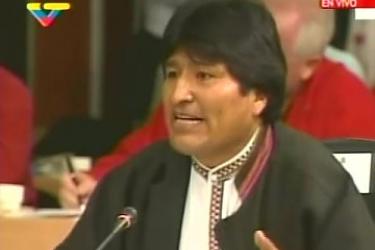
Evo Morales: `I declare myself Marxist ... now let the OAS expel Bolivia'
During his intervention at the seventh ALBA Summit, Bolivia's president Evo Morales recalled the 1962 documents of the Organisation of American States (OAS) that resulted in Cuba being expelled from the organisation, and outlined the importance of reflecting on the motives of that expulsion.
By Farooq Sulehria
March 30, 2009 -- Fidel Castro finds beards a practical advantage: “You don't have to shave every day. If you multiply the fifteen minutes you spend shaving every day by the number of days in a year, you'll see that you devote almost 5500 minutes to shaving. An eight-hour workday consists of 480 minutes, so if you don't shave you gain about ten days a year that you can devote to work, to reading, to sports or to whatever you like.”
But having a beard is more than saving time. Cuban revolutionaries let their beards grow out also as a symbol of the Cuban Revolution. Castro describes how it happened: “We didn't have any razor blades, or straight razors. When we found ourselves in the middle of the wilderness, up in the Sierra, everybody just let their beards and hair grow, and that turned into a kind of badge of identity. For the campesinos and everybody else, for the press, for the reporters we were ‘los barbudos’ – ‘the bearded ones.’ The positive side was that in order for a spy to infiltrate us, he had to start preparing months ahead -- he'd have to have a six-month's beard growth, you see. So the beards served as a badge of identification, and as protection, until it finally became a symbol of the guerilla fighter. Later, with the triumph of the Revolution, we kept our beards to preserve the symbolism.”