Partido Lakas ng Masa

Typhoon Haiyan bears down on the Philippines.
Stop the US-led war on Syria! (Updated Sept. 1)

[Below are statements from the left in Asia, from Australia, Malaysia and the Phil
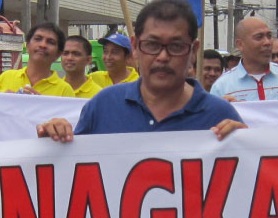
Assassinated transport workers’ leader Antonio “Dodong” Petalcorin.
Bolivarian Revolution inspires Philippines revolutionaries

PLM members.
By Sonny Melencio

US sailors aboard the aircraft carrier George Washington pre
Hugo Chavez Frias – visionary, fighter, companero (Asia-Pacific left statements) (updated Mar. 17)

[Below are statements issued by socialist and progressive organisations in the Asia-Pacific region. More will be posted as they come to hand.]
* * *
Statement of the Socialist Alliance (Australia)
March 6, 2013 -- The Socialist Alliance in Australia expresses its deepest sympathies with the people and government of Venezuela on the death of Companero Hugo Chavez Frias on March 5. His passing is a huge loss for all peoples, across Latin America and the globe, struggling for a world free of inequality, exploitation and oppression.
It is testament to Hugo Chavez’s great leadership that, while mourning his death, we are also confident that the Bolivarian Revolution and the new movement for socialism of the 21st century that Chavez inspired will be continued by the mass of people, to whom he worked so hard to give power.

Philippines left: In wake of Typhoon Pablo, global South demands 'reparations and climate justice'

Typhoon hits the Philippines, December 4, 2012.
By Partido Lakas ng Masa (Party of the Labouring Masses), Philippines
A total ban on all logging and mining activities!
Implement massive reforestation and a sustainable development plan!
Climate justice now!
We demand full reparation from rich countries and their corporations!
December 11, 2012 -- The Partido Lakas ng Masa (PLM) extends full sympathy to the victims of Typhoon Pablo: to the families of those killed and missing, and to the millions suffering from the destruction of their homes and crops and those still waiting for relief. The PLM demands answers to serious questions raised by the government’s response to the catastrophe.
These include: why, despite the authorities warning of the impending disaster in advance, no concrete evacuation plans were in place; evasiveness about the death toll; delays in getting food and other supplies to survivors and diversion of resources to prevent small-scale looting by desperate survivors rather than providing food.

A protest in Parramatta, a suburb of Sydney, on November 15, 2012, called for an end to Israel's attacks on Gaza.
The Noynoy government must condemn Israel’s actions and support build-up of international pressure to stop Israeli aggression!
Statement byPartido Lakas ng Masa (PLM, Party of the Labouring Masses, Philippines)
Solidarity statements: 'A vital victory for Chavez, Venezuela and the Bolivarian revolution'
 Brigadistas from the Australia-Venezuela Solidarity Network brigade get ready for the massive march in Caracas, October 4,
Philippines: PLM officially recognised as political party of the marginalised sectors
Statement by Sonny Melencio, chairperson, Partido Lakas ng Masa (Party of the Labouring Masses)