Uruguay
Lateinamerika: Ende der 'Rosa Welle' vorschnell prognostiziert
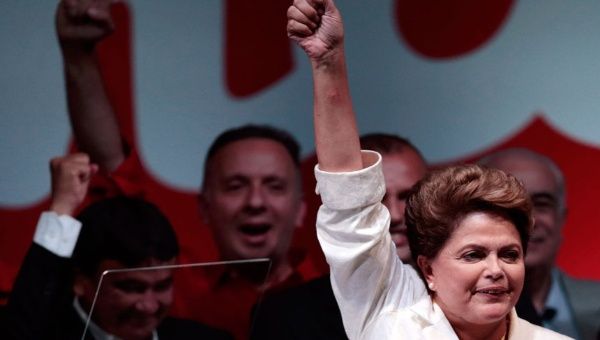
Dilma Rousseff.
Latin America: Why predictions of an ebb in the 'Pink Tide' proved premature
On October 26 Brazilians re-elected Dilm

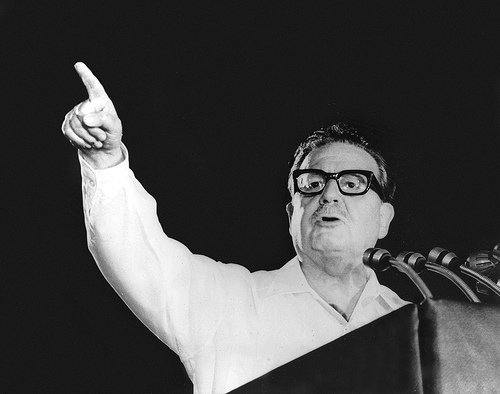
`Foro Social Latinamericano', June 2013 issue: Green Left Weekly's Spanish-language supplement

[Haga clic aquí para más artículos en español.]
June 16, 2013 -- Links International Journal of Socialist Renewal -- Providing facts and analysis, and publicising and organising Latin America solidarity activities in Australia, Green Left Weekly and Links International Journal of Socialist Renewal has sought to promote greater understanding and solidarity between the people of Australia and Latin America.
We are therefore delighted to publish Latin America Social Forum (Foro Social Latinamericano), a Spanish-language supplement produced regularly by the Latin America Social Forum in Sydney.

Latin America’s new left in power: the governments of Hugo Chavez, Evo Morales and Rafael Correa
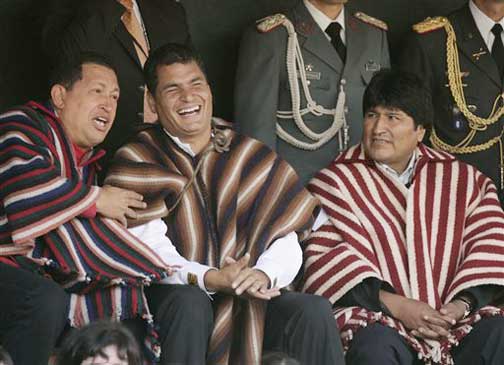
Presidents Hugo Chávez (Venezuela), Rafael Correa (Ecuador) and Evo Morales (Bolivia).

[This is the eleventh in a series of regular articles. Click HERE for other articles in the series. Please return to Links regularly read the next articles in the series.]
By Marta Harnecker, translated by Federico Fuentes for Links International Journal of Socialist Renewal
1. I have previously argued the case for the need to create a large social bloc against neoliberalism that can unite all those affected by the system. To achieve this, it is fundamental that we create spaces that allow for the convergence of specific anti-neoliberal struggles where, safeguarding the specific characteristics of each political or social actor, common tasks can be taken up that aid in strengthening the struggle.
Characteristics of the experiences underway in Venezuela, Ecuador and Bolivia
June 27, 2008 -- In Latin America, if we exclude Cuba, we can point to three general categories of governments. First, the governments of the right, the allies of Washington, that play an active role in the region and occupy a strategic position: these are the governments of Álvaro Uribe in Colombia, Alan García in Peru and Felipe Calderón in México.
Second, we find supposed “left” governments that implement a neoliberal policy and support the national or regional bourgeoisies in their projects: Brazil, Uruguay, Chile, Nicaragua and the government of Cristina Fernandez Kirchner, from Argentina’s Peronists. They are governments that implement a neoliberal policy that favour grand capital, covered up with some social assistance measures. In effect, they make it a bit easier to swallow the neoliberal pill by applying social programs. For example, in Brazil poor families receive a bit of help from the government, which assures them popular support in the poorest region of the country.
XIV Sao Paulo Forum: Left parties debate the current historic conjuncture
By Inés Hayes, with reports from Montevideo by Cristina Camusso and Julio Louis.