Strikes and resurgent trade unionism in Chile: Interview with Domingo Pérez Valenzuela
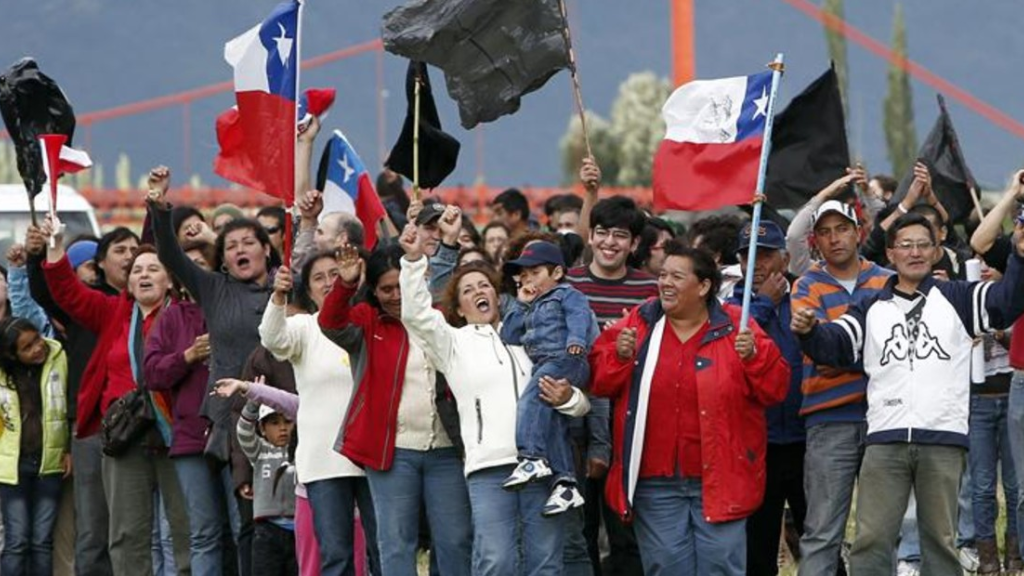
The labour movement is in crisis across much of the world. One exception is Chile. Since the mid-2000s, the South American country has seen a sustained upward trend in strikes and labour mobilisations. But does this represent a genuine revitalisation of trade unionism — and what are its limits?
Domingo Pérez Valenzuela is a Chilean sociologist whose research focuses on labour geography, trade union movements and strike dynamics in contemporary Chile. He is an academic at the Institute of International Studies (INTE), Arturo Prat University, in Iquique, Chile, and Director of the Observatorio de Huelgas Laborales (OHL, Labour Strike Observatory), which has systematically recorded strikes in Chile since 2010. He is co-author, with Rodrigo Medel, Diego Velásquez, Francisca Gutiérrez, Pablo Pérez and Maurizio Atzeni, of Huelgas laborales y revitalización sindical en Chile (Strikes and Trade Union Revitalization in Chile, OHL, 2025).
Pérez Valenzuela spoke with Serhii Shlyapnikov for LINKS International Journal of Socialist Renewal to discuss the resurgence of Chilean trade unionism in Chile, strengths and limitations of its strike model, and what lessons the country’s recent labour struggles offer for labour renewal internationally.
How did the OHL project come about?
The OHL emerged as a result of three factors.
First, there used to be a database for recording major strikes in Chile, which registered a huge number of labour stoppages that did not figure in official statistics and were little known about in the social sciences. This database stopped being maintained after 2010, because its creator [Alberto Armstrong, from the Pontifical Catholic University of Chile] unfortunately passed away.
Second, the 2010s saw the consolidation of a steep rise in strikes and social mobilisations, which had a significant impact on labour and social class studies.
Third, a group of researchers concluded that strikes were essential for reading capitalist society, as they facilitated a structural estimation of social conflict. So, around 2014–15, this group, together with the Centre for Social Conflict and Cohesion Studies (COES) and Alberto Hurtado University, founded the OHL.
The main objective was to register and study, from a social sciences perspective, all workers’ collective actions involving a deliberate withdrawal of labour over demands, requests or claims, regardless of their legal status.
When did the trade union movement’s resurgence begin? The “Summary of Labour Strikes in Chile 2022–23” graph (below) shows that the strike wave peaked in 2015–19. Was it a consequence of the huge social protests between 2006–19?
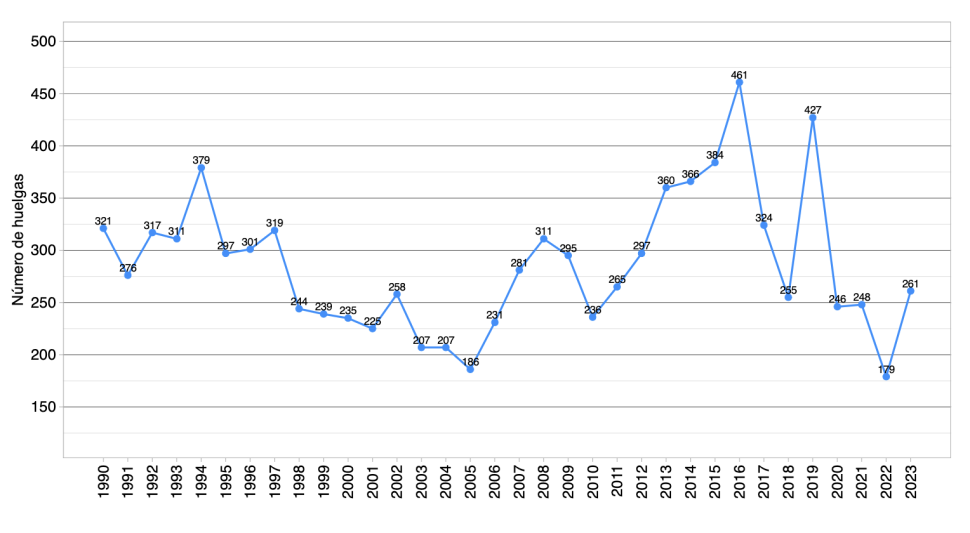
Many researchers and union leaders have sought to understand to what extent this trade unionism resurgence was, on the one hand, the product of one or several specific events and, on the other, the product of a long cumulative process.
There is a broad consensus that the first clear signals or revival came in 2006–07 when subcontract workers at Codelco [the National Copper Corporation of Chile], and then subcontractors in other strategic primary industries, staged strikes and radical actions that shook entire sectors, forced contracting companies to negotiate and exposed to the country what lay beneath economic growth: tens of thousands of precarious and discriminated workers, earning a fraction of what plant workers earned, under worse working conditions and without access to serious negotiations [with contracting companies]. Those strikes were a turning point for labour and society, and one of several “mobilisation milestones” achieved by different labour sectors in subsequent years, all of which we explore in the book.1
Then, 2006 saw an unprecedented school students’ rebellion and strong residents’ mobilisations for housing, followed by university mobilisations in 2011. After many other events, the October 2019 explosion finally occurred — a true popular rebellion in which Chilean society rediscovered that protest was possible and that the established order could be challenged on the streets.
During this protest cycle, many strikes evolved into stoppages at the comuna [local council] level, as well as general strikes for specific demands. Evidence suggests that trade unionism managed to become dynamic mainly through the labour strike wave that grew sharply from 2007, peaking with the largest mass political strike in the country’s history in 2019.2

Of course, the strongest unions — those covering miners, public employees, and industrial and port workers — built their power through patient and sustained organisational work, often in silence and at high cost (including deaths), during years of centre-left and right-wing governments. But union forces also emerged for the first time in the service sector, covering bank, supermarket, telecommunications, warehouse and transport workers, among others. Here, social protest amplified what had been built from below.
What lessons can be drawn from the strikes in Chile? What can be replicated in other countries? Developing trade union culture through the use of the media? Developing workplace organising? Developing mutual support groups at the neighbourhood level?
The Chilean experience suggests that none of these three paths works alone. And that unions must also be prepared to mobilise, which was the most dynamic factor we observed. That said, there is a sequence that appears to show a way forward. Workplace organising is the foundation without which all other aspects become fragile, especially when a repressive and anti-union environment prevails at work and when the collective bargaining system is fragmented (as in Chile). A union that has no power in the workplace, that cannot stop production, that workers do not respect or trust, that employers do not fear, cannot sustain any of these other strategies for very long.
Neighbourhood mutual support networks, or even forms of community unionism, are an indispensable complement to creating a union movement at the local scale, sustaining long conflicts and uniting workers in various companies with similar conditions. Strike “resistance funds,” union halls shared between organisations, and community solidarity with workers’ organisations — all of this is real, not rhetorical, infrastructure that builds strength. The media — and today social networks — can be used against companies. They are also needed to spread information among dispersed workers and useful for communicating concrete victories. However, a union without a base will have nothing to communicate, or not be able to do so clearly. In turn, leaders or members without training in managing social networks can fall into traps and disorganisation.
All these factors, and others, allow us to tell when a union is strong and when it is not. But this opens up another huge debate: strong for what? The big debate is really about strategy: what do different unions want to achieve? This determines whether such factors will benefit a group, a sector or a portion of the working class.
In Chile, trade union strategies have historically been shaped by a high degree of organisational fragmentation. The predominant form of action has been isolated activity at the enterprise union level, in a context where only a minority of organisations (about a quarter) are affiliated to federations, confederations or national labour centres. At the same time, at the national coordinating level, the second predominant strategy has been a socio-political form of trade unionism, with these coordinating bodies being closely linked to the historic centre-left and left-wing parties. The main institutional expression of this has been the Central Unitaria de Trabajadores de Chile (CUT, Workers’ United Centre of Chile), the country’s largest labour confederation. However, even at this level there have been significant fractures, reflected in the existence of other labour centres, confederations and movements operating outside the CUT’s orbit, though without any broad transversal unity among them.
During the 2019–20 uprising, this scenario evolved dynamically. The outbreak was rapidly transformed into a popular revolt by social movements, especially neighbourhood class-struggle organisations and the feminist movement [Coordinadora Feminista 8M or March 8 Feminist Coordinating Committee] that focuses on building a general strike. The CUT took several days to interpret the situation and define its position. But thanks to its greater organisational stability and coordinating capacity, it managed to lead a broader Trade Union Bloc, with forces outside its traditional sphere, which called the largest political mass strike in the country’s history, constituting the rebellion’s high point.
This process bears important similarities to what Alexander Gallas and Jörg Nowak have written regarding contemporary mass strikes. Such mobilisations are no longer led primarily by the traditional, stable, industrial worker, but rather by precarious and frequently non-unionised sectors. Similarly, along the lines of the authors’ conclusion, the 2019 mass strike in Chile was initially a defensive response to a neoliberal offensive and deepening social precarisation. However, ultimately driven by the broader social rebellion, it took on an offensive character and advanced multiple structural demands, nearly bringing down the government.
The book looks at trade union resurgence along the four dimensions proposed by Behrens, Hamann and Hurd: membership, economic influence, political influence and institutional changes. Which of these dimensions contributed the most and least to the resurgence in Chile? Why?
In our book, we show how membership — in successful but initially limited experiences — and mobilisation energised the political and social dimensions. On the other hand, collective bargaining was not so successful; it did not lead to any major legislative changes nor the construction of broad alliances with political forces. Outside this general framework, strong Chilean unions — particularly large industry-wide federations — have managed to directly influence the creation of new unions, government programs, legislative agendas and constitutional negotiations, since 2019.
Membership remains weak, marked by unionisation rates in the private sector of about 15–20%. This structural situation, together with the difficulty of achieving unity, is what most limits or conditions the scenario I have described. Finally, the economic dimension, perhaps naturally, remains key. Chile is one of the most unequal countries in the world. This fuels workplace tensions. In turn, financial precarity makes unions generally poor. Therefore, sharing resources has become vital for them to project themselves into the future.
Is it easy to start a strike in Chile? What is the procedure? Is it true that the strongest unions (with the best contracts) resort to strikes more frequently?
Quite the opposite: it is always an intense and difficult process to carry out successfully, so its execution must come from a careful strategic analysis by the union.
Strictly speaking, in any society with high inequality, workers will begin to feel the first conflict simply because they want to organise at work. From there onwards, the conflict occurs under unequal conditions. Then, if a group of workers manages to establish a union after long silent, underground, hidden work, they find that the legal procedure to hold a strike is regulated and limited: the union must be in a formal process of collective bargaining, which has strict deadlines; there is a mandatory mediation stage; and the vote to go on strike requires an absolute majority of members.
Until the 2016 labour reform, companies also had the right to replace striking workers, which made work stoppages much more ineffective. After the reform, this changed to only allowing companies to maintain “minimum services,” which still means a total stoppage cannot occur.3
This explains why so many of the most significant strikes in recent decades have been technically illegal: powerful unions (primarily in terms of their size) have called strikes when needed or in response to urgent demands, while protecting themselves from possible reprisals.
That said, in comparative terms, the OHL found that conflict arises at an intermediate level of strength relative to employers, because if power is high, the union imposes its demands even before sitting down at the negotiating table. Due to the lack of institutional power, unions in Chile have to compensate for their lack of legal power through the power of mobilisation. When this power is high, you can choose to take legal or non-legal strikes, or alternate between them, depending on need and context.
When reading the chapters on specific strikes (Codelco subcontractors, teachers), one gets the impression that Chilean unions use the strategy of “trade unionism as a social movement” (street mobilisation, coalitions, direct action). Is this impression correct?
This impression is accurate for the most dynamic and long-standing sectors but not the majority of unions, given that in Chile union affiliation with federations, confederations and central bodies is a minority phenomenon.
What the literature calls “trade unionism as a social movement” — the combination of workplace negotiation and public space mobilisation — describes well the effect that subcontractor mobilisations had from 2006 onwards, but it does not describe these germinal events themselves. Rather, it was only in the 2010s that unions began to receive greater social support and to unite with other social sectors — still insufficiently — to achieve results.
What have been the most important strikes in Chile in the past two decades? Could you point to any strike that was a turning point?
The strikes from 2006 to 2008 unleashed deep labour unrest and produced real changes: a greater predisposition to unionise, legislation on subcontracting, new forms of alliances, and increased scientific research on workers’ power.
After that, I would say that a series of mobilisation milestones took place. Many of these had a large community impact when they occurred within key industries in a region. Other milestones had strong public repercussions when they took on a mass character in cities, such as the mobilisations by education and health workers. But among this series of milestones that were fundamental, the most powerful were the local council-scale mobilisations, such as the regional strikes in Aysén or Calama, where unions and communities paralysed an entire city to put forward their demands.4
The book also shows that the strongest unions are in the public sector and mining. Why does the public sector have strong unions, despite the lack of a legal right to strike?
This is one of the most striking paradoxes of the Chilean case, although, to be precise, the strong levels of unionisation is limited to permanent public employees, and does not extend to fee-based contract workers, where the challenge of achieving unity remains.
The explanation has several layers. The first is institutional: public sector workers have job stability that private sector workers do not, because they benefit from much more effective regulations regarding grounds for dismissal. This reduces the individual cost of organising and going on strike. A public employee who participates in a work stoppage will not fear dismissal in the same way as a worker in a private company, where firing someone is very easy.
The second layer is historical: public sector unions covering teachers, healthcare workers, municipal employees, etc, have decades of organising culture and a national structure. They know how to hold assemblies, manage internal conflicts or share organisational resources with other groups seeking to unionise or with social movements.
The third layer is socio-structural: a strike by teachers or hospital workers receives immediate public visibility, which tends to politicise these movements. If the employer state is also a political state that sometimes seeks to make public work precarious, public employees respond as a union movement. Unity, then, is and has been their greatest strength.
What about mining? Why has this sector also seen a sustained resurgence?
Mining concentrates conditions that are almost unique for union power. The strategic position of Chilean copper in the global economy — the country produces about 25–30% of the world’s copper — means that a stoppage at Codelco or at Escondida is felt in international commodity markets.
Added to this are the cohesive nature of mining communities. Cities such as Calama, El Salvador or Chuquicamata are largely mining towns, where the union is not just a labour institution but the centre point of social, sporting and cultural life. This community implantation is what allows long strikes to be sustained. Union communities also have a strategic advantage: companies depend on vulnerable transport routes and facilities located in geographical areas where workers’ power has pushed back police forces through united mobilisation. The unions themselves, in turn, have been very strategic in analysing the potential for mobilising labour in these communities.
In many countries, mines are closing and workers are trying to leave such places. In Chile, is it older workers that mainly work in mines or are young people also seeking employment there due to high wages? What can you tell us about the social profile of miners?
The profile of miners is heterogeneous and changing. High wages in large-scale mining attracts many young people with technical training from institutes and universities. Once in the mine, they learn from older generations of the unionised working class, both plant workers and contractors. This, however, poses a challenge for classical trade unionism. The new generations often bring very specific practices and are focused on wages and working conditions, rather than solutions to the broader challenges of uniting different labour groups across thousands of contracting companies and within the plant itself. There are different paths to politicisation.
Chile had a left-wing government when Gabriel Boric was president. To what extent did this help trade unions and social movements?
At the OHL, we have not analysed this, as we have concentrated on researching workers’ agency and conflict in the labour process. That said, personally, I believe it is a mistake — one often made in the international media — to associate Boric’s government with the left, given that its main reference point is “progresismo” (progressivism), which seeks a broad alliance between the centre-left and liberals. Its driving force, moreover, was the middle classes. Even so, many left-wing people organised to support this government. But the relationship was more complex than a simple sum of its parts.
Boric came to power in 2022 with an agenda that included historic trade union demands, mainly advocated by the Communist Party: reduction of the workday, better protection for platform workers, collective bargaining reform. Some of those promises were fulfilled: in 2023, the work week was reduced to 40 hours. This was an advance that the trade union movement applauded.
The government had to deal with deep tensions, an unprecedented pandemic, market pressures, a radical sector that refused to support it, the defeat of the constituent process in the September 2022 referendum, and public opinion, which grew more conservative as changes (either minor or radical) failed to materialise. This led the government to moderate its agenda, with structural reforms, such as industry-wide collective bargaining, left pending until the last days.
There is broad union consensus that bargaining across entire occupational sectors, instead of company by company, would have radically changed the balance of forces. Some, however, also warned this was not a panacea, and could result in union bureaucratisation if the balance of forces at the grassroots did not change.
What threat does the new right-wing José Antonio Kast government pose to trade unions?
Kast and the Republican Party, although only one portion of the ruling class, represent an ideological right-wing force that is not afraid to confront other political sectors. This threat is not abstract. The most direct threat is to reverse or weaken recent labour reforms: roll back the 40-hour work week law, enable employer irregularities, and provide fewer resources for labour inspection. But the government has already accumulated multiple tensions, and many issues remain on the table, from the significant weakening of real wages to the privatisation of state-owned companies.
Today, the far right is once again proposing a wave of anti-popular initiatives. But recent history teaches us that trade union movements can not be easily dismantled by governments. Augusto Pinochet’s dictatorship tried to destroy trade unionism through direct repression but never fully succeeded. The government of mega-capitalist Sebastián Piñera militarily repressed a social uprising, but he too failed to dismantle union forces.
What films or books on the Chilean labour movement can you recommend?
Tejedores de la revolución (Weavers of the Revolution) by Peter Winn is one of the best books on Chilean labour history. It follows the Yarur textile factory workers during the Unidad Popular (Popular Unity) period: how they organised, how they pushed beyond what then-president Salvador Allende wanted, and how they experienced defeat. It is history from below.
In terms of more recent developments, El renacer de la huelga obrera en Chile (The Rebirth of the Workers' Strike in Chile) by Antonio Aravena and Daniel Núñez, details the resurgence of union mobilisation, looking at the struggles of subcontract workers between 2006–08. It highlights the new forms of organisation and collective action that converted spontaneity into organisation in the sector.
From a broader perspective, there is Building Power to Shape Labor Policy: Unions, Employer Associations, and Reform in Neoliberal Chile by Pablo Pérez, which delves into “class power” to explain why Chilean trade unionism has struggled to influence institutional power, despite the country's political changes.
Rodrigo Medel and Sebastián Osorio’s Sindicalismos en Chile: Desde la reestructuración neoliberal a la posdictadura (Trade Unionisms in Chile: From Neoliberal Restructuring to the Post-Dictatorship Era) offers a multi-sectoral study.
Finally, Guía de Acción Sindical (Trade Union Action Guide), which was recently published and is available for free and online, draws together and synthesises many of the tactics and innovations of unions in terms of membership, bargaining, and strikes.
As for the OHL, we have produced many annual reports that provide a first-hand, rigorous and accessible source of information on contemporary labour conflict. Among them is our 2018 Report, which includes an important comparative perspective, and our 2019 Report, which focuses on the general strike at the centre of the social uprising.
As for documentaries, I have to mention the feature film, Pueblo en huelga (People on Strike), which I was invited to collaborate on. It follows 11 labour struggles, in sectors such as retail, warehouses, education and industries, during the 2010s, culminating in the 2019 social revolt, all of which centred on the demand for dignity at work.
- 1
Note by S.Shlyapnikov: The Codelco subcontractors’ strike took place between June 25–July 31, 2007. It involved 28,000 workers employed by subcontracting and contracting companies providing services at Escondida, the world’s largest copper mine. Subcontractors demanded equal pay with permanent workers employed by Codelco at the mine. The movement's leader was Cristián Cuevas, President of the Confederation of Copper Workers (CTC) and, at the time, a member of the Communist Party of Chile.
- 2
Note by S.Shlyapnikov: The 2019 Estallido Social (Social Outburst) was a wave of popular protest that took place from October 7, 2019 to March 18, 2020. The formal trigger was a rise in metro train fares. After the first weeks of protest, then-president Sebastian Piñera declared a state of emergency, deploying troops to Santiago and then other regional capitals. By February 2020, 36 deaths and more than 11,000 injuries were recorded. The Social Outburst also gave rise to new cultural symbols, such as the dog “Negro Matapacos” (Black Cop-Killer) and the “Dark Avengers” or “Chilean Avengers”. The protests ended after a security force crackdown, the onset of the COVID-19 pandemic, and the decision to hold a referendum on a new constitution.
- 3
Note by S. Shlyapnikov : Unlike in the United States, there is no official vote to certify a union as the exclusive representative of all workers. The union represents only its members. At the same time, collective bargaining is decentralised and takes place at the company level.
- 4
Note by S. Shlyapnikov: The Aysén strike began on February 18, 2012, in the city of Puerto Aysén, located 1640 kilometres south of Santiago. Residents protested against the high cost of living, the lack of quality healthcare and education, poor transportation links with other regions, and the fact that profits from natural resource extraction (mainly gas and water) went to the central government rather than remaining in the region.