May 1, 2026: The Venezuelan working class at a historic crossroads
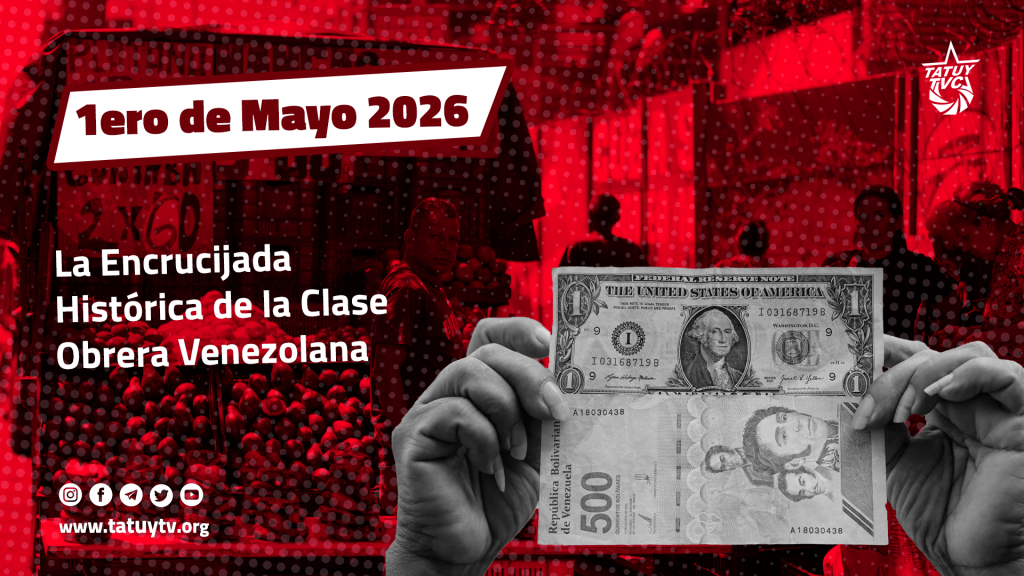
First published in Spanish at TatuyTV. Translation by LINKS International Journal of Socialist Renewal.
As we approach another International Workers’ Day, Venezuela finds itself amid one of the most decisive political and economic junctures in its contemporary history. Recognising that media is not a sterile exercise, but a factory producing ammunition for the battle of ideas, we are initiating a crucial debate on the minimum wage in Venezuela in 2026. Our analysis goes beyond the mere expectation of an isolated presidential announcement.
Today, the wage issue has become the epicentre of a structural struggle over the model of society we defend in the face of imperial siege and deep internal contradictions. In this article, we examine the real threats facing the Venezuelan working class — from US tutelage over energy geopolitics to the state’s silent reconfiguration — to provide grassroots activists with solid arguments in this non-negotiable struggle for life and dignity.
The LOTTT: A historic achievement under imperial siege
To understand the scale of the minimum wage crisis in Venezuela, it is essential to draw on historical memory. Working people experienced a highpoint in the struggle for their rights when, on April 30, 2012, Commandante Hugo Chávez enacted the Organic Law on Labour and Workers (LOTTT).
This legal instrument represented a historic safeguard: it restored the retroactive calculation of retirement/redundancy payouts, established job security as a principle, and built a powerful legal bulwark against outsourcing and precarious employment. The LOTTT was, in essence, a legal expression of the socialist ideal of the Bolivarian Revolution, ensuring that labour was recognised as a social fact and not a commodity subject to the savage laws of capital.
However, this emancipatory project was the target of a fierce onslaught by imperialism. Barely five years later, on August 24, 2017, the first economic sanctions imposed by Washington marked a tragic turning point. Designed with surgical precision against PDVSA [the state oil company] and the national financial system, these measures deliberately sought to strangle the republic’s revenues, with a direct impact on people’s purchasing power, at a time when the nation was already suffering a severe recession as a result of falling oil prices.
The blockade is not a metaphor: it is an act of economic warfare that resulted in estimated annual losses of more than US$25 billion and the confiscation of international assets worth more than $30 billion — resources that could have been channelled into social welfare and decent wages.
The blockade’s devastating impact on workers
The financial siege imposed since 2017 not only shattered the country’s macroeconomic equilibrium, it triggered a hyperinflationary cycle that ultimately wiped out the value of the minimum wage. By 2019, year-on-year inflation exceeded 300,000%, according to official figures, destroying a decade of progress in income distribution.
The working class’ purchasing power collapsed. If in 2012 a minimum wage could cover the basic food costs of three households, by the end of the hyperinflationary cycle that same wage was not enough to cover even 1% of the food that a typical family of five needed. The sanctions made no distinction between political activists and the civilian population; they penalised the entire nation, plunging Venezuela’s historic working class into an unprecedented crisis of survival in peacetime.
Internal blows: The dismantling of labour rights
If external aggression is the starting point for understanding Venezuela’s reality, the next step is turning our attention to the government’s response. Faced with this economic siege, the executive’s response was to liberalise, yielding more and more to the demands of capital.
In the labour sphere, this entailed a progressive erosion of rights and safeguards. On August 20, 2018, the so-called Programme for Economic Recovery, Growth and Prosperity brought with it currency devaluation and a de facto relaxation of controls, severely impacting the labour ecosystem.
One of the most insidious and lethal blows to institutionalised protections was Memorandum 2792, issued on October 11, 2018. This ministerial document, which had no force of law, served to flatten pay scales in the public administration and overrode vital clauses in collective agreements signed over many years. This memorandum was the first direct blow to the heart of collective bargaining. The measure was strongly rejected by the trade union movement.
Subsequently, the offensive against public sector pay intensified on March 22, 2022 with the ONAPRE Directive, which cut bonuses, eliminated historic compensation and sparked the most intense street protests in recent times, led by educators and healthcare workers.
In parallel with making working conditions more precarious, the government established control of inflation as an absolute priority. One of the tools it used was to freeze the minimum wage. Set at 130 bolivars a month since March 15, 2022 — equivalent to at the time — it is now a purely symbolic figure, completely eroded by devaluation [and equivalent to $0.27].
The bonus trap: Subsistence with no future
Faced with a declining minimum wage, the government adopted a compensation strategy that generates deep scepticism among organised workers: bonuses. Denounced by Chávez as a recurring policy of the Fourth Republic, bonuses [non-salary compensations] reduce costs for employers, erode labour liabilities, and facilitate redundancies.
Ahead of an expected May 1 announcement, workers fear a repeat of the policy introduced in 2023: indexation of variable bonuses through the Patria System, without touching the statutory minimum wage. The acting president and other spokespeople have sought to lower expectations, insisting that wage increases must be “responsible”.
This bonuses policy amounts, in practice, to the hollowing out of labour rights. Although it allows for immediate survival, it has no bearing whatsoever on the calculation of holiday pay, benefits and long service, or severance pay. More critically, and perversely, it wipes out a lifetime’s savings by not contributing to retirement payouts, as severance pay is calculated based on the final salary, condemning the worker to a retirement without assets. It is the philosophy of day-to-day survival, a trap that robs the working class of its future and hides behind the technical justification of “not fuelling inflation”.
The situation regarding pensions is even more dire. The elderly population receives even less in bonuses than public sector workers.
Expectations regarding a new minimum wage in Venezuela for 2026 will put the macroeconomic reality to the test. Despite five consecutive years of growth, Venezuela’s current GDP stands at about 36% of the 2012 figure. However, demands are fuelled by optimistic forecasts, realistic or otherwise, regarding the country’s future.
However, the current context of US semi-colonial tutelage is a major obstacle. The government does not directly manage oil revenues, the economy’s main source of foreign exchange, leaving it at the mercy of the Trump administration’s whims to access (part of) its own resources. US officials have arrogantly stated that the Venezuelan government must submit a budget proposal for approval before funds are released.
Another spectre looming large is the International Monetary Fund (IMF), with its “recommendations” for fiscal discipline. Although the Venezuelan government has stated that there are currently no plans to take on debt, it is possible that external debt could pave the way for a future of debt and structural adjustments. For all these reasons, it is likely that Delcy Rodríguez’s government will adopt a conservative stance in the face of the increasingly widespread demands for wage rises.
The state’s restructuring: modernisation or silent dismantling?
Alongside job insecurity, an enigmatic “modernisation of the state” is currently underway. Strategic, albeit unofficial, information confirms a thorough purge of the public administration’s payrolls through the Patria System and ONAPRE, under the formal pretext of eliminating duplicate positions and conducting attendance audits.
However, the underlying political interpretation is far harsher: we are facing an imminent and silent structural reduction of the state apparatus. In parallel with the commission assessing the “strategic” value of state assets, the trend towards shrinking the state is clear. One scenario is the creation of a bureaucratic elite with privileged salaries to sustain the various institutions, casting hundreds of thousands of workers into the unprotected ranks of casual labour, the informal sector and the transnational subsistence economy.
At the same time, a commission has been set up to draft up a reform of the labour law and the pension system.
Proposals for the minimum wage: The battle over figures
The class struggle is being waged on several fronts, from the streets to the tripartite negotiating tables. The fundamental demands of the trade union rank-and-file are non-negotiable:
- Full restoration of rights: A radical minimum wage rise and the total and immediate conversion of bonuses into wages.
- Scientific indexation: A wage indexed to the real household costs, currently estimated by Cendas-FVM at more than $530 a month for a family.
- Dismantling of illegal measures: Complete repeal of Memorandum 2792 and the ONAPRE Directive.
- Freedom of association: Release workers and trade union leaders detained for peaceful protest.
- Collective bargaining: The immediate resumption of negotiations on fair collective agreements, preserving the historic achievements of the LOTTT at all costs.
In quantitative terms, the differences highlight the tension between street-level realism and technical adjustments:
- Trade union sectors: The Bolivarian Socialist Workers’ Confederation (CSBT, pro-government) is proposing quarterly increases of $50. The Confederation of Workers of Venezuela (CTV, centre-right) is demanding an initial $200, rising to $450. The Federation of University Professor Associations of Venezuela (FAPUV) is requesting a base pay of $300 plus indexation. The Independent Trade Union Alliance (ASI, Christian Social) estimates its minimum at $377.
- Liberal economists: Spokespersons such as Luis Oliveros and José Guerra, representatives of orthodox austerity thinking, propose amounts of just $100 and $150, figures completely disconnected from the dollarisation of the popular economy and more in line with employers’ need to contain labour costs.
The capitalists demand flexibility
While various labour organisations demand dignity and fair wages, the business sector, represented by trade associations such as Fedecámaras and Conindustria, is seizing the opportunity and “tripartite dialogue” (state, trade unions and business) to sink its claws into protective legislation. Taking advantage of the weakness of incomes, their aims are clear and directly undermine the doctrine of social justice that characterised the original Chavismo:
- Abolition of retroactive calculations: Elimination or drastic reduction of the retroactive application of social benefits, seeking a simple payment system that liquidates accumulated labour liabilities.
- Make it easier to sack workers: Complete dismantling of job security to facilitate low-cost mass redundancies, allowing staff turnover without fair compensation.
- Dismantling of historical calculation: Comprehensive review of the pension system to eliminate historic pension calculation mechanisms, replacing them with capitalisation schemes or universal minimum amounts.
Conclusion: A May Day of struggle and dignity
This May 1 is not a date for empty applause or for the complacency of bureaucracies disconnected from reality. The Venezuelan working class, which stoically resisted the onslaught of the United States’ illegal sanctions, cannot be sacrificed once again, this time on the altar of “macroeconomic stabilisation” or the internal re-engineering of the capitalist state under imperialist tutelage.
Unconditional defence of the LOTTT is the indispensable starting point for any project of national recovery with a human face. Wages are not a variable in spreadsheets to be optimised in the face of monetarist conceptions of inflation. They are a materialisation of the social debt owed by the state and capital to those who actually produce wealth. Precarious employment is not an inevitable fate. We demand indexation, back pay and full respect for the history of workers’ struggle. In the face of transnational capital and our own mistakes, there must be but one slogan: not one step back.