Russian society in war mode
First published at Rosa-Luxemburg-Stiftung.
On 24 February the war that Russia is waging against Ukraine entered its fifth year. This means that it has already lasted longer than the Soviet participation in the Second World War.
Despite grandiose proclamations, the Russian side has not yet achieved the goals it set itself. Nevertheless, the Russian delegation at ongoing talks under the mediation of the USA continues to be unyielding with Ukrainian representatives. Even if the talks succeed in ending the armed conflict, the question remains as to what impact this would have on the Kremlin’s domestic policy. After all, the state of war that has lasted for years has a firm grip on Russian society and dictates the rules of the game — whether in the economy, education, or the actions of the security forces.
The war economy exacerbates social inequality
Since the start of Russia’s full-scale invasion of Ukraine in February 2022, the public military expenditure and the cost of the armed forces has risen to astronomical levels. Around 40 percent of the state budget is now spent on the military.
In the first two years of the war, the massive boost to arms production led to an increase in demand for skilled workers and significant wage increases for particularly sought-after professions. Following a slump in 2022, Russia ’s economy recorded growth of around four percent; this fell significantly again last year.
However, the strong short-term growth was based on a number of other aspects, such as the positive export balance in the oil industry, a liberalization of regulations in the financial sector, including specifically bankruptcy, the ability to circumvent import sanctions, and tax breaks. The state fueled the military-industrial complex and largely left the private sector to its own devices. There were positive effects on purchasing power, particularly in low-income regions, due to the comparatively high pay of soldiers deployed on the front.
In the meantime, the Russian economy had reached its limits and the relative expansion of the first years of the war was over. Even the production of armaments has been in decline since autumn 2025 because orders have to be paid for from the state which is increasingly running out of funds. President Vladimir Putin wants to support the arms industry over the next three years by significantly increasing arms exports abroad, particularly to African countries.
Russia’s budget has a planned deficit of at least one percent of gross domestic product. This is not a critical figure, but in order to fill the state coffers, the government has decided to take drastic measures that are affecting the population directly and drastically. Gone is the grace period for small and medium-sized enterprises which now have to forget various tax benefits. The state already increased the profit tax in 2025, and since 1 January the VAT has also been raised from 20 percent to 22 percent, which hits people on low incomes particularly hard.
The problem of growing wage debts is adding fuel to the fire as employers (especially of state-owned enterprises) are unable to pay their employees on time. The state statistics authority Rosstat recorded a 2.3-fold increase for 2025 alone and puts the total of current back wages at around 22 million euros. In short: Russia’s war against Ukraine is not only costing the state dearly - the economic burden is also being borne by those who never benefited from the promotion of the war economy.
The recruitment machine
With the exception of border regions such as Belgorod, where air raids and drone strikes have long been part of everyday life, the fighting seems to be taking place far away from the Russian population. Visually, however, the front is omnipresent. Even those who avoid the propagandistic news flow of state television come across hard-to-miss posters on billboards or at bus stops in St. Petersburg or Moscow every day, celebrating Russia's frontline fighters as heroes — supplemented by calls to volunteer for the army. Recently, the armed forces have been emphasizing the recruitment of future drone pilots.
This year, 261,000 male conscripts between the ages of 18 and 30 are to be drafted. Previously conscription summonses were only issued in spring and autumn, the military offices have been able to issue conscription summonses all year round since 1 January 2026. Although conscripts are not officially allowed to take part in frontline missions, the reality shows dozens of documented deaths of conscripts in combat zones. Time and again, reports of young men or their relatives have come to the public’s attention, revealing that army superiors have used pressure or false pretenses to trick them into signing a contract as a regular soldier. The law stipulates that in this case adults are allowed to fight even without basic military training.
Resisting this pressure requires knowledge of one’s own rights and the courage to demand them. Legal advice is still available in Russia for men who wish to refuse military service; civilian service is also possible in principle, although the hurdles are high and the chances of success are uncertain.
During their studies, conscripts are exempt from conscription. At many universities, it’s possible to acquire an officer’s rank as an alternative to military service, although this carries the risk of being conscripted as a reservist in times of war. The war is also drawing ever closer for students at Moscow’s universities who are at risk of being ex-matriculated due to poor performance. Since the beginning of the year, students have been receiving letters informing them that they can avoid ex-matriculation by signing a one-year contract with the Ministry of Defense. They are promised that they will be trained and deployed as drone pilots. At the end of the contract period, they are guaranteed to be able to resume their studies, provided they do not wish to extend their contract as a regular soldier. This clause is a novelty. However, lawyers familiar with the matter, led by the opposition medium Verstka, doubt that such promises will be implemented, as they explicitly contradict the current regulations on partial mobilization.
Danger for deserters
On 21 September 2022, Putin signed an ukase on partial mobilization. In the five weeks up to 28 October, over 300,000 people were drafted, as the battle line had expanded so much in the previous months that it could not be maintained with the units available at the time. In many regions, the recruitment offices resorted to harsh measures in order to meet the specified quotas. Some of those affected were picked up at home, picked up on the street or lured with the ruse that it was merely a matter of updating the personal data recorded in the military register.
One person affected by the latter was Georgi Avaliani from Moscow. He was conscripted against his will and deported to the front but managed to escape to Germany. There, the authorities rejected the deserter’s application for asylum on the grounds that he would only face a fine if he returned and referenced that, according to the then Russian defense minister, Sergei Shoigu, the partial mobilization had been suspended at the end of 2022.
The reality is, in Russia Georgi Avaliani is considered a deserter and that means fifteen years in prison. Or, worse still, he could be transferred to a penal battalion at the front, which would almost certainly mean his death. The argumentation of the Federal Office for Migration and Refugees (BAMF) is therefore a fatal error. Although partial mobilization has been suspended since October 2022, it has not yet been completely lifted. Until the end of the so-called special military operation, the same rules apply to soldiers drafted at that time as to those who voluntarily joined the armed forces in return for a relatively high salary and bonus payments. They only have three legal options for leaving the service: reaching the maximum age permitted for deployment, poor health, or if they are sentenced to imprisonment. Even those who are de facto unfit can be used on the front line, especially for kamikaze missions where high personnel losses are calculated. This refers to infantry advances known as “meat storms”, which — with little or no support from the air or artillery — become living targets for the Ukrainian army. In most cases, these are former prisoners or soldiers accused of violating troop discipline. Their chances of survival are extremely low.
In mid-February, the US Institute for the Study of War suggested that declining recruitment figures could lead to a new wave of partial mobilization. Hundreds of thousands left Russia in 2022 as a result of the first wave, but those who remained were also very displeased. Russia’s power apparatus is having to weigh out the risks: continuing the war at any cost due will exacerbate war fatigue in society and the tight budget situation, even among those citizens that are loyal to the Kremlin.
The power of the security apparatus
The Russian security apparatus is extremely powerful. Even before the war it had risen to become the central building block within the Russian power structure; the continuation of the war is strengthening it even further. In terms of its powers, the FSB domestic intelligence service now surpasses even its Soviet predecessor, the KGB, the agency being under the sole control of the president. In practice, this is also accompanied by a growing number of criminal proceedings for terrorism and treason, and it is not uncommon for such offenses to be punished with the maximum penalty. In the first eleven months of 2025 alone, Russian courts handed down one hundred sentences of life imprisonment — a record level.
If you also consider the extent to which the Russian authorities are now using digital control tools, it becomes clear that open resistance to the Kremlin’s militaristic social model is essentially impossible.
Yunarmiya: The “Young Army”
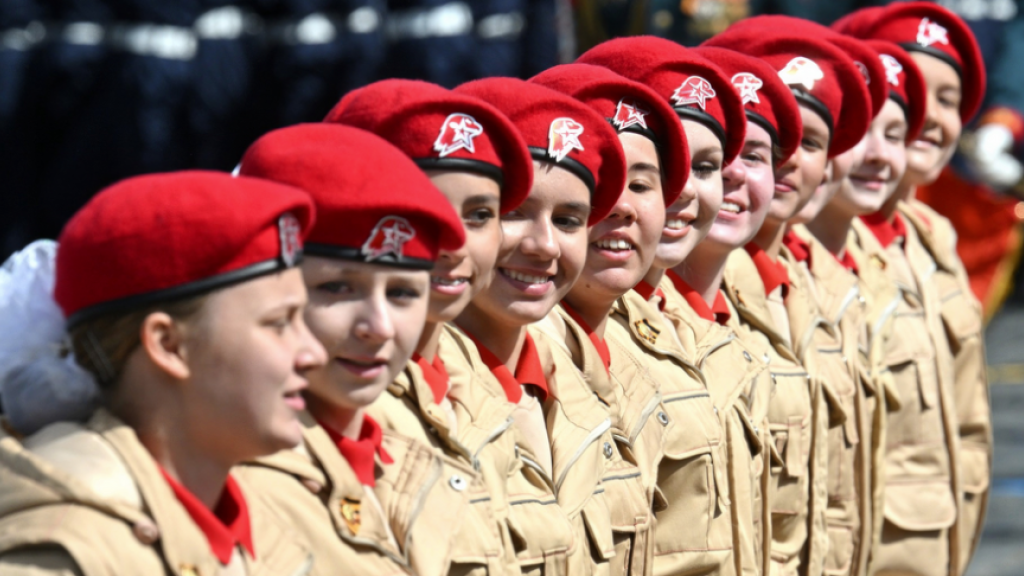
It is not just about stopping resistance in its tracks, but also about actively affirming the Kremlin’s line. A lot is therefore being done to prepare the younger generation to serve the state and its interests — including with weapons. In Yunarmiya, an organization founded in 2016 for children and young people between the ages of 8 and 18, the members’ sand-colored uniforms and red berets convey a military appearance. Boys and girls learn how to line up for roll call, stand at attention, take machine guns apart and put them back together again — blindfolded. They are invited by official organizations and courted as the future elite who are supposed to guarantee national security. According to their own figures, over 1.7 million minors have gone through the military-inspired education program over the past ten years.
The “Movement of the First”, which was only founded in 2022 and enables participation from the first grade, has an even broader impact than Yunarmiya. A corresponding legislative initiative was symbolically submitted to the Duma on the day of the centenary of the founding of the former communist pioneer organization “Vladimir Ilyich Lenin”. Within just a few years, the number of members in the “Movement of the First” has risen to nearly 14 million (although they should actually be referred to as participants, as there is no official membership). Parents must formally give their consent before their children reach the age of 14, but this often seems to be overlooked in everyday school life. The daughter of one of the people I spoke to, for example, automatically found herself in the ranks of the “First” without being asked, simply because she had taken part in several school Olympics.
Children and teenagers are enticed with leisure activities: sportings, commemorative events to preserve the memory of glorious Russian history, the publication of their own newspapers or magazines, etc. The aim is to learn the basics of military patriotism in a playful way, with theoretical instruction and practical exercises complementing each other. There is no formal obligation to participate, but as the example above shows, boundaries are fluid.
The Oscar-nominated British documentary Mr Nobody against Putin vividly demonstrates how military patriotic education found its way into everyday school life after 2022. Lining up for roll call, marching with the Russian flag or admiring experienced front-line fighters who are supposed to make the business of death appealing to potential soldiers — there are plenty of lessons like this.
The take-away for children and teenagers, however, is another story. One interviewee reports that her daughter now simply switches off when it comes to the Great Patriotic War. Teachers are not necessarily convincing when they simply implement their superiors’ instructions to tick certain boxes. As one teacher reports, participation in state-sponsored activities earns ‘bonus points’ and that is likely why many parents support their children’s participation.
Militarism does not even stop at pre-school education. In the run-up to 23 February, the “Defender of the Fatherland Day”, participants in the war appeared before them. At the beginning of February, a number of kindergartens proudly claimed on social media that they had organized puppet theatre performances, such as the one about the rabbit who volunteers for the army. The characters at the center of the show are proud of the fact that the troupe has brought them together.
Schools undoubtedly have an important educational mission, but they only represent part of reality. The programs offered by the “firsts” are often unable to grab their target groups emotionally, whereas propagandistic films do not have the goal of education do. They explore how the emotional connection of the younger generation to a heroic war narrative can be effectively linked. The animated film “The Little T-34”, developed by students and lecturers at the Moscow Film Academy, which portrays the life and development of a baby tank, is just one of many examples.
In any case, there are plenty of scenes on social networks that demonstrate the extent to which a section of the younger generation has now internalized the omnipresent military tone. This goes so far that uniformed teenagers recently marched in front of the altar with firearms in a church not far from Moscow. This also illustrates how deeply militarization has become ingrained in Russian society.