The smoke of capitalism
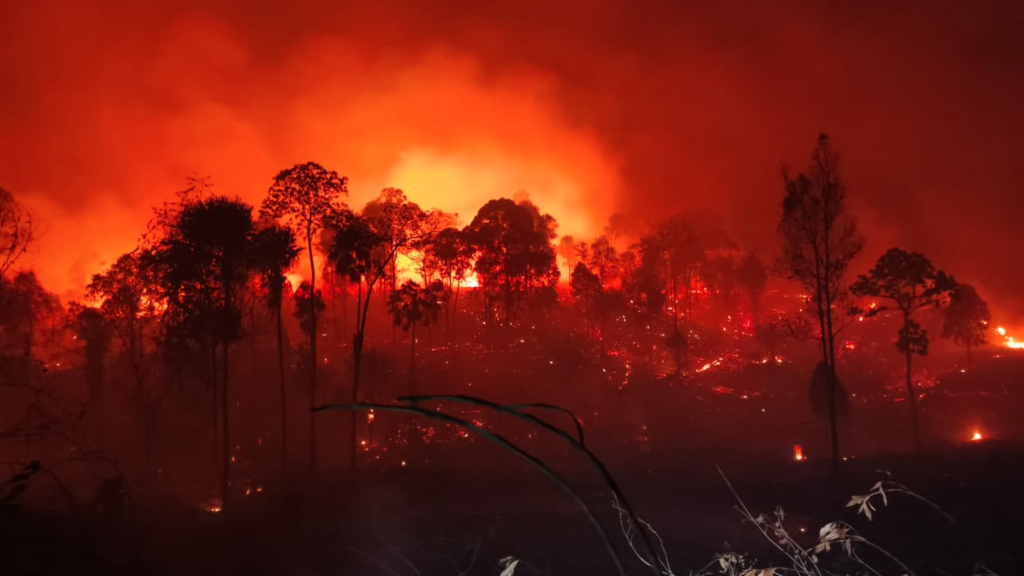
Each year, the islands of Indonesia witness colourful apparitions, oscillating between red and yellowish-brown hues demarcating the geographical locations of tropical forest fires. For nearly a month between August-September, Indonesia consumed the smoke of capitalism through forest fires and exported it to neighbouring countries without their consent. In the fires’ aftermath, tropical forests were converted into monoculture plantations, dominated by oil palm. Corporate and state occupation, facilitated by the fires, forms part of the circuit of capital accumulation within this commodity infrastructure.
During the 1960s, about 80% of Indonesia’s territory was covered in forest. However, the country experienced the world’s highest rate of deforestation, triggered by fires and illegal logging. Land became an asset that could not be removed; transforming it into a productive commodity required a regime of exclusion. By the beginning of the 21st century, Indonesia had lost 12 million hectares of tropical forests.
Various companies and groups have monopolised Indonesia’s forest, controlling 60 million of a total of 130 million hectares. Corporate control of forests includes Forest Concession Rights covering 25 million hectares granted to 303 companies, and Industrial Plantation Forests (HTI) covering 10.1 million hectares granted to 262 companies. Furthermore, oil palm plantations cover 12.3 million hectares and are controlled by 1605 companies, while mining concessions covering 3.2 million hectares are controlled by 1755 companies, highlighting extreme inequality in land control.
Forests have been regarded as state assets since the Dutch colonial government implemented domein verklaring (free state domain), which stipulated that all land for which no one could prove ownership was state property. The transition towards forestry capitalism is becoming increasingly evident. Its primary driver is extensive extractivism through forest-based collective violence as a form of accumulation by dispossession within the state’s version of development. This is all designed to ensure the capitalist territorial logic of power remains constantly interconnected and interwoven. The smoke from forest fires marks the start of this process.
There is no safe haven, as anger mounts among Indonesia’s 280 million people, as well as in neighbouring countries forced to endure the export of unwanted haze. Responsibility has once again been shifted onto the individuals who suffering, rather than those fuelling the fires. This reveals the limitations of capitalist climate policy and explains why neoliberal solutions are so out of step with the scale of the crisis: safety must not interfere with profitability. That contradiction is resolved by shifting responsibility back onto the citizens who breathe in the smoke — the first touch of the palm oil capitalist economic cycle.
The impact of climate change remains a subject of considerable debate. This is a capitalist scheme: fossil fuel industry-funded disinformation and dependence on palm oil create political uncertainty while simultaneously ensuring the occurrence of forest fires in Indonesia. Palm oil is found in half of the products sold in supermarkets and in biofuels. About 50% of the world’s supply is grown in Indonesia, mostly on large plantations. Government land concessions granted to palm oil companies, totaling 22 million hectares, cover a third of Indonesia’s agricultural land, not to mention independent plantations operating under different land concession schemes.
Forest fires, which are used to clear land for oil palm plantations, demonstrate the importance of a rules-based global order. If rules can be bent, suspended or selectively interpreted whenever strategic interests demand, we are entitled to ask: whose order is this, and whose interests are ultimately served by these rules, such that fires become part of the global supply chain for certain commodities?
Following the occurrence of forest fires in Indonesia, there is a possibility that land use changes may be legalised through the implementation of Ministry of Forestry Regulation No. 448 of 2020. This particular regulation designates “authoritative land” under the forest area release policy scheme, thereby rendering them legally permissible for oil palm, food crops or mining activities. Moreover, in the event of a forest fire occurring in a production forest area, the designation of a “coordinated land” can facilitate its conversion to oil palm or food crop plantations. Both these factors suggest that forest fires are state-sponsored, as a straightforward and cost-effective method of land clearance.
Indonesia is the fourth-largest emitter of greenhouse gases, surpassed only by China, the United States, and the European Union. This significant contribution to global emissions can be attributed to several key factors, including substantial deforestation, frequent peatland fires and extensive coal usage. In Indonesia, the access of mining oligarchs and palm oil tycoons to policy-making, government insiders, financial institutions and opinion leaders is facilitated by the state and public officials. These entities are lauded by an international community mesmerised by the illusory image of development and growth. Within the context of a capitalist rent-seeking economy, this dynamic is seen as fundamental for capital accumulation.
The process by which less developed or peripheral countries, such as Indonesia, are steered towards integration into the neoliberal system has been shown to result in deforestation and chronic ecocide. These countries become locked into a relationship of dependency with “developed” nations and the international financing of the global economy, caught in a debt trap and lopsided trade agreement. The maximisation of production of extracted primary commodities, such as palm oil and coal, extracted from tropical forests across the planet, including in Indonesia where the prices of these non-value-added goods are kept low, serves to reinforce global supply chains despite causing environmental and social damage.
Below we will examine how the palm oil industry is embedded within capitalism — a process that begins with forest fires. Indonesia accounts for as much as 55% of the global palm oil market. Palm oil represents projects that will always exist as a defensive measure, hiding behind nationalism and economic development to remain part of the global supply chain of neoliberal capitalism, while securing policies they desire within the Roundtable on Sustainable Palm Oil (RSPO), Indonesian Sustainable Palm Oil (ISPO) and COP forums.
The concept of high conservation value is regarded as a Trojan horse of deceit, employed by palm oil companies to mislead unsuspecting communities and governments. This is done to meet the controversial assessment criteria of the RSPO and ISPO as a form of pseudo-conservation within the sustainability criteria for palm oil. The outcome is that palm oil companies gain access to North American and European markets. These standards offer a certain degree of transactional flexibility, adapted to prevailing local, national and regional political directions shaped by neoliberal policies. Through agreements such as the European Free Trade Association (EFTA), these countries aim to import only “sustainable” palm oil at lower tariffs. But what sort of “sustainability” can be offered by a commodity production system that begins with the burning of tropical forests and peatlands — the lungs of the world?
Under President Prabowo Subianto (2024–29), Indonesia has become a major force within the global capitalist system in producing palm oil and minerals such as coal and nickel, even though its domestic policies are admired even by some nationalist left-wing circles. The government’s response to palm oil resulting from forest fires will invariably feature nationalistic rhetoric about the economy and job creation, while also invoking Indonesia’s territorial integrity. What we are witnessing today is the consequence of public policy choices, not the supposedly neutral forces of the market or technological change. To speak of a natural or pre-political economic system is a profound misunderstanding of historical and social reality.
Following in the footsteps of his predecessor, President Joko Widodo or Jokowi (2014–24), Prabowo has never been willing to disclose land data, particularly regarding oil palm plantations and mines, as required by the Supreme Court in 2017, as well as Indonesian Law No. 14/2008 and a decision by the Public Information Commission No. 057/2015 to disclose the names of landowners, locations, land areas and maps of the regions — including landowners affected by fires. How can we prevent forest fires, improve the climate and reduce emissions, if the factors causing the damage are ongoing? Forest fires as a climate disaster represent an epic battle against smoke, a stark manifestation of global neoliberal corporate criminality and state capitalism.
How do those responsible for forest fires evade Indonesian law? Corruption, collusion and cronyism are rife, creating systemic impunity between corporations, particularly palm oil companies, and the state. This is facilitated by regulations protected by the House of Representatives and enforced by the police and military. There is also a lack of organised resistance and action against deforestation and the palm oil industry. We are confronted with the central issue of climate change, inextricably linked to the development of palm oil plantations that have been constructed on a foundation of capitalism and further enhanced by imperialist elements, resulting in the preservation of extinct species. The haze from forest fires blurs the landscape, creating a faint silhouette.
The damage caused by those who set forest fires with impunity is severe. This is further compounded by the spatial concentration of companies competing for concession licences and the subsequent flow of capital, thereby establishing a mutually beneficial relationship that is challenging to dislodge, particularly when major corporations support campaigns for local, national and even presidential elections as part of their corporate strategy.
Electoral democracy and regional autonomy, achieved through the 1998 reforms, conceal another side to campaign financing: one that bypasses strict regulations on corporate political spending and opens the door to virtually unlimited spending and undisclosed “black money,” which dominate Indonesia’s current political system — a system in which the palm oil and mining oligarchies wield immense influence. A palm oil tycoon can outspend millions of people to control their political future.
During the 2019 presidential election, a “palm oil is good” campaign emerged, backed by Jokowi’s incumbent administration. As in 2024, Jokowi faced off in 2019 against Prabowo — a former military general with a history of human rights violations and a business owner who controls thousands of hectares of land in Indonesia, particularly in Kalimantan. Prabowo finally won in 2024, with Gibran Rakabuming — Jokowi’s eldest son — as his running mate. Jokowi and Prabowo are much the same: both are backed by tycoons who operate large-scale land holdings for oil palm plantations and mining across Indonesia under various company names. Consequently, any moratorium is nothing but a paper tiger, while continuing land reform and deforestation serves merely as a populist slogan.
Prabowo is a fan of oil palm, which he refers to as a “miracle crop” and strategic national commodity. He is intent on expanding oil palm cultivation in Papua beyond the current level, which has already reached 250,000 hectares. He states the claim oil palm causes deforestation is a false and cruel accusation, as oil palm is also an evergreen tree and no different from other forest trees.
Fuelled by antek asing (foreign agent) rhetoric, the harassment of activists and civil society organisations is set to continue. This has become a favoured tactic of Prabowo’s administration to discredit critics and counter public sentiment regarding foreign aid in the wake of natural disasters, citing nationalism and national resilience as justifications. This term emerged when floods and landslides struck Sumatra in 2025 as a result of deforestation and expanding oil palm plantations, leaving thousands dead and hundreds of thousands affected.
However, during the 2026 forest fires — when the effects of smoke had already reached neighbouring countries such as Malaysia, Singapore, Brunei and the Philippines, and amid fears of international threats and sanctions — assistance to extinguish fires from Japan and Malaysia was finally accepted. Furthermore, Prabowo is reviving the colonial term londo ireng (Black Dutchman), thereby importing a dangerous authoritarian logic that trades democratic accountability for loyalty tests and targets critics in the media, including those questioning the government’s defensive response to these forest fires.
Indonesia has responded to the forest fires with a spirit of adaptation, viewing them as an inevitable disaster to be weathered to ensure investment flows in promptly. Furthermore, the farcical measures to tackle the fires — such as using manual fire extinguishers and even the president’s suggestion to use cassava flour — along with allowing children to remain in school so that the president’s “Free Meal Nutrition” scheme, which has caused tens of thousands of food poisoning cases, can continue to run, have enraged the people. The forest fires have exposed the limitations of capitalist climate policy as a palliative for a “normality” that must be dismantled, and illustrate why neoliberal solutions are out of step with the scale of the emerging crisis.
In tackling forest fires, Prabowo appointed Haji Isam — a palm oil tycoon and mining oligarch — as head of the Kalimantan Forest Fire Extinguishing Task Force. However, following public controversy, this was changed to a private entity appointed as a technical adviser, which also provided operational funding for firefighting amounting to US$500,000. As well as controlling thousands of hectares of coal mines in Kalimantan with a turnover of 400,000 tons a month, Haji Isam owns 17,000 hectares of oil palm plantations in South Kalimantan and 22,782 hectares in East Kalimantan, and is currently expanding into Papua.
Haji Isam is a business owner who purchased 2000 excavators from China to clear tropical forests and peatlands in Papua for Prabowo’s 2.25 million-hectare “food estate” project, intended for rice production for food and sugarcane for bioethanol. However, these commodities may change, as both will struggle to be productive given Papua’s climate and soil conditions. They are likely to result in failure similar to the one million hectare food estate during the Jokowi era. Consequently, the alternative scenario would be to replace them with oil palm, under the pretext of producing bioethanol and reducing dependence on fuel imports, while also appealing to nationalist sentiment, as Indonesia has set a target of 20% bioethanol (E20) in petrol by 2028 and projects energy self-sufficiency.
A total of 25 palm oil holding companies are owned by prominent figures within the palm oil industry, 20 of which are listed on the stock exchange. These companies continue to successfully obtain capital by issuing shares. Financial institutions have provided substantial capital to palm oil conglomerates controlled by these tycoons over the past two decades, through direct lending and by underwriting the shares and bonds sold to investors. Key banks providing palm oil financing are the Oversea-Chinese Banking Corporation (Singapore), CIMB Group and Malayan Banking (Malaysia), Bank Negara Indonesia and Bank Mandiri (Indonesia), Credit Suisse (Switzerland), Rabobank (Netherlands), BNP Paribas (France) and Citigroup (US). Consequently, financial capital has supported the palm oil industry, and as the land for these plantations is acquired through the clearing or burning of tropical forests, it indirectly contributes to forest fires, the smoke from which returns without provoking any significant outrage against Indonesia.
Neoliberalism’s crisis, particularly after the 2008 economic crash, has further strengthened the search for alternative state approaches to accumulate the fruits of production through state intervention and control, in the form of state corporations or state-owned enterprises (SOEs). The relationship between the state and the mode of economic production has become increasingly close. The state no longer merely acts as a regulator through legislation, but also features as a player in economic production activities. To accommodate the palm oil sector, in 2025 Prabowo established an SOE called PT Agrinas Palma Nusantara, led by a military general, which controls 1.7 million hectares of palm oil plantations — an area set to expand, partly through the reclamation of forest areas, including those burnt or deliberately set alight.
Its resource wealth is not an intrinsic or natural quality, but a constellation of materialities, relationships, technologies and discourses that must be harmonised to make it a viable investment. At present, we urgently need to scrutinise the political and legal structures that amplify and protect capital at the expense of communities and forests. If elected officials fail to establish ecological justice, the common good and equality before the law, then it matters little who wins the presidential, parliamentary or local elections, because an oligarchy is far easier to create and maintain when insulated from political pressure. We must wait to see how these fires will end but, in the meantime, we have every right to be concerned about the direction Indonesia is heading without its tropical forests. The fires have scorched the lungs of the Earth and the smoke is already in our lungs.
Frans Ari Prasetyo is an independent researcher, planner and photographer whose work explores landscape politics, spatial planning and grassroots movements in Indonesia. His research focuses on the political ecology of land use, infrastructure development and the struggles of marginalised communities, including youth movements, underground collectives and rural populations affected by state and corporate development projects.