Pax Silica: A plan for peace or preparations for war?
First published at Workers Make Possible.
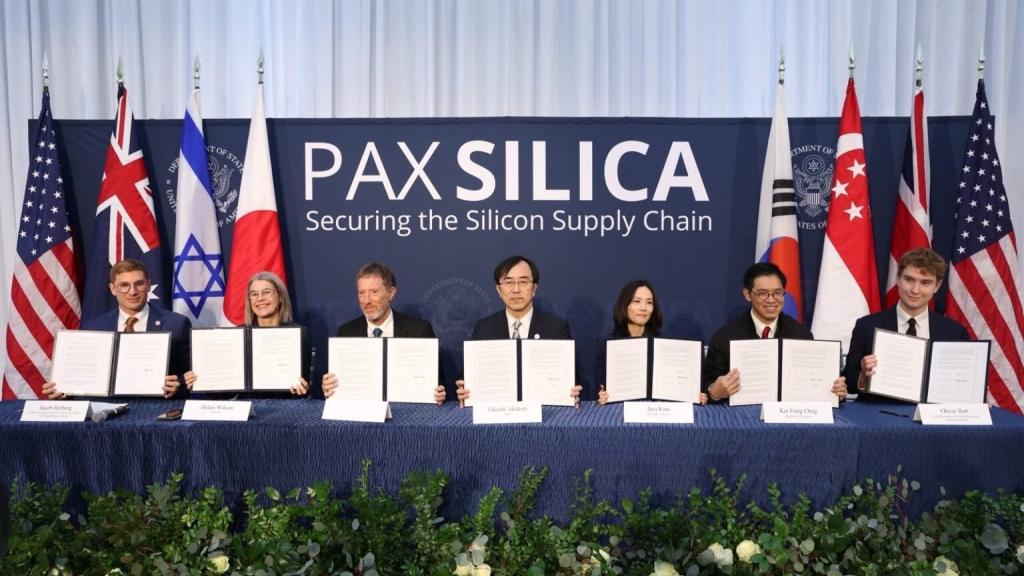
On the 12th of December 2025, at the close of the inaugural Pax Silica Summit, seven countries signed the Pax Silica declaration in Washington, D.C.: the United States, United Kingdom, South Korea, Japan, Australia, Israel, and Singapore. Following a second summit in June 2026, the number of signatories grew to 24.
According to the text of the declaration, these signatories have committed to advancing “mutual prosperity, technological progress, and economic security”, through “shared efforts on investment security practices, infrastructure, and incentives.”
This initiative signals an apparent push for both greater cooperation between the US, its partners and client states, and for their deeper integration into the US technology stack.
As our newspaper of record, the Straits Times reported on the declaration in similarly diplomatic language, calling it an “agreement to collaborate on artificial intelligence (AI), tech supply chains and infrastructure”. Later in 2026, in an interview with the Straits Times, US Under Secretary of State for Economic Affairs Jacob Helberg claimed that Pax Silica does not aim to “ringfence a US-led AI supply chain of trusted partners against China”.
Other media outlets have framed the initiative in more antagonistic terms. For instance, a report from the Washington Post cautions the reader that “Breaking China’s grip on critical minerals opens up a world of opportunities — and risks” and states that the initiative is “aimed at countering China’s dominance in both the mining and refining of several critical minerals, which presents a threat to both U.S. national security and economic security”.
Similarly, the Center for European Policy Analysis poses the question, “Pax Silica — Can it Stop China?”, and reports that the initiative is “framed as a response to ‘countries of concern,’ implicitly, but not naming the target as China”.
Pax Americana, past and present
Is Pax Silica an innocuous agreement for economic cooperation, or an instrument of domination? To understand what it is meant to accomplish, we must consider the context from which it emerges.
Since 2018, the US has been putting pressure on the Dutch government to prevent semiconductor lithography tool manufacturer ASML from exporting its most advanced machines to China. The Biden administration’s 2022 CHIPS Act sought to reverse decades of US semiconductor firms offshoring, while also placing restrictions on funding recipients “expanding semiconductor manufacturing in China”. The US Department of Commerce then banned the export of several advanced Nvidia chips to China in 2023. Pax Silica fits into these recent developments, as the USA’s latest effort to kneecap potential technological rivals.
Such efforts are not new, as the US-Japan chip war in the 1980s demonstrates. In the face of an ascendant Japanese semiconductor manufacturing sector, their US counterparts, in concert with the Reagan administration, successfully pressured the Japanese government to sign the 1986 US-Japan Semiconductor Agreement. The agreement’s US-set price controls, forcing open the domestic Japanese market, and threat of sanctions would ultimately play a key role in the shrinking of Japanese market share from 75% to 20% between 1987 and 2001.
Returning to the present day, we must also consider the belligerence of the second Trump administration. It began a trade war with China, ramped up its illegal, unilateral economic siege of Cuba, and illegally invaded Venezuela to abduct its sitting President. It continues to escalate tensions with China over the issue of Taiwan, and persists in arming and supporting Israel, despite that government’s referral to the International Court of Justice for plausibly committing genocide against the Palestinian people. It is now waging an illegal war of aggression on Iran, during which it has openly targeted civilians, boasted of offering “no quarter”, and threatened the death of an entire civilisation — all of which are war crimes, or crimes against humanity.
However, it must also be recognised that Trump is not an exception. His administration’s policies are not a significant departure from the imperial adventurism of previous US administrations. The difference is that the Trump administration does not care as much about concealing its intentions with highfalutin rhetoric about freedom and human rights: it is comfortable with nakedly fascistic proclamations.
By considering both the deeper historical context, as well as current events, it becomes increasingly difficult to accept the claim that Pax Silica is no more than a framework for economic cooperation. Instead, it would seem that the US is focused on its technological hegemony by securing access to territories, resources, technology and infrastructure across the 5-layer AI stack. It is also increasingly clear that the US political and corporate leadership interprets China’s increasing technological development primarily as an existential threat to its supremacy. Partners in Pax Silica may stand to benefit from their increased integration into and collaboration with the US AI industry, but only insofar as such benefits serve the maintenance of US hegemony.
This is, in a way, announced in the name of the initiative itself. The US State Department describes “Pax” as a “historical term denoting peace, stability, and prosperity”. They would like us to imagine a ‘silicon peace,’ unburdened by history, by omitting a key detail: “Pax” refers to stability under the influence of a dominant military power.
In the words of the late historian and political scientist Michael Parenti, “Empires are often represented as creations of peace. They’re even given names of peace, right? Pax Romana, the Roman peace. The Roman peace was a brutal, bloody world conquest... Pax Britannica and there’s even Pax Americana... Empires are often represented as bringing stability, justice, and prosperity to their subject peoples.”
What is Pax Silica, but an attempt to entrench Pax Americana through domination of the technological supply chain? If so, what are the dangers of wedding ourselves to this imperial project, and integrating ourselves into its technological architecture?
Straining sovereignty
Dr Govand Azeez of Macquarie University cautions, “Southeast Asia is rapidly embracing artificial intelligence, with governments, businesses and investors touting its potential to transform economies and deliver up to US$1 trillion in growth by 2030. But beneath this optimism lies a more uncomfortable reality: the region risks becoming structurally dependent on technologies it does not own or control.”
This point about technological sovereignty has larger implications for both economic and political sovereignty.
Countries and economies that are deeply integrated into a foreign technology stack become particularly reliant on foreign corporations, and vulnerable to political interference by foreign governments.
Singapore is already an established and important node in the global semiconductor supply chain, a position achieved through a combination of state industrial policy, favourable tax incentives, a relatively educated local workforce, the availability of low-cost labour power in nearby countries, and its geostrategic location. In fact, a recent Channel News Asia article reported that approximately 10% of the global supply of semiconductor chips and 20% of semiconductor equipment are produced in Singapore.
Significant foreign investment — particularly by US multi-national corporations — have contributed to the creation of substantial fixed capital in terms of factories and equipment, including Micron wafer fabrication plants (fabs), and Applied Materials’ research centre and manufacturing facilities. Fabless semiconductor companies like AMD, Qualcomm and Broadcom have also established local facilities, along with other European and East Asian companies like UMC, ST Microelectronics, NXP, VIS, Siltronic, Infineon and Toppan. Many of the largest US technology multi-nationals including Meta, Alphabet, Amazon, Google, Microsoft and OpenAI have substantial local research and development (R&D), logistics and procurement operations serving as a key node in the Asia-Pacific region.
Given that the local semiconductor and technology industries are dominated by foreign firms, this makes both the supply of materials and technology required and the demand for the products and services generated by these industries largely subordinate to decisions made overseas. That these industries also constitute a major proportion of the Singapore economy further increases the weight of foreign political pressure that can be exerted by, for instance, unilateral US action in the form of sanctions, export restrictions and/or tariffs, or even threats thereof.
The New Lines Institute, another DC-based think tank, also highlights that a “core objective of the plan is to ‘export the entire U.S. tech stack’ to secure allies and establish global dependency on U.S. technology ahead of competitors like China.”
“Global dependency” is about as ominous a phrase as they come.
Additional risks to national sovereignty have also been illuminated by recent events. The former Chief Prosecutor of the International Criminal Court (ICC) lost access to his Microsoft account in May 2025 after US President Donald Trump imposed sanctions on him, evidently in response to the ICC issuing arrest warrants for the Israeli Prime Minister and former Minister of Defence for alleged “ war crimes and crimes against humanity”. This incident has been cited as a key factor in European countries such as France, Germany and Denmark shifting away from dependency on US technology provided by companies such as Microsoft and Palantir in favour of open-source or indigenously-developed alternatives, as part of a move towards protecting digital sovereignty. The US has also suddenly and unexpectedly imposed 12.5% tariffs on 45 countries including Singapore on Jul 24, 2026, for a reported failure to ‘adopt and effectively enforce prohibitions on trade in goods produced with forced labour’, allegations rejected by the Singapore state.
As if to underscore these risks, based on a leaked draft of a letter from the US State Department, it was also reported earlier in August 2026 that the United States intends to compel nations around the world to choose sides. While the leaked letter is an unsent draft whose full contents have not been disclosed, it would appear that the United States has a simple message to the nations of the world: You can submit to our ‘silicon peace’, or participate in the World Artificial Intelligence Cooperation Organisation, but not both.
A balanced pragmatism has long been a central feature of Singapore’s foreign policy. As recently as this June, speaking at a dialogue session as part of the Singapore Press Club’s Eminent Speaker Series, prime minister Lawrence Wong reiterated this position, stating, “We want to have an active multi-engagement approach towards bringing all the key parties and having all of them have stakes in Southeast Asia.”
The engagement that Pax Silica represents is already facing widespread and vocal opposition in the Philippines, our fellow ASEAN nation, whose sovereignty is even more gravely challenged through Pax Silica.
We have to ask ourselves: is Pax Silica compatible with our independent foreign policy, and the peaceful, stable development of Southeast Asia? And if the US more openly demands subordination to its belligerence, should the people of Singapore not question our participation in this scheme?
Nicholas is a mechanical engineer.