The far right as a global phenomenon and the ecosocialist alternative
First published at Amandla!.
In recent years, we have seen a spectacular rise in reactionary, authoritarian and/or fascist far-right movements across the globe. They already govern half of the world’s countries, including Trump (USA), Modi (India), Orbán (Hungary), Erdogan (Turkey), Meloni (Italy), Netanyahu (Israel), and, recently, Milei (Argentina). Elsewhere, they have recently governed Brazil (Bolsonaro) and are serious candidates for power with the National Rally (France), the AFD (Germany), the Republican Party’s Kast (Chile), etc. And Putin’s regime in Russia is not very far from this model.
In each country, the far right has its own characteristics: in many cases (Europe, the United States, India), the ‘enemy’ — i.e. the scapegoat — is the Muslims and/or the immigrants; in some Muslim countries, it is some religious minority (Christians, Jews, Yezidis). In some cases, xenophobic nationalism and racism predominate; in others, religious fundamentalism, or hatred of the Left, feminism, and homosexuals.
Despite this diversity, there are some common traits shared by the majority, if not all: authoritarianism, integral nationalism — ‘Deutschland über alles’ and its local variants ‘America First’, ‘O Brasil acima de tudo’, etc; religious or ethnic (racist) intolerance; and police/military violence as the only response to social problems and crime. The characterisation as fascist or semi-fascist may apply to some, but not to all. Enzo Traverso uses the term ‘post-fascism’, but I believe that neo-fascism is the best term to describe both the continuity and the novelty of the 21st-century far right.
Neo-fascist not ‘populist’
The concept of ‘populism’ is used by some political scientists, the media and even part of the Left. But it only serves to sow confusion. While in Latin America from the 1930s to the 1960s the term corresponded to something relatively precise — Vargasism, Peronism, etc — its use in Europe since the 1990s has become increasingly vague and imprecise.
Populism is defined as “a political position that sides with the people against the elites”. But this applies to almost any political movement or party! This pseudo-concept, applied to far-right parties, leads — intentionally or unintentionally — to legitimising them. It makes them more acceptable, if not sympathetic—who is not for the people against the elites? — while carefully avoiding terms that cause offence: racism, xenophobia, fascism, far right. ‘Populism’ is also used in a deliberately misleading way, by neoliberal ideologues, to conflate the far right and the radical Left. They are characterised as ‘right-wing populism’ and ‘left-wing populism’, since they are opposed to liberal policies, ‘Europe’, etc.
Climate change rejected
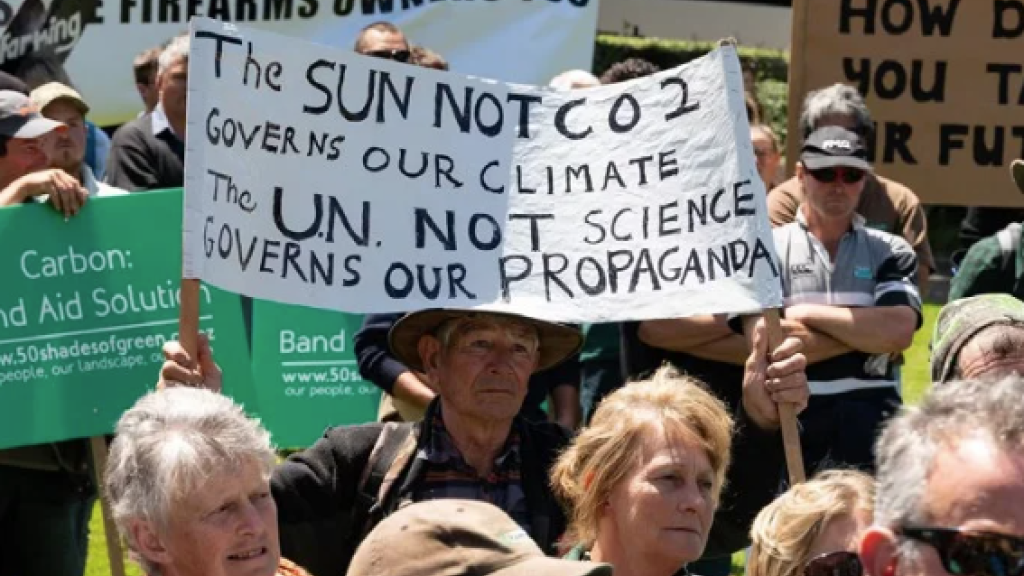
One common element in most of these neo-fascist governments or movements is negationism — the refusal to acknowledge the ecological crisis and climate change. In spite of the overwhelming scientific evidence, they persist in denying, or simply ignoring, the reality of global warming. Donald Trump is only the most vociferous and vulgar proponent of this trope, which is not only an ideology but an ecocidal praxis.
This is illustrated again by Trump, who is totally devoted to the unlimited development of fossil fuels. These suicidal politics represent the interests of the fossil oligarchy — the capitalist sectors linked to the production of oil, coal, gas, chemicals, plastics, cars and airplanes, etc. Their short-sighted perspective is exclusively focused on immediate opportunities for profit and accumulation.
Back to the 1930s?
History does not repeat itself; we can find similarities or analogies, but current phenomena are quite different from past models. Above all, we do not—yet—have totalitarian states comparable to those of the pre-war period. The classic Marxist analysis of fascism defined it as a reaction by big capital, with the support of the petty bourgeoisie, to the revolutionary threat posed by the labour movement. One may wonder whether this interpretation truly accounts for the rise of fascism in Italy, Germany and Spain in the 1920s and 1930s. In any case, it is not relevant in today’s world, where there is no ‘revolutionary threat’ anywhere.
There are other significant differences with the fascism of the past: neo-fascist regimes are devoted to neoliberalism, not to corporate-national economies. And they are involved in ecocidal activities on a much larger scale than in the 1930s.
What is the explanation?
It is difficult to offer a general explanation for such diverse phenomena, which are the expression of contradictions specific to each country or region of the world.
One ‘explanation’ that should be rejected is that it is linked to waves of migration, particularly in the US and Europe. Migrants are a convenient pretext, a useful tool for xenophobic and racist forces, but they are by no means the ‘cause’ of their success. Moreover, the far right is thriving in many countries—Brazil, India, etc. — where immigration is not an issue.
The most obvious and undoubtedly relevant explanation is that capitalist globalisation — which is also a process of brutal cultural homogenisation—produces and reproduces, on a global scale, forms of ‘identity panic’ (a term coined by Daniel Bensaïd). This leads to nationalist and/or religious intolerance and fosters ethnic or religious conflicts. The more nations lose their economic power, the more they proclaim the immense glory of the ‘Nation Above All Else’.
Some of these explanations are useful, but they are insufficient. We do not yet have a comprehensive analysis of a phenomenon that is global and is taking place at a specific moment in history.
How can we fight back?
Unfortunately, there is no magic formula. Bernie Sanders’ call for a Global Anti-Fascist Front is an excellent proposal. At the same time, we must build broad coalitions in defence of democratic freedoms in every country affected. This is also an ecological imperative: prevent the rise of negationist and ecocidal governments, or when they are in power, resist their destructive politics.
But we must also take into account that the capitalist system, especially in times of crisis, constantly produces and reproduces phenomena such as fascism, coups d’état and authoritarian regimes. The root of these tendencies is systemic, and the alternative must be radical; it must be anti-systemic. In 1938, Max Horkheimer, one of the leading thinkers of the Frankfurt School of Critical Theory, wrote, “If you don’t want to talk about capitalism, you have nothing to say about fascism.” In other words, a consistent anti-fascist is an anti-capitalist.
This is more relevant than ever today, when the active destruction of the environment and global warming are the inevitable consequences of the expansive logic of the capitalist system. If we want to avoid ecological catastrophe, the only way is to look for anti-systemic proposals, such as ecosocialism.
Ecosocialism the way forward
Ecosocialism is an attempt to provide a radical, civilisational alternative, based on the basic arguments of the ecological movement and of the Marxist critique of political economy. It counters capitalism’s destructive idea of ‘progress’ with an economic approach guided not by money or economics, but by social needs and ecological balance. This dialectical synthesis is attempted by a broad spectrum of authors (including Joel Kovel and John Bellamy Foster). It is at the same time a critique of ‘market ecology’, which does not challenge the capitalist system, and of ‘productivist socialism’, which ignores the issue of natural limits.
Ecosocialism has the potential to bring together social and ecological movements, peasants, indigenous peoples, youth, women and workers, in the resistance against neo-fascist negationism and environmental destruction.
An ecosocialist transformation is impossible without public control over the means of production and planning; that means public decisions on investment and technological change. These must be taken away from the banks and capitalist enterprises to serve society’s common good. Socialist planning is grounded in democratic and pluralist debate, on all levels where decisions are taken: different propositions submitted to the people, in the form of parties, platforms, or other political movements, and delegates elected accordingly. However, representative democracy must be completed — and where necessary corrected — by forms of direct democracy, in which people directly choose among options on major issues at the local, national, and, later, global levels.
The passage from capitalist ‘destructive progress’ to socialism is a historical process, a permanent revolutionary transformation of society, culture and ways of thinking. This transition would lead not only to a new mode of production and an egalitarian and democratic society, but also to an alternative way of life—a new ecosocialist civilisation, beyond the reign of money, beyond consumption habits artificially produced by advertising, and beyond the unlimited production of commodities that are useless and/or harmful to the environment.
Such a process cannot begin without a revolutionary transformation of social and political structures, and the active support of the vast majority of the population for an ecosocialist programme. The development of socialist consciousness and ecological awareness is a process in which the decisive factor is people’s own collective experience of struggle, from local and partial confrontations to the radical change of society.
Michael Löwy is a Franco-Brazilian sociologist. Emeritus Research Director at the CNRS (National Centre of Scientific Research), Paris, and author of, amongst others, Ecosocialism: A radical alternative to capitalist catastrophe.