Navigating Kurdish unity: An internationalist perspective
First published in Turkish at Jineolojî. English version published at News From Kurdistan.
When Jineolojî Magazine asked me to write an article on Kurdish unity, I wasn’t sure what to say. Although I have long supported the Kurdish struggle against oppression, I am very wary of anything that opens up the possibility of ethnic nationalism, or cuts across the wider struggle for a better world. One of the achievements of the revolution in Rojava has been the insistence on cultural freedom for all ethnic groups, not just the Kurds. How can this universality sit alongside the concept of Kurdish unity? And how can the representatives of a system that takes inspiration from the communitarian ideas of Murray Bookchin form a unity with the feudal and materialist society of Erbil?
But in these times, when people are being attacked for their Kurdishness, and prevented from living and celebrating their Kurdish culture, they should be able to expect the support of everyone with a conscience, and especially of other Kurds. And Kurdish unity against anti-Kurdish oppression can exist alongside other political allegiances.
Navigation of this type of relationship has been a constant theme of progressive political debate, and I thought I would take the opportunity to look at some historic examples, both beyond and within the Kurdish movement.
Lenin and the national question
Just over a century ago, when Kurdistan was being divided up by the victors of the First World War, political activists from all parts of the world were pinning their hopes on the new socialist future that was being pioneered in Russia. Those activists, who envisaged a path to real equality, would be astonished as well as devastated if they could visit us today; and among the things that would astonish them is the persistence of ethnic division and of interethnic prejudice and oppression.
The Russian empire was a patchwork of different nationalities, and how to bring these together in the struggle for socialism was a subject of vital debate. Positions taken at that time have echoed through the decades, with Lenin’s writings providing a source of reference — and of disputed interpretation.
For Lenin, ending capitalism and its class divisions was paramount, and to achieve this he insisted on a unified party. He repudiated the nationalism of dominant oppressor nations, and he was very wary of how nationalism can be used to divide people who otherwise have a shared class interest in dismantling existing hierarchies; but he insisted on national and cultural rights and freedoms in opposition to the coercion of the Russian empire.
An early testing of these ideas was brought about by the Jewish Bund, which adopted the concept of national-cultural autonomy put forward by the Austrian socialists. This has many similarities to the practices of multicultural representation developed in Rojava — especially in the form in which it was taken up by the Bund, which recognised national groups not tied to a distinct territory.
Jewish workers were relatively well organised, and the Bund was an important founding constituent of the Russian Social Democratic Labour Party (RSDLP). Profoundly anti-Zionist, it was established to combine the general socialist struggle with the struggle for Jewish civic rights, “because,” in the words of one of its founders,1 “Jewish workers suffer not only as workers but also as Jews”. However, by the time of the RSDLP’s second Congress in 1903, the Bundists were demanding a federal party structure and the exclusive right to speak in the name of the RSDLP on all Jewish affairs. After extensive debate, both Bolsheviks and Mensheviks rejected this demand for organisational autonomy. As Julius Martov argued, “We cannot allow that any section of the Party can represent the group, trade or national interests of any section of the proletariat. National differences play a subordinate role in relation to common class interests. What sort of organisation would we have if, for instance, in one and the same workshop, workers of different nationalities thought first and foremost of the representation of their national interests?”
However, that same congress agreed on a programme that included equal rights regardless of sex, religion, race and nationality; the right to mother tongue education at the expense of the state and the right to use the mother tongue in all local, public and state institutions; extensive local self-government; and the “right of self-determination for all nations included within the bounds of the state.”
Nine days after the October revolution, the right of nations to self-determination was passed into law. For Lenin, this was a democratic right like divorce, and “repudiation of the right to self-determination… means nothing more than defence of the privileges of the dominant nation and police methods of administration, to the detriment of democratic methods.” But, like with divorce, the desirability of separation depends on circumstances and was not the main focus of socialist politics.
Many of the demands of the Bundist programme became official policy in the early years of the Soviet Union. And Lenin argued that rather than alienate people from the class struggle by offending them it could be “better to over-do rather than under-do the concessions and leniency towards the national minorities.” However, while the Bolsheviks respected cultural difference and cultural rights, they saw their role as bringing peoples together rather than promoting difference. They dismissed the politics of national-cultural autonomy as a compromise with bourgeois nationalism, “which drugs the minds of the workers, stultifies and disunites them in order that the bourgeoisie may lead them by the halter”; and they embraced a modernism that replaced the shackles of custom and convention with a new proletarian internationalism. This made it difficult for them to comprehend the positive human values that are also part of traditional culture and community, and the solidarity and richness that traditional culture can bring.
As Trotsky explained (in his description of Marxism and the National Problem, which Stalin wrote under Lenin’s guiding hand) “One of the aims of the Austrian program of “cultural autonomy” was “the preservation and development of the national idiosyncrasies of peoples.” Why and for what purpose? asked Bolshevism in amazement. Segregating the various nationalistic portions of mankind was never our concern. True, Bolshevism insisted that each nation should have the right to secede — the right, but not the duty — as the ultimate, most effective guarantee against oppression. But the thought of artificially preserving national idiosyncrasies was profoundly alien to Bolshevism.”
The Turkish left
With the emergence of numerous Left movements in 60s and 70s Turkey, these debates, and Lenin’s copious writings, informed long and heated discussions; especially with respect to the Kurdish Question — the endemic oppression of Kurdish culture and denial of Kurdish identity that was built into the Turkish Republic from its first constitution of 1924. While Kurds increasingly viewed their position as that of an internal colony within the Turkish state, Left organisations were wary of falling into the nationalist trap. In emphasising working-class unity, they postponed addressing the very real and brutal oppression of the Kurds.
This position was expressed as political principle, but long-instilled prejudices persist even within Left organisations that proclaim socialist equality. Lenin observed (in 1919) “Scratch some communists and you will find Great-Russian chauvinists;” and these prejudices were shared by Stalin, who, despite his own Georgian origins, rolled back the freedoms of the early revolutionary years. Similarly, Turkish chauvinism and Kemalist nationalism are no strangers to the Turkish Left, even among people of non-Turkish ethnic backgrounds. The theoretical picture was complicated by the understanding that Turkey itself was a victim of American imperialist oppression, and this was allowed to obscure Turkey’s own role in oppressing the Kurds.
Of course, Turkish responses to the National Question were not uniform. In the early seventies, İbrahim Kaypakkaya, following in the footsteps of Lenin, argued that the Turkish left should not ignore the national oppression faced by Kurdish workers, and that the Communist Party’s historic failure to support the Kurds against national oppression had damaged the class struggle by encouraging Kurdish resentment towards Turkish workers. The Turkish state regarded him as the most dangerous revolutionary in Turkey, and he was murdered in a Turkish prison before he could see his 25th birthday.
But this understanding was far from general. The seventies saw the emergence of a plethora of left groups that together struggled against capitalism, US imperialism, and the brutal oppression of the Turkish state and its far-right thugs; but these groups also carried out intense, and sometimes violent, ideological battles between themselves. In her memoir of that period, Sakine Cansiz gave a vivid account of the intense debates taking place among the students; and she reserved her deepest criticism for fellow Kurdish students who aligned themselves with those Turks who disregarded the additional oppression suffered by the Kurds. She wrote: “the revolutionaries of an oppressor nation had different tasks from those of an oppressed nation. How could anyone try to make a revolution in another country, when they rejected revolution in their own country and ignored the concerns of their own people?”2
It was the failure of so much of the Turkish left to address the Kurdish Question that forced Abdullah Öcalan and the group around him to organise separately and, eventually, in 1978, to found the Kurdistan Workers’ Party (PKK) to struggle for an independent Kurdish socialist republic. Sakine Cansiz was a founding member. The PKK has never been exclusively Kurdish, but it has put Kurdish liberation at the centre of its struggle.
Rivalries and political difference in an international colony
The Kurdish condition was given sociological recognition in the 1980s by Turkish sociologist, İsmail Beşikçi, who described Kurdistan as an “international colony” ruled over by four different countries, Turkey, Iran, Iraq, and Syria. In each of those countries, Kurds are engaged in a different struggle. And within countries, there have been major, sometimes violent, disagreements between movements: in the 1990s, Iraqi Kurdistan saw three years of fratricidal civil war. Besides basic power rivalries, there are important differences in political ideology that no one wants to concede.
As the PKK grew, it promoted a Kurdish national consciousness that traversed international frontiers. At the same time, repression in Turkey, forced the organisation to relocate many of its operations to neighbouring states. Öcalan’s sojourn in Syria left a lasting legacy for Syrian Kurdish politics that inspired the Rojava revolution. In Iraq, initially with the agreement of the Kurdistan Democratic Party (KDP), the PKK established bases in the northern mountains, and these mountain regions became effectively under PKK control. However, relations with the other Iraqi Kurdish parties were often difficult and sometimes collapsed into military conflict. The KDP has joined Turkey in attacking the PKK, and in recent years has provided Turkey with information and logistical support.
Under Öcalan’s leadership, the PKK developed their own socialist ideology that continued to distinguish them from “bourgeois nationalists” such as the KDP. During the 1990s, the organisation shifted emphasis from national liberation by independence, to local autonomy that — it was hoped — would increasingly marginalise state control without challenging existing state boundaries. These ideas were further developed by Öcalan after his capture and imprisonment in 1999, and were put into practice in the creation of new social structures in Rojava, the Autonomous Administration created by the Kurds in north and east Syria in the political vacuum of the Syrian civil war.
In line with Öcalan’s thinking, Rojava adopted a system that ensured that all ethnic groups were represented, with leadership roles deliberately divided up between different ethnicities (as well as being shared between men and women). This organisation by ethnic group shares similarities with the cultural-national autonomy of the Austrian Marxists. Ethnic groups even organised their own units within the Syrian Democratic Forces. These practices can be criticised for solidifying ethnic difference, but for the short term, in today’s volatile Middle East, they helped ensure an island of peace and stability.
The Autonomous Administration always insisted that their system could provide a model of ethnic and religious coexistence for the whole of Syria, but the United States and Europe, through their support for and recognition of Al-Sharaa, ensured that this was not to be.
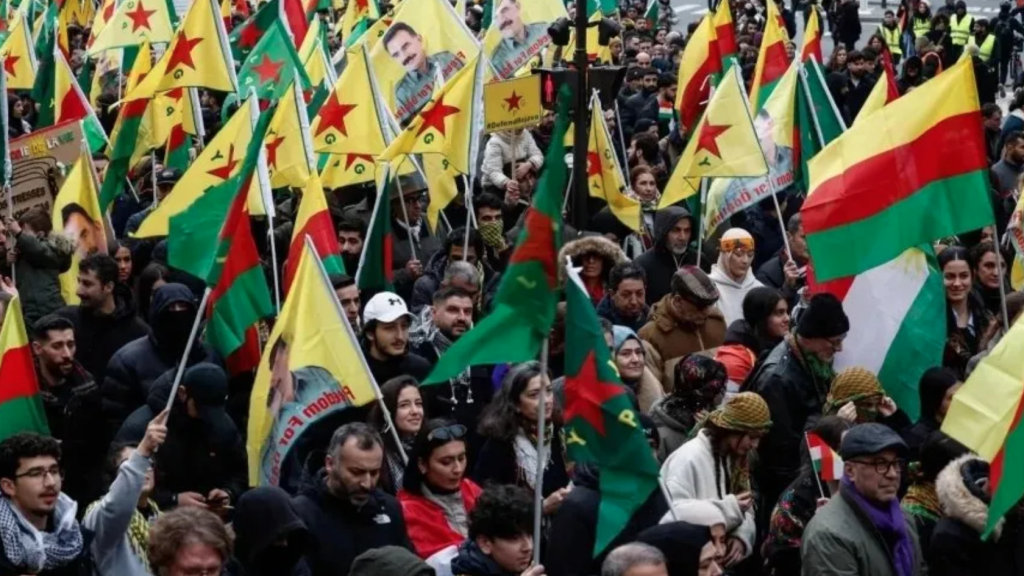
When Rojava came under attack from al-Sharaa’s forces, Kurds everywhere came out in support of their brothers and sisters in Syria. The call for Kurds from all four parts of Kurdistan to unite in self-defence was expressed in the phrases 2+2=1 and the Kurdish People are One. In the face of a largely indifferent world, Kurds created a movement too big to be ignored. Arguably, this put pressure on the United States to negotiate a ceasefire agreement between al-Sharaa and the Autonomous Administration’s Syrian Democratic Forces, though it couldn’t change the overall trajectory towards centralisation and control from Damascus.
The Autonomous Administration, which once controlled almost a third of Syria, has been reduced to its Kurdish core, and Arab tribes that once supported them quickly changed their allegiance to the new power in Damascus. Integration with al-Sharaa’s government is the only option on the table, and Syria’s Kurds have been left trying to salvage some of their hard-won social gains.
Within Syria, Kurdish political divisions are exemplified by relations between the Democratic Union Party (PYD), which follows Oçalan’s ideas and has dominated politics in the Autonomous Administration of North and East Syria, and the Syrian Kurdish National Council (EKNS), which takes a Kurdish nationalist position, has organisational and political links to the KDP in Iraq, and has been accused of working with Turkey. The EKNS lacked the PYD’s broad support, and chose not to take part in the structures of the Autonomous Administration. However, they had backing from the United States, who kept pushing for a power-sharing agreement that would have diluted the PYD’s radicalism.
With al-Sharaa’s rise to power in Damascus, EKNS and the PYD agreed to work together for Kurdish interests, but the new alliance has not survived much beyond its initial celebration of unity. While the Autonomous Administration has taken a principled stance against the Syrian Transitional Government’s mockery of democracy, EKNS has used the system, and their own Turkey friendly image, to get their members into positions of power. Kurdish politics has to be about more than getting individual Kurds into government.
Kurdish unity within a wider struggle
The history of Kurdish oppression has led many to put the blame on Kurdish division, and to attempt to bring Kurds together. They want to end the — sometimes-lethal — competition, and to see Kurds combine against their external oppressors.
No organisation has been more consistent in trying to unite Kurds in the cause of Kurdish freedoms than the Brussel’s-based Kurdistan National Congress, which was established in 1999, shortly after Öcalan’s capture, but builds on an older organisation. The Congress is a project of the Öcalan-inspired Kurdish Freedom Movement, but it attempts to live up to its name by working with Kurds of all different parties, other than the political right and the Islamists. With the notable exception of the KDP, most Kurdish parties respond to their initiatives and take part in their discussions.
Like all progressive movements for oppressed peoples, the Kurdish Freedom Movement must combine their fight for national survival with the general struggle for a fairer society — a struggle that has made them an inspiration to activists throughout the world. At the same time as combining with other Kurdish parties in the fight for Kurdish rights, they recognise the importance of inclusivity — both politically and tactically — and they continue to promote their own alternative to the dead end of capitalism and liberal democracy.
In negotiations with the Syrian Transitional Government, the Kurdish-led Autonomous Administration has attempted to act with and for all the peoples of their multicultural region, and also as part of a Kurdish alliance. In Iran, Kurdish parties have made links with other minorities; however, there has been worryingly little connection with progressive groups from the majority Persian community.
Disappointingly, outside a politicised core, the Movement’s approach is not well understood, as was made clear recently in Syria. Many Kurds reacted to the collapse of their hopes in Rojava by retreating into Kurdish nationalism and blaming the PYD ideology — especially the idea of working with other peoples. But nationalism alone cannot solve structural inequality, and can even risk replacing one oppression with another. Israel provides an extreme example of this, but any state based on one ethnic group risks mistreating others.
Kurdish unity against oppression can be vital. And in the right circumstances the fight for freedom can include a fight for independence, if this is inclusive and doesn’t prioritise one ethnicity. But no national unity should be at the expense of wider solidarity, or of the struggle for systemic change.