First International Anti-Fascist Conference: A political victory
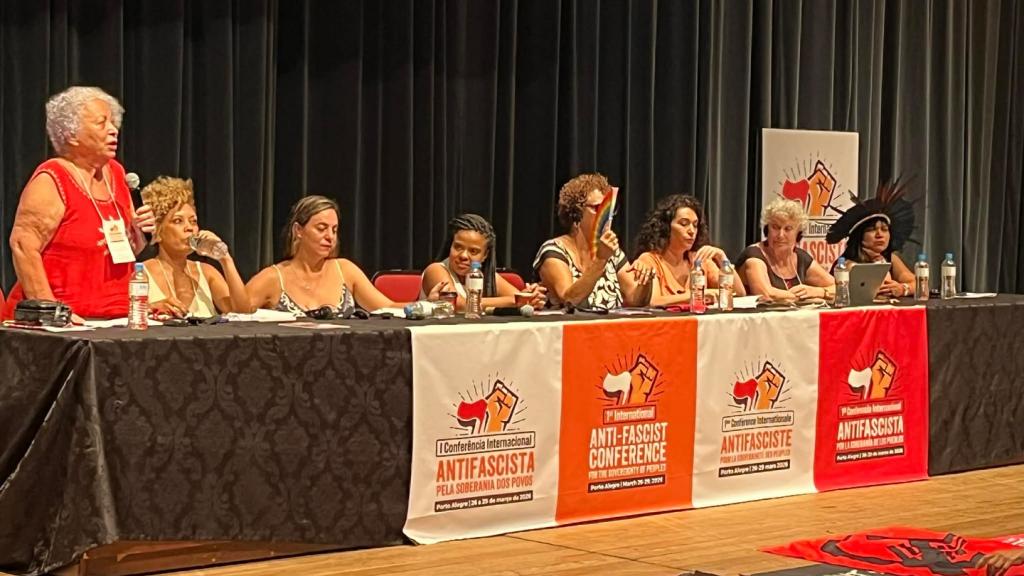
The 1st International Anti-Fascist Conference, held in Porto Alegre between March 26–29, has just concluded. This is not a complete assessment, but some initial thoughts on the enormous success of the conference.
The figures speak for themselves. The opening march drew about 7000 people, evoking Porto Alegre’s tradition of struggle, and in particular its connection to the alter-globalization movement and the World Social Forum. It was an initiative that cut against the still-dominant paralysis on the left, demonstrating that mobilisation is possible. It also laid the groundwork for building upon this process.
There were 4000 registered participants, 11 thematic panels, a forum featuring government representatives and parliamentarians, and an impressive 150 self-organised activities. This effort was only possible thanks to international coordination, the urgency of the global situation, the unified mood of the local committee, and organisational commitment, with several comrades playing a decisive role. We had the presence of about 40 countries and an impressive representation from all five continents.
A leap forward in international coordination
The genesis of this triumph, beyond persisting with the activity even after its suspension due to the 2024 climate tragedy, lies in the unity between the Socialism and Freedom Party (PSOL) in Rio Grande do Sul and the Workers’ Party (PT) in Porto Alegre, which then expanded to included the Communist Party of Brazil (PCdoB), the Landless Workers’ Movement (MST), and Andes, the latter responsible, along with the Lauro Campos and Marielle Franco Foundation, the Rosa Luxemburg Foundation, and the Socialist Left Movement (MES)-PSOL, for being organisational guarantors of the meeting. The international scope of participation was only possible thanks to the efforts of the Committee for the Abolition of Illegitimate Debts (CADTM), led by comrade Eric Toussaint, who is connected to the Fourth International (which was represented by dozens of sections and members) and other sectors that signed up to the appeal for an international anti-fascist front, which was launched to publicise the conference.
There was a qualitatively important presence of different international revolutionary and socialist organisations. Among them were: the Democratic Socialists of America (within which the Bread & Roses current play a central role); parliamentarians from the European left, including from France Unbowed (LFI); other French anti-fascist groups such as NPA (New Anti-Capitalist Party), Après, Attac, Le Digue and Jeune Guard (Young Guard); Workers’ Party of Turkey leaders and parliamentarians; a contingent of almost 200 people from Argentina, the largest from any country, involving Vientos del Pueblo (Peoples’ Winds), Libres del Sur (Free and from the South), MST (Workers’ Socialist Movement) from the International Socialist League, and Union por la Patria (Unity for the Homeland); a Uruguayan delegation with a bus load of delegates from the PIT/CNT (Intersyndical Plenary of Workers — National Convention of Workers), the PCU (Communist Party of Uruguay) and the People’s Victory Party.
There were also significant delegations from North America, with dozens of cadres and leaders, including from Puerto Rico (Socialist Democracy and the Citizen Victory Movement, among others) and Mexico (MSP [Socialist Movement for Popular Power], ONPP [National Organisation of Popular Power], PRT [Revolutionary Workers Party], as well as leaders of the electrical workers’ union). Comrades from Zabalaza for Socialism in South Africa, and from Socialist Alliance and Green Left in Australia also attended.
CADTM was represented by delegations from various countries, especially from Africa and Asia, including from South Africa, Mali, Congo, Kenya, Ivory Coast, Morocco, India, Pakistan and the Philippines. Two other very special delegations, which fought a decisive battle in defence of internationalist principles at the conference, were those of the Russian and Ukrainian comrades, linked to the European Solidarity Network with Ukraine and the Marxist opposition in Russia.
CPAC with Flávio Bolsonaro and Trump, Porto Alegre in the streets
The same weekend as the conference, there was a meeting of CPAC — the Conservative Political Action Conference, a rising neo-fascist international network based in Trump’s United States. Flávio Bolsonaro, the son of jailed far-right leader Jair Bolsonaro, spoke, establishing himself as the representative of Trumpism in Brazil.
Porto Alegre was, in practice, the immediate counterpoint to that forum. The conference also established a link with the March 24 demonstrations [against the former military dictatorship] in Argentina; with the Nuestra America convoy that carried solidarity and solar panels to Cuba (many of its members returned in time for the conference); with the enormous anti-fascist demonstration that took place in London (where some 500,000 people attended); and with the discussions over Iran, which has resisted and transformed Trump and Netanyahu’s offensive into a deep problem. Above all, it connected with the large No Kings demonstrations, the third unified day of action against Trump that mobilised millions of people in thousands of cities across the US.
As the conference manifesto states, Porto Alegre was where a response began to be prepared, one prioritising street protests against the actions of the far right:
Never has the struggle against imperialism and fascism been as urgent and necessary as it is today. This struggle must be organized internationally. The Antifascist Conference for the Sovereignty of Peoples commits to continuing the struggle without rest and to serving as a space for building unity against the rise of the far right and imperialist aggression. In the face of barbarism, we raise the banner of international solidarity, the struggle of peoples, and a socialist, ecological, democratic, feminist, and anti-racist future.
MES/PSOL activities
In addition to the large opening march, we were involved in both some of the main panels and self-organised activities. The launch of Retomada magazine brought together hundreds of comrades along with our collaborator, Vladimir Safatle, and many other significant figures. Our new magazine, a dossier named “The Name For This is Fascism” was launched, resuming the battle of ideas in service of a critical anti-capitalist reference in Brazil.
The launch of the Fourth International’s Ecosocialist Manifesto, attended by comrade Michael Löwy, was another point of participation.
We also built and supported significant activities such as the Ecosocialist Youth plenary, with the presence of Juntos, an organisation that stood out at various moments of the conference for its large and vibrant contingent; the launch of the Maré Negra (Black Tide) movement manifesto, with US Connecticut councillor Abdul Osmanu and political thinker Mireille Fannon; a meeting of delegations from the Emancipa Network of Popular Education; and union activities with the presence of SEPE, Andes, Fasubra, Metro Workers of Rio Grande do Sul and Sao Paulo, ASERGHC, and Municipal Workers. We also participated in activities on feminism, through Juntas and our public figures, and in a workshop on Big Tech, reflecting on the growing body of knowledge about the digital issue. In addition, we took in part in numerous international activities on topics such as Argentina, the US, Ukraine, Russia, France, Kurdistan, and Puerto Rico.
An example of the need to fight and win
The unity expressed in the activity, with the leading role played by MES-PSOL and various sectors of the Fourth International, without excluding or imposing on other sectors, is a step forward. The Porto Alegre conference leaves us better equipped, nationally and internationally, for the challenges ahead, including the Brazilian elections, which will be a key chapter in the confrontation with imperialism and Trump. We have three decisive, polarised elections, coming up, in which Big Tech is more than likely to interfere: Colombia’s presidential election, Brazil’s general election, and the US midterm elections.
We defend Iran’s military victory against Israel and Trump, without lending political support to the regime; Cuba’s campaign against the blockade; the struggle of immigrants throughout the planet; and the demand for the release of President Nicolás Maduro and National Assembly deputy Cília Flores, as well as denouncing Putin’s imperialism and standing with the resistance of Ukrainian workers against Russian aggression.
To win in Brazil, we must combine the key banners of struggle — shorten the workday, tax the rich, defend the Amazon and the environment, and fight against gender violence — with a broad mobilisation that affirms sovereignty. The next steps will involve new conferences and activities, such as those in the Porto Alegre Manifesto, especially considering the dynamics of the Argentine situation, which will host the next event of this kind: a defeat for Argentine President Javier Milei would be costly for the far right and could open a new political cycle in the country.
Porto Alegre has once again placed itself at the forefront of the international struggle. Let us take up the challenge and fight to defeat the far right.
Israel Dutra is a sociologist, PSOL Secretary of Social Movements, and MES/PSOL National Directorate member.