Class struggle today: Fragmentation and the crisis of political form
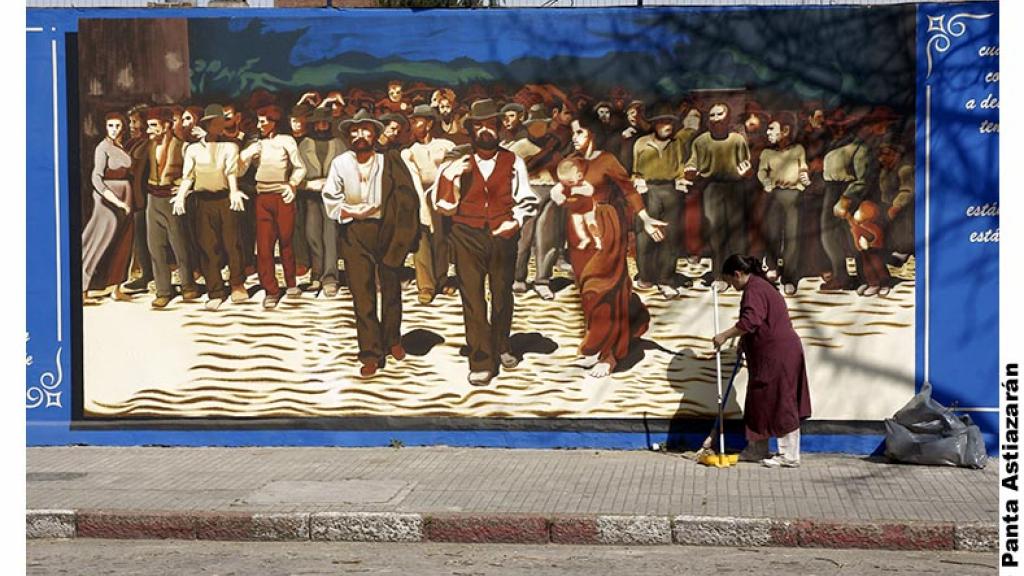
It has become fashionable to declare that class struggle has faded into the past — dissolved by deindustrialisation, scattered by fragmented labour markets, eclipsed by identity-based movements, and exhausted along with the institutions that once gave it political form. From this vantage point, class appears to have lost its centrality, surviving at best as a residual category of analysis.
Yet this verdict rests on a fundamental confusion between the visibility of class struggle and its structural necessity. Rather than transcending class antagonism, capitalism has shifted and restructured the battleground. What has weakened is not the antagonistic relationship between capital and labour, but rather the political and organisational forms through which that antagonism was once legible, durable and effective.
The present crisis of class politics is therefore not a crisis of absence but one of recomposition under adverse conditions. To understand class struggle today, one must begin from this reorganisation, rather than from nostalgia for lost forms or retreating to cultural explanation.
Neoliberalism and the reorganisation of class relations
Neoliberalism, often mischaracterised as the state’s retreat in favour of markets, has entailed a profound reorganisation of state power, aimed at reshaping class relations. It has resulted in flexible employment, diluted welfare systems, tightened migration regimes and commodified public services.
Far from withdrawing, the state has become deeply involved in organising the grounds for accumulation and disciplining labour. This overhaul has altered the form of class struggle, which is dispersed from the point of production across a wider social terrain: housing, debt, care, health, education, borders and policing. To insist on this point is not to deny the continuing importance of workplace struggles, but to recognise that exploitation and domination are now organised across the whole of social life. The question is not whether class struggle exists, but why it so often fails to accumulate into a durable political force.
Informalisation is often treated as a descriptive condition: the absence of contracts, regulations or security in labour markets appears either as a residue of underdevelopment in the Global South or a contingent erosion of previously stable employment in the Global North. However, this is not merely a labour market restructuring; it is a mode of class rule.1
In much of the Global South, informal work is not marginal or transitional but the dominant form of proletarian existence. Historically, formal jobs have never functioned as a universal norm capable of anchoring social reproduction.2 Employment has long been episodic, multi-sited and interwoven with household survival strategies, petty commodity production, migration and debt. Neoliberal restructuring did not introduce this condition; it consolidated it.
Informality today is structured through state policy, with urban planning regimes criminalising street vendors, while selectively tolerating them. Welfare systems regulate populations without ensuring rights, and control is exercised through policing and regulation rather than labour law. Migration regimes create a large, necessary workforce that remains in a legally precarious situation. Informality represents regulation without protection, rather than a lack of regulation.
In the Global North, informality takes a different historical form but serves a similar function. Here, it appears to be a process of regression: subcontracting chains, bogus self-employment, zero-hour contracts, platform jobs, and the expansion of migrant and racialised labour regimes. Often portrayed as technological disruption or labour market flexibility, the reality is a deliberate dismantling of the wage norm.
The institutional compromises that once stabilised employment relations — collective bargaining, welfare entitlements, and employment law — were hollowed out and the risks of reproduction shifted back to households and individuals. This fragmentation strategy hampers collective bargaining and shifts social costs to communities, which in turn undermines workers’ collective power.
Despite localised protests and workers’ mobilisations, workers lack organisational cohesion. Informalisation fragments not only employment relationships but also time, space and legal status. Work becomes intermittent, dispersed across sites and often criminalised or semi-legal, raising the costs and risks of sustained organisation. Under such conditions, collective action is repeatedly forced into short cycles of mobilisation, which makes accumulation structurally difficult rather than politically misdirected.
Class struggle sans wage norm
Even though class struggle always extended beyond the workplace, for much of the 20th century, the wage relationship functioned as its principal organising axis. Stable employment, identifiable employers, collective bargaining and legally recognised unions provided the material and institutional basis on which conflict between labour and capital could be generalised.
Today, wage relationships can no longer serve as the primary point of political aggregation. Workers confront not a single employer but a dispersed set of intermediaries, algorithms, municipal authorities and welfare offices. The classical strike, while it persists, is losing its capacity to function as a universal weapon.
This transformation does not depoliticise workers; it displaces the sites of struggle. This displacement multiplies conflict zones without providing a common institutional or organisational anchor. Struggles emerge simultaneously across housing, welfare, care and employment, yet there is no mechanism capable of linking these sites into a unified resistance. The result is not depoliticisation, but a dispersion of political energies across disconnected fronts.
The growing centrality of struggles over social reproduction is also reflected in the expansion of what has been described as a “connected” workforce across care, education, health and service work.3 Far from representing a sphere insulated from capitalist domination, this workforce is increasingly subject to the same imperatives of control, deskilling and rationalisation that historically transformed industrial work. Now, managerial techniques and digital systems systematically measure, script, and reorganise practices of care, emotional engagement and human connection — long treated as informal, feminised or naturalised capacities.
This change does not elevate reproduction above class conflict; it intensifies it. As capital seeks to extract value from labour that is inseparable from human interaction, struggles over workloads, staffing ratios, time and professional autonomy become central forms of class antagonism. The politicisation of care is not a cultural shift but a material consequence of accumulation’s deepening penetration into the conditions of social reproduction.
Care work is exemplary rather than exceptional. Similar processes impact education, logistics, platform services and public-sector work, as they increasingly subject relational and temporal capacities to measurement and control. The expansion of such work indicates not a shift away from class conflict, but capital’s extension into domains previously partially shielded from direct valuation.
Identity, difference and class recomposition
The fragmentation of contemporary class struggle is often attributed to the rise of identity politics. Struggles around race, gender, caste, migration, sexuality or nationality appear as key, diverting attention from exploitation and undermining class unity. Proponents of identity politics treat class as merely one identity among others, no longer capable of providing a central unity for political action. These positions misidentify the problem by transforming a structural condition into a cultural dispute.
Of course, identity plays a crucial role in stratifying work and governing inequality in capitalist societies, rather than being a mere ideological construct. It helps segregate workers based on gender, race, caste, citizenship and legality, resulting in hierarchies that support capital accumulation and control. For instance, migrant workers can be deported, women’s work is often relegated to caregiving or flexible roles, and racialised or caste-affected individuals frequently occupy the most hazardous and marginalised types of work. Capitalism, as a totalisation of all exploitation, absorbs identity as a fundamental mechanism of class rule, rather than merely a superficial marker of difference.4
The problem, therefore, is not identity as lived experience or the basis of resistance, but as a political form detached from mechanisms of generalisation. When struggles remain confined to particularised grievances, they become intelligible to power precisely because they do not threaten the organisation of accumulation as a whole.
Identity-based struggles are integral to class struggles, as they act as responses to special forms of domination, such as gendered violence, racialised policing, caste oppression and exclusionary citizenship practices. However, it is useful to examine the political forms through which these identity struggles manifest. Under neoliberal conditions, such struggles tend to be individualised and mediated through NGOs and legal frameworks, shifting the focus from collective opposition to issues of recognition and inclusion. Despite the recognition of differences, the underlying structures that perpetuate inequality remain largely unchanged.
This form of mediation represents a deliberate governance strategy that manages social conflict while upholding existing accumulation. NGOisation continues not merely due to political naivety but because it aligns with the project-based, depoliticised logic of neoliberal governance. Operating within donor frameworks and administrative mandates, these forms stabilise survival while neutralising antagonism, mostly replacing confrontation with management and collective power with representation.
By interpreting structural domination as personal or group grievances, it restricts the potential for broader struggles, making identity a marker of vulnerability instead of a foundation for collective strength. This leads to a paradox where, despite the proliferation of identity struggles and heightened visibility, class dynamics remain static. The working class appears divided, not due to new differences, but because of a lack of political organisation.
We must acknowledge the critical role identity conflicts play in class formation, rather than dismissing them as mere distractions from class issues. Without a process of recomposition, differentiation solidifies hierarchy, turning identity into a tool for reorganising class power rather than a means of challenging it.
The contemporary prominence of “middle-class” identity — celebrated in the Global South and mourned in the Global North — should be read not as evidence of class transcendence but as a politically-induced formation that channels status anxiety and inequality away from capital and toward fragmented, often reactionary, forms of social identification.
A renewed class politics cannot resolve this impasse by appealing to an abstract unity or by demanding that particular struggles subordinate themselves to a pre-given class agenda. Class unity is not a sociological fact; it is a political achievement. It must be constructed across differentiated positions produced by capitalism itself. This requires recognising identity struggles as diagnostic — revealing where exploitation, dispossession and coercion are most concentrated — while insisting that their political horizon cannot remain confined to recognition or representation.
Recomposition, in this sense, does not mean erasing difference. It means organising across difference. Feminist struggles point toward the decommodification of care and socialisation of reproduction. Migrant struggles raise questions of borders, labour discipline and imperial hierarchies. Anti-racist and anti-caste movements expose the coercive apparatuses that manage surplus and informalised workforce. When generalised in this way, identity struggles deepen class politics rather than fragment it.
Political accumulation and political form
The above analysis points to a paradox that defines the present conjuncture. Class antagonism is widespread and often acute. Informalisation, dispossession and coercive governance generate recurrent waves of struggle across labour markets, communities and territories. Yet these struggles rarely accumulate into durable challenges to capitalist power. Mobilisation is frequent; transformation is rare. The central problem confronting the left today is therefore not the absence of struggle, but the absence of political forms capable of accumulating it.
Political accumulation refers to the capacity to preserve struggles beyond their moment of eruption, generalise demands across sectors, and sustain pressure over time. It is distinct from mobilisation. Without accumulation, even intense and repeated struggles fail to alter the balance of class forces.
This problem cannot be explained by a lack of militancy, consciousness or moral commitment. Nor can it be reduced to repression alone. It is rooted in the structural conditions; namely, the fragmentation of labour, the displacement of struggle from the workplace to multiple sites of reproduction, and the differentiation of the working class along lines of identity, legality and access to resources. These conditions generate antagonism while simultaneously undermining the mechanisms through which antagonism can be generalised.
Political accumulation requires mediation.5 It depends on organisations and institutions capable of linking struggles across sectors, translating local conflicts into general demands, and sustaining confrontation with capital and the state over time. Under contemporary conditions, such mediating forms are weak, absent or politically misaligned. The result is a proliferation of struggles that remain episodic, sectoral or symbolic.
One response to this impasse has been electoralism. Faced with fragmented movements and declining organisational capacity, many on the left have treated electoral success as a shortcut to power, substituting representation for organisation and policy programs for social forces. Yet electoral strategies detached from class organisation confront a hostile state apparatus and organised capital without the capacity to reshape the balance of forces. When electoral openings close, as they often do, the underlying weakness of accumulation is brutally exposed.
This substitution is visible even in the most sophisticated contemporary debates on working-class “dealignment,” particularly in the United States, where extensive empirical work documents declining electoral support for social-democratic parties among working-class voters across racial lines. While such analyses rightly reject culturalist explanations and emphasise material grievances, they nonetheless treat electoral realignment as the primary horizon of class politics — reducing recomposition to a problem of messaging, candidate selection or policy delivery.
The intensity of this debate is itself symptomatic of the deeper organisational vacuum: where durable forms of class organisation are weak or absent, electoral alignment becomes the proxy through which the crisis of political accumulation is interpreted.
A second response has been movementism, the valorisation of spontaneity, horizontality and continuous mobilisation. This orientation correctly recognises the limits of institutional politics and the importance of struggles beyond the workplace. But without durable forms of coordination and strategy, it tends to confuse intensity with power. Mobilisations erupt, generate visibility and then dissipate, leaving organisational capacities no stronger than before.
Recent debates within the workers’ movement reflect this impasse. Proposals that emphasise leverage at logistical “choke points” in supply chains — ports, warehouses, transport hubs — implicitly recognise that capitalist power is no longer concentrated at a singular workplace or wage relation, but dispersed across networks of circulation and reproduction. This shift usefully directs attention to the material infrastructures through which accumulation is organised under contemporary capitalism.
Yet the strategic limitation of such approaches lies not in their diagnosis of where disruption may occur, but in their inability to resolve the problem of political accumulation. Disruptive capacity, even when precisely targeted, does not in itself generate durable organisation or generalisable class power. Without mediating forms capable of linking episodic disruption to sustained collective strategy, logistical leverage risks reproducing the same pattern that afflicts contemporary mobilisation more broadly: intensity without accumulation, confrontation without recomposition.
A third form of mediation is NGOisation, particularly prevalent in contexts of informalisation and state retreat. NGOs often stabilise survival, provide services and articulate grievances in the language of rights and inclusion. But precisely because they operate within narrow institutional mandates, they tend to depoliticise conflict. They manage vulnerability rather than confront accumulation, translating structural antagonisms into technical problems or individual cases.
These responses differ politically, but they share a common limitation: they substitute partial forms of mediation for the hard work of class recomposition. None resolves the problem of accumulation because none reconstructs the organisational capacities needed to confront capital and the state as class actors.
The weakness of political form is therefore not accidental. It reflects the historical disarticulation of the workers’ movement, the erosion of parties rooted in class organisation, and the absence of new forms capable of operating across new labour regimes. Where such forms do exist, they are often confined to specific sectors or moments, lacking the capacity to generalise.
This does not imply that political form can simply be reinvented at will. Forms emerge from struggle, but they also shape its trajectory. The challenge today is not to replicate inherited institutions — unions, parties or fronts — as they once existed, but to develop forms of organisation capable of linking production and reproduction, formal and informal labour, citizens and non-citizens, without collapsing these differences into abstraction.
Crucially, the state cannot be treated as a neutral instrument awaiting capture. It is a central site of class power. Political accumulation therefore requires strategies that confront the state as a terrain of struggle, and not merely an arena of representation. Without sustained pressure from organised social forces, state power reproduces existing class relations, regardless of electoral outcomes.
The persistence of fragmented struggle alongside weak accumulation has produced widespread frustration on the left. This frustration often expresses itself either as cynicism toward politics or as impatience with organisation itself. Political accumulation today demands recomposition across fragmented social relations. It requires forms of organisation that can operate at multiple scales, endure beyond moments of mobilisation, and articulate a general antagonism without erasing difference.
This is a demanding task, and there are no shortcuts. But without confronting the problem of political form directly, class struggle will continue to erupt without converging, and mobilisation will continue to substitute for power.
Recomposition should be viewed as a historical process rather than simply an organisational design. It unfolds unevenly, is characterised by conflict, failure and partial advances, and is influenced by shifting relations between production, reproduction and state power. Any sustainable class politics will arise from these contradictions, rather than from simplistic solutions.
There is no blueprint for this task. Political forms cannot be designed in abstraction from struggle, nor can they be improvised without regard to the conditions they must confront. What can be said is that the problem facing the left today is not the absence of class antagonism, but the absence of forces capable of organising it at scale and over time.
- 1
Jan Breman, At Work in the Informal Economy of India (Oxford University Press).
- 2
Jairus Banaji, Theory as History: Essays on Modes of Production and Exploitation (Haymarket).
- 3
Lise Vogel, Marxism and the Oppression of Women (Brill); see also Nancy Fraser, “Contradictions of Capital and Care,” New Left Review, on reproduction as a structural site of crisis.
- 4
Stuart Hall, “Race, Articulation and Societies Structured in Dominance,” and Nicos Poulantzas, State, Power, Socialism
- 5
Daniel Bensaïd, Marx for Our Times, on political accumulation, temporality, and organisation.