The rise and fall of ‘Leninism’
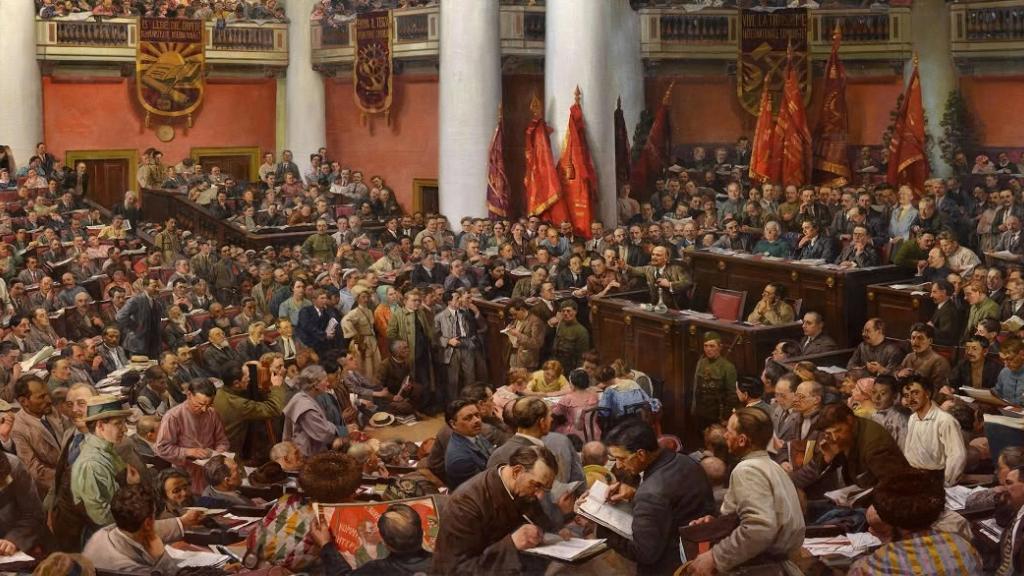
“The rise and fall of ‘Leninism’,” by John Marot, is a reply to Dan La Botz’s “Goodbye to Lenin and Leninism,” first published in LINKS International Journal of Socialist Renewal. In his critique of La Botz’s essay, Marot contends that any discussion on democracy in Soviet Russia in Lenin’s times must be placed in its rightful historical context. Marot’s response is appearing simultaneously on Communis and LINKS. You can read the other contributions here.
The starting point for understanding “Leninism” in Lenin’s time lies in the social-property relations of late Imperial Russia. These relations determined what was — and was not — possible. We cannot ignore the constraints and opportunities for historic action that the Bolshevik Party, the peasantry, the proletariat, and the petty bourgeoisie faced after the destruction of the landed aristocracy and its near-absolutist feudal state.
Below, I will focus on the trajectory of “democracy” in Soviet Russia, beginning with the Bolshevik-led Soviet seizure of power in the fall of 1917, through the turbulent years of Civil War and War Communism (1918–1921), and into the era of peace and reconstruction brought about by the New Economic Policy (NEP, 1921-1929).
Limits of the NEP
Russia’s economic recovery under the NEP came to a halt in the fall of 1927, when the country experienced severe harvest failures due to inclement weather in its food-producing regions.
Peasants reacted by keeping more for themselves to stay alive, resulting in less for workers and those living in urban areas more generally. The Bolsheviks were compelled to ration foodstuffs in cities and many towns. Extant social-property relations determined the crisis, potentially opening the way to their transformation — or preservation — through class conflict, whose outcome was not pre-determined.
The stalled economy sparked a prolonged political crisis in the Bolshevik Party, lasting 18 months. In the spring of 1929, Joseph Stalin and his supporters defeated the last inner-party opposition to his intent to abolish the NEP, a policy that had popular support, especially in the countryside. In the summer and fall, the Stalinists amassed forces to confront growing peasant defense of their way of life.
Stalin finally struck in December 1929, launching his forced collectivization program in the countryside, overcoming ferocious peasant opposition by destroying their primary line of defense, the self-governing peasant commune. Twenty-five million peasant households were forcibly transformed into a few thousand collective farms, the kolkhoz. The state could now, through the kolkhoz, systematically extract a surplus from rural producers.
In the cities, Stalin forced workers to build huge factories to house heavy industries. They worked for long hours but were paid little. Real wages crashed by as much as 50%. Trade unions, now purged of anti-Stalinists, systematically sided with management. Here, too, the state compelled workers to perform surplus labor, securing the ruling class’s control over the investment function.
By 1933, Stalin had eliminated the Bolshevik Party, retaining only the name. He had transformed his faction into a state, creating a new class-exploitative society, and annulling any prospect for socialism. As Stalin did this in Vladimir Lenin’s name, Stalin identified Leninism with Stalinism accordingly.
The limits of socialism in Russia
If social-property relations are at all relevant in political matters, as Second International Marxists affirmed, then socialism was not possible in NEP Russia — no matter what policy was pursued. But if socialism was possible had the Bolsheviks adopted “democratic” policies, as Dan La Botz argues in “Goodbye to Lenin and Leninism,” then social-property relations were not an insurmountable obstacle to socialist progress — if there was a democratic will, there was a democratic way. Holding both positions is untenable.
As the Civil War ended in 1921, peasants called for War Communism’s abolition and freedom to trade. The Kronstadt rebels wanted the same thing — “soviets without Communists” — because the only Communists they had dealt with were the anti-free-trade Communists of the Civil War period. NEP satisfied both demands. It also fulfilled the peasant dream of self-governance through the mir, free from exploitation by the landed aristocracy. This was democracy.
The Constituent Assembly dispersed
La Botz recognizes democracy in forms such as soviets, which are organs of proletarian self-rule, and bourgeois-democratic institutions such as the Constituent Assembly, dispersed by the Bolsheviks and their once ally, the Left Socialist Revolutionaries (SRs), in January 1918. On the surface, the dissolution of the popularly-elected Assembly was a wanton anti-democratic act — a classic case of dictatorship. But appearances can mask essential realities.
The Right SRs were a majority in the Constituent Assembly. They formally represented the peasantry, but not substantively, as they did not represent the peasantry’s material interests. When the Constituent Assembly convened for its only session, the Right SRs refused to recognize the lawfulness of peasant-organized expropriations of the landed aristocracy. They also rejected Lenin’s Soviet Land Decree. They acted as counterrevolutionaries, for obvious reasons.
In the countryside, the peasantry had swept away the organs of Tsarist administration, the zemstvo, rendering superfluous the people working in them. But SRs leaders and cadres were almost exclusively drawn from zemstvo administrative personnel: surveyors, teachers, nurses, agronomists, veterinarians, lawyers, doctors and other professionals.
This personnel, employers and employees alike, dominated both the right and left wings of the SRs, and formed a distinct social layer in Tsarist society, often called the rural intelligentsia. Peasants paid burdensome taxes to maintain the zemstvo intelligentsia — taxes that grew more onerous over the years. Hence the peasantry’s hostility to this Tsarist institution.
In the Civil War that broke out in the spring of 1918, the Right SRs rallied to the White armies to fight for La Botz’s “Republic” — and to get their zemstvo jobs back, thereby restoring the social status they held under the old regime. Through its actions, the Right SRs proved to be neither socialists nor revolutionaries but counterrevolutionary petty-bourgeois democrats, hostile to Soviet democracy and Soviet power.
The Left SRs, Soviet democracy, and the Treaty of Brest-Litovsk
The Left SRs were equally hostile to the rule of the organized working class, but for a different reason. They recognized Soviet democracy — but only when it accorded with their politics.
In March 1918, the Bolshevik majority at the Congress of Soviets ratified the Treaty of Brest-Litovsk, ending Russia’s participation in the imperialist World War. The Left SRs decided the majority were wrong to prioritize defense of Soviet power over defense of the nation against the Kaiser’s armies. They launched an armed insurrection against the Congress’s lawful decision, targeting leading Bolsheviks for assassination, wounding Lenin. The Bolsheviks said the Left SRs were acting unlawfully and outlawed them.
Unlike the Left SRs, the Bolsheviks acknowledged the legitimacy of Soviet democracy. They demonstrated their commitment to workers’ rule by taking action to enforce it. In this, the Bolsheviks differed from their non-Bolshevik opponents, many of whom recognized the dictatorship of the proletariat only on paper. By no fault of their own, the Bolsheviks ended up ruling alone.
The Bolsheviks and democracy
I will now segue to the last point, perhaps the most difficult as it is poorly analyzed by Dan La Botz and others in the past: single-party democracy.
We are told that, consistent with the 1921 ban on party factions, party leaders outlawed all minority opposition. But that is not the truth. The truth is party leaders did not need to invoke the ban to deal with the many instances of inner-party opposition that arose throughout the NEP period. Elections were held and votes tallied — and the dissidents lost virtually everywhere and every time.
Partisans of the various left oppositions within the Bolsheviks today repeat La Botz’s argument that party leaders took anti-democratic measures against minority tendencies’ right to bid for leadership, in violation of democratic centralism. Electoral hijinks and dodgy vote counting certainly abounded, but anti-democratic shenanigans alone cannot explain historic trends.
The self-proclaimed left oppositions all urged the party leadership to build socialism more quickly by raising the rate of accumulation, explaining to workers that “primitive socialist accumulation” meant working harder today to live better tomorrow. But most workers were already living better and working hard enough under the NEP. They were not prepared to sacrifice what they had now for the sake of future material benefits.
Neither was the peasantry. To them, left opposition talk of levying a “tribute” (dan’) on them to finance accelerated economic development was too reminiscent of War Communism, when the Bolsheviks resorted to force to collect grain. Peasants put up fierce resistance to predatory Soviet power then, and they were ready to do it again.
In sum, under the Bolshevik-initiated and “bureaucratically” implemented NEP, workers and peasants saw improvements in their daily lives. Why remove the Bolshevik leadership responsible for leading the country away from the abyss of War Communism?
Exercising hegemony, not domination, over party ranks
With this in mind, I want to reconstruct the raison d’être and mindset of the minority left oppositions between 1918–29, including the Workers’ Opposition, the Group of Democratic Centralism, the Trotskyists, the Zinovievists, and others. They all argued along these lines:
- The party leaders are willy-nilly leading the country away from socialism. The leaders — Stalin, Grigory Zinoviev, and Lev Kamenev, at one point; Stalin and Nikolai Bukharin at another — are deceiving the regimented and gullible party rank-and-file, who fall for false promises of undisturbed progress. We, the “Old Bolsheviks,” tempered “Leninists,” withdraw the confidence we have hitherto placed in these leaders.
- The party must be free of careerists, nest-featherers, red-tape-ists, shirkers, ne'er-do-wells, unthinking Stalin-loyalists, closet Mensheviks and SRs, and downright scoundrels. We must have a different rank-and-file: honest, diligent, integral revolutionaries who take the long view, make no promises, analyze soberly, call a spade a spade, denounce blue-sky thinking, and are prepared to meet every challenge and lead the proletariat toward socialism.
But where could such near immaculate cadres be found, beyond those already present in the minority? The original Bolshevik cadres were minuscule in numbers by 1921, certainly no more than 10,000. In sharp contrast, party members recruited after the October Revolution and especially after the Civil War, numbered in the hundreds of thousands.
To conclude, as La Botz and most Trotskyists do, that Stalin’s police measures alone, or even largely, kept veteran revolutionary party cadres in the minority and in line throughout the NEP period stretches credulity. Certainly, Leon Trotsky never held this view.
No police state was necessary to discipline the party recalcitrant, Old Bolshevik or not. Under the NEP — and only under the NEP — all Stalin had to do to get his way was hold elections. The NEP benefited ordinary workers and peasants; voters naturally cast their ballots for those who pushed those beneficial policies, such as Stalin, not those who persistently challenged them and argued the leadership was not doing enough to stem the growth of capitalism, such as Trotsky.
The last faction fight
As the Bolsheviks argued over where the Soviet Union was going, the peasantry asserted its class interests when confronted with an agrarian crisis in the fall of 1927, putting the NEP under great strain. Bad harvests led peasants to reallocate their diminished grain surpluses, retaining them for their own consumption instead of selling them to the Soviet state to feed urban Russia.
The crisis of the late NEP period generated the last faction fight in the Bolshevik Party over the future of the worker-peasant “alliance” (smychka), as the NEP was popularly known. Stalin’s faction called for peasant grain expropriations, threatening the voluntary principle at the core of the NEP. Bukharin, Stalin’s erstwhile ally, dissented, urging party unity to preserve the NEP.
Stalin also urged party unity — but on Stalin’s terms. Stalin, with Trotsky’s “critical support,” ground down Bukharin’s faction, called the “Right Opposition” by its Stalinist and Trotskyist foes. Stalin came out the winner. In destroying the last “Leninists” in the Bolshevik Party, Stalin buried the “Leninist” October Revolution for good in 1929, setting up the untrammeled dictatorship of the Stalinist state over associated producers.
Looking ahead
No matter whether socialist activists are “for” or “against” “Lenin” and “Leninism,” discussing these in relation to this historical context will help activists gain a better understanding of the issues. Unfortunately, empirically meandering and conceptually disordered accounts of history are customary fare. La Botz and many others have been asking the same questions for the past 50 years, framing the debate in terms of yes or no. It is high time to ask different questions.