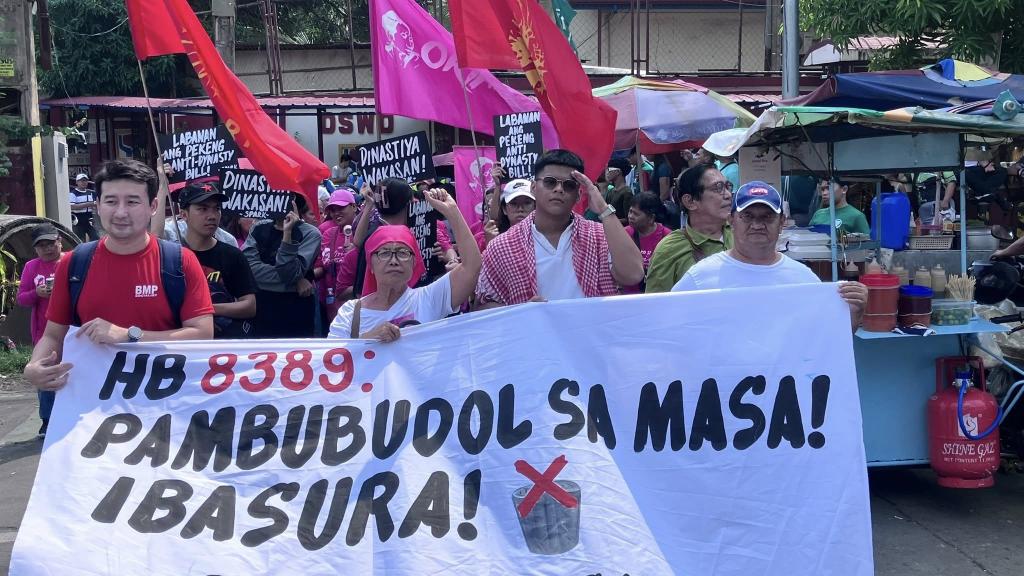
Partido Lakas ng Masa (The Philippines): HB 8389 is a fake anti-dynasty bill
[Editor’s note: Filipino socialist activist Khyl Ramos, from the Partido Lakas ng Masa, will be speaking at Ecosocialism 2026, September 11-13, Magan-djin/Brisbane, Australia. For more information visit ecosocialism.org.au.]
The House of Representatives approved House Bill No. 8389, the proposed Anti-Political Dynasty Act, on June 3 before Congress adjourned for recess.
The bill is a response to the growing public demand to curb political dynasties. According to the Pulse Asia survey conducted from February 27 to March 2, 2026, support for banning political dynasties reached 71% in Luzon, 81% in the Visayas, and 53% in Mindanao.
HB 8389 was approved by a vote of 267 in favour, 20 against and 7 abstentions. Such overwhelming support is hardly surprising. More than 80% of House members belong to political dynasties. The House of Representatives has effectively become a House of Dynasties.
The bill will now be transmitted to the Senate for deliberation and possible consolidation with Senate bills on the same subject.
Yet we have little reason to expect a genuine anti-dynasty bill to emerge from the process.
First, the Senate is locked and consumed by factional struggles. Like many measures that address the needs of ordinary people, the fate of a genuine anti-dynasty bill hangs in the balance amid political manoeuvring and elite rivalries.
Second, the Senate itself is dominated by political clans: 83% of its members belong to political dynasties (including eight senators who are siblings, and other senators who belong to entrenched family clans.
HB 8389: A fake anti-dynasty bill
HB 8389 adopts an extremely narrow definition of political dynasty, covering only relatives up to the 2nd degree of consanguinity and affinity — spouses, parents, children, grandchildren, and siblings.
Why exclude nephews, nieces, and cousins when they are among the most common instruments of dynastic succession today?
Under HB 8389, political clans may continue fielding relatives in neighbouring districts, provinces, cities, municipalities, and other elective positions at both the national and local levels. They may also continue using party-list organisations as alternative vehicles for political control.
A social cancer
Political dynasties are a social cancer that corrodes democratic governance.
They perpetuate vote-buying, patronage politics, and political dependency. They transform public office into family property and reduce ordinary citizens to clients of powerful clans. Government becomes a family enterprise.
Many control, directly or indirectly, the contractors and business interests that profit from government projects. By monopolising political power across generations, they foster corruption, abuse of authority, and impunity.
PLM’s call
Partido Lakas ng Masa (PLM, Party of the Labouring Masses) calls for a genuine Anti-Political Dynasty Law that:
- Covers relatives up to the 4th degree of consanguinity and affinity, including nephews, nieces, and first cousins;
- Prohibits both simultaneous and successive occupation of elective positions by members of the same political dynasty;
- Establishes a cooling-off period before former officials and their relatives may run for office;
- Prevents the use of party-list organisations and other mechanisms to circumvent anti-dynasty restrictions;
- Applies to all levels of government, from the national level down to the barangay.
The struggle goes beyond Congress
The struggle against dynastic rule is part of the broader struggle against elite domination, oligarchic control, corruption, patronage politics, poverty, and exploitation.
We therefore will bring the issues directly to the masses.
The masses have never been consulted in the drafting of anti-dynasty legislation. We will organise people’s assemblies across the country to discuss a people’s alternative to HB 8389.
The fight against political dynasties is inseparable from the fight for genuine democracy and for a social and political order free from exploitation, oppression, and elite rule.
End political dynasties!
For a government of the masses, not of the trapos [traditional politicians] and dynasties!