Tech billionaires, the AI threat and resistance
[Editor’s note: Marty Hart-Landsberg will be speaking at Ecosocialism 2026, September 11-13, Magan-djin/Brisbane, Australia. For more information on the conference visit ecosocialism.org.au.]
First published at Monthly Review.
Silicon Valley tech billionaires hold fanciful ideas. For example, many believe Artificial General Intelligence (AGI) will be realized in the very near future and its achievement will usher in an era of plenty, with trillions of sentient beings contentedly populating the heavens.
However, underpinning such ideas is a serious and destructive political agenda. Using their vast wealth, control over critical technologies, and strong representation in government, these billionaires have secured expanded fossil fuel production, corporate tax cuts, subsidies for chip makers and data centers, favorable trade policies, a strong AI-driven military and national security apparatus, and the gutting of programs designed to address climate change, discrimination, and inequality.
Their success owes much to the fact that President Donald Trump largely shares their agenda. As the news website Axios describes, “Trump zigs and zags into countless political and diplomatic issues. But none comes close to his sustained, and surging, all-in alliance with tech billionaires and AI companies reshaping the U.S. economy.”1 No wonder working people are experiencing worsening working and living conditions.
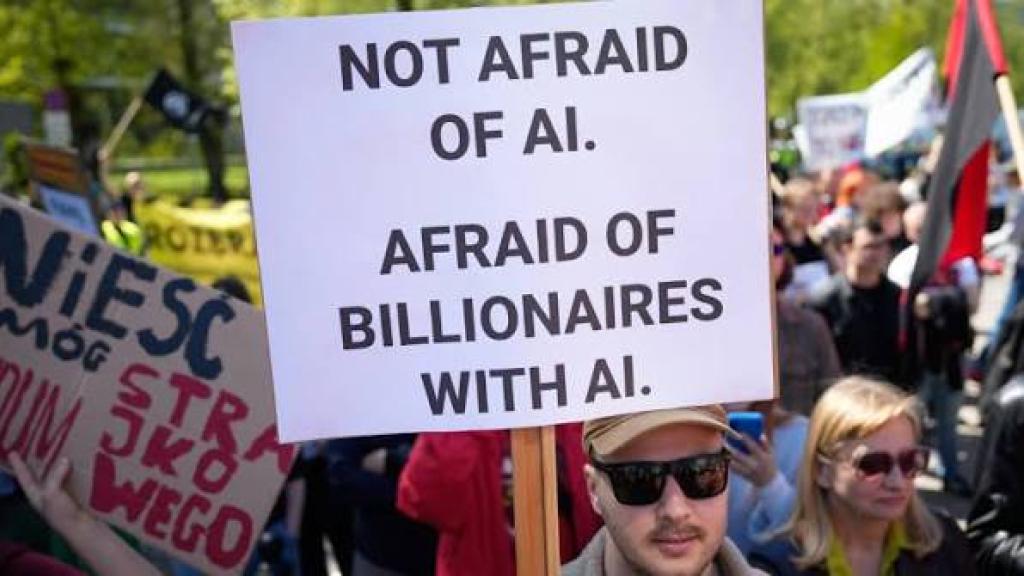
We are up against a powerful group of tech oligarchs who are happy to destroy our lives in pursuit of mega-profits and a fantasy future. We need to organize accordingly. Thankfully, there are strong indications that capitalism’s own motion is creating fertile grounds for our efforts.
The billionaires and their networks
At the heart of the Silicon Valley tech billionaire community is the so-called PayPal Mafia, a loosely affiliated group of people who were either founders or executives of the company. The most important are Peter Thiel, Elon Musk, and David Sacks. All three spent time as children in South Africa and have maintained a close relationship since their time at PayPal.
In 2003, Thiel started Palantir Technologies, and he continues to serve as chair of its board of directors. Two years later, Thiel cofounded a venture capital fund, the Founders Fund, which has invested in Anduril, Facebook, Neuralink, Palantir Technologies, SpaceX, and xAI.
Elon Musk started the Boring Company, Neuralink, SpaceX, and xAI. He was also a cofounder of OpenAI. David Sacks cofounded the enterprise networking service Yammer (which he sold to Microsoft) and then, in 2007, the venture capital fund, Craft Ventures. Craft Ventures has invested in Facebook, Palantir Technologies, SpaceX, and xAI.
There are also powerful Silicon Valley tech billionaires who are not members of the PayPal Mafia. Marc Andreesen cofounded Netscape before starting his own venture capital firm. In 2009, he and Ben Horowitz joined their separate funds to create Andreessen Horowitz, today the largest venture capital fund in the United States. Its portfolio includes investments in Anduril, Facebook, SpaceX, and xAI.
Palmer Luckey, the creator of the virtual reality headset Oculus Rift, cofounded Anduril in 2017, with seed funds from the Founders Fund. Other prominent community members include Sam Altman, CEO of OpenAI; Dario Amodei, CEO of Anthropic; Jeff Bezos, founder and executive chairman of Amazon; and Mark Zuckerberg, cofounder of Facebook and its parent company, Meta.
Visions of the future
Over the last four decades, Silicon Valley has given birth to a series of overlapping ideologies that have garnered considerable attention within the tech community.2 All embrace transhumanism, a broad philosophical movement with roots in the twentieth-century eugenics movement. Transhumanism asserts that humans can transcend existing biological limitations with the aid of technology to achieve indefinitely long lifespans and augmented cognitive abilities. The most influential are Singularitarianism, Effective Altruism, and Effective Accelerationism.
Singularitarianism, which became popular in the early 2000s, holds that the creation of AGI is near and that its achievement will lead to a “technological singularity,” with AGI generating such rapid and unprecedented technological advances that there will be a fundamental rupture in human history. Supporters believe humans will eventually upload their consciousness to robots, creating self-improving superbeings that will, in great numbers, establish themselves throughout the universe.
Effective Altruism shares a similar starting point, but its adherents worry that if AGI is not aligned with appropriate values, it could end up annihilating or enslaving humanity. Therefore, they place a high priority on developing AI safety measures and ensuring that the United States, not China, is first to achieve it.
Effective Accelerationism is the most recent addition to transhumanist thinking. Its advocates believe that the pursuit of AGI should not be slowed by concerns over existing social and ecological problems. Convinced that the number of future sentient beings will far exceed the number currently living, they seek its fastest possible development to minimize the unnecessary suffering or death of untold numbers of future beings.
They talk the talk
These ideologies might easily be dismissed as little more than fodder for philosophers and science fiction writers, if it was not for the fact that the tech billionaires highlighted above have embraced many of their beliefs. Zuckerberg has stated that “superintelligence is now in sight,” and with it, “the creation and discovery of new things that aren’t imaginable today.” Amodei believes we will soon achieve “escape velocity” from death itself.3 Altman claims that AGI will be realized by 2030, allowing us to easily solve the myriad problems we face here on Earth and colonize space.4
Bezos predicts that in a few decades people will be living in millions of giant space stations, each housing up to a million people.5 His company Blue Origin is working on the rocket technology needed to get us to the moon, which he believes can serve as a base for the colonization of the solar system, and on the orbital data center technology to power the required space stations.
Musk also believes we are close to AGI. His company Neuralink is pursuing the development of implantable brain–computer interfaces to enable humans “to achieve a symbiosis with artificial intelligence.”6 Musk long planned to use SpaceX to reach and colonize Mars. But, in February 2026, he decided to prioritize beating Bezos to the moon and building a “self-growing” colony there within the next decade.
Andreessen, the driving force behind Effective Accelerationism, speaks of AGI as a “universal problem solver.” His 2023 “Techno-Optimist Manifesto” highlights the ideas and policies that must be overcome to achieve it: “Our present society has been subjected to a mass demoralization campaign for six decades — against technology and against life — under varying names like ‘existential risk,’ ‘sustainability,’ ‘ESG’ [Environmental, Social, and Governance], ‘Sustainable Development Goals,’ ‘social responsibility,’ ‘stakeholder capitalism,’ ‘Precautionary Principle,’ ‘trust and safety,’ ‘tech ethics,’ ‘risk management,’ ‘de-growth,’ ‘the limits of growth.'”7
Luckey is another believer in AGI. Because his greatest worry is that China might achieve it first, he supports both AI research and a powerful military.8 His company, Anduril, is engaged in the development of AI-powered autonomous weapons systems.
Thiel believes that technology is the central driver of societal change and that there are powerful demonic forces at work seeking to suppress its liberatory potential. In 2025, he gave a series of private lectures in San Francisco where he described the coming battle against those forces as the prophesied Armageddon, when the armies of God will destroy the armies of the Antichrist.9 At times he has labeled Effective Altruists as the Antichrist.
While it is difficult to know whether these tech oligarchs believe what they say, there are good reasons to dismiss their visions of an AGI-powered future.10 Even the most powerful existing AI systems appear to be technological dead ends.11 As the writer Cory Doctorow notes, the idea that “adding compute power and data to the next-word-predictor program will eventually create a conscious being, which will then inevitably become a superbeing…is a proposition akin to the idea that if we keep breeding faster and faster horses, we’ll get a locomotive.”12
Getting down to business
It is easy to imagine why these billionaires are attracted to transhumanism: it celebrates the superior individual and technology. Of course, their interest in AGI fairy tales would quickly flag if they were not enjoying substantial rewards in the present from the development of AI for commercial purposes and in support of an expanded national security state. And as they well understand, the enormous costs of AI investment mean that continued success requires securing significant and ongoing state support.
Their ability to win Trump administration backing owes much to personal connections. Thiel was a mentor to Vice President JD Vance, helping him get a start in the venture capital business. Vance likewise enjoyed substantial support from both Thiel and Andreessen when he launched his own venture capital firm in 2019. Thiel was also a major contributor to Vance’s 2022 Senate run, donating a record-breaking $15 million.
David Sacks also financially backed Vance’s Senate run, and later supported Trump’s reelection campaign, hosting several big fundraising events at his house. Sacks’s reward was an appointment as White House AI and Crypto czar, a position he has used to great effect.13
Trump’s AI policies have been overwhelmingly favorable to the tech industry. He repealed environmental regulations and offered significant subsidies to boost fossil fuel production. He signed an executive order requiring the Environmental Protection Agency to speed data center projects on federal and non-federal lands. He exempted servers, semiconductors, circuit boards, and many of the other electronics used by data centers from tariffs. He ordered several federal agencies to build a digital platform to make federally collected data available to tech companies for their AI work. And he continues to push to make it illegal for states to develop their own regulations on AI use.
Other important but lower-profile appointments have also helped advance tech’s AI agenda. Thiel’s former chief of staff, Michael Kratsios, was chosen to direct the White House Office of Science and Technology Policy. Gregory Barbaccia, who held multiple leadership positions at Palantir, was picked to be the Federal Chief Information Officer, responsible for overseeing the implementation of secure and high-performing technology across the federal government.
Tech industry leaders also occupy critical positions in the military. For example, Michael Obadal, a former Anduril executive, serves as Under Secretary of the Army despite continuing to hold some $1 million in Anduril stock. Such connections have helped both Palantir and Anduril become integral to defense and homeland security policy.
In July 2025, Palantir signed a $10 billion contract with the Department of Defense. It consolidated some seventy-five different procurement agreements and represents, in the words of researcher Francesca Bria, “a strategic handover of core military functions to a private company.”14 Anduril, for its part, is driving the military’s pursuit of autonomous warfare capabilities. As Bria explains: “Its Lattice platform connects satellite feeds, radar data and battlefield imagery into a single operational network, allowing military missions to be planned and executed at lightning speed.”
Moreover, these companies, along with leading AI developers like OpenAI, Google, and Microsoft, are set to enjoy an expanded role. Secretary of Defense Pete Hegseth has called for shifting 8 percent of the military budget in each of the next five years from legacy defense contractors to AI-tech firms.15
The tech billionaire–Trump alliance is far from one-sided. Transhumanist thinking meshes well with Trump’s own political program, and tech leaders have enthusiastically supported his aggressive foreign policy, efforts to boost corporate power and profits, and dismantling of most regulatory agencies and social programs. One way is by using their control over media like X (formerly Twitter), Fox News, the Washington Post, CBS News, and CNN to amplify Trump’s racist, xenophobic, anti-immigrant, and misogynist explanations for the decline in majority living and working conditions.
The AI economy: From boom to bust
Tech oligarchs enjoy unrivaled political influence for one main reason. Political and business leaders recognize the centrality of AI, and by extension tech sector investments, to the profitability and growth prospects of the U.S. economy.
Spending on AI infrastructure — data centers and their associated equipment and software — has become the primary driver of U.S. economic growth. Yearly AI-related capital spending by the biggest tech companies (Alphabet, Amazon, Meta, and Microsoft) rose from $150 billion in 2022 to $360 billion in 2025, with spending predicted to reach a substantially greater $650 billion in 2026. Bloomberg puts that total in perspective by noting that: “The largest US-based automakers, construction equipment manufacturers, railroads, defense contractors, wireless carriers, parcel delivery outfits, along with Exxon Mobil Corp., Intel Corp., Walmart Inc., and the spun-off progeny of General Electric — 21 companies — are projected to spend a combined $180 billion in 2026.”16
And these four tech companies are not the only ones investing in data centers. For example, Oracle has also become a major supplier of cloud services. In 2025, it signed a contract with OpenAI to provide it with $300 billion in computing services over five years.
The economy has also benefited from an AI-driven boost in stock market valuations. The November 2022 launch of ChatGPT triggered an explosive growth in the value of AI-related stocks, with the market reaching its second-highest valuation in history in 2025. The richest Americans disproportionately benefited from this gain, and the resulting increase in their consumption spending has also been an important contributor to U.S. economic growth.
However, although tech leaders and major investment funds continue to speak with confidence about an AI-powered future, there are good reasons to believe we are close to the peak of the AI boom and its ability to prop up a weakening system. The most important: none of the leading AI models have proven to be profitable.17
This may seem counterintuitive, given the perception of AI use everywhere, but that is because there is no agreed upon definition of AI, allowing companies to slap the label on all sorts of products. Broadly speaking, AI refers to technologies that can mimic cognitive functions commonly associated with human intelligence. These technologies are typically divided into two groups: machine learning and generative AI. Machine learning models use algorithms to identify patterns, make decisions, and improve performance through experience; they do not generate new content. They are used to run search engines and for tasks such as facial and image recognition, email and phone call spam filtering, predicting traffic conditions and optimizing routes, and language translation.
Generative AI models create new content thanks to training on data sets. Non–large language models specialize in non-text content such as images and video. Large language models have the capacity to generate human-like text. The most advanced versions can also code and produce image and video outputs. It is the development and operation of these advanced models that is driving the AI boom.
The best known include ChatGPT (OpenAI), Claude (Anthropic), Gemini (Google), Grok (xAI), and Llama (Meta). And it is belief in their future profitability that spurs tech companies to keep building the data centers needed for their training and operation. But there’s the rub: mounting evidence suggests that these advanced AI models are technologically incapable of serving as a bridge to anything resembling AGI and too flawed and expensive to win significant paid adoption by business.
All rely on complex neural networks that are programed to probabilistically select words or images based on pattern recognition developed during training to generate responses to prompts. They do not “think” or “reason,” and there is no way, given their internal structure, that they can be transformed into autonomously operating units able to solve novel problems without task-specific reprogramming.18
This structure also seriously limits their suitability for general use. For example, because much of the data used for their training is scraped from the web, and thus includes hateful, discriminatory, and plain old wacko writings, these models generate output that often replicates these biases and can also encourage dangerous delusional thinking.19
Perhaps most worrying to businesses is the fact that they also periodically make things up or “hallucinate.” A case in point: in February 2025, the BBC tested the ability of all the leading AI models to summarize news stories by feeding them content from the BBC website and then questioning them about it.20 Approximately 20 percent of their answers “introduced factual errors, such as incorrect factual statements, numbers, and dates.”
AI developers generally dismiss the seriousness of these problems, claiming they will be overcome with better and larger data sets, more sophisticated algorithms, and greater computational power. However, numerous studies have found the opposite to be true. As the New York Times explained: “The newest and most powerful technologies…are generating more errors, not fewer.”21 And a study by OpenAI researchers concluded that “large language models will always produce hallucinations due to fundamental mathematical constraints that cannot be solved through better engineering.”22
Not surprisingly, then, a 2025 MIT Media Lab evaluation of hundreds of AI adoptions found “that 95 percent of organizations are getting zero return.”23 A survey of more than 1,000 enterprises across North America and Europe by S&P Global Market Intelligence discovered that 42 percent had abandoned most of their AI initiatives in 2025, up from 17 percent in 2024.24 A National Bureau of Economic Research survey of leading executives from the United States, the United Kingdom, Germany, and Australia, conducted between November 2025 and January 2026, revealed that “firms report little impact of AI over the last 3 years, with over 80 percent of firms reporting no impact on either employment or productivity.”25
This dismal record has left AI developers in a bind. Their models are expensive to train and run, but given their limitations they can only build their customer base by offering free or highly subsidized subscription services. Even paid pro accounts cost OpenAI money because of the high computing costs that come with each query.26
ChatGPT lost $5 billion in 2024 and $8 billion in 2025. OpenAI forecasts a loss of $14 billion in 2026 and some analysts believe the company might run out of cash by mid-2027 without major new funding.27 ChatGPT has more than 500 million weekly users, but only 15.5 million are paying subscribers, which, as the tech commentator Ed Zitron points out, “is an absolutely putrid conversion rate.”28 Anthropic is heading down the same road: It lost $5.2 billion in 2025.29
Undeterred, AI developers keep pouring money into new models, and hyperscale builders keep constructing ever-larger data centers to support them.30 These commitments may well carry the U.S. economy forward for several more years but eventually profit pressures will force a downward adjustment in AI-related investment and overall U.S. growth. However, this is the optimistic scenario. A number of economists and analysts have begun warning that the AI boom is transitioning into a bubble that may soon collapse, triggering a potentially serious recession.31
A major reason for their concern is the financial vulnerability of OpenAI. The company has already signed deals committing it to spend some $1.4 trillion on AI infrastructure over the next eight years, including $500 billion to purchase chips from Nvidia and $300 billion for computing services from Oracle.32 That is an enormous sum of money for a company that remains unprofitable, which means that a considerable amount will have to be raised in private debt markets.
But if OpenAI continues to burn through money at its current rate, its financing needs will likely soon grow beyond what markets will find acceptable. When that happens, the company will have no choice but to retrench, and its lenders will take a hit. The ripples will spread. For example, Oracle is also relying heavily on debt to finance its data center building and is counting on OpenAI for most of its future revenue. OpenAI’s pullback will thus create serious financial difficulties for Oracle and its lenders. Since both OpenAI and Oracle are major customers of Nvidia, their belt-tightening will cause a fall in demand for Nvidia’s chips and likely its stock price. And on it goes.
Even the largest tech companies are at risk. They have also been borrowing heavily, with money raised in debt markets projected to cover at least half the cost of their data center investments. As one financial analyst notes: “If the market for artificial intelligence were even to steady in its growth, pretty quickly we will have over-built capacity, and the debt will be worthless, and the financial institutions will lose money.”33
While it is impossible to know when and how the AI boom will end, two things are clear. First, we are not on track to create an AGI system that will effortlessly solve our myriad crises. In fact, quite the opposite is true: The effort expended by tech billionaires to dominate our lives has left us worse off, with an unbalanced economy, weaker state capacities and social protections, and a growing dependence on problematic AI systems.34
Second, an end to the boom will not lead to an automatic reset of our political economy. If we want a new, more responsive one, we will have to fight for it.
On the move
There are signs that capitalism’s motion is slowly but steadily helping to grow a movement of resistance with the potential to dramatically transform the political landscape. For instance, polls show that the more experience people have with generative AI systems, the more they distrust them. A 2025 YouGov poll found that “Increasing shares of Americans are feeling skeptical about AI and expecting it to have a negative impact on society.”35
At present, the most organized opposition to AI use comes from unions, especially those representing journalists, graphic designers, script writers, and actors, with some important victories to their credit.36 The rapid introduction of AI systems in schools and hospitals has also spurred teacher and health care unions to demand that AI use become a mandatory bargaining issue. No doubt, workers in other industries will soon follow.
The fastest growing opposition to the AI boom comes from the anti-data center movement. Most data centers being built now are hyperscale centers, which are, as their name implies, enormous. Those living near them are justifiably worried about the health effects of the noise pollution from their cooling fans and the air pollution from their diesel backup generators. They are also concerned about their impact on local property values and the livability of their neighborhoods.
Still, it is the enormous energy use of these hyperscale data centers that has become the greatest concern. It is driving up home electricity bills and encouraging state governments to reopen or extend the life of many of the country’s existing coal-fired power plants. Data centers currently consume some 5 percent of America’s electricity and predictions are that this will climb to nearly 10 percent by 2030.37 It is impossible to overstate the danger this trend poses to the fight against global warming. Hyperscale data centers are also heavy water users. A large data center can consume up to 5 million gallons of drinking water per day, roughly equal to the daily water use of a town of 50,000 people.38
These concerns have motivated many environmental organizations to join community groups in opposing new data centers. Their efforts have produced important victories in cities and states across the country, including moratoriums on the construction of new data centers.39
The tech billionaire–Trump alliance is built on more than a shared interest in AI development. It is also buttressed by a shared distrust of democratic practices and opposition to laws, regulations, and government agencies that have the capacity to place checks on capitalist money-making. And this is also generating resistance: Outrage over ICE actions, especially the January 2026 killings in Minneapolis, has led many tech workers to demand that their companies cancel contracts with the agency and end their broader support of Trump administration policies.40
More generally, resentment if not downright hatred of billionaires is growing. Musk has become a special target of derision because of the way he used his leadership of the Department of Government Efficiency to gut social programs. “Tesla Takedown” actions are popular events.
Demonstrations in many parts of the country now directly target billionaires, with chants of “People over Billionaires” commonly heard. The No Kings demonstrations in October 2025 and March 2026 each drew millions of people. In some cities, people have gone beyond simply voicing dissatisfaction to electing self-declared socialists to positions of limited but real political influence, such as mayors and city councilors.
In short, tech billionaires have failed to achieve the dominance they desire. People continue to show both a capacity and determination to resist. But resistance alone will not be enough; a standoff that allows capitalism to continue to shape our choices will only ensure a steady worsening of our living and working conditions.
Moving beyond that standoff is no simple matter. One reason is the always present lure of a Democratic Party-led, anti-Trump electoral effort. Unfortunately, Democratic Party leaders have already made clear that they hope to rebuild ties with the tech oligarchs. In December 2025, House of Representatives Minority Leader Hakeem Jeffries announced the creation of the House Democratic Commission on AI and the Innovation Economy. All five appointed members have close, supportive relations with the tech-AI community.41
Helping those in resistance avoid this trap will not be easy, but it is far from impossible. High on the list of tasks must be the development of an organizing strategy that can bring the broader labor movement more directly into the struggle, strengthen connections between the various labor and community organizations and movements already in motion, and perhaps most importantly, help participants see that underlying the threats to our well-being from AI systems and the tech billionaire-Trump alliance is a destructive capitalist political economy that must be our main target for change.
Martin Hart-Landsberg is professor emeritus of economics at Lewis and Clark College, Portland, Oregon. He is the chair of the Oregon chapter of the National Writers Union and a member of the Board of Directors of the Korea Policy Institute. He blogs at Reports from the Economic Front.
- 1
Mike Allen, “Behind the Curtain: Trump Bets Party, Presidency on AI,” Axios, December 8, 2025.
- 2
See Timnit Gebru and Émile P. Torres, “The TESCREAL Bundle: Eugenics and the Promise of Utopia Through Artificial General Intelligence,” First Monday 29, no. 4 (April 2024).
- 3
Benjamin Riley, “Cutting-Edge Research Shows Language Is Not the Same as Intelligence,” The Verge, November 25, 2025.
- 4
Alex Morris, “What Is Up with These Tech Billionaires? This Astrophysicist Has Answers,” Rolling Stone, July 14, 2025.
- 5
Jeannine Mancini, “Jeff Bezos Says He Doesn’t Understand Why Anybody Alive Now Would Be ‘Discouraged,'” Yahoo Tech, October 24, 2025.
- 6
Matthew Purdy, “The Techno-Futuristic Philosophy Behind Elon Musk’s Mania,” New York Times, May 31, 2025.
- 7
Marc Andreessen, “The Techno-Optimist Manifesto,” Andreessen Horowitz, October 16, 2023, a16z.com.
- 8
Margaux MacColl, “Palmer Luckey: Every Country Needs a ‘Warrior Class’ Excited to Enact ‘Violence on Others in Pursuit of Good Aims,'” TechCrunch, October 1, 2024.
- 9
Johana Bhuiyan, Dara Kerr, and Nick Robins-Early, “Inside Tech Billionaire Peter Thiel’s Off-the-Record Lectures About the Antichrist,” The Guardian, October 10, 2025.
- 10
For an excellent overview of the arguments, see Adam Becker, More Everything Forever: AI Overlords, Space Empires, and Silicon Valley’s Crusade to Control the Fate of Humanity (New York: Basic Books, 2025).
- 11
Martin Hart-Landsberg, “Exposing the Big Con: The False Promise of Artificial Intelligence,” Reports from the Economic Front (blog), February 21, 2025, economicfront.wordpress.com.
- 12
Cory Doctorow, “The Real AI Fight,” Cory Doctorow (blog), Nov 27, 2023, doctorow.medium.com.
- 13
Sacks left the position in March 2026, having served as long as possible as a special government employee. However, his influence remains; he was appointed co-chair of the newly created President’s Council of Advisors on Science and Technology.
- 14
Francesca Bria, “Takeover by Big Tech,” Le Monde diplomatique, November 2025.
- 15
Aaron Mehta and Ashley Roque, “Pentagon Seeks to Shift $50B In Planned Funding to New Priorities In FY26,” Breaking Defense, February 19, 2025, breakingdefense.com.
- 16
Matt Day and Annie Bang, “Big Tech to Spend $650 Billion This Year as AI Race Intensifies,” Bloomberg News, February 5, 2026.
- 17
Edward Zitron, “The AI Bubble Is a Time Bomb,” Where’s Your Ed At? (blog), January 23, 2026, wheresyoured.at.
- 18
Martin Hart-Landsberg, “It’s Time to Confront Big Tech’s AI Offensive,” Reports from the Economic Front (blog), August 4, 2025.
- 19
Martin Hart-Landsberg, “No, You Aren’t Hallucinating, the Corporate Plan for AI Is Dangerous,” Reports from the Economic Front (blog), June 21, 2025.
- 20
Imran Rahman-Jones, “AI Chatbots Unable to Accurately Summarize News, BBC Finds,” BBC News, February 11, 2025.
- 21
Cade Metz and Karen Weise, “AI Is Getting More Powerful, But Its Hallucinations Are Getting Worse,” New York Times, May 5, 2025.
- 22
Gyana Swain, “OpenAI Admits AI Hallucinations Are Mathematically Inevitable, Not Just Engineering Flaws,” ComputerWorld, September 18, 2025.
- 23
Aditya Challapally et al., “The GenAI Divide, State of AI In Business 2025,” MIT NANDA, July 2025.
- 24
Lindsey Wilkinson, “AI Project Failure Rates Are On the Rise: Report,” CIODIVE, March 14, 2025.
- 25
Ivan Yotzov et al., “Firm Data On AI,” NBER Working Paper no. 34836, National Bureau of Economic Research, Washington DC, February 2026.
- 26
Fenwick McKelvey, “Generative AI Might End Up Being Worthless—and That Could Be a Good Thing,” The Conversation, September 28, 2025.
- 27
Martin Hart-Landsberg, “AI and the Economy: A Losing Bet for Working People,” Reports from the Economic Front (blog), February 16, 2026.
- 28
Edward Zitron, “Make Fun of Them,” Where’s Your Ed At? (blog), June 30, 2025.
- 29
Edward Zitron, “The Hater’s Guide to Anthropic,” Where’s Your Ed At? (blog), February 20, 2026.
- 30
Elissa Welle, “Racks of AI Chips Are Too Damn Heavy,” The Verge, December 16, 2025.
- 31
Hart-Landsberg, “AI and the Economy.”
- 32
Jez Corden, “OpenAI Is a Loss-Making Machine, With Estimates That It Has No Road to Profitability by 2030,” Windows Central, November 29, 2025, windowscentral.com.
- 33
Bobby Allyn, “Here’s Why Concerns About an AI Bubble Are Bigger Than Ever,” National Public Radio, November 23, 2025.
- 34
The tech oligarchy appears increasingly committed to “making government agencies and public institutions the wholesale customers of last resort for their AI products.” See Matt Seybold, “‘You Have to Use It. You Have to Trust It.’: Forced Adoption of AI Is the Subtext of Davos,” American Vandal (blog), January 23, 2026, theamericanvandal.substack.com.
- 35
Jamie Ballard, “Americans Are Increasingly Skeptical About AI’s Effects,” YouGov, March 13, 2025.
- 36
Keith Brower Brown, “Four Union Strategies to Fight on AI,” Labor Notes, March 5, 2026.
- 37
“The Data Center Backlash Is Brewing in America,” The Economist, October 30, 2025.
- 38
Miguel Yañez-Barnuevo, “Data Centers and Water Consumption,” Environmental and Energy Study Institute, June 25, 2025, eesi.org.
- 39
Martin Hart-Landsberg, “Data Center Resistance: A Good Ground Game Can Help Stop the Corporate AI Offensive,” Reports from the Economic Front (blog), November 12, 2025.
- 40
Mike Isaac and Natallie Rocha, “As Tech Chiefs Woo Trump, Silicon Valley Seethes Over Minneapolis Shootings,” New York Times, January 26, 2026.
- 41
Henry Burke, “Democratic Voters Are Clamoring for AI Regulation. Their Leaders Aren’t Interested,” American Prospect, December 12, 2025.