Bolivia
Latin America’s new left in power: the governments of Hugo Chavez, Evo Morales and Rafael Correa
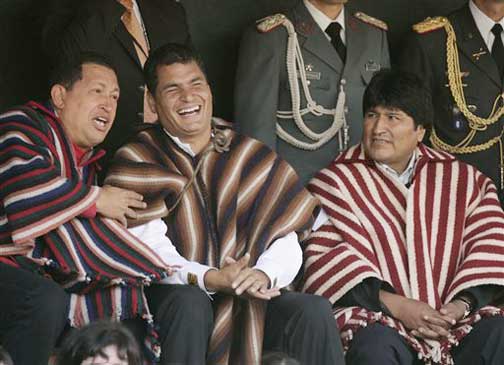
Presidents Hugo Chávez (Venezuela), Rafael Correa (Ecuador) and Evo Morales (Bolivia).
Workers’ governments and socialist strategy — a discussion

"The FSLN government in Nicaragua immediately after the fall of the Somoza dictatorship may qualify as a workers' gove
Bolivia's proposals on the 'rights of nature' for Rio+20
December 19, 2011 -- The proposals developed by the Plurinational State of Bolivia bring together and build upon the progress made in the World Charter for Nature (1982), the Rio Declaration (1992), the Earth Charter (2000) and the World People’s Conference on Climate Change and the Rights of Mother Earth (2010).
[The United Nations Conference on Sustainable Development (Rio+20) is scheduled for June 20-22, 2012, in Brazil. It marks the 20th anniversary of the 1992 United Nations Conference on Environment and Development (UNCED), in Rio de Janeiro, and the 10th anniversary of the 2002 World Summit on Sustainable Development (WSSD) in Johannesburg.]
I. A DEEPER COMMITMENT TO SUSTAINABLE DEVELOPMENT IN THE 21ST CENTURY


Durban climate talks: ‘Forests are not for carbon stocks’ -- climate justice activists condemn REDD

Photo: Anne Petermann/GJEP-GFC.
Pablo Solon: What to expect from Durban climate talks: temperature to rise more than 4° C

Balance sheet and perspectives on the climate change negotiations
By Pablo Solon

March from TIPNIS arrives in La Paz. Photo by Dario Kenner.
By Federico Fuentes
November 20, 2011 -- Green Left Weekly/Links International Journal of Socialist Renewal -- The recent march in Bolivia by some Indigenous organisations against the government’s proposed highway through the Isiboro Secure National Park and Indigenous Territory (TIPNIS) has raised much debate among international solidarity activists. Such debates have occurred since the election of Bolivia's first Indigenous president, Evo Morales, in 2005 on the back of mass uprisings.
Overwhelmingly, solidarity activists uncritically supported the anti-highway march. Many argued that only social movements — not governments — can guarantee the success of the process of change.
However, such a viewpoint is not only simplistic; it can leave solidarity activists on the wrong side.
Kevin Young’s October 1 piece on Znet, “Bolivia Dilemmas: Turmoil, Transformation, and Solidarity”, tries to grapple with this issue by saying that “our first priority [as solidarity activists] must be to stop our governments, corporations and banks from seeking to control Bolivia’s destiny”.
Bolívia: As ONGs equivocadas com relação a Morales e à Amazônia

[Available in English at http://links.org.au/node/2512 and http://boliviarising.blogspot.
Federico Fuentes
28/09/2011 -- Horadopovo.com.br -- Declarações, artigos, cartas e petições circularam na Internet durante o mês passado pedindo o fim da "destruição da Amazônia".
O objeto dessas iniciativas não têm sido as corporações transnacionais nem os poderosos governos que as respaldam, mas o governo do primeiro presidente indígena da Bolívia, Evo Morales.
No centro do debate está a proposta do governo boliviano de construir uma estrada através do Território Indígena Parque Nacional Isiboro Sécure (TIPNIS).
O TIPNIS, que cobre mais de 1 milhão de hectares de florestas, obteve o estatuto de reserva indígena do governo de Evo Morales em 2009. Cerca de 12.000 pessoas de três grupos indígenas diferentes vivem em 64 comunidades dentro do TIPNIS.
Bolivia: NGO's geven verkeerd beeld over Morales en Amazonewoud
Mars in Trinidad tegen de snelweg op 15 augustus.
[Available in English at http://links.org.au/node/2512 and http://boliviarising.blogspot.
Federico Fuentes, vertaald uit het Engels door Sabrina Verswijver
28/09/2011 -- DeWereldMorgen.be -- Het doelwit van de acties waren deze keer niet de transnationale bedrijven of machtige overheden die dergelijke bedrijven steunen, maar wel de eerste inheemse president van Bolivia, Evo Morales.
Aan de basis van het debat ligt het controversiële voorstel van de Boliviaanse overheid om een snelweg aan te leggen door het Isiboro Secure Nationaal Park en Inheems Gebied (TIPNIS).
TIPNIS beslaat meer dan één miljoen hectare aan bos en kreeg in 2009 de status van inheems gebied toegewezen door de regering-Morales. Ongeveer 12.000 mensen van drie verschillende inheemse groepen leven in 64 gemeenschappen in TIPNIS.
Bolivia: le ONG sbagliano su Morales e l'Amazzonia
[Available in English at http://links.org.au/node/2512 and http://boliviarising.blogspot.
di Federico Fuentes
25/09/2011 -- Radiocittaperta.it -- Dichiarazioni, articoli, lettere stanno circolando in Internet chiedendo la fine della "distruzione dell'Amazzonia".
L'obiettivo di queste iniziative non è rappresentato dalle corporazioni transnazionali né dai potenti governi che le appoggiano, ma il governo del primo presidente indigeno della Bolivia, Evo Morales.
Al centro del dibattito c'è la controversa proposta del governo boliviano di costruire un'autostrada attraverso il Territorio Indigeno del Parco Nazionale Isidoro Sécure (TIPNIS).
Il Tipnis, che copre una superficie di più di 1 milione di ettari di foresta, ha ottenuto lo statuto di territorio indigeno dal governo di Evo Morales nel 2009. Circa 2.000 persone vivono in 64 comunità all'interno del TIPNIS.