capitalism
United States: Race and class -- African Americans in a sick system
By Malik Miah
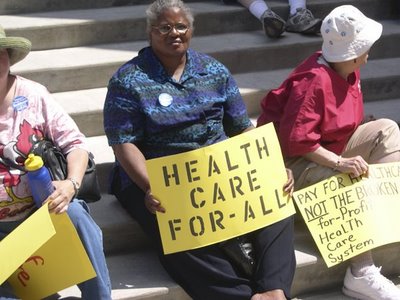
August 2009 -- The critical lack of quality and affordable health care is devastating for African Americans. Twice as likely as whites to go without health insurance, African Americans suffer chronic illnesses such as high blood pressure and diabetes at an escalating rate. The root of the problem is not inferior Black — or better white — health care. It is first and foremost a class issue, exacerbated for Blacks and Latinos because of the institutional racism that still permeates society.
Only the wealthy can afford “the best medical care in the world”. Everyone else’s care is rationed by the employer or private plans that each can afford to buy, or if uninsured, by the use of “free” clinics and emergency rooms. The debate over the broken US health-care system and what to do about it is one of life and death.
Stubborn facts
The false promise of energy efficiency and a real alternative

By Don Fitz
August 22, 2009 -- An action can have opposite effects, depending on it s social contexts. An isolated individual who protests company policy by refusing to go to work could well get fired and become an example used to intimidate others. When an entire workforce stays off the job, it’s called a “strike” and has a very good chance of forcing the company to change its policy.
As positive as they may be for friends and family, individual lifestyles of non-violence do not stop wars from being fought. But a society that eliminates corporate control of the economy gets rid of the need for expansion and takes an enormous step towards non-violence. In this context, non-violent lifestyles solidify non-violent global politics.
It is even more so with “energy efficiency”. It is impossible for individual choices to purchase energy-efficient products to have any positive effect on climate change. But, in a democratically run economy, energy efficiency would be a cornerstone of resolving the catastrophic legacy of production for profit.
Climate change: Why population is not the problem
By Jess Moore
August 9, 2009 -- We face a climate crisis and something needs to change. The world’s resources are finite, as is the amount of destruction humans can do to the planet if we are to survive. There is a debate in the environment movement about whether or not curbing population is an essential part of the solution. We have a decade, maybe a decade and a half, to transform our current relationship with the planet. Of course, the starting point for environmentalists cannot be solutions. We first need to identify the cause of the crisis before we can know how to fight it.
People who see limiting population as essential to solving the climate crisis argue the cause of environmental degradation, at least in part, is overpopulation. Most “populationists” argue there are already too many human beings on the planet to provide for everyone’s basic needs. All contend that curbing population growth or decreasing population is some or all of the solution to climate change and to the fact that the basic needs of many people are not satisfied.
Sustainability: utopian and scientific

By Mark Burton
Read an exclusive excerpt from Foster's The Ecological Revolution: Making Peace with the Planet at http://links.org.au/node/1066.
Links readers are also encouraged to purchase a copy of this important new book HERE.
* * *
Versailles vs Comintern: two visions of world peace
By Barry Healy
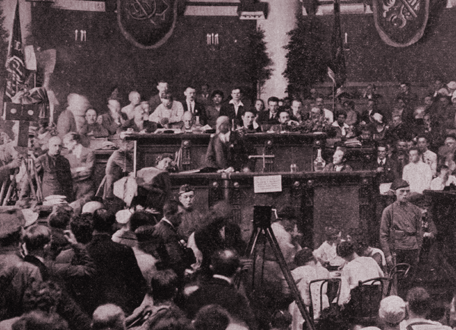
June 28, 2009, was the anniversary of the two bookends of World War I, in which it is estimated more than 15 million people died. On that date in 1914 Austrian Archduke Franz Ferdinand was assassinated in Sarajevo and, five years later, in 1919, 90 years ago this year, the Versailles Treaty was signed in Paris.
The first war in which the capacity of modern industry to deploy, feed, arm and dismember people was so hideously demonstrated, WWI was experienced by its victims as the "war to end all wars". Unfortunately, it proved not to be.
Out of the ashes of the conflict two competing visions of world peace arose: Versailles and the revolutionary and democratic alternative represented by the Communist International (Comintern) emanating from the 1917 Russian Revolution.
US President Woodrow Wilson swept into the treaty negotiations declaring: “The world must be made safe for democracy.” Over six months of intense horsetrading at Versailles a new imperialist order was hammered out, resulting in many of the conflicts that followed.
Can carbon trading save our forests?

By Susan Austin
June 26, 2009 – Hobart, Tasmania -- Along with over 400 other people, I turned up to the Wrest Point Casino here to attend the premiere of The Burning Season on June 1. I had the film’s headline -- “As inspiring as The Inconvenient Truth was frightening” in the back of my mind, hoping for a good news story. Instead I sat through a well-orchestrated promo for a carbon trading company, set up by a young Australian-based millionaire whose message was that it is possible to make money and save the environment at the same time.By setting up a carbon trading company called Carbon Conservation, and brokering high-level deals between big banks and provincial Indonesian governors, the film’s “star”, young entrepreneur Dorjee Sun, was able to secure the protection of large areas of forests that may otherwise have been logged or burnt.
Adam Smith was closer to Karl Marx than those showering praise on Smith today

Biofuels and sustainable transport -- Can biofuels be produced and used responsibly?

By Renfrey Clarke
June 16, 2009 -- For governments and vehicle corporations, the charm of biofuels used to be the promise they held out of a ready-made solution to transport-related greenhouse gas emissions -- a solution that might simply be dropped in, while changing almost nothing else. Freeways, suburban sprawl, four-wheel-drive family cars -- everything could remain. Only the fuel on sale at service stations would be different.
Biofuels, the promise to the public ran, would be ``clean and green’’, an environmental zero-sum. Although carbon was released to the atmosphere when biofuels were burnt, this was carbon that had been there earlier, before being taken up by the plants from which the fuels were derived.


By Rick Wolff
June 5, 2009 -- The greatest tragedies among many in the collapse and bankruptcy of General Motors (GM) concern what is not happening. There are those solutions to GM's problems not being considered by Obama's administration. There are the solutions not being demanded by the United Auto Workers Union (UAW). There are all the solutions not even being discussed by most left commentators on the disaster. Finally there are crucial aspects of GM's demise not getting the attention they deserve.