climate change
Nationalisation — a key demand in the socialist program

By Dave Holmes
`Too many people' arguments provide no solution to the global warming crisis
By Simon Butler
November 17, 2008 -- In Green Left Weekly, Climate and Capitalism and Links International Journal of Socialist Renewal , I argued that population reduction schemes provide no answers to the threat of climate change. Population-based arguments wrongly treat population levels as the cause, rather than an effect, of an unsustainable economic system. This means they tend to divert attention away from pushing for the real changes urgently needed.
Campaigning for such measures as the rapid introduction of renewable energy and the phasing-out of fossil fuels, along with a shift to sustainable agricultural methods, should instead be the highest priority of the environmental movement.
Strategies to reduce human population also end up blaming some of the world’s poorest people for the looming climate crisis, when they are the people least responsible. Instead, it is the powerful, vested interests that profit most from the fossil-fuel economy who pose the real threat to the planet. They must be confronted.
John Bellamy Foster: Ecology and the transition from capitalism to socialism

Walk Against Warming, Sydney, 2006.
Photo by Alex Bainbridge/Green Left Weekly
By John Bellamy Foster
[This article, which first appeared in the November 2008 issue of Monthly Review, is a revised version of a keynote address delivered at the “Climate Change, Social Change” conference, Sydney, Australia, April 12, 2008, organised by Green Left Weekly. It is posted at Links International Journal of Socialist Renewal with the author's permission. Watch and listen to Bellamy Foster's presentation HERE. For more articles on Marxism and the ecology, click HERE.]
Is the climate crisis caused by overpopulation?

By Simon Butler
November 12, 2008 -- Many environmentalists believe that environmental destruction is a product of “overpopulation”, and that the world is already “full up”. So are population reduction strategies essential to solving the climate crisis?
At best, population control schemes focus on treating a symptom of an irrational, polluting social and economic system rather than the causes. In China, for instance, such measures haven’t solved that country’s environmental problems.
At worst, populationist theories shift the blame for climate change onto the poorest and most vulnerable people in the Third World.
They do not address the reasons why environmental damage, or even instances of overpopulation, happen in the first place and they divert attention away from the main challenge facing the climate movement — the urgent need to construct a new economy based on environmentally sustainable technologies and the rising of living standards globally.
For at least 200 years, “overpopulation” has been used to explain a host of social problems such as poverty, famine, unemployment and — more recently — environmental destruction.
Once again on ‘The myth of the Tragedy of the Commons’: a reply to criticisms and questions
A reply to criticisms and questions about my article on Garrett Hardin’s influential essay.
By Ian Angus
John Bellamy Foster on climate change: `Demand solutions based on necessity, not wealth and profits'
John Bellamy Foster: We need to go down to 350 parts per million [of carbon dioxide], which means very big social transformations on a scale that would be considered revolutionary by anybody in society today -- transformation of our whole society quite fundamentally. We have to aim at that, and we have to demand that of our society.
Forget about capitalism, forget about whether the system can do it. Don't let that be your barometer. Say this is necessary for the planet, for human survival, for justice, for environmental justice, and we just have to do it.
We demand that be done, and we work out the operating system of the world economy, we work out our social relations of production, in accordance with necessity, in accordance with what is necessary for the planet, not in accordance with what is necessary for the accumulation of wealth and profits for a very few.
Evo Morales: Ten commandments to save the planet

By Evo Morales Ayma, president of the Republic of Bolivia
Message to the Continental Gathering of Solidarity with Bolivia in Guatemala CityOctober 9, 2008 -- Sisters and brothers, on behalf of the Bolivian people, I greet the social movements of this continent present in this act of continental solidarity with Bolivia.
We have just suffered the violence of the oligarchy, whose most brutal expression was the massacre in Panda, a deed that teaches us that an attempt at power based on money and weapons in order to oppress the people is not sustainable. It is easily knocked down, if it is not based on a program and the consciousness of the people.
We see that the re-founding of Bolivia affects the underhanded interests of a few families of large landholders, who reject as an aggression the measures enacted to favour the people such as a more balanced distribution of the resources of natural gas for our grandfathers and grandmothers, as well as the distribution of lands, the campaigns for health and literacy, and others.

US$700 billion dollars is twice the combined debt of the world’s poorest 49 countries.
By Tony Iltis
October 11, 2008 -- “Meltdown” is a word that one hears a lot on the news these days.
Despite the US$700 billion government bailout of banks in the US, similar (albeit smaller) bailouts in Europe, and various forms of state intervention in the finance industry on both sides of the Atlantic, sharemarkets worldwide are in free fall. Comparisons with the Great Depression of the 1930s are common. Homelessness and unemployment are rising and are set to increase dramatically.
Meanwhile, more quietly but even more relentlessly, another meltdown is occurring: that of the polar icecaps. According to the Western world’s establishment politicians and corporate media, the way to avert catastrophic climate change lies in setting up elaborate emissions trading schemes and carbon markets: that is, relying on precisely the mechanisms that have created the economic meltdown!
Global warming - No more business as usual: This is an emergency!

By David Spratt
October 10, 2008 -- A year ago I was researching what was intended to be a short submission to the Garnaut review [commissioned to advise the Australian federal government of Labor Party Prime Minister Kevin Rudd], when events in the polar north turned the world of climate policy upside down. It was found that eight million square kilometres of sea-ice — an area the size of Australia — was melting, in the immortal words of one glaciologist, "a hundred years ahead of schedule".
Yet the international policy debate carried on as if this had not happened. Out-of-date scenarios, research and observations were being used to propose emission reduction targets that would still lead to catastrophe even if fully implemented.
And so a short submission became a long detour into how the climate debate is being constructed, and the result, with Philip Sutton, was a book we did not intend to write, Climate Code Red.
Climate change -- the case for public ownership
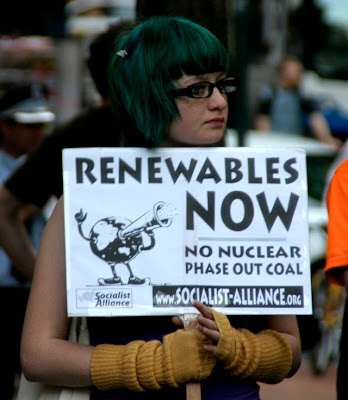
Australia’s Socialist Alliance urges a 10-point plan to cut atmospheric CO2
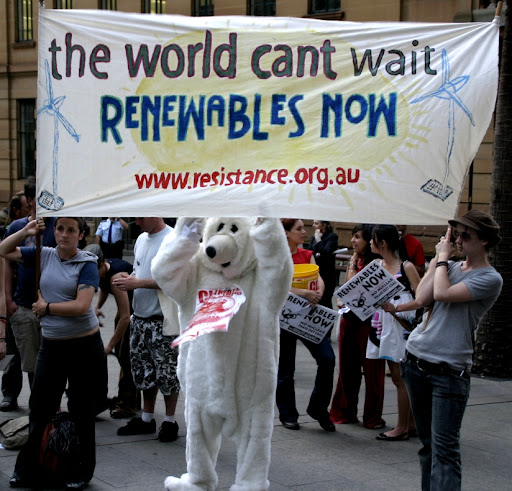
Sydney climate emergency rally, October 3, 2008. Photo by Alex Bainbridge.
Climate action now!
September 25, 2008 -- The Australian federal government’s climate change adviser, Professor Ross Garnaut, has released his recommendations for medium-term cuts to Australian greenhouse gas (GHG) emissions.
He calls for reductions by 2020 of just 5% if there is no comprehensive international agreement on emissions reductions, or reductions of 10% if there is an agreement. At the Bali climate summit in December 2007 many developed countries expressed support for goals of 25-40% reductions.