Latin America
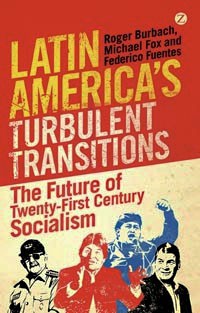
Latin America’s Turbulent Transitio

March 6, 2013 -- Links International Journal of Socialist Renewal -- Venezuela's revolutionary leader Hugo Chavez has died. The Venezuelan people will face the enormous challenge of continuing their socialist revolution without unifying and mobilising figure of Chavez, who has been at the forefront of deepening and extending its radical course.
Green Left Weekly's Ryan Mallett-Outtrim, reported from Venezuela:
Venezuelan media today announced that Venezuelan President Hugo Chavez has died.
At approximately 5.30pm local time on March 5, Vice-President Nicolas Maduro addressed the nation, stating that after nearly three months of treatment in Cuba and Venezuela, Chavez passed away in the Dr. Carlos Arvelo military hospital in Caracas.
“Those who die for life, can’t be called dead”, he stated, after announcing that the president has lost his two year battle with cancer.
Jean-Luc Mélenchon, Die Linke salute Hugo Chavez's socialist vision
Above: March 6 press conference by Jean-Luc Mélenchon (Front de Gauche, Left Front) on the death of Venezuela's President Hugo Chávez Frias.
l’Humanité interview with Jean-Luc Mélenchon, spokesperson Front de Gauche (Left Front), France, translated by Dick Nichols
March 7, 2013 -- You have always supported the revolutionary process in the Venezuela, why?
We need to place the Bolivarian Revolution in its continental and historical context. The collapse of state communism was presented to the whole world as the end of history for communist and socialist sentiment and aspiration. But the flame flared up again in South America because the new age of capitalism had made that continent its proving ground. Neoliberalism was tried out there by military dictatorships on the one hand and by Operation Condor and CIA acts of violence on the other. The policies which then got applied were the same everywhere: free and unbridled competition, monetarism and deregulation, leading the whole continent to disaster. It is in this context that the revolutionary flame flared up again. Bolivarian Venezuela has occupied a special place: not only has been it been built on democratic foundations, but it has outmaneuvered the criminal plans of the opponent by peaceful and popular action.
African solidarity with the Venezuelan revolution and tributes to Hugo Chavez

Hugo Chavez's funeral, March 8, 2013.
[Below are statements issued by left and progressive organisations in Africa. More will be posted as they come to hand.]
* * *
Taking forward the revolutionary life and symbolism of hugo Rafael Chavez Frias
March 10, 2013 -- The Democratic Left Front (DLF) of South Africa joins the millions of poor and working people and their mass movements in Venezuela, the Caribbean, Latin America and across the world who celebrate the revolutionary and emancipatory life and symbolism of Hugo Rafael Chávez Frías. Since his tragic passing away on March 5, our hearts have drawn inspiration and courage from his example and symbolism.
As the 9 million people who attended his funeral on March 8 showed, Chavez represented and personified immense hope and possibility: hope for the wretched of the Earth, hope and faith in the ability of the mass of exploited and oppressed people to self-organise and challenge inordinate power relations in society, and thereby be their own liberators, and realistic hope in the possibility of constructing a socialist alternative to the barbarism of capitalism.
Media lies exposed: Venezuela's economic and social performance under Hugo Chávez, in graphs
Jim McIlroy, an activist from the Australia-Venezuela Solidarity Network, interviewed by ABC TV News, on March 8, 2013, on the significance of Venezuela's socialist President Hugo Chavez. He successfully refutes the misinformation of the hostile "interviewer".
March 10, 2013 -- Links International Journal of Socialist Renewal -- Following the tragic death of Venezuela's President Hugo Chávez from cancer after 14 years in office, the world's big-business media has gone into overdrive to dishonestly describe Chavez's record as being "authoritarian", "dictatorial" and having made the Venezuelan economy a "basket case", as was rudely interjected by an Australian Broadcasting Corporation "journalist" in the video above. Such media lies have been refuted by Fairness and Accuracy in Reporting and VenezuelAnalysis.
Marta Harnecker: 'Chavez's legacy: with the people, building a socialist alternative to capitalism'

Thousands turn out in Caracas to remember Chavez.
By Marta Harnecker, translated by Yoshie Furuhashi for MRZine
March 6, 2013 -- La Segunda -- When Hugo Chávez triumphed in the 1998 presidential elections, the neoliberal capitalist model was already floundering. The choice then was whether to re-establish the neoliberal capitalist model -- clearly with some changes including greater concern for social issues, but still motivated by the same logic of profit seeking -- or to go ahead and try to build another model.
Hugo Chavez Frias – visionary, fighter, companero (Asia-Pacific left statements) (updated Mar. 17)

[Below are statements issued by socialist and progressive organisations in the Asia-Pacific region. More will be posted as they come to hand.]
* * *
Statement of the Socialist Alliance (Australia)
March 6, 2013 -- The Socialist Alliance in Australia expresses its deepest sympathies with the people and government of Venezuela on the death of Companero Hugo Chavez Frias on March 5. His passing is a huge loss for all peoples, across Latin America and the globe, struggling for a world free of inequality, exploitation and oppression.
It is testament to Hugo Chavez’s great leadership that, while mourning his death, we are also confident that the Bolivarian Revolution and the new movement for socialism of the 21st century that Chavez inspired will be continued by the mass of people, to whom he worked so hard to give power.
Hugo Chavez, undefeated! Why the rich and powerful hated Chavez
'So let the corporate media lie about Chavez in their cynical way.

Michael Lebowitz: Working-class response to devaluation measures in Venezuela

By Michael A. Lebowitz
Excerpt from new book, 'Race in Cuba: Essays on the revolution and racial inequality'

The following is an excerpt from Est