United States
Review of `Renegade: The Making of Barack Obama'

Renegade: The Making of Barack Obama
By Richard Wolfe, Virgin Books, London 2009
Review by Jeff Richards
October 14, 2009 – Whatever your views are about Barack Obama, there is no doubt that his campaign for the US presidency was a major milestone in the history of electoral politics in the United States. How did a senatorial rookie who was black, with an alien name and a background in community organising get to the centre of the system of power? It was both a matter of circumstance (the crises and failure of neoconservative project) and the remarkable political skills of Obama and the campaign team led by David Axelrod.
United States: `Birthers', `deathers' and haters -- Right-wing populism and liberal retreat

October 11, 2009 — The heat is on the administration of US President Barack Obama. The energised conservative base has taken over town hall meetings on health care. There are “birthers” (those who claim Obama is not a US citizen and ineligible to be president), “deathers” (those who claim Obama’s health care reform is a plan to kill old people) and just pure haters. Obama has been personally attacked as a racist, socialist, communist, Stalinist, fascist, Nazi, Pol Potist, foreigner and every other name the right finds in its vocabulary.
When Obama led the US delegation to Copenhagen to get his home town of Chicago the 2016 Olympics — and failed — he was attacked as “out of touch” by the right. When Chicago was knocked out in the first round of voting, the right gleefully cheered! The “country first” crowd forgot that a Chicago Olympics would be in the United States, not “Obama Land”.
On September 17, 2009, John Bellamy Foster appeared on Democracy Now! to discuss the financial
United States: Ted Kennedy -- The myth of the `liberal lion'

Ted Kennedy during his first campaign for US Senate in 1962.
By Lance Selfa
August 28, 2009 -- Democratic Party senator Ted Kennedy's political career reflects the course of US liberalism, from its heyday in the 1960s to its sorry state today.
For decades, Ted Kennedy was the bogeyman used by conservatives in their fundraising appeals to raise millions of dollars. To them, the liberal Kennedy seemed to represent everything they hated--there was no easier way to get a right-wing crowd booing and hissing than to mention Kennedy's name.
So it was more than a little jarring to hear conservatives sing Kennedy's praises for his "bipartisanship" in the wake of Kennedy's death from brain cancer on August 25.
"There is nobody else like him", Republican Senator Judd Gregg told the Associated Press. "If he had been physically up to it and been engaged on this [the current health-care reform debate], we probably would have an agreement by now."
Yeah, right.
The free-market fallacies of Ayn Rand

By Phil Hearse
United States: Race and class -- African Americans in a sick system
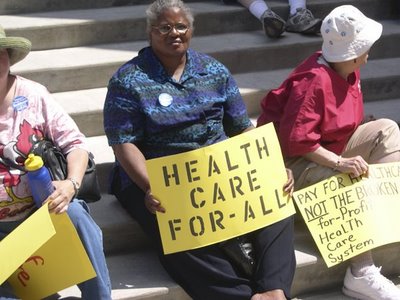
By Malik Miah
August 2009 -- The critical lack of quality and affordable health care is devastating for African Americans. Twice as likely as whites to go without health insurance, African Americans suffer chronic illnesses such as high blood pressure and diabetes at an escalating rate. The root of the problem is not inferior Black — or better white — health care. It is first and foremost a class issue, exacerbated for Blacks and Latinos because of the institutional racism that still permeates society.
Only the wealthy can afford “the best medical care in the world”. Everyone else’s care is rationed by the employer or private plans that each can afford to buy, or if uninsured, by the use of “free” clinics and emergency rooms. The debate over the broken US health-care system and what to do about it is one of life and death.
Stubborn facts
United States: Healthcare `town hall' meeting a charade of democracy

By Billy Wharton
August 19, 2009 -- The were two big winners at the recent “town hall” healthcare meeting held in the North Bronx, New York City, neighbourhood of Parkchester on August 17 – the lunatic right wing and the private health insurance industry. These victories came despite the fact that the vast majority of those who lined up to participate in the meeting supported either a single-payer system or a public option. Most came away disappointed. I got kicked out.
The right wing won this contest without even participating in it. Sure there was one woman with a “Freedom Isn’t Free Shirt”, but there were certainly none of the antics that have come to typify other ``town hall'' meetings. Not even one “Death Panel” sign. How then did the right wing win? Democrat Representative Joseph Crowley, the organiser of the event, guaranteed this by closing off all space for public discussion.
United States: Industry-backed opponents of healthcare reform react with racism, violence

By Don Fitz
August 14, 2009 -- St. Louis -- Did you hear about the town hall meeting in St. Louis on August 6, where union thugs attacked a black conservative and sent him to the hospital with multiple injuries? Well, it didn’t happen exactly like that. In fact, events were the opposite of what talk show hosts Rush Limbaugh and Bill O’Reilly broadcast and what the corporate media relayed across the US.
The right-wing Tea Party group announced to the world that their supporter Kenneth Gladney was assaulted by Elston McCowan, who is an organiser for the Service Employees International Union (SEIU). Earlier this year I worked closely with McCowan, a black minister, when he ran for mayor of St. Louis on the Green Party ticket. Since nothing that I heard fit the McCowan I know, I interviewed him about the August 6 incident.
Vietnam: Chemical companies, US authorities knew the dangers of Agent Orange

By Jon Dillingham
Thanh Nien -- August 10, 2009, was the first Orange Day organised in Vietnam –- not only to be remembered by victims of Agent Orange but to mark Vietnam's common pain. Those responsible for exposing Vietnamese citizens and US troops to toxic defoliants kept silent about known health implications, a review of documents finds.
US chemical companies that made Agent Orange and the government and military authorities who ordered its spraying on Vietnam knew the human health toll it could take, according to official and unofficial documents detailing the history of the deadly defoliant.
A review of the documents related to the use of Agent Orange –- a dioxin-laden herbicide -– in Vietnam, including decades-old declassified papers from the companies that manufactured it and the government and military that used it, provides compelling evidence that those in charge also concealed evidence of the devastating effects it could have on people.
Lipstick on a pig: The failure of Obama’s health-care reform

By Billy Wharton
July 19, 2009 -- Consider it a symptom of a larger disease. A fervent commitment to defend the profit margins of private industry seems to be a national religion for politicians in the United States. No matter how deeply the private sector mucks up society, some senator or representative or, if things get really out of control, president will appear to rescue the day for the corporations all in the name of justice for the citizens of the US. Like any religion, this process has highly crafted rituals. First a confession, then march the sinners around at one hearing or another, then mete out acceptable penance and then all is forgiven.
[With the permission of Monthly Review Press, Links International Journal of Socialist Renewal is publishing an exclusive excerpt from Steve Early’s new book, Embedded With Organized Labor: Journalistic Reflections on the Class War at Home. Embedded With Organized Labor describes how trade union members in the United States have organised successfully, on the job and in the community, in the face of employer opposition now and in the past. Steve Early has produced a provocative series of essays -- an unusual exercise in “participatory labor journalism” useful to any reader concerned about social and economic justice. As workers struggle to survive and the labour movements try to revive during the current economic crisis, this book provides ideas and inspiration for trade union activists and friends of labour alike.