Venezuela: Epitaph for a revolution?
First published at Luís Bonilla-Molina's blog. Translated by LINKS International Journal of Socialist Renewal.
“We are in a new political moment.” This is how [Acting President] Delcy Rodríguez concisely summed up the situation in Venezuela. The United States intervention in Venezuela, involving two-hours of relentless bombing of Caracas, La Guaira and elsewhere along with the most shameful event in the national Armed Forces’ history, seems a distant memory. The events of January 3 have quickly become a historical event, worthy of commemorating in activist-packed halls, and for international audiences who prefer to live in Narnia in order to prop up their national political projects.
Anti-imperialism is conspicuously absent from contemporary Venezuelan public discourse. Although [former president Hugo] Chávez's cry, “Fucking Yankees, go to hell!” still echoes outside Miraflores Palace, for the past two weeks, the presidential palace microphones have, in a measured manner, indicated that any complaints about the events of January 3 [including the kidnapping of President Nicolas Maduro and First Lady Cilia Flores] will be made exclusively through diplomatic channels, in an attempt to overcome the stain left on US-Venezuelan relations.
Bewilderment still pervades Madurismo’s social base, where there are few meetings in which activists speak ill of the gringos — though, of course, always careful not to mention the orange man in the White House — a kind of consolation for those just beginning to awaken from the grief of their loss.
[US President Donald] Trump’s assertion on the afternoon of January 3 — as the cries of humble mothers for the deaths of a hundred sons reverberated across the besieged homeland — cannot be refuted by the facts: Rodríguez has pledged to cooperate and not repeat Maduro’s mistakes. The mistake Trump referred to appears to have been made by Maduro himself.
Between 2014-25 Maduro dismantled the national-popular program — not to mention so-called 21st-century socialism — that Chávez had embodied, but failed to fully implement the political, legal, and institutional measures needed to transform Venezuela into a new US colony.
Maduro’s error was not one of principles, but political calculation: he believed he could negotiate his continued hold on power in exchange for selling off the country’s wealth to the US. Maduro successfully dismantled a frustrated revolution, but did not know how to present its demise without losing his base. None of this stops us from denouncing his kidnapping on January 3 and demanding his release, because Venezuela is a republic that must resolve its affairs without the intervention of any empire.
The Fantastic Four and Wonder Woman
On January 15, Trump, who enjoys the spectacle of professional wrestling so much that he appointed wrestling entrepreneur Linda McMahon to head the Department of Education, decided to use terms from the Marvel and DC Universes to describe his political options in Venezuela.
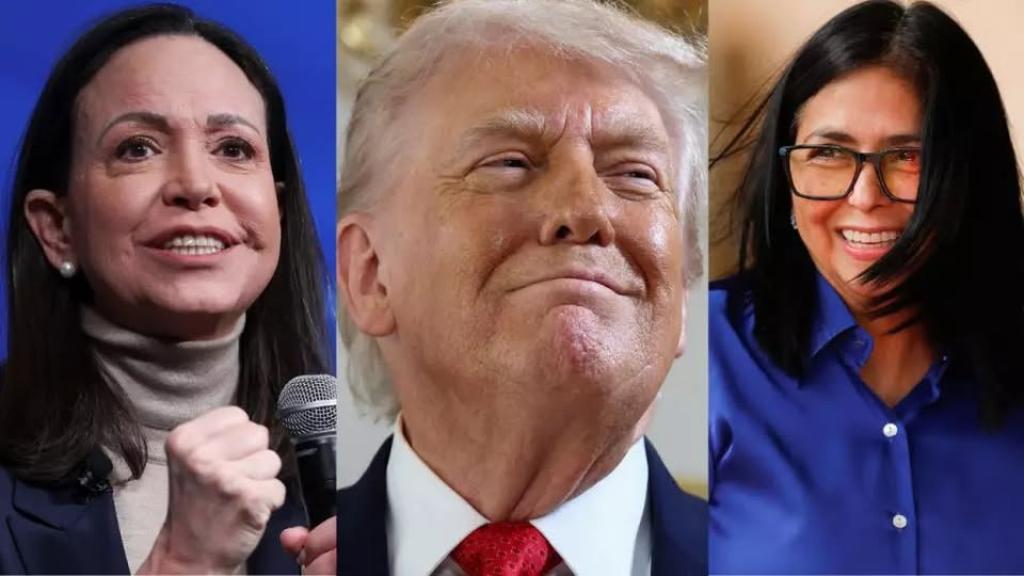
He said that he had a long telephone conversation that morning with Rodríguez, whom he described as “fantastic” and with whom, he said, they were working very well. That afternoon, he met with right-wing opposition leader María Corina Machado behind closed doors. He had brushed Machado aside on January 3 as a potential option to lead Venezuela, but now referred to her as “wonderful” — after, of course, she presented him with her Nobel Peace Prize medal.
Perhaps Trump wanted to replace the “Super moustache” and “Cilita” saga — action figures Venezuela’s government created to represent Maduro and Flores, which were given as Christmas gifts to poor children — with his own rhetorical imagery.
But, in fairness, the term “fantastic” is shared by three other figures who, along with Rodríguez, are at the helm of the Venezuelan administration: Jorge Rodríguez (National Assembly president), Diosdado Cabello (Minister of the Interior and Justice), and [Vladimir] Padrino López (Minister of Defense). They are the “Fantastic Four” of this “new political moment,” who must avoid angering the Lex Luthor in the White House.
The “Wonder Woman” moniker, however, is clearly for Machado, who seems to have distanced herself from the rest of the Venezuelan opposition, which is more inclined to reach agreements with Maduro and now Delcy Rodríguez. As Bifo Berardi would say, these are merely reflections of the mental health problems surrounding power in the 21st century.
Dismantling the remnants of the Bolivarian revolution
The Bolivarian process reached January 3 like a zombie feeding on rhetoric devoid of any basis in reality — a terrible caricature of the promises enshrined in the 1999 Constitution. The decline began before the Unilateral Coercive Measures (US sanctions), but these clearly accelerated the transition from entropy to counterrevolutionary dissolution, most starkly expressed in the 2018 package of economic measures. This package shifted the burden of the crisis onto the working class while protecting circuits of capital accumulation.
The Maduro government became authoritarian, dismantling even the most basic democratic freedoms and ruthlessly creating the worst material conditions any Venezuelan worker alive today has experienced. The “Fantastic Four” were structural components of this decline; they did just inherit this situation, but were co-participants.
The question everyone asked was whether the January 3 imperialist attack on Venezuela could trigger an internal revolutionary response, with the ruling quartet at its head, that could resume the path outlined in the 1999 Constitution. Subsequent events have shattered that illusion. Not only are diplomatic relations between Caracas and Washington being normalised within the framework of an illiberal and colonialist agenda, but the needed counter-reforms are solidifying the new status of US-Venezuelan relations.
At Delcy Rodríguez’s request, the National Assembly has simplified trade regulations to remove restrictions on foreign investment, while initiating reforms to the Hydrocarbons Law to legitimise the plundering of Venezuela’s oil and re-entry of transnational corporations ousted by the Chávez revolution. These rapid restoration measures seek to align Venezuela with Trump’s aims, which were presented to the 16 oil magnates gathered to establish a $100 billion investment fund. This fund will allow the US to increase its current control of nearly one million barrels of Venezuelan oil to more than four million within a couple of years.
Venezuela is rejoining the SWIFT banking system, allowing local financial transactions to be routed through the US. Four private banks (BNC, BBVA Provincial, Banesco, and Mercantil) have already been authorised by the Trump administration to receive a portion of the foreign currency transferred to the country from oil sales. It appears these private banks will sell the foreign currency, while the Central Bank of Venezuela will only receive Bolivars generated from this auction, less the respective intermediary fees.
Delcy Rodríguez promotes this mechanism as a form of “energy cooperation with the US, which will allow any incoming currency to be allocated to two funds: the first for social protection to improve workers’ wages and strengthen areas such as health, education, food, and housing; the second for infrastructure and services.” A quick calculation of the impact of the first US$300 million to be transferred shows how ineffective the 30% of the revenue from oil sales that the US plans to send to Venezuela through the colonial form of intermediation will be in improving the working class’s living conditions.
On January 9, the White House made public its executive order, “Safeguarding Venezuelan oil revenue for the Good of the American and Venezuelan people,” the embodiment of the colonial relationship when it comes to managing resources derived from oil sales. The US assumed for itself the role of “custodian” of Venezuela’s funds, whose use and circulation depends on the US Secretary of State. This was tested with the 50 million barrels of oil the US announced it had confiscated for this purpose.
The Delcy Rodríguez government responded by initiating legislative and institutional reforms to facilitate this. On January 15, the same day as the phone conversation between Delcy Rodríguez and Trump, the reform of Venezuela's Hydrocarbons Law was announced. It was like witnessing a competition to see who could present themselves as the most obedient to the White House occupant: Machado presented Trump with the Nobel Prize medal while Delcy Rodríguez introduced the Hydrocarbon Law reform.
As a smokescreen, the Trump administration ordered the closure of Venezuela’s El Helicoide detention centre, which had been denounced as a torture site, and the release of political prisoners held there. The National Assembly president went from claiming Venezuela had no political prisoners to reporting that more than 400 had been released, with the remaining cases being reviewed. Human rights advocates have previously said the number of political prisoners could be more than 1000. It is important to emphasise that these releases are the result of the struggle waged by the families of political prisoners and human rights organisations that have supported them, and are not an imperial handout.
All this is occurring while Article 5 of Venezuela's State of Emergency decree continues to allow the arrest of anyone who criticises the government. Today, it is common to see police and military personnel in Venezuelan cities checking phones and arresting anyone with information against the government. Most people now leave their homes without a phone, or with a device incapable of receiving WhatsApp messages or accessing social media.
As if this was not enough, on January 15 it was announced that the executive and legislative branches, together with the bureaucratic and employer-oriented Bolivarian Socialist Workers' Central (whose key architect was Maduro), would fast-track a labour legislation reform, creating a new Labor Code adjusted to the new political moment.
The reaction of the capitalist class and business leaders remains to be seen. However, Delcy Rodríguez is very adept at moving in business, financial and banking circles. In fact, between 2018–25, she was tasked by Maduro with finding common ground with the traditional business sector, something she accomplished efficiently.
[The main big business chamber] Fedecamaras had participated in the 2002 coup against Chávez and severed all ties with the government. But Delcy Rodríguez successfully achieved the seemingly impossible: not only was she the star guest at national business meetings starting from 2021, but she managed to break them away from Machado’s calls for confrontation. This experience could prove useful for Delcy Rodríguez in achieving what Maduro could not: an agreement among the various capitalist factions for an orderly transition, where all the wealthy win and no particular sector loses. Of course, in such agreements, those at the bottom always lose.
Changes are happening at breakneck speed while any anti-imperialist perspective seems to further fade.
The great absentee
Internationally, people are asking: Where is the popular response? The truth is that there have been no spontaneous mass mobilisations and autonomous responses to what occurred. The small marches that have taken place have been called by the government, mobilising mainly public employees and the social base it still maintains, which, although diminished, is nonetheless important for these purposes.
How can we explain this? Maduro’s regime has created such a disaster for workers’ living conditions that large segments of the population see his departure as the only chance for change. Citizens seem to have reached a point where they are willing to see if the new circumstances leads to improved wages, allows for the return of the 8 million migrants whose exit fractured Venezuelan families, restore the regular and stable functioning of public services (water and electricity), and establish institutions to address the healthcare, food and housing needs of the vast majority.
However, the colonial-style administration is unlikely to meet these aspirations. A mobilised social movement will only return to the extent that this becomes evident.
In the land of the blind…
Now everyone in politics is talking about transition and solving problems in the short term. But this cannot be done with good intentions alone; it demands a comprehensive understanding of the structural causes of the current situation.
From our perspective, Venezuela’s current crisis originated in February 1983 with the collapse of the rentier model of capitalist accumulation, class collaborationism and political representation. It deepened with the disappearance of the “people” as a unifying element of the nation-state, beginning with the Caracazo uprising of 1989.
This was further exacerbated by the crisis within the military, manifested in the February 4 and November 27 uprisings in 1992. To this we should add the profound crisis of credibility in democracy, a phenomenon that became undeniable with the 1993 election results, and intensified with each subsequent election.
The 1999 Constituent Assembly garnered majority support, but failed to reconstitute the people as the subject of state consensus; on the contrary, chaos deepened, punctuated by periods of apparent stability. The emergence of a new capitalist class in 2002, following the military-backed coup against Chávez, sparked a struggle for wealth accumulation that nearly erupted into civil war between 2014–17.
This inter-capitalist conflict remains unresolved and, worse still, reveals a tendency in both sides to reject class collaboration; that is, they seek to dismantle even the minimum basis for a reformist social agenda that could keep the seeds of radical revolution at bay. We also must now add the trauma of the loss of sovereignty inflicted with the January 3 imperialist attack and the shameful role of the armed forces.
This represents 43 years of unresolved structural crisis in the model of accumulation and political representation. A transition conceived from the perspective of the working class must be capable of addressing each and every component of this crisis. Machado has stated that her approach is different, and the Delcy Rodríguez government seems more interested in clinging to power than resolving this structural crisis. The coming months will be key to understanding and determining the course of events in the country.
So much swimming only to die on the shore
Cuban writer Leonardo Padura recently published a novel that could easily include a chapter about Venezuela. Morir en la arena (To Die on the Shore) tells the story of a disillusioned generation that criticised capitalism as a result of the political, economic, social, cultural and technological problems; that embraced socialism as an alternative; and now seems to accept that the only solution to its problems is a return to a savage, free-market capitalism of competition and labour exploitation, but with a decent wage.
Explaining that what happened in Venezuela was not a socialist experiment, but rather an appropriation by dispossession of the narrative of radical transformation, is not easy. Certainly, the Chávez government had some redeeming qualities, as did the Fourth Republic, but both ultimately became attempts to resolve the capitalist crisis without changing the rentier model of production and accumulation.
More than creating formulas, relaunching future projects today means listening to the people, because a revolution is only possible and sustainable when it resonates with the expectations, needs and requirements of the humble. It is about swimming against the current to avoid drowning on the shore.
The difficult task of revolutionaries
Given this situation, there is no doubt about the priorities. The central task is defending national sovereignty from an anti-imperialist working class perspective; that is, every step in defence of the republic must be accompanied by the demand to re-democratise Venezuelan society and for wage justice. There is no territorial sovereignty without political sovereignty.
It is very difficult to cohere a defence of Venezuelan sovereignty that omits the need to resolve inequality and lack of freedoms in Venezuela. Correctly combining these demands is the challenge of anti-imperialism today.
Therefore, the call for a global anti-imperialist front, based on solidarity with Venezuela, must include the demand to fully restore political, labour and civil freedoms in Venezuela. This will require tact and creativity, commitment and a clear vision.
In this spirit, and with this orientation, we raise our voice as part of the call to organise a global platform, which began to take shape with the online meeting on January 17, bringing together diverse and pluralistic voices that continue to believe that another world and another Venezuela are possible.