August Bebel’s death and the revival of socialism in prewar Japan
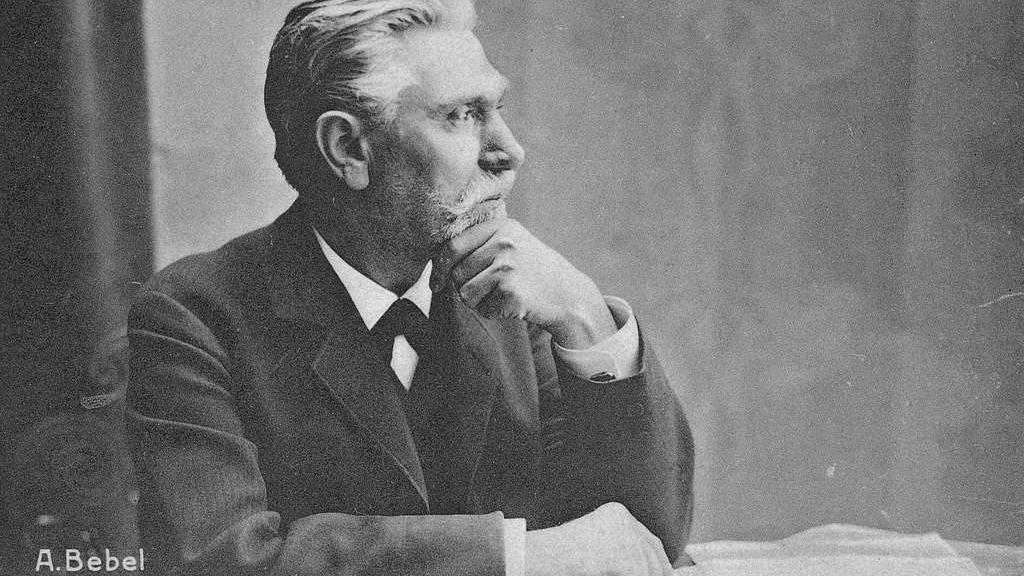
August 13 marked the 113th anniversary of the death of August Bebel, a great socialist, German Social Democratic Party (SPD) leader and the world’s first Marxist feminist. In Japan, the year 1913 when Bebel died, was a dark period known as the “Winter Era” for socialists. Two years earlier, the infamous High Treason Incident had occurred; with the exception of those already in prison, all leading socialist figures were arrested, and some such as Shūsui Kōtoku and Sugako Kan'no were executed as traitors. The media stoked fear of socialists, portraying them as vicious and treacherous criminals who had targeted the life of His Majesty the Emperor, a figure of absolute authority for all Japanese citizens.
However, this was also a time when a new current of Taishō democracy was taking shape. It was during this period that news broke of Bebel’s death. The German socialist leader's death and the media coverage surrounding it became a catalyst for Japan to emerge from its “Winter Era.” One might wonder how a politician’s death in distant Germany could spark the revival of socialism in this backward island nation. However, for the Japanese socialist movement — which had virtually no history of mass-based socialist parties, consisting of scattered individuals, small magazines and study groups — news of the socialist heavyweight’s passing provided a crucial opportunity to speak openly about socialism in Japan.
Many bourgeois newspapers, including major dailies, reported on his death in their August 15 editions (the same date that the Emperor’s broadcast accepting the Potsdam Declaration was aired 32 years later). The Tokyo Asahi Shimbun interviewed Sen Katayama at his home. Katayama had been released from prison the previous year under a general amnesty granted upon Emperor Taishō’s accession. Based on that interview, the paper published an article, “Passing of a Socialist Leader: Remarks by Sen Katayama, the Labor Party’s Valiant General.”1
In 1904, amid the Russo-Japanese War, Katayama became famous for shaking hands with Russian Marxist Georgi Plekhanov at the Second International Congress in Amsterdam in demonstration of their opposition to the war. He met Bebel at that congress and whenever there was a conflict between the Bebel faction (revolutionary) and the Jaurès faction (reformist), Katayama consistently supported Bebel. Katayama’s autobiography states that during the congress, he dined with Bebel and other congress leaders on numerous occasions.2 It was therefore appropriate for the Asahi reporter to have sought comment from Katayama, one of the few Japanese individuals to have had direct contact with Bebel.
The relationship between Bebel and his Woman and Socialism is so inseparable that the two are practically synonymous. Katayama briefly touched on this at the end of his obituary, noting, “Among his works is a book titled Woman in the Past and Present, which discusses the woman question from a socialist perspective. This is a world-renowned book.” Since Bebel’s book had also been published under the title Woman in the Past, Present, and Future, Katayama was likely referring to this title.
Newspapers such as the Yomiuri Shimbun, Tokyo Nichinichi Shimbun and Osaka Mainichi Shimbun also reported on Bebel’s death. Among these obituaries, the longest and most in-depth was written by Tokuzō Fukuda, a professor at Keiō University. Having studied under Lujo Brentano, a leading figure of the German Historical School, and possessing a deep understanding of German socialism, he was another ideal person to write about Bebel. Furthermore, having heard Bebel’s great speech while attending a SPD convention as an observer, he was all the more suited to penning this memorial essay.
Over the course of three days, August 18–20, he wrote a memorial series, “Bebel is Dead,” in the Jiji Shinpō, a daily newspaper founded by Yukichi Fukuzawa and one of Japan’s five major daily newspapers, alongside the Asahi, Yomiuri, Osaka Mainichi, and Hōchi. Publishing three consecutive, extremely favourable editorials about a revolutionary socialist in such an influential newspaper was unprecedented in Japan's history. This essay was later included in his book Essays on Economics. The below quote is taken from this version.
The essay begins with the following passage:
Since August Bebel was born in 1840, he turned 74 this year, making him roughly the same age as the economists Wagner and Schmoller. Now that Professor Schmoller has retired from the University of Berlin and it is reported that Professor Wagner also intends to retire soon, the news of the passing of Mr. Bebel — a worthy adversary and a grand elder statesman of the Social Democratic Party — stirs profound emotion in us, younger scholars.3
Following this introductory passage, Fukuda traced Bebel’s background in detail. He discussed how Bebel, despite being a socialist of working-class origin rather than an academic, rose to become SPD leader through his energy and indomitable spirit. He went on to comment on Bebel’s Woman as follows:
Yet, among social democrats around the world, no book is as widely read as his. People often refer to Marx’s Capital as the “Bible of socialism,” but this is a profoundly mistaken notion; Capital is not like a Bible. Like Buddhist sutras, it is an extremely difficult and obscure text that is not easily understood by anyone who reads it; moreover, it lacks coherence and is, as a whole, extremely flawed and incomplete. To call this a “Bible” is, after all, the idle talk of someone who has never even held Capital in their hands. If socialism has a Bible, it is not Marx’s Capital but rather Bebel’s book Woman and Socialism. While Capital has seen only a few editions to date, Woman and Socialism has now reached its fifty-second or fifty-third edition; by the time the fiftieth edition was published a few years ago, the original German edition alone had already sold 117,000 copies, and it has been translated into fourteen languages, each of which has also seen numerous editions (the English translation of Capital only saw the completion of its third volume a few years ago). There is simply no other work on socialism that has been read so widely throughout the world. Even if Mr. Bebel were to claim to have made no practical contribution to the movement whatsoever, the mere fact that he is the author of Woman and Socialism is more than enough to secure him an immortal place in history.4
Fukuda offered a glowing assessment of Bebel’s Woman. As discussed later, both Sen Katayama and Toshihiko Sakai took note of Fukuda’s obituary essay.
News of Bebel’s death came as a great shock to Japanese socialists. In September that year, they held a small memorial gathering for Bebel. As they could not do so openly, they secretly held it at a comrade’s home. Katayama described the event in his German article, “August Bebel in Japan,” which he contributed to the German Marxist theoretical journal Die Neue Zeit.
We held a memorial gathering for the late Comrade Bebel at the home where a certain comrade had lived during his stay in Tokyo. The fact that this was not publicly announced was because doing so would certainly have resulted in the event being banned. Comrade Toshihiko Sakai spoke at length, drawing on the English translation of Bebel’s memoirs, while Comrade Takahata translated several newspaper articles about Bebel and spoke about him. Comrade Daidō and this essay’s author [Katayama] spoke about their personal acquaintance with Bebel, as well as what they knew of him from their own experiences or from what they had observed and heard since the International Socialist Congress in Amsterdam. In this way, we Japanese paid our respects to the late socialist leader!5
The fact that the memorial gathering had to be held secretly at an individual's home speaks volumes about the political situation in Japan at the time. In this German-language article, Katayama specifically mentions Fukuda’s obituary: “In particular, the Jiji Shinpō published a long essay on Bebel’s life and work in three consecutive issues. The author was Professor Tokuzō Fukuda of Keio University.”6
Articles commemorating Bebel were also published in Gaikō Jihō [Diplomatic Review], Kokka Gakkai Zasshi [The Journal of the Association of Political and Social Sciences], Shin Seiki [New Century], and even Taiyō [The Sun]. Taiyō was Japan’s first full-fledged opinion magazine. Spurred by victory in the Sino-Japanese War, it was launched in 1895 with the aspiration to becoming a comprehensive opinion journal that could rival those of Europe and the United States. Each issue featured in-depth essays by leading intellectuals in Japan (including liberals and socialists).
The memorial article was written by Isoo Abe, a Christian socialist who was deeply knowledgeable about the woman question. Like Bebel, Abe was also a socialist advocate for the abolition of prostitution. Abe’s article, published in the December 1913 issue of Taiyō, was the longest memorial essay on Bebel published in Japanese media. Abe stressed Bebel’s historical significance as follows.
Starting out as a mere labourer, he rose to take the reins of the German Social Democratic Party and became a warrior whose every move immediately captured the world’s attention — and struck fear into its hearts — and whose passing was mourned with a ceremony of such grandeur that even kings and princes could not match it. This Bebel is truly a great figure produced by modern civilisation.7
Abe discussed Bebel’s life in detail, but referred to Bebel’s Woman only briefly at the end of his essay: “Bebel, who strove to rescue the working class from the oppression of the capitalist system, also fought to liberate women from the oppression of men.”8 It can therefore be said that Fukuda’s memorial essay, which focused on Bebel’s Woman, was truly outstanding.
Kindai Shisō [The Modern Thought], a socialist magazine that was barely managing to stay in print, also published several brief obituaries for Bebel. One was written by Toshihiko Sakai, a pioneer of Japanese socialism. As shown in the quote below, this obituary also referred to Fukuda’s tribute:
Japanese newspapers have also written quite a lot about Bebel’s passing. I, too, have a few things I’d like to say, but I cannot write them here. However, I see no harm in discussing just one of his works. The most famous of his books is Woman. The contents of this book are, for the most part, already well known among our circle. However, the 50th edition, published in 1909, includes significant new additions and revisions. Mr. Tokuzō Fukuda recently discussed this book specifically in the Jiji Shinpō. While Marx’s Capital is commonly referred to as the “Workers’ Bible,” it is far too difficult to read to serve as reading material for workers. He writes that Woman is far more deserving of the title “the workers’ Bible.” Although this book is titled Woman, its appeal lies in its plain explanation of the general trend of social evolution and, in particular, its vision of the character of a new society in the future. Both the original German edition and the English translation should be available at Maruzen [Maruzen is a Japanese bookseller specializing in Western books.].9
Sakai discussed Fukuda’s article, specifically mentioning his assessment of Bebel’s Woman, which would later have an unexpected impact on Japanese socialism. Among readers of this socialist journal was a young woman named Kikue Yamakawa, who later became a leading women’s rights activist in prewar Japan. After reading this article and becoming interested in Woman, Yamakawa read an English translation she found at a used bookstore in Kanda.10 This experience opened her eyes to socialist theories of women’s liberation.
Ten years later, in 1923, she published a translation of Bebel’s Woman.11 This was the first complete Japanese translation of the book (though several partial translations had been published earlier), and in all of East Asia, too. Consequently, when Woman was translated in South Korea and China, Kikue’s edition served as either a source text or reference work. In this way, the causal threads of history are intricately intertwined, even across national borders.
The various news reports surrounding Bebel’s death served as the first signal for the revival of socialism in prewar Japan. In the Neue Zeit essay discussed earlier, Katayama wrote: “Even in Japan, where socialism is so deeply despised, feared, and persecuted, it is clear that Bebel worked for our cause!”.12 In this way, the late Bebel contributed just as much to Japanese socialism as the living Bebel had.
- 1
Tokyo Asahi Shimbun, August 15, 1913.
- 2
Sen Katayama, Waga Kaisō [My Memoirs], Vol. 2, Tokuma Shoten, 1967, p. 146.
- 3
Tokuzō Fukuda, Keizaigaku Ronkō [Essays on Economics], Daitōkaku, 1921, p. 330.
- 4
Ibid., p. 332.
- 5
S. Katayama, “August Bebel in Japan,” Die Neue Zeit, 32.1913–1914, 1. Band (1914), H. 4, p. 124.
- 6
Ibid., p. 123.
- 7
Isoo Abe, “Ogusuto, Beberu [August Bebel],” Taiyo [The Sun], December 1913, p. 155.
- 8
Ibid., p. 162.
- 9
Kindai Shisō [The Modern Thought], September 1913, p. 17.
- 10
Kindai Nihon Josei-shi e-no Shōgen [Testimonies on the History of Modern Japanese Women], Domes Publishing, 1979, pp. 29–31.
- 11
Bebel, Fujin-ron [Woman], Ars, 1923. Kikue’s translation was subsequently published in 1929 as one of Kaizōsha’s paperback series; it sold just as well as the original German edition and became a major bestseller, reaching 50 printings in the prewar period alone.
- 12
Katayama, “August Bebel in Japan,” p. 124.