Belgium’s student protests against austerity
First published at Rosa-Luxemburg-Stiftung.
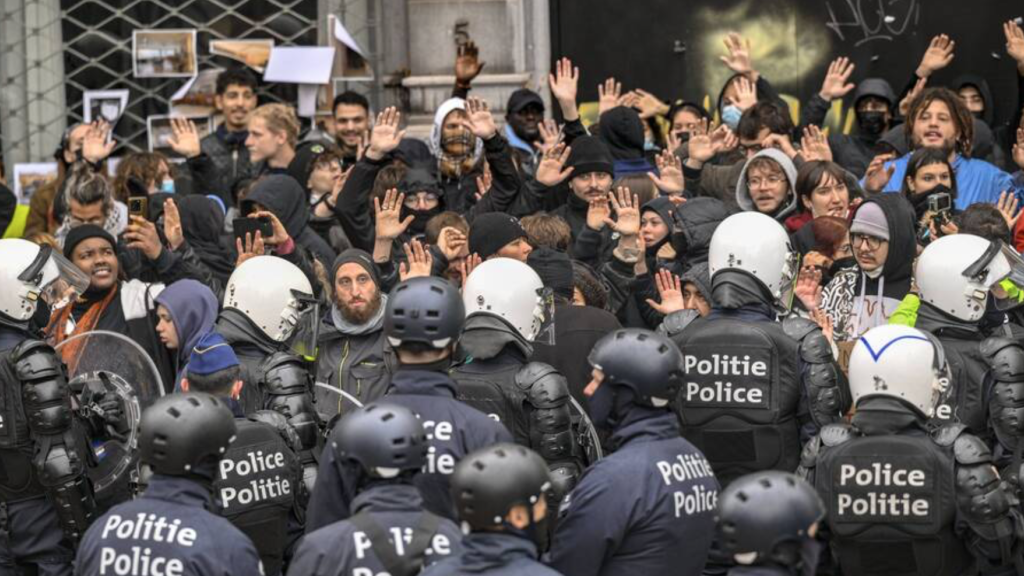
Hundreds of thousands of students are protesting against poor state of their education systems across Europe. These movements are a part and parcel of a growing social pushback against European austerity politics, which slash funding for public services, pensions and wages, but divert billions of public funds to the military industry.
In Belgium, the protests are already shaking up government: Prime Minister Bart De Wever has submitted his resignation amid a deadlock over the government’s austerity budget. With another major mobilisation planned for 17 November, students, teachers and trade unions are continuing to challenge the government’s plans.
Alexandra Gerasimcikova spoke to Bruno Bauwens, member of the Brussels parliament for the Workers’ Party of Belgium (PTB-PVDA) about the education sector protests and the wider anti-austerity struggle in Belgium.
In Belgium, the latest wave of protests started in the beginning of October with a big action in the city of Liège, including students as well as teachers. This was soon after protests erupted in France. Was that the beginning of mobilisations in the educational sector in Belgium, or did French experience trigger it?
Actually, there have already been protests for two years over cuts in the education sector. They were triggered by the new “Arizona coalition” government, which has been in place since 2024 and is led by Prime Minister Bart de Wever of the right-wing nationalist New Flemish Alliance (N-VA).
The student protests of the last 2 years were against reforms by minister of education Valérie Glatigny of the francophone Federation Wallonie-Bruxelles. She wanted to increase teachers’ workloads by 10 percent, cut 2000 teaching positions, and abolish free school lunches. At the same time there were also protests against similar cuts in Flanders.
Liège saw big demonstrations, but protests have also taken place in Brussels, Namur, Charleroi, and smaller cities. There is deep discontent about education policies, but also about investments in the arms industry, and cuts to salaries and pensions. The only budget that is growing is that of Defence Minister Theo Francken.
Trade unions say they don't know anymore because there have been so many. In October last year, 140,000 people, including many students and teachers, gathered against austerity cuts and proposed pension reforms. It was one of the biggest rallies in Belgium in the last 30 years.
What are the proposed education system reforms, and how do they fit into broader austerity plans in Belgium?
Our government is negotiating a new budget that would result in 10 billion euros in austerity cuts. They still do not have an agreement because they know that whatever they will propose, people will get angrier.
But many measures were already taken in the education sector, and they reflect a really aggressive ideology. For the francophone Wallonia-Brussels Federation, one of the three language communities in charge of education and culture in Belgium, the main issue is the increase in university entrance fees, called the Minerval, from 400 to 1,200 euros.
This closes the door to higher education for many people. The main objective is to create a more elite education system, giving the chance to go to university to a small group of people. This amounts to a policy of de-democratisation of education.
Another important measure is that that secondary-school teachers would have to work 10 per cent more without a salary increase. Studies have shown that an average working time of a teacher in high school is already 42 to 47 hours a week. Teachers are protesting against this measure, but so are pupils, because they want a school where teachers have time for them.
The government has also cut subsidies for free meals in schools in poorer areas, which is a very unpopular measure. This means that children come to school with empty stomachs, and if they don't have enough to eat, they cannot learn.
The liberals and the social democrats in the government are shrinking democratic education. The result of that would be a society where a small elite group will enjoy higher quality education, while the rest will become a flexible working class for whom education is unnecessary.
It seems like the protests are concentrated in Wallonia and Brussels, the French-speaking parts of Belgium. Are there also similar problems in Flanders?
There are also problems and protests in Flanders. We might see them less, but they are there. Zuhal Demir, the Flemish Minister of Education from the N-VA, is also cutting several million euros from teachers' salaries. Schools that are already suffering from a lack of teachers have even fewer teachers available. This also means larger classes.
Another measure is to abolish student grants at universities, which might impact around 20,000 students and would limit access to higher education.
Do the school protests have a class dimension, or is it students from all schools, both well-off and more marginalised, who come out to protest?
The measures target people who have more financial difficulties, but that group is getting bigger and bigger. They affect both lower- and middle-class people.
So at the protests you meet students from all kinds of schools because everybody is concerned. You worry about your own school, your big brother that has to go to university but cannot afford it, and your parents who will have to work until they are 67 and are exhausted.
Everybody is affected by these anti-social policies, not only in Belgium but also other countries. It is really good to see that people are standing up and organizing to protest.
How does the Belgian Workers’ Party PTB-PVDA support the school protests, politically speaking and on the ground?
We support the protesters in as many ways as we can. We bring people’s demands into parliament to put the pressure on the government, but our party always says that our DNA is in the streets. It is important to help the people that are getting organised, because these kinds of actions can make a difference and force the government to retreat. When there are strikes in schools, or pickets in front of factories, we always go there to talk to people and support them.
We also have our youth movement of secondary-school students, Red Fox, where many people are organised. The students see that COMAC, our student movement of higher education and university students, and the PTB-PVDA support their struggle. This gives them hope that there is a political party that takes the side of people who want answers and a different society.
Is the government negotiating with the students and offer some concessions, or does it largely ignore what is being demanded?
There are two sides to this. Openly, they ignore them. If you ask student or teacher unions, they always say it is a one-way dialogue. The government says they will never listen to the movement.
But we know that several measures have not been implemented because of the protests.
For example, Valérie Glatigny, the education minister for Wallonia and Brussels from the liberal Reformist Movement (MR) party, wanted at first to abolish the status of permanently appointed teachers, which provides a form of employment stability. This stability is one of the reasons teachers stay in the education system. But the number of students that want to become teachers has already been decreasing for several years, and abolishing this status would create more uncertainty and make teacher shortages worse.
This September Glatigny said that perhaps they will not go ahead with this measure. We have also seen the federal government take some steps back on pension reform because of the movement. Bart de Wever has now submitted his resignation following stalled negotiations over the austerity budget, the government might fall and there could be new elections. This is because of the clear pressure on the government coming from the mass movement present in the streets for over two years.
Some liberal and right-wing politicians are blaming PTB-PVDA for stirring up public disorder and violence. How would you respond to that? Are such accusations part of a broader desire by the right-wing parties to discredit the PTB-PVDA?
They want to talk about violence but they do not want to talk about what the people are actually asking for, especially the 99% who do not commit those acts of violence: proper pension, better education, and an end to the militarisation of our budgets that can just lead to wars.
They claim that PTB-PVDA is behind all the acts of violence. We asked them to provide proof, but they have none — because we are not behind it.
We are actually against the acts of violence we see, such as burning public buses and scooters, or breaking shop windows, because this hurts mainly working people.
They are also attacking us because they want a more repressive state. The federal government is discussing a new law, called the Quintin law after the minister of internal affairs, which would allow ministers to prohibit an organisation they consider “radical” without going through the judicial system. That is dangerous, because a trade union, grassroots organisation or political party could be prohibited simply because some ministers name it radical.
How does the militarization issue show in the protests and how does defense minister Theo Francken respond to that?
There are two paths that our society can go down now.
Many students and many teachers see that the cuts they are suffering from is a way for the government to give more money to Theo Francken and his war machine.
This is happening beyond education, too. Frank Vandenbroucke, the federal health minister of the Flemish social democratic party Vooruit, is making significant cuts to healthcare and increasing prices for patients, while military sector spending is rising.
And people see this more and more not only in Belgium, but also in countries like Germany — anti-social cuts on the one hand, and more money for the arms industry on the other.
Francken is responding by pushing for more militarization and more cleavages in the society. He wants to deploy the army against the mass movement, militarise the police and making it more repressive.
Francken wants more violence to protect a vision of society in which a minority decides for everyone. This is not the way we want to go. We want to protect the mass movement that has another vision of society. When you see pupils in front of their school with cardboard signs against F-35 fighter jets, you see how these struggles come together and can unite against the war efforts, for a society of peace that invests in people, healthcare, and salaries.
Do you think the students and teachers protesting are feeling particularly encouraged by all the other protests going on across Europe?
It gives people hope to see others protesting internationally, in France, Albania, the United States, including mass protests against ICE and workers protesting at Amazon factories, or Germany, where people are also protesting against militarisation. It is important to cultivate international solidarity because we are all struggling for a better society for ordinary people, not just the elites.
These movements are evidence that people everywhere are standing up against the injustices of a capitalist system that provides opportunities to a small part of society while increasingly repressing the rest. People are talking about capitalism, socialism and the kind of society they want. The people are saying no to this right-wing Trumpization of society.