Brazil: Defeat neofascism in the runoff! Mobilize and vote for Lula!
First published at Revista Movimento.
Lula can win the runoff and be elected president: we have less than 20 days to secure the votes we still need. It is also clear that the first-round results represented a significant victory for the far right across the country. The second-round battle will therefore be extremely tough, with Flávio Bolsonaro entering the race with an advantage. As we begin our preliminary analysis of the election results, we are not wasting any time. We are already rolling up our sleeves to organize and mobilize activists for this battle. Meetings, plenaries, marches, and other mobilization activities are already being organized for this week.
PSOL achieved a historic result, expanding and strengthening its parliamentary caucuses, ranking among the most-voted parties in several states and even placing five of its candidates among the most-voted legislators in the country. Despite this, the anti-democratic mechanisms of the current restrictive political system — which helped pave the way for Bolsonarism — threaten to be used against PSOL. The so-called electoral threshold was created primarily to prevent the anti-capitalist left from growing, and had there not been an alleged misuse of women’s quotas by the PSD (a right-wing party) in the state of Espírito Santo, or anti-democratic measures against PSOL in the state of Sergipe, the party would have secured the ninth state it needed to overcome these restrictions.
This was the only major contradiction in PSOL’s results. It is a difficulty bordering on the absurd, since it is clear that PSOL is a necessary party for the people. Restrictions imposed through measures such as the performance clause constitute an attack that can only be defended by opponents of democracy, and this issue is now the subject of political and legal struggle.
Over the coming weeks, our organizations will meet to produce a more in-depth assessment of the political process we are experiencing, the initial lessons emerging from the electoral process, and the overall dynamics. Here, we want to continue calling on MES and PSOL activists to engage in an unrelenting struggle to turn the election around, re-elect Lula, and prevent neofascism from coming to power. This is the time to fight; this is the time for political warfare.
Far-right victory on October 4
Flávio Bolsonaro and the far right were the big winners of the first round. The far-right bloc bringing together the Bolsonaro clan and the faction aligned with Tarcísio de Freitas (São Paulo’s governor) had a sweeping election victory. Contrary to all the polls, Flávio won 47% of the valid votes, compared with Lula’s 45%, a difference of just over two million votes. The elections for state governments and the Senate reflected this major victory as well.
Almost all of the major states were decided in the first round, with the PL (Bolsonaro’s party) electing five governors and Flávio’s supporters being elected in Rio Grande do Sul (Zucco), Santa Catarina (Jorginho), Paraná (Moro), Mato Grosso do Sul (Riedel), Mato Grosso (Pivetta), São Paulo (Tarcísio), Minas Gerais (Cleitinho), Pará (Dr. Daniel), Roraima (Arthur), and Rondônia (Marcos). Particularly noteworthy were Tarcísio’s and Cleitinho’s victories, as well as the surprise rise of Ruas in Rio, who could be declared the winner if Garotinho’s votes are annulled.
The PL won 19 of the 54 Senate seats up for election, making it the largest bloc in the chamber. It also achieved a historic result in Congress, securing the largest-ever delegation elected to the Chamber of Deputies, with 121 representatives. These are striking numbers — truly a political blowout.
The initial electoral assessment already points to an unfavorable shift in the balance of forces.
Flávio Bolsonaro and the far right won “à la Colombian.” In other words, they outperformed the scattered polling by several points, demonstrating their ability to mobilize voters and establishing a new balance of forces. They inflicted multiple defeats on the political camp built around Lula, in stark contrast to the overly optimistic assessments of PT leaders, some of whom had even anticipated a first-round victory.
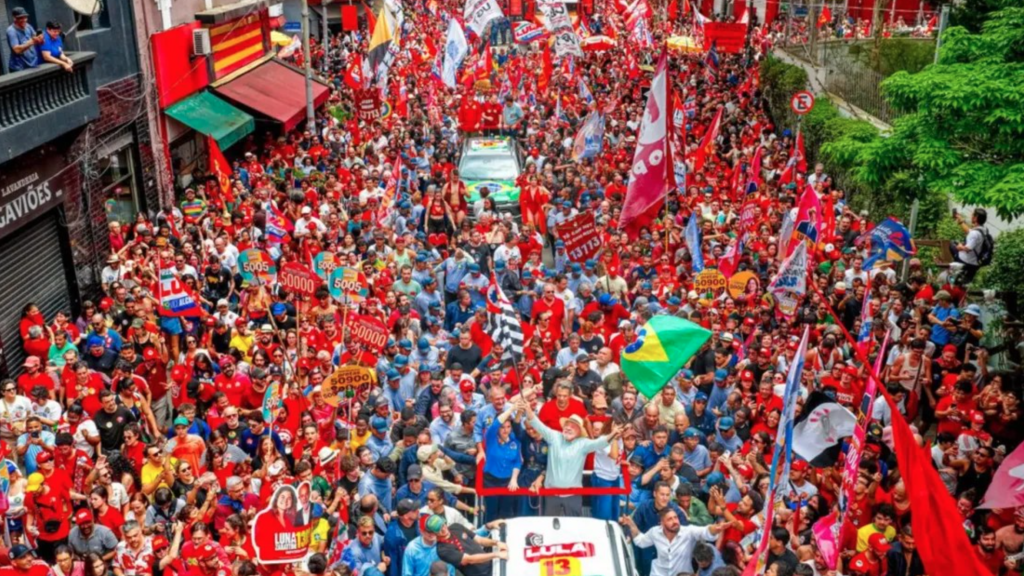
The campaign unfolded in a relatively “cool” political climate until the Supreme Court (STF) crisis erupted, weakening the government and further amplifying the allegations against the political establishment. The exposure of Alexandre de Moraes and the STF neutralized the defensive position Flávio had adopted following the initial revelations about the Dark Horse case (a corruption scandal involving involving Bolsonaro’s family), leaving the “Vorcaro” issue as a neutral factor, increasingly turning against the “New Republic.” In the home stretch, a package of political measures was introduced. This was accompanied by greater mobilization among activists and strong street rallies organized by the campaign and by Lula himself, creating a stronger visible presence of voters and supporters in the streets. Unlike on previous occasions, Bolsonarism kept a lower profile and relied on a “silent majority,” securing a solid electoral majority by winning over sections of the Centrão and patronage-oriented parties. The presence of right-wing candidates failed to halt Flávio’s momentum.
The PT maintained its dominance in the Northeast, although by a narrower margin than in previous elections, winning in the three states where it currently holds the governorship: Piauí, Ceará, and Bahia. In Rio Grande do Norte, which is also governed by the PT, the party’s candidate, Cadu, performed strongly and made it to the second round with a chance of winning. In Amapá and Pará, the government-backed candidates were defeated.
Lula was unable to reverse his government’s unpopularity with the limited measures he introduced. The media — even largely non-Bolsonarist outlets such as Globo, Folha, and Estadão — adopted an increasingly confrontational stance toward the government, particularly after the crisis surrounding the Globo televisional debate. They amplified criticism calling for a more severe fiscal adjustment and for placing a future government under greater constraint.
To understand the result, we need to understand how the erosion of Lula’s support has fueled a resilient far right, even when it has sometimes been on the defensive. We cannot forget that Jair is in prison and that Flávio failed to unite the business community and its political parties. Lula’s defeat and that of the political camp around him stem from both broader and more specific factors. At the broader level, we can speak of a threefold exhaustion: (I) the exhaustion of the New Republic regime, with the STF crisis representing a particularly grotesque manifestation of it; (II) the exhaustion of Lula himself (and, by extension, his party) as a political force — a kind of “material fatigue”; and (III) the strategy adopted by the PT since the New Republic, based on the “institutional” resolution of class conflicts.
The New Republic has seen its last pillars shaken. The STF, which had played a progressive role in confronting the anti-democratic actions surrounding January 8 and the interference of Trump and of the Centrão, which had strengthened its position through congressional amendments, ultimately became the target of a protest vote amid growing discontent, and was captured by the far right.
Lula, the greatest statesman in Brazil’s history, a man who embodies the country’s recent political history in his own person, has been weakened by the lack of prospects and has been unable to regain the initiative and build a movement strong enough to stop the far right.
Finally, the strategy of class conciliation has created a dependence on a corrupt STF and on the Centrão (the opportunistic and right-wing sector of Congress), as well as on the government’s own austerity program, led by Galípolo (the president of the Central Bank), which has been unable to meet popular demands. In other words, most of the popular vote for Flávio and his allies — the greatest asset of anti-PT sentiment — reflects rejection of the government and its inability to respond to the deterioration of people’s living conditions, as well as rejection of the political system as a whole, which is seen as corrupt and which Flávio encourages through his hypocritical rhetoric against the “system.” Lula governs within the limits imposed by his alliances, generating popular discontent that, in turn, fuels the far-right opposition and strengthens the Centrão’s and sections of the business elite’s influence over the government, creating a vicious cycle that repeats itself as tragedy.
Flávio established himself as the Clan’s direct choice, bringing together the social coalition that brought his father to power in 2018: from sections of the business elite and the financial sector, the powerful ranks of agribusiness, major extractive and mining corporations, and technology companies, to sections of the military and civilian security forces, conservative sectors of the state apparatus, and a broad base of evangelical sectors.
The presence of technology companies is a defining element of contemporary politics. Meta, Starlink, and other so-called Big Tech companies have acted — and continue to act — to defeat Lula and elect Flávio. Peter Thiel has been following developments in Brazil from Buenos Aires and was in São Paulo a few months ago. According to the text, this is an organized effort underpinning a “new type of party” — what researchers at Cebrap have described as a “Bolsonarist digital party.”
Trump has mobilized, and Brazil’s political struggle is part of a broader global struggle. The closure of embassies was one of the measures, but the truth, according to the text, is that Trump has spent the past year actively working to remove Lula from power through the elections. He has used Milei, but there are other channels as well, such as funding from BlackBridge, described here as a kind of billionaire “combat” think tank. Pressure on Moraes and Pix, Trump, and Zionism are racing against the clock. The “conquest of Brasília” is essential to this project, given the uncertain outlook for the next U.S. elections and the weakening of far-right governments in the region. It could have a domino effect: Chile, Venezuela, Peru, Colombia, and now Brazil.
It is important to understand that this process runs deeper, because Flávio and the far right have a more comprehensive strategy. Their aim is not merely to take control of the government, but to pursue a strategy of “revolution” that is, in reality, a counterrevolution.
Elect senators and surround the STF, concentrate power in the hands of the Clan, grant Jair amnesty, and advance authoritarian measures; then build a country according to their strategy and program and hand it over to Trump as a colony. According to the text, this is the action plan of this new government.
Nunes Marques (a Supreme Court justice allied with Bolsonaro ) has already put Bolsonaro’s amnesty on the agenda, while the market has also sent signals, with euphoria in the stock market and financial circles following last Sunday’s results.
The specific factors explaining the process include serious political-strategic mistakes by the PT, as well as its mistaken assessment of the possibility of winning in the first round. They also include the “broad-front” strategy of backing weak candidates, which led to disasters in states such as Rio Grande do Sul and São Paulo, as well as the delay in choosing a candidate in Minas Gerais, among other factors.
Nevertheless, in our assessment, there is a real polarization, with the left also among the most-voted political forces in the country and in several states. This is a battle with a generational dimension: Nikolas and Pavanato versus Érika Hilton and Sâmia Bomfim; the case of the young Minas Gerais candidate Ana Elise, who was among the PT’s top vote-getters; and Fábio Félix, the most-voted candidate in the Federal District. These are ideological examples that stand in opposition to the conservative vote of the so-called “red pills.”
There is a living political energy, even though it is tempered by anxiety and disorientation among the movement’s major leaderships. It can be seen, for example, in the state capitals where Lula won — São Paulo and Porto Alegre — as well as in the final campaign rallies and in the growing recognition of the neofascist implications of a new government led by the Clan, together with a certain awareness of the limitations of the Lulist strategy.
PSOL and the fight against the electoral threshold
PSOL must fight against the electoral threshold. This was the contradiction at the heart of the election results: the party has just emerged from the elections with successful candidates, reflecting the aspirations of sections of the population for political renewal and greater radicalism, yet it now faces a situation in which restrictive measures could be imposed on the party’s operations, including the loss of a number of political rights for failing to clear the electoral threshold. In last week’s editorial, we warned that this was a challenge every bit as important as the struggle to elect Lula and our candidates:
The second, no less important task, is to convince voters to vote for PSOL candidates for the Chamber of Deputies and Senate. PSOL needs to overcome the electoral threshold, one of the many anti-democratic mechanisms of the political system.
After the PSOL/Rede federation ticket in the state of Sergipe was disqualified on what the text describes as a legalistic pretext, the possibility of securing a ninth state came to rest on three or four potential states, with Santa Catarina considered the most likely by PSOL’s leadership. The unfavorable result left the party dependent on Espírito Santo, where the initial count put PSOL just 185 votes short. What remains at stake is that several cases of alleged fraud involving the gender quota by patronage-oriented parties in the state have since been uncovered. This could lead to a recount that would put PSOL at 1.50% of the vote for the Chamber of Deputies in Espírito Santo. A similar case was successfully decided years ago, giving PSOL an additional seat in the Belém City Council after a recount following the annulment of a ticket that had fraudulently circumvented the mandatory quota for women.
We are fighting with all our strength to prevent this measure from being imposed on PSOL, which represents a political project fundamentally opposed to neofascism and enjoys the solidarity and support of millions of Brazilians.
Our Party has grown in parliamentary terms, with the PSOL/Rede Federation electing 15 federal deputies, winning representation for the first time in four of the country’s five regions. We also outperformed the PT federation in the state of São Paulo, the birthplace of Lulism and the country’s main economic hub. The party has grown with a feminist and anti-racist profile, presenting itself as a coherent and combative alternative, confronting reactionary forces and placing its bets on collective struggle. It has also made gains in state legislatures, expanding its caucuses in several states.
In the face of such a profound contradiction, we are calling for a major campaign among Brazilian society, in light of the evidence of fraud in Espírito Santo, so that PSOL can retain its full political rights, including its television and radio airtime and its ability to operate with full rights in the National Congress. We will strengthen and affirm PSOL as a Necessary Party, committed to the major causes at the heart of the Brazilian people’s struggles.
The struggle of today shapes the future: Our role as MES/PSOL
From this moment on, we call on all activists and supporters to become even more engaged in the runoff. We need to expand and channel this social energy into a permanent collective mobilization to win over the votes separating Lula from Flávio, grounded in the political awareness of working people. The involvement of universities and the convening of broad plenaries are examples that should be followed.
Our message is simple and should be directed toward people in the peripheries and those who voted neither for Lula nor for Flávio — or who simply did not vote: it is all or nothing, yes or no, when it comes to ending the 6×1 work schedule; defending women’s lives; preventing Brazil from becoming a protectorate of Trump; preventing the Brazilian economy from collapsing and forcing us back into the breadline; deciding who can cut or abolish Bolsa Família; and confronting those who want to shut down unions and surround universities. We must also find a way to reach the hearts and minds of the millions of Brazilians trapped in debt and held hostage by high interest rates and financial capital, while addressing among young people the issues of education, democratic freedoms, and the climate emergency.
And we make this call with our heads held high and proud of MES’s performance. Our organization has grown because we have combined political radicalism with broad influence. We elected three federal deputies: Sâmia, Fábio, and Fernanda. Sâmia was a true phenomenon, ranking among the five most-voted female deputies in Brazil, with nearly 600,000 votes. Fernanda Melchionna increased her vote total and ranked among the most-voted candidates in Rio Grande do Sul, with 276,000 votes, despite the far-right electoral wave that swept through the state. Fábio Felix was the most-voted candidate in the Federal District, and, proportionally, one of the most-voted candidates in the country.
We re-elected three state deputies, including Luciana Genro and Camila Valadão, who ranked among the most-voted candidates in Rio Grande do Sul and Espírito Santo, respectively. Monica and the Pretas surpassed all their previous vote totals, coming close to 200,000 votes.
We also suffered some setbacks, such as the case of Josemar, a combative deputy from Rio de Janeiro who was not re-elected, despite increasing his vote total and surpassing the 40,000-vote mark. PSOL fell just a few votes short of winning a second seat in Rio Grande do Sul, where Roberto Robaina was the Party’s second-most-voted candidate.
We elected two new female deputies: Mariana Conti, with more than 124,000 votes, internationally recognized for her role in the Flotilla, expanding MES’s collective caucus in São Paulo; and Keka Bagno, the first Black left-wing woman to hold a seat in the District Legislative Chamber, and a leader of MES and PSOL.
Although they were not elected, Vivi and Professora Ângela received significant vote totals in the states of Pará and Paraná, respectively, establishing themselves as key political figures for the Party. We are also proud of the dozens of comrades who ran for the Chamber of Deputies and the Senate under the banner of MES and PSOL, as well as the comrades we supported and whose campaigns we actively participated in.
Polarization will continue and intensify, as it is doing around the world. Trump may lose the next legislative elections in the United States; new youth mobilizations are shaking Spain and France; the extremes are gaining ground, with neofascists once again becoming a mass political force in Germany through the AfD, while Berlin responds with Die Linke’s victory. In the United States, the DSA is confronting Trump and growing as a mass political force. In Peru under Keiko Fujimori, left-wing leader Verónika Mendoza has just been elected governor of Cusco. And here in Brazil, the hope placed in PSOL expresses the desire for a renewed anti-capitalist left.
We will fight on the front line against the neofascist Flávio, Trump’s auxiliary force. This is the battle of the coming days, placing our bets on strategic debate and the struggle of ideas while reorganizing militant forces for what lies ahead. The future is decided now.