Brazil: Winning the ‘third round’
First published in Portuguese at Esquerda en Movimento. Translation by Federico Fuentes for LINKS International Journal of Socialist Renewal.
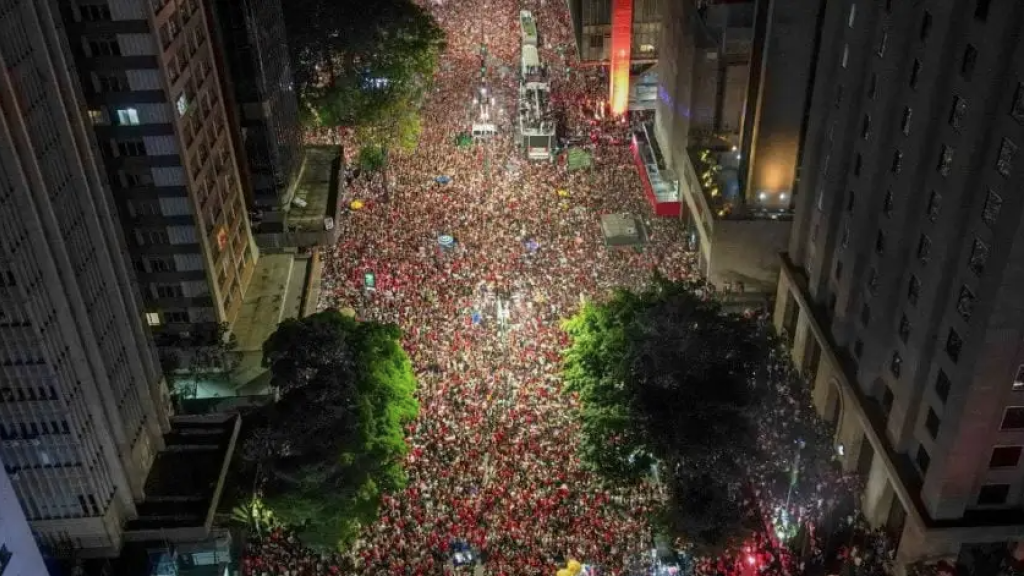
Anyone who experienced October 25 will never forget it. It was a democratic uprising that took on an electoral form, thereby securing Lula da Silva’s greatest victory and defeating far-right and miliciano (paramilitary) leader Flávio Bolsonaro.
It was a unique moment in Brazil’s history, a historic event that will have repercussions and ramifications for some time to come. It represented a qualitative leap in the situation and a leap in popular consciousness. It was a victory that set an example for the world.
Following the win, as we debate and examine the factors that led to this outcome, the political scene remains frenetic. A “third round” has already begun, albeit with contours somewhat different than expected.
The new dynamic now combines the immediate effects of Lula’s victory with the next steps in the political struggle, with Brazil, the class struggle and the Socialism and Liberty Party (PSOL) entering a new phase.
Immediate effect: Flávio has fled
It was a profound and intense victory, despite the fiercely contested race. Profound because, despite the extremely close contest, the end result was an improvement on 2022, when Jair Bolsonaro was the candidate, and involved a higher level of mobilisation and awareness on the streets and social media. Intense because the shift in the political situation was very rapid and surprising, with Lula enjoying strong support and Flávio finding less room for his coup-mongering rhetoric.
Flávio’s escape, which appears to have been improvised, exposed his ties to the international far right, with Argentine President Javier Milei and US President Donald Trump as key allies. This move, however, has weakened him on the national stage: his allies and party recognised the election result and distanced themselves from his disastrous statements (which he changed several times) regarding not recognising the election.
Two dynamics are at play: if Trump loses the midterm elections, the pendulum of the global political situation will swing against the far right, effectively making Lula’s victory an international turning point; the other dynamic is domestic, with the far right remaining resilient, but its leadership core — embodied in the Bolsonaro clan — have suffered a crushing defeat that could usher in a period of reorganisation and infighting within this political camp.
The fact is that this “third round” may lead to the consolidation of a new phase in the global anti-fascist struggle, in which Brazil is already playing a central role.
Streets, streets and more streets!
What now? The next steps must be coordinated, without losing touch with the streets, and involve fighting on two fronts: against the coupmongers, who must be stopped and proscribed; and in defence of social rights and the agenda for change that Lula committed himself to in the second round. These are the challenges of the third round.
Flávio did not act alone. Any measure involving amnesty deals or attempts to mediate with coup-plotting factions must be rejected and opposed. We must fight the active coup-plotting core within the Liberal Party (PL) and other parties, as well as their financiers, by taking on the Big Tech companies and demanding that the government use institutional means to stifle openly coup-plotting factions.
We must block anti-worker initiatives that pro-business sectors wish to carry out in retaliation against the popular vote, fuelled by the calls for “political dismissals” that Bolsonaro supporters are stirred up on social media. At the same time, we must fight against the attacks that reactionary governors are already preparing against the people.
The other battle must be defence of a program that guarantees the people’s demands, which were endorsed by the streets and at the ballot box: reduce the working week; guarantee pay rises and pension increases; extend free public transport; cancel the debts of households and small and medium-sized business owners; invest heavily in healthcare (through the SUS, Unified Health System) and in free, universal public education; and adopt a new direction in economic policy by lowering interest rates and ending fiscal austerity, which hands over a large part of the public budget to speculators.
The capitalists and sections of the government have announced that they intend to pursue austerity measures, which will clash directly with the immense popular energy of a mobilised, conscious and self-confident working class eager for solutions.
The answer to this dilemma lies in the streets. It is “the streets, the streets and more streets”, as we heard from crowds in the country’s squares and avenues over the past three weeks. It is from the streets, from places of study, work, home and leisure, that we will achieve greater self-organisation of society itself, to completely change the course of events. It was in this spirit that the Socialist Left Movement-PSOL (MES-PSOL) acted on the front line of this process, just as Juntos! did within the student movement and many other movements we have built.
PSOL’s place: In the trenches on the streets
PSOL played a prominent role in the second round. Its leaders were instrumental in Lula’s comeback and were an integral part of this broad democratic uprising. Many new members join throughout the election, with the party emerging as an independent and socialist pole committed to building unity with Lula while representing not only an electoral alternative but also an organisational alternative for the many people now seeking to organise themselves politically.
We have overcome the electoral threshold, as unanimously decided by the Electoral Supreme Court (TSE). This is an anti-democratic rule designed to block parties such as the PSOL, but which we have defeated once again due to the party’s significant rise in votes.
PSOL can and must grow stronger in the face of the new challenges that this new phase brings. The first of these is its positioning: we need to respond to these challenges by centring efforts on the “trenches in the streets” — that is, by prioritising political action as the driving force behind society’s demands, and fighting in Congress based on a direct connection with social struggles. To this end, the PSOL must preserve its independence and refrain from accepting ministers or positions of trust within the federal government.
The battle for the future has begun. The positive shift in the balance of forces must be accompanied by the development of an anti-capitalist and internationalist party project, geared towards fighting and winning through a radical approach that listens to the desires of the streets and responds to the real problems of the population.
Israel Dutra is a sociologist, PSOL’s Secretary for Social Movements, and a member of the party’s National Executive and of the MES/PSOL.