Russia’s peripheral imperialism: Class, ideology and war
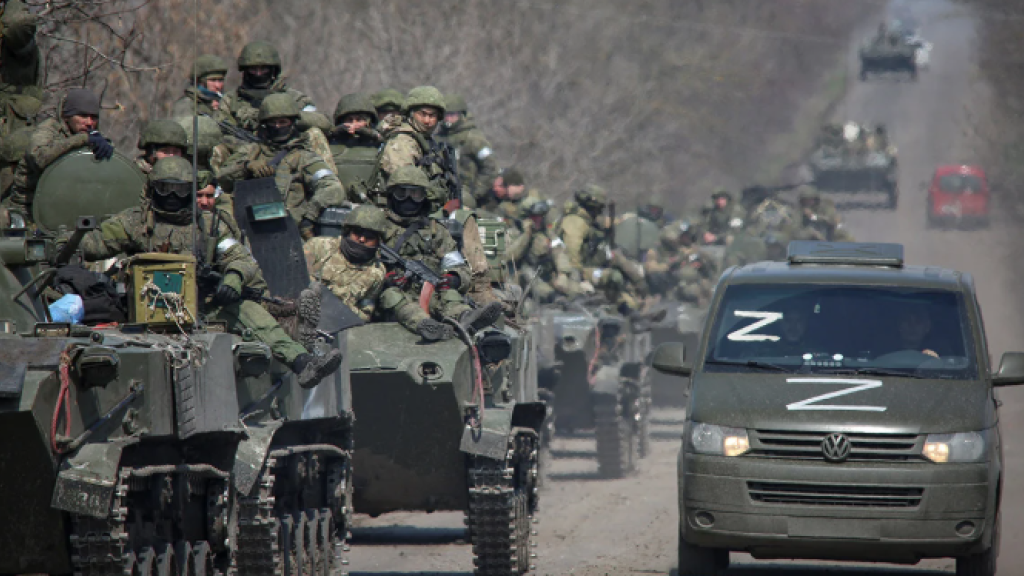
Russia’s invasion of Ukraine presents a problem for analyses that identify imperialism exclusively with the dominant centres of global capitalism. How can a country dependent on commodity exports, imported technology and external financial networks itself act as an imperialist power? In our contribution to the forthcoming Suhrkamp anthology on contemporary imperialism and anti-imperialism, Boris Kagarlitsky and I argue that dependence and domination can coexist. A state subordinately integrated into global capitalism can exercise imperial power over weaker neighbours. Russia exemplifies this combination — an empire of the periphery.
Russia’s contemporary imperialism must be understood through the class order that emerged from the Soviet Union’s dissolution. Privatisation transferred productive assets, natural resources and financial infrastructure into the hands of a narrow group whose fortunes depended heavily on political access. The resulting concentration of ownership established a durable relationship between economic privilege and state power. Control over public office, regulatory decisions and state property became a means of private accumulation.
Commodity exports, especially oil and gas, sustained this order. According to Rosstat (Russia’s Federal State Statistics Service), mineral products accounted for about 70% of the country’s merchandise exports in the early 2010s and still represented 63.3% in 2019, before the pandemic. Export revenues financed public expenditure, supported domestic demand and permitted selective redistribution, while generating enormous private fortunes. During the commodity boom of the 2000s, economic growth helped stabilise a social settlement in which rising incomes accompanied extreme inequalities of wealth and power. Yet much of the surplus generated within Russia flowed abroad through capital flight, offshore holdings and purchases of foreign assets. By 2015, Russians’ offshore wealth was estimated at roughly three-quarters of annual national income.
This external orientation was integral to the accumulation regime. Russia supplied resources to the world economy while relying on more advanced capitalist centres for technology, finance and preserving elite wealth. Integration enriched its dominant classes without producing a sustained transformation of the country’s productive structure. Their position combined domestic power with external dependence. Within this arrangement, access to political authority remained a decisive determinant of profitability. State contracts, resource concessions, subsidised finance and administrative protection sustained powerful business networks. The state was therefore a central terrain of accumulation, and the boundary between political and economic elites was often indistinct.
Russia’s ruling bloc therefore confronted a contradiction rooted in its own formation. Its wealth depended on participation in a global order that constrained its ambitions, while its domestic power rested on arrangements that obstructed a developmental alternative. This tension provides the starting point for understanding the relationship between the crisis of dependent accumulation and Russia’s increasingly confrontational imperial project.
From the crisis of accumulation to war
The 2008 Global Financial Crisis exposed the vulnerability of Russia’s accumulation regime. Real GDP per capita contracted by about 8% in 2009, and the subsequent recovery failed to restore the dynamism of the commodity boom. Average annual real GDP per capita growth fell from about 7.3% in 2000–08 to 1.7% in 2010–19. The slowdown therefore began before the sanctions imposed in 2014. High export earnings temporarily eased the pressure, but resource dependence, weak productive investment and the externalisation of wealth increasingly constrained sustained expansion.
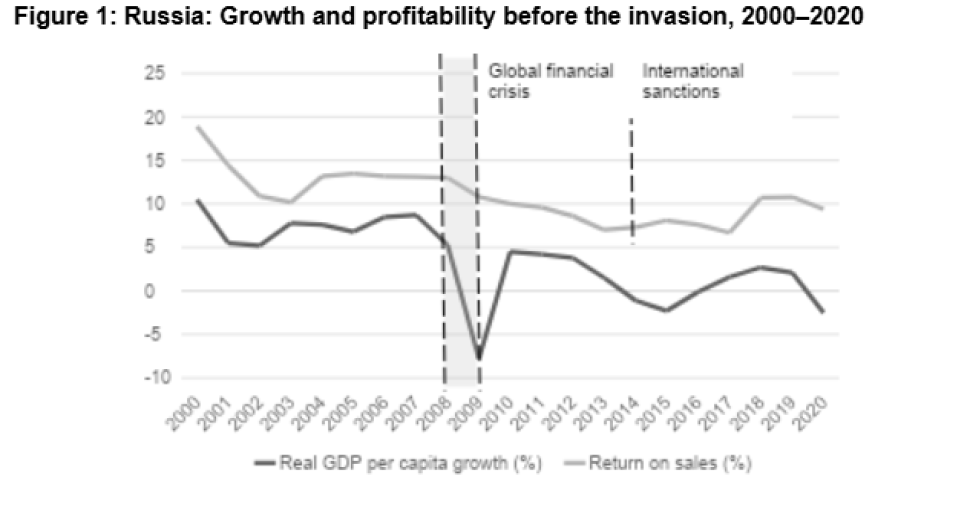
Profitability also weakened, although its trajectory was uneven. Returns on sales stood at about 13–14% in the mid-2000s, compared with about 7–10% through much of the following decade. Their recovery to about 11% in 2018–19 shows this was not an uninterrupted decline. Nevertheless, the combination of slower growth and generally lower sales profitability indicates the accumulation regime’s difficulties preceded the pandemic and full-scale invasion.
This trajectory matters for assessing the alternatives available to Russia’s ruling bloc. In Russia’s New Imperialism: Capital and Ideology, Ilya Budraitskis and Ilya Matveev argue continued cooperation with the West would have better served Russian capitalist interests than the confrontation unleashed by the invasion. This counterfactual supports their emphasis on ideological commitments overriding economic interests. Yet the superiority of that alternative requires demonstration. Continued participation in the existing international arrangements offered opportunities, but the pre-war record also reveals mounting difficulties in sustaining growth and profitability within those arrangements.
These trends do not establish that invasion was economically preferable. They do, however, show why the relative advantages of continued cooperation cannot simply be assumed from the existence of profitable international ties: the model’s constraints and their differing implications for capitalist groups also require examination. A convincing comparison must assess both the prospects of continued integration and the possibilities for domestic restructuring. The economic damage caused by war cannot, by itself, establish that the decision lacked a material or class rationale.
The constraints on accumulation had political consequences. A sustained developmental program would have required redirecting resources toward productive investment and challenging the privileges of networks controlling existing rents. The ruling bloc had strong reasons to preserve the arrangements that generated its wealth, even as their capacity to sustain growth diminished. Its divisions also mattered: owners with substantial international interests did not necessarily share the priorities of groups whose fortunes depended more directly on domestic political access. For the latter, preserving control over resources and state-mediated opportunities could outweigh the advantages of further international integration.
Ukraine became a decisive arena in which these contradictions intersected with geopolitical conflict. Volodymyr Ishchenko argues its competing orientations were rooted in class relations: influential sections of the professional middle class associated their advancement with Western integration and alignment with transnational capital; political capitalists sought to preserve advantages grounded in privileged access to the state. Neither project adequately represented the independent interests of the working class. Ukraine’s westward shift therefore expressed a particular constellation of social interests and political forces, rather than an undifferentiated national interest. It threatened Russia’s regional influence and the prospects for an economic and political sphere organised around Moscow. These interacting class projects and geopolitical strategies help explain the confrontation without making Russia’s invasion either necessary or justified.
An attempt to subordinate Ukraine could appear to offer a means of preserving regional power and extending politically controlled accumulation. This does not establish that particular businesses directed the decision or that invasion followed a coherent economic plan. The choice depended on the leadership’s assessment of alternatives and its expectations of Ukrainian resistance and Western responses. A strategy premised on rapid victory could reflect identifiable interests while catastrophically misjudging the means of advancing them.
That ideology can shape political decisions is unproblematic within historical materialism. In his letter to Joseph Bloch, Friedrich Engels rejected reducing history to economic causation alone, emphasising that political institutions and ideological forms influence historical struggles and can predominate in determining their form. The issue is how ideological commitments develop within, and act upon, material relations and class struggles. Imperial convictions may sincerely motivate political leaders without their holders recognising their connection to the reproduction of class power. The analytical difficulty arises when the explanation treats ideology as detached from these relations, leaving the social foundations and class content of political decisions unexplained.
Public rhetoric cannot establish either the sincerity of those convictions or their weight in a specific decision. We must distinguish ideas informing the invasion from propaganda legitimising it and narratives developed to sustain a prolonged war. Budraitskis and Matveev describe an increased emphasis on civilisational and moral struggle after the failure to secure a rapid victory. That subsequent development cannot simply be read backwards as proof of the original motivation.
Budraitskis and Matveev connect the Russian leadership’s worldview to the experience of post-Soviet primitive accumulation. Our disagreement concerns whether their explanation sufficiently connects subsequent strategic choices to the continuing reproduction of class power. The leadership’s autonomy from individual capitalists does not establish its independence from the class order. Where political authority itself provides access to wealth, separating the interests of rulers from those of capitalists is particularly problematic — a feature central to Kagarlitsky’s account of post-Soviet capitalism. The relevant questions concern which forms of accumulation the state protects, which groups it privileges, and how ideological commitments shape its pursuit of those objectives.
The invasion can therefore be understood as a contingent decision combining imperial conviction, the defence of an established social order and profound strategic miscalculation. Its subsequent costs cannot settle what its architects expected to achieve. Nor can later gains prove their original intentions.
Wartime stabilisation and its limits
The war has produced a mixed picture for Russian capital. Bank of Russia figures show Russia’s outward FDI stock fell from US$374.6 billion in 2021 to US$235 billion in 2025, while inward FDI declined from US$497.7 billion to US$258.2 billion, reductions of about 37% and 48%, respectively. These changes reflect transactions and valuation adjustments, rather than equivalent realised losses, but demonstrate a substantial contraction in cross-border investment positions.
Meanwhile, military procurement, subsidised credit and infrastructure spending have opened domestic opportunities for businesses with privileged access to state decisions. Property transfers provide another channel. These include court-ordered seizures from Russian owners — through challenges to privatisation, anti-corruption proceedings and other legal mechanisms — and placing foreign-owned businesses under “temporary management,” transferring control without immediately extinguishing ownership rights. Estimates compiled by the New Eurasian Strategies Centre put the value of assets seized during 2022–25 at 5–6.5 trillion roubles. These interventions can penalise owners deemed disloyal and reward politically connected groups, reinforcing the dependence of private accumulation on state power.
Public expenditure has been central to this reorganisation. Official federal defence allocations rose from about 3.5 trillion roubles in 2021 to more than 13 trillion in 2025, increasing from about 15% to more than 30% of federal expenditure. Over the same period, the combined share allocated to social policy, healthcare and education fell from about 37% to 25%, despite nominal increases in spending. The state has sustained demand through a pronounced shift toward military production and its associated supply chains.
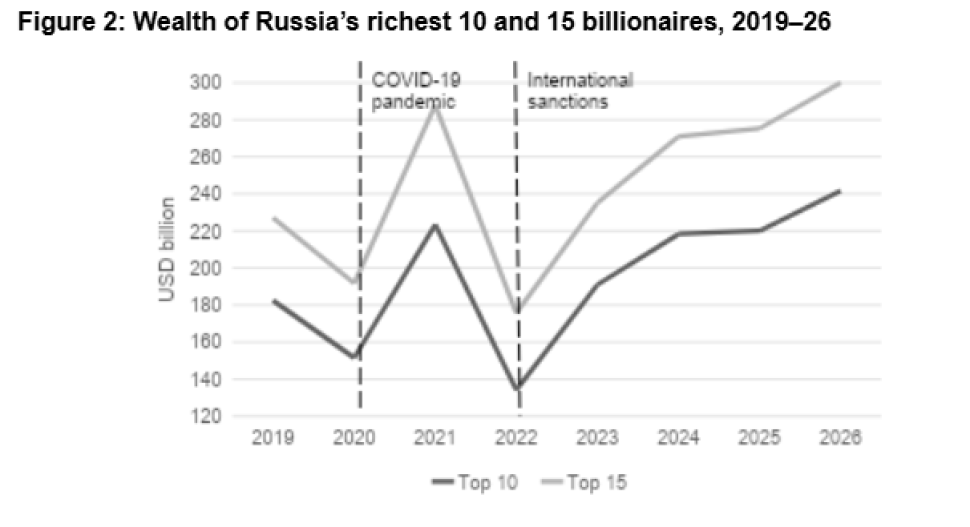
The recovery of wealth among Russia’s richest billionaires illustrates the capacity of large capital to adapt. Although their combined wealth fell sharply in 2022 relative to the exceptional peak of 2021, the decline was considerably smaller against the pre-pandemic benchmark of 2019. By 2023, the combined wealth of the richest ten and the richest fifteen billionaires had surpassed their 2019 levels, with further increases thereafter (Figure 2). These estimates reflect asset valuations as well as accumulated profits, but they demonstrate that the initial shock was followed by a rapid restoration of wealth at the top.
Enterprise profitability also complicates the picture of economic losses. Rosstat figures demonstrate aggregate return on sales averaged 12.5% during 2022–25, compared with 8.6% in 2011–20. The rise began before the invasion, reaching 14.7% in 2021, and, although it has subsequently dropped, wartime sales margins remained appreciably above their previous decade’s average.
These outcomes do not establish that Russian businesses are better off than they would have been without the invasion. Answering that question requires an assessment of opportunity costs: a comparison with plausible alternative trajectories, including the profits, investment opportunities and productive capacities forgone. Budraitskis and Matveev acknowledge differing assessments of these costs, depending on the time horizon and whether the focus is particular businesses, capital as a whole or the wider economy. These questions remain unsettled, making a categorical verdict on the net economic consequences premature. Short-term enrichment can coexist with longer-term developmental damage, just as gains for powerful owners can coexist with substantial losses for society.
Even if that counterfactual assessment established a net economic loss for Russian capital, a further question would remain: whether the decision nevertheless reflected an attempt to preserve its political and social power. Michał Kalecki’s argument about full employment is instructive: business leaders may resist policies that raise profits when those policies threaten their authority over labour and political influence. Preserving class domination can take precedence over maximising immediate returns. This does not prove that war serves capital’s collective interests; it explains why profitability alone cannot settle the question.
The relationship is further complicated by the lumpenisation of the bourgeoisie. Drawing on André Gunder Frank’s concept of the lumpenbourgeoisie, this denotes a ruling class whose enrichment reproduces dependency rather than sustaining an autonomous developmental project. In Russia, rent extraction, offshore wealth preservation and dependence on political access have reinforced this orientation. Fragmented by competing private interests, the bourgeoisie struggles to articulate a common political project beyond enrichment. State leaders consequently acquire greater scope to define its collective interests while pursuing institutional and personal priorities of their own.
Karl Marx’s analysis of Bonapartism illuminates this relationship: an executive power can acquire considerable autonomy from the bourgeoisie’s political representatives while safeguarding the property relations and social order underpinning its domination. Preserving that order may involve overriding particular capitalists and imposing losses on them. Such autonomy neither guarantees successful decisions nor eliminates their class content. The relevant distinction is between the fortunes of individual owners and the reproduction of capitalist power — a distinction that becomes especially important when considering who bears the social costs of wartime stabilisation.
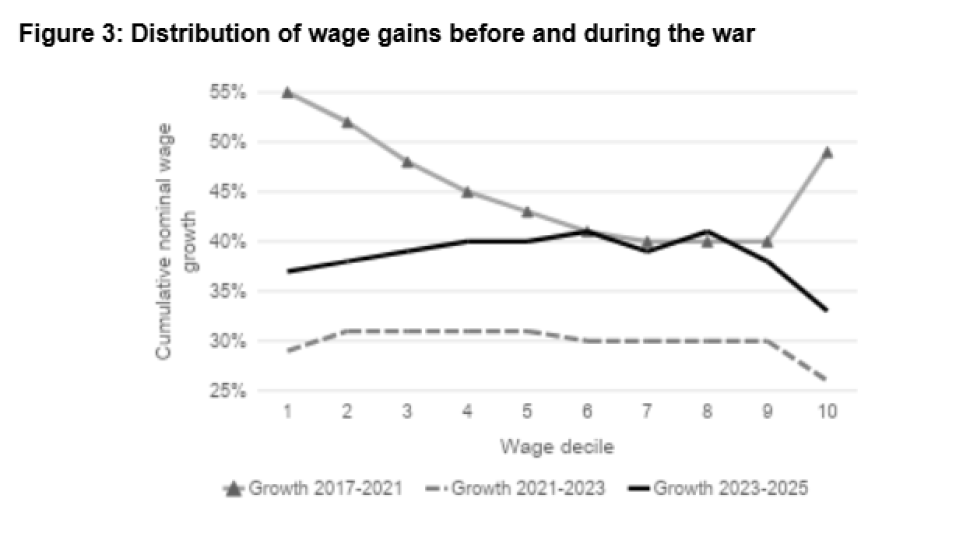
Within Russia, the principal social burden falls on the wider population, although its distribution is uneven. Labour shortages, military payments and expanding defence production have raised incomes for some workers and households. Yet aggregate wage growth conceals differences in the distribution of gains. The strongly pro-poor pattern of 2017–21 became considerably flatter in 2021–23. During 2023–25, the lowest-paid groups received smaller percentage raises than several middle groups (Figure 3). The later pattern therefore weakened the relative position of the lowest-paid compared with parts of the middle when it comes to wage distribution.
Alongside these inequalities, households bear the costs of deaths and injuries, inflation, intensified work, indebtedness and the diversion of public resources from civilian priorities. According to the Bank of Russia, household indebtedness rose from about 27.6 trillion roubles in early 2022 to more than 43 trillion by early 2026. Higher earnings in selected sectors have also failed to translate into stronger independent labour organisation or democratic control over economic decisions.
Wartime stabilisation has reproduced external dependence. Despite official celebrations of import substitution, Russia’s reorientation has not amounted to delinking in Samir Amin’s sense: the subordination of external economic relations to the priorities of internally centred development. Commodity exports have been redirected toward new markets, while China has assumed a larger role in supplying machinery and equipment. The direction of dependence has changed more substantially than its underlying structure. Military demand supports selected industries, but has not established a broadly diversified economy organised around domestic social needs and productive development.
Internationalism and possibilities for the left
Russia’s confrontation with Western powers offers no socialist alternative to the order it challenges. Its imperial project reproduces capitalist domination at home and seeks to impose political subordination abroad. Equally, opposition to that project cannot require socialists to identify their objectives with those of Western governments. The starting point must be the capacity of working people to organise independently and challenge the forces sustaining war.
Inside Russia, repression and organisational weakness should not be mistaken for the disappearance of a left social constituency. In a recent letter to me from the penal colony where he is detained, Kagarlitsky identified a generational change: younger people are less shaped by inherited anti-Soviet hostility, while also being less inclined to equate contemporary left politics with the Soviet experience. He also observed greater receptivity among parts of the liberal intelligentsia. Letters reaching him from different regions suggest that interest extends beyond a narrow metropolitan milieu. These observations indicate an opening, rather than demonstrate the existence of an already consolidated movement.
The distinction is crucial. Dissatisfaction with inequality, arbitrary power and the costs of war does not automatically produce socialist organisation. Kagarlitsky emphasised in the same letter that public interest must be transformed into political support. That requires connecting immediate concerns over wages, public services and social protection with demands for democratic rights and an end to the war. It also requires rebuilding the relationships, institutions and capacities for collective action that repression and prolonged depoliticisation have weakened.
For the left outside Russia, solidarity should help sustain those capacities. Supporting political prisoners and their families, independent socialist media, labour initiatives and networks connecting activists inside the country with those in exile are practical contributions. Exile can preserve intellectual and organisational resources, provided it maintains connections with the experiences and struggles of people who remain in Russia. International support should strengthen their capacity to articulate and pursue their own political objectives.
Such solidarity must extend to Ukraine’s independent labour and democratic movements, alongside unequivocal opposition to invasion and annexation and recognition of Ukrainian self-determination. Defending national rights and building independent class organisation are connected tasks. Cooperation between Russian and Ukrainian socialists can advance both without obscuring the unequal responsibilities of aggressor and invaded society. Peace and democratisation would widen the space for these struggles, opening questions of ownership, redistribution and public priorities to popular contestation. The socialist objective is to turn that opening into greater power for working people over the conditions of their lives.