Brazil: Global antifascist forum a strategic space for struggle against the far right and imperialism (plus statement: Reject US aggression on Venezuela)
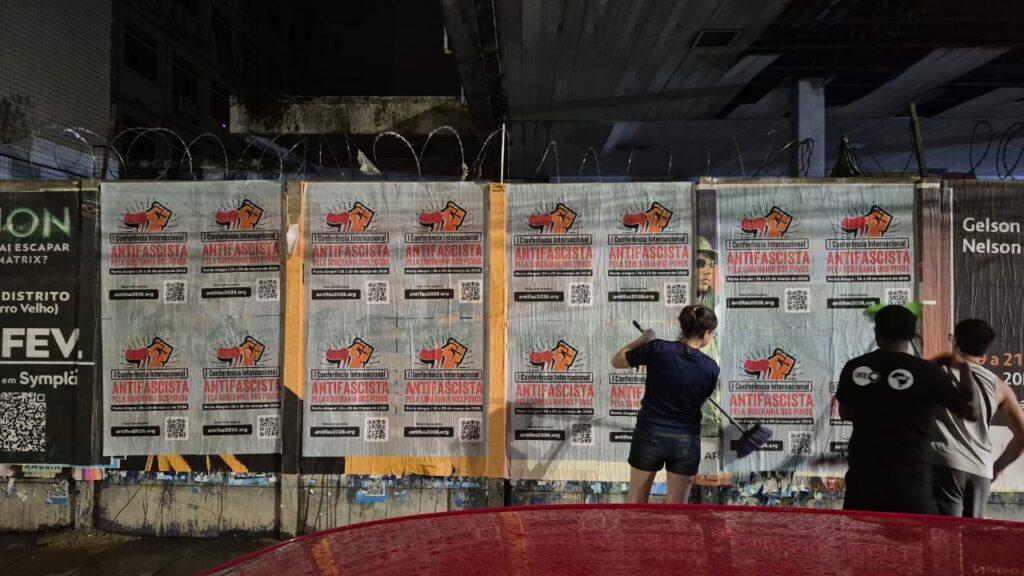
First published at International Anti-Fascist Conference for the Sovereignty of Peoples.
The Second Meeting of the International Committee projected the 2026 Antifascist Conference as a strategic space for unity, solidarity, and struggle against fascism and imperialism.
The second meeting of the International Committee of the Antifascist Conference and for the Peoples’ Sovereignty held last Tuesday (16th Dec. 2025), consolidated the international coordination of the Left toward holding the event. Organized from the capital of Rio Grande do Sul state, the virtual meeting brought together more than 80 comrades from different countries in Latin America, Europe, Africa, and Asia, with simultaneous translation in French, English, and Spanish, reinforcing the plural, internationalist, and unifying character of the conference scheduled to take place between 26th and 29th of March, 2026.
At the opening, City Councilor Roberto Robaina, president of PSOL in Porto Alegre and one of the event’s coordinators, contextualized the political importance of the meeting and of the conference itself.
“We are holding the second meeting of the International Committee at a special moment. Every week it is confirmed that an international initiative of this nature is absolutely necessary, because the advance of fascism, the far right, and imperialism is happening in a coordinated way,” he said. Robaina also highlighted that the initiative stems from the unity between PSOL, PT, and PCdoB, strengthened by the incorporation of social movements. “This Conference’s organizing was only possible because it is anchored in the strength of the working class, with the participation of the MST, CUT, CPERS, and dozens of other organizations,” he said, recalling that Porto Alegre carries the tradition of the World Social Forums as a reference for global articulation.
Representing the Workers’ Party (PT), the party’s president in Porto Alegre, Rodrigo Dilélio, reinforced the unified character of the Conference building in Brazil and the popular mobilization effort that precedes the event.
“Today there is a great unity among PT, PSOL, PCdoB, and the main organizations of the Brazilian working class to build this conference as an international antifascist reference,” he stated. Dilélio highlighted that the preparation for the event is directly connected to recent mobilizations in the country. “We are very happy with the demonstrations that have taken to the streets in recent days, and we believe that the conference will deepen this process of popular mobilization,” he added.
Eduardo Mancuso, also a PT leader and a member of the event’s coordination team, presented in detail the Forum of Democratic Antifascist Authorities, which will officially open the conference on the 26th March 26 at the Legislative Assembly of Rio Grande do Sul (State Parliament House).
“From the very beginning of the organization, there was the idea of building a forum of democratic authorities, inspired by the experience of the World Social forums of the early 2000s, when popular governments dialogued directly with social movements,” he explained. According to Mancuso, the goal is to articulate experiences of democratic radicalization. “We want parliament representatives and popular governments to be part of the opening demonstration, showing that institutional politics can also walk alongside popular mobilization.”
The centrality of anti-imperialism was reinforced by remarks from Raul Carrion, of the Communist Party of Brazil (PCdoB), who linked the fascist offensive to the strategy of the major powers.
“The new security policy of the United States is a declaration of aggression against all peoples, especially the Latin American ones,” he stated. Carrion was categorical in summarizing the political axis of the conference: “There can be no struggle against fascism without a struggle against imperialism, just as it is not possible to confront imperialism without fighting fascism.”
Next, there was a speech by Belgian historian Eric Toussaint (CADTM), a leading figure in the alter-globalization movement and international organizer of the Conference. Toussaint celebrated the progress of the conference organization and the confirmation of important international delegations.
“We have already managed to secure the presence of numerous parties and parliamentarians from Europe, from the French, Italian, Spanish, Greek and British Lefts,” he stated. At the same time, he warned of the seriousness of the international situation. “For the first time, a president of the United States openly affirms his support for all European neo-fascist parties. This combines with the reaffirmation of the Monroe Doctrine and the designation of China as a systemic enemy, creating an extremely dangerous scenario,” he said. For Toussaint, the Porto Alegre conference can be an organized response to this scenario. “I am convinced that it will be a great success.”
In the organizational field, Gabi Tolotti presented the practical progress in the preparation of the event, highlighting the opening of registrations for self-managed activities and the structure for welcoming international delegations.
“We want to put a lot of weight on self-managed activities, because they allow each organization to find in the conference its own space for articulation and strengthening,” she explained. According to her, the organization team is working to guarantee accessibility. “We are structuring accommodations, partnerships with hotels and streamlining visa processes so that no one is excluded.”
The international speeches gave further density to the global character of the conference. From the refugee camps of Western Sahara, Ahmed Moulayali, of the Polisario Front, welcomed the initiative and highlighted its strategic importance.
“This conference comes at a very necessary moment. The Sahrawi people have been fighting for 50 years against colonialism, first Spanish and now Moroccan, with the support of powers such as Israel, France and the United States,” he stated. Moulayali highlighted the centrality of Africa. “Africa is the future because of its demographics and its wealth, and that is why it is the target of this imperialist dispute. Supporting the Sahrawi people is supporting the entire left in North Africa.“
Representing the Arab Palestinian Federation of Brazil (Fepal), Ualid Rabah reinforced the commitment to building a panel dedicated to Palestine.
“We are deeply committed to holding a conference that addresses the genocide in Palestine and the global resistance to it,” he stated. For Rabah, unity is a historical imperative. “Nothing exempts us from our differences, but everything obliges us to maximum unity in the face of an existential enemy. What is happening in Palestine today could happen anywhere in the world.”
From Uruguay, Daniel Dalmau brought greetings from the 33rd Congress of the Uruguayan Communist Party and reaffirmed the party’s commitment to the initiative.
“Our congress discussed the international situation in depth and the need for solidarity with all aggrieved peoples,” he said. He also highlighted the willingness to participate. “There is a great desire for the Communist Party of Uruguay to be present with a strong delegation in Porto Alegre.”
The Latin American dimension was also reinforced by the speech of Luis Bonilla, from Venezuela, who linked the anti-fascist struggle to resistance against neoliberalism, especially in the education topic.
“For fascists, education is not a priority, and that is why they try to destroy ministries and dismantle public policies,” he stated. Bonilla reinforced the commitment of his movement. “For us, this conference is part of the struggle for public, democratic, and anti-fascist education.”
Following this, Mauri Cruz, from the Brazilian Collective of the World Social Forum, connected the conference to the WSF process and the global anti-capitalist struggle.
“Fascism is the most radical face of capitalism. We will not overcome it without overcoming capitalism itself,” he stated. According to him, the conference can strengthen strategic alliances. “Only an alliance between left-wing parties and social movements can build a real alternative.”
From Chile, comrade Pablo Reimers, from the Communist Party, brought a political reflection and self-criticism.
“The response to the advance of fascism involves unity, honest self-criticism, and the resumption of the deep bond with the people,” he stated. He emphasized that electoral defeats do not end historical processes. “We are a party of struggle and we remain firm, because this battle already has a continental and global dimension.”
Comrade Flávia Verri, a militant of France Insoumise and a member of the Insoumise Eco-socialist Network, provided a detailed account of the French situation and the challenges for building broad participation in the conference process. Speaking in Portuguese, she explained that, despite a recent experience of unity on the left allowing the Popular Front to come out ahead of the far right in the 2024 parliamentary elections, the scenario has become deeply fragmented after the French Socialist Party supported an austerity budget from the center-ground.
“This unity has exploded, and one of the consequences was a deep division between political parties and the social movement,” she stated. According to Flávia, there is currently a strong autonomy of social movements in France, which resist re-articulating with political parties. Given this, she made a direct request to the conference coordination:
“Could the CUT [Central Única dos Trabalhadores], could the MST [Movimento dos Trabalhadores Rurais Sem Terra] make direct invitations? Because we could rely on these invitations to create a real dynamic in France. Otherwise, we run the risk of representing people, but not living realities and dynamics, which are crucial.”
From Argentina, comrade Julio Gambina (ATTAC Argentina, CADTM AYNA) warned of the gravity of the regional and international political moment, positioning the conference as an urgent response to the escalation of the far right.
“We are living through very serious times for Latin America, the Caribbean, and the world. The aggression against Palestine was correctly mentioned, but we also need to denounce the offensive against Venezuela, Colombia, Cuba, and Honduras,” he stated. Julio drew attention to the international articulation of the far right, explicitly citing the alliance between Trump, Milei, and Kast, the newly elected president of Chile.
“We cannot underestimate the electoral consensus of the far right. They are products of changes in global capitalism,” he said, advocating for a strategic reconfiguration of the unity of the left and the people, capable of responding to the offensive of capital, the growth of criminal capitalism, and the threat of wars on a global scale.
From Chile, comrade Luiz Schwaiger (MIR Chile) gave a critical analysis of the recent cycle of the institutional left in the country. According to him, the government of Gabriel Boric not only administered but deepened the neoliberal model, frustrating popular expectations that arose in the 2019 uprising.
“There has been a profound abandonment of the political struggle and the class struggle,” he stated. Schwaiger highlighted that, after the failure of the constitutional referendum process, the government chose not to mobilize the people, which opened space for the advance of the right. He also warned about reforms that seek to restrict the legalization of parties, excluding popular and revolutionary forces.
“Those who are left out are precisely the popular sectors and the left that have no money,” he denounced. For him, the conference should prioritize the rebuilding of the struggle of the working class and the strengthening of the trade union movement.
Comrade Patricia Pol, from Attac France, reinforced the importance of coordination between social movements, trade unions, and political forces, as well as raising the need to confront gender inequalities within the left itself.
“To fight against fascism and imperialism, we will need more women,” she stated, noting the low parity in speeches and decision-making spaces. Patricia highlighted the interest of Attac, the CGT, and other French unions in participating in the conference, connecting the anti-fascist meeting to the World Social Forum process.
“These spaces are not only for dialogue, but for acting together, proposing resistance, and showing that other worlds already exist and are possible,” she stated.
Representing the Communist Party of Argentina, Marcelo Rodriguez emphasized the central character of the anti-imperialist axis.
“Milei’s government is a mere follower of the policies of the United States and its new national security doctrine,” he denounced. For him, being anti-imperialist necessarily implies being anti-capitalist and anti-fascist. “These spaces are fundamental to strengthening the struggle of the people against policies of plunder and repression,” he concluded, reaffirming the party’s commitment to the success of the conference.
Also from Argentina, Sergio Garcia, leader of the MST and the national board of the FIT-U, brought an international perspective on the scenario. Fresh from a congress in Istanbul, he highlighted that the far-right offensive is global, but encounters resistance in different countries.
“There are very real dangers for the people, for the youth, for life itself, but there is also a very strong pole of resistance,” he stated. Sergio advocated for the building of united fronts in the streets and the articulation between anti-imperialist and anti-capitalist policies, also citing the ongoing resistance against the regressive reforms of the Milei government.
From Colombia, William Gaviria (UNEB, CADTM Ayna) offered an important self-criticism of the progressive camp.
“After the implementation of the neoliberal model, we did not realize the advance of fascism, which has been taking root in the popular imagination since the 1990s,” he stated, acknowledging the left’s responsibility for not reacting with due firmness.
Comrade Jose Cambra, from the Panama Teachers’ Association and the Pueblo Unido por la Vida Alliance, recounted a decade of popular struggles in the country. He described important victories, such as the defeat of neoliberal reforms, the reduction in fuel prices, and the closure of a large transnational mining company after massive mobilizations.
“However, today we live with repression, persecution, dismissals, disappearances, and a systematic violation of human rights,” he denounced. José warned of the return of US military bases to Panama and defended the united front as a fundamental strategic lesson.
“We hope that this conference will be a real expression of unity for continental and global actions against the far right.”
Comrade David Otieno, from Via Campesina Kenya, made a brief intervention to express the international peasant organization’s support for the conference initiative.
From Mexico, comrade Veronica Carrillo de la Promotora Nacional por la Suspensión del Pago de la Deuda Pública highlighted new challenges facing the anti-fascist struggle, especially in light of new technologies and artificial intelligence.
“We need to discuss how to build anti-fascism in this new context and include youth and the diversity of social movements,” she stated. For her, the fragmentation of the left and the inability to respond to social crises explain recent defeats and the advance of the right. “Whenever there is capitalism, there is a danger of fascism, especially in crisis scenarios,” she concluded, before emphasizing the importance of youth participation in anti-fascist movements.
Moving the debates forward, Roberto Robaina reinforced the need to incorporate the concerns raised into the conference planning.
“Flávia Verri’s request expresses a central concern: the conference cannot appear to be merely an articulation of political parties,” he stated. Robaina highlighted the role of the MST and the CUT as key elements in expanding dialogue with social movements and proposed a new, expanded meeting in January, with specified proposals for the panels.
Concluding his participation, Raul Carrion suggested that the conference be broadcast online to broaden its international reach. “This would allow for a much greater effect and impact,” he stated.
Finally, Eric Toussaint welcomed the suggestions presented, emphasizing the importance of gender balance and youth participation.
“We must guarantee the balanced presence of women on the panels and create specific spaces for youth,” he stated, reinforcing the democratic and pluralistic character of the conference.
At the end of the meeting, it became evident that the Anti-Fascist and Peoples’ Sovereignty Conference is consolidating itself as a strategic space for the reorganization of the international left, seeking to articulate parties, social movements, and popular struggles in the face of the gravity of the historical moment.
Reject US aggression against Venezuela
The Local Organizing Committee of the “1st International Antifascist Conference for the Sovereignty of Peoples” expresses its strongest repudiation of the aggression by the United States against the Venezuelan people, through the closure of Venezuela’s airspace and the implementation of a naval blockade of the country, while at the same time seizing ships and Venezuelan oil being transported to Cuba and to other countries.
Where is the cynical so-called “freedom of navigation,” proclaimed by the United States to justify the patrolling of all seas and oceans by its seven naval fleets?
Adding to this are attacks on Venezuelan civilian vessels and the summary execution of more than 80 Venezuelan citizens under the accusation—without any evidence—that they are “drug traffickers,” which constitutes extrajudicial killings of an extraterritorial nature.
No less serious is the authorization granted by the President of the United States to intelligence services and armed forces to assassinate President Nicolás Maduro and to carry out a so-called “regime change” in Venezuela.
It is also astonishing to hear statements by Donald Trump claiming that Venezuela’s oil and mineral wealth belong to the United States and will be taken by it.
This represents a neocolonial posture of plunder and pillage that flagrantly violates International Law, the UN Charter, the sovereignty of each country over its airspace, and the United Nations Convention on the Law of the Sea.
It must be clarified that there is no declaration of war by the United States against Venezuela—something that can only be done through a decision of the U.S. Congress.
These open and illegal aggressions by the United States against Venezuela are carried out with the expectation that Venezuela will respond defensively, allowing the aggressor to portray itself as a “victim” and then attack by all possible means, creating a serious military conflict in the Americas, a region declared a Zone of Peace by its countries.
The newly released U.S. National Security Strategy makes it clear that the target is not Venezuela alone, but all of Latin America—considered the United States’ “backyard”—to be plundered on the basis of the notorious Monroe Doctrine, now updated with the so-called “Trump corollary.”
For all these reasons, we not only denounce and repudiate the U.S. aggression against the brotherly Venezuelan people, but we also call upon all exploited and oppressed peoples and nations to close ranks in their defense.
We further invite everyone to join the 1st International Antifascist Conference for the Sovereignty of Peoples, to be held in Porto Alegre, Brazil, from March 26 to 29, 2026, where we aim to build a broad global articulation of an antifascist and anti-imperialist character to better resist these aggressions.
Porto Alegre, December 19, 2025.
Local Organizing Committee of the 1st International Antifascist Conference for the Sovereignty of Peoples
We are all Venezuela!
Trump, take your hands off Latin America!