For a global anti-fascist and anti-imperialist front
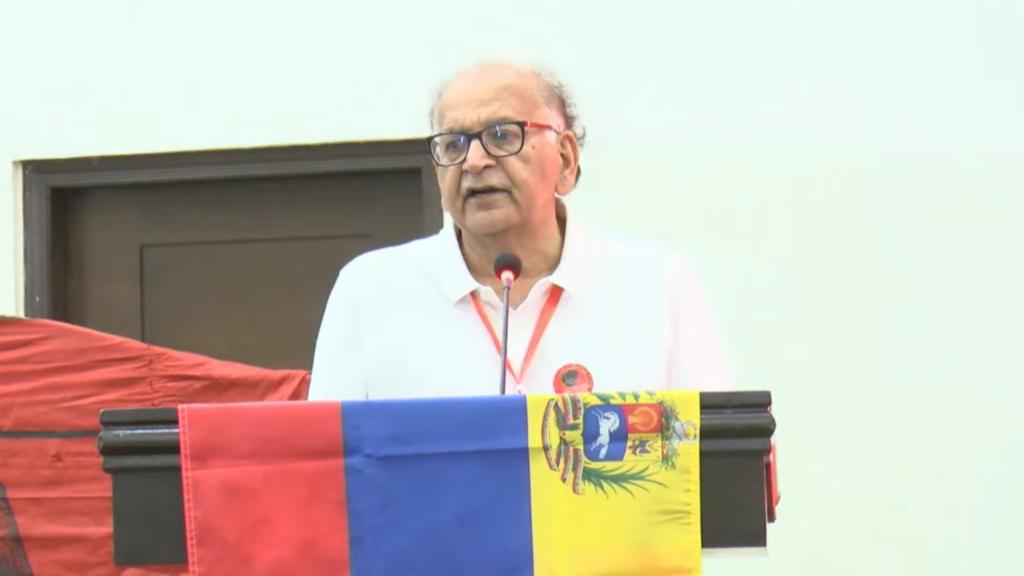
The International Anti-Imperialist Conference in Lahore, Pakistan, takes place at a very critical time, where Western capitalist centres have upped the imperialist ante in the face of receding global hegemony.
United States President Donald Trump’s second term — with its far-right agenda and foreign policy of recolonisation and war — has brought about a shift in the international situation.
Together with his partner in massacres, Israeli Prime Minister Benjamin Netanyahu, Trump has waged war on Iran, seeking to ensure complete domination of the oil and gas market. This comes after the genocide in Gaza, the invasion of Venezuela, the attempt to strangle Cuba and threats to annex Greenland.
The tyrant is striving to normalise genocidal language, blackmail and interventionism, as well as racism, misogyny and hatred of migrants, as he attempts to expel millions of workers from the US.
Declining US empire
Imperialism is an essential part of capitalism. But it has also been the most reliable partner of Euro-American powers in times of crisis.
Lagging behind China and other countries in securing hegemony over renewable energy sources, the US empire has fallen back to strengthening its control over traditional oil supplies.
The kidnapping of Venezuelan leaders and the war on Iran are two glaring examples of an empire refusing to innovate amid the climate change crisis and instead taking violent control over developing countries’ resources.
At the same time, US gangsterism cannot be reduced to simply securing control over fossil fuel value chains. Trump’s all-out war against Venezuela, Iran, Palestine, Lebanon and Cuba must be seen in the larger context of a war against the “axis of resistance”, even if these opponents are only anti-imperialist, and not anti-capitalist.
Bloody authoritarianism is the central instrument of imperialism in our time, because it needs to impose its policies of hunger, the proliferation of ecocidal technologies and practices, the excessive power of Big Tech, the dispossession of natural and energy resources, and increased military spending.
US imperialism will embark on a blind march toward ecological disaster if it is not defeated.
Anti-imperialism is not enough
Anti-imperialism directed toward the US is a direct threat to US hegemony over violence, even if it does not pose a threat to global capitalism. That is why we must support Iran and other developing countries resisting imperialist aggression, even if their anti-imperialism is devoid of anti-capitalism.
But this strategy is only good in the short run. In the long run, we must work toward building movements and parties that are anti-imperialist and anti-capitalist.
Anti-imperialism devoid of anti-capitalism is a slippery slope. It can take the form of a theological anti-US state, such as Iran, or a secular state capitalism, as with China.
While resisting US imperialism, we must resist these anti-imperialist caricatures too. This does not mean we stop supporting their fight for sovereignty, even if it comes with localised versions of capitalism. But we must be clear that this can only be a short-term strategy.
We cannot afford to reduce the socialist project to the point where a capitalism with a human or anti-imperialist face becomes acceptable or even desirable. We must not lower the bar that far. We must fight against imperialism and capitalism.
Pakistan
While the world admires the Pakistani state’s role as peacemaker between Iran and the US and Israel, here we have seen the state implementing its neoliberal agenda, bulldozing working-class settlements in Islamabad, right as talks are happening.
This is not an isolated incident but a microcosm of the state’s re-invigorated enthusiasm for dispossessing the urban and rural working masses of their social and ecological cushions, in the name of developmentalism. We want to remind the state that it cannot build its peacemaking diplomatic credentials abroad while being repressive at home.
Pakistan has faced 32 years of military dictatorship and political activists have paid the maximum sacrifices for fighting for genuine democracy and socialism. I personally spent 8 years in exile, was arrested dozens of times and my family faced intimidation. This happened to thousands of others after the military took over.
One of our main tasks is to regain the civic space that the military took away.
Left unity
We must develop a positive project for progressive, socialist futures. A project that stands against capitalism in its various imperialist, fascist, liberal, theocratic, statist and hybrid forms, under electoral and dictatorial conditions.
Despite internal differences, the left must forge a united front against the right. The global pro-Palestine movement is a good example of progressives from diverse convictions joining hands to fight for a common cause. Similar instances of left forces converging around common causes and developing a ground-up socialism are rampant across the Third World.
Some may question the success of these synergies, but my life-long experience working with movements and parties reveals there are no quick fixes to the imperialist, genocidal machinery we are up against. It is only after we develop a powerful confluence of working masses, farmers and other marginalised classes that we will have a united front to reckon with.
Capitalist governments refuse to recognise that popular mobilisations against them are the result of deep social contradictions. They typically attribute them to the actions of internal or external “agents”. We cannot accept this conspiracy version of history.
Undoubtedly, imperialism and its agencies try to take advantage of struggles, such as that of the Iranian people. But that does not reduce those struggles to an imperialist operation. We must oppose such interventions, while continuing to support those struggles.
Consistent internationalism
Today more than ever, we must practice consistent internationalism: a solidarity without borders, which encompasses struggles by workers and the oppressed, as well as struggles for self-determination across the world, without exceptions.
This is a policy that opposes all forms of imperialism. It does not subordinate the struggle in any country to that of another country. It is a policy that corresponds to the slogan: “Workers of the world, unite!”
For solidarity without borders! For internationalism without exceptions!
This is an edited version of the opening remarks delivered by Farooq Tariq at the International Anti-Imperialist Conference, hosted by Haqooq-e-Khalq Party (HKP) and People's Academy on May 3, in Lahore, Pakistan. Tariq is President of HKP.