Still steadfast: Punishment and perseverance in Singapore’s movement against genocide
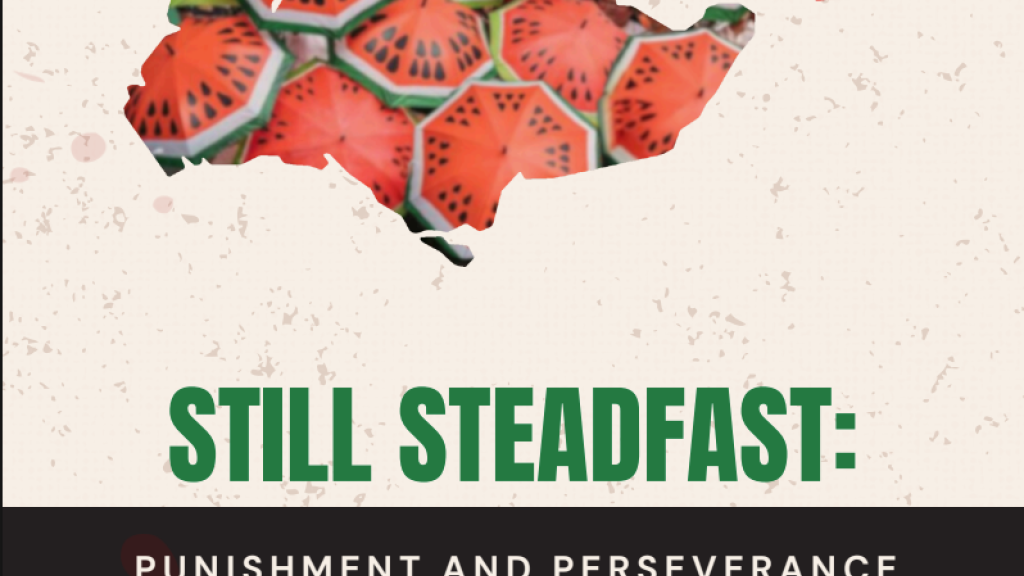
Israel’s genocidal response to Hamas’s October 7 attack in 2023 has been livestreamed all over the world, filling social media feeds. People all over the world have seen footage and reports of massacre, torture, starvation, displacement, the assassination of journalists, and the destruction of schools and hospitals. The desire to demand an end to such horrors has fuelled the growth of a dynamic and determined pro-Palestine, anti-imperialist movement in Singapore.
Solidarity with Palestine, as well as dissatisfaction with the Singapore government’s lacklustre response to Israel’s violent actions, has emerged at levels unseen in recent decades. There have been student actions across local universities, independent fundraising efforts, and peaceful demonstrations.
Singapore’s repression of civil liberties is well-known and documented. However, the Transformative Justice Collective (TJC) has observed that the authorities are particularly sensitive and quick to respond to pro-Palestinian discourse and action. Seeking to manage public discontent, the government has responded to grassroots actions with oppression and suppression. Non-state actors have also, on multiple occasions, participated in policing pro-Palestine expression and activity. Despite this, grassroots activists and organisers have not backed down. Through these efforts, the pro-Palestine movement has arguably won some concessions from those in power, reflecting the potential of direct action in challenging the state narrative and shifting public sentiment on Palestine.
Still Steadfast: Punishment and Perseverance in Singapore’s Movement Against Genocide examines the push-and-pull between activists and the forces attempting to silence them, and is part of TJC’s ongoing effort to document the nature and extent of authoritarian control in Singapore.
We first provide the historical and legal background to the state’s suppression of dissent, which often appears in the form of sanctions against activists and organisers in the name of “national stability”, “public order”, and “racial harmony”. We also include a brief overview of Singapore–Israel relations.
We then present a narrative timeline of events and developments from October 2023 to December 2025, mapping out incidents — encouraging or otherwise — related to pro-Palestine discourse and activism in Singapore. Our intention is to allow readers to see the interplay between repression and resistance, and how the movement for Palestinian liberation persists despite reprisals from the state, employers, schools, families, and other actors.
Based on interviews and focus group discussions conducted with nearly 20 pro-Palestine activists and organisers, we uncover and analyse the different forms of sanctions and reprisals activists have faced, in both the public and private domain. Our goal is to shed light on the varied challenges the pro-Palestine movement has had to overcome or navigate — some of which have been, until now, less understood, kept in the shadows, or hidden in plain sight.
We conclude this report by looking at how pro-Palestine activists have responded to the reprisals they’ve faced, and how they continue to navigate this hostile and repressive environment. We asked them:
- How have the reprisals affected you?
- What keeps you going despite the ever-increasing cost to your political work?
What the data shows is that there is a strong core of grassroots, pro-Palestinian activists and organisers who have remained undeterred by the obstacles put in their way. They are steadfast in their solidarity with Palestinians, and persist in expanding their capacity to keep Singapore’s pro-Palestine movement growing.
With this report, TJC does not only seek to draw attention to the way authoritarian control has intensified in Singapore through sophisticated methods of repression and reprisal. It is also important that we highlight the strength and perseverance of committed and well-organised individuals who — despite the price they have paid for their activism and the risks they still face — continue to educate, agitate, and organise around Palestinian liberation. The going has been tough, but these activists have never given up on finding creative ways to sustain themselves and the movement, and to push forward with their demands for accountability and change from the Singapore government.