Syrian government launches assault on Aleppo’s Kurdish neighborhoods
First published at Rojava Information Centre.
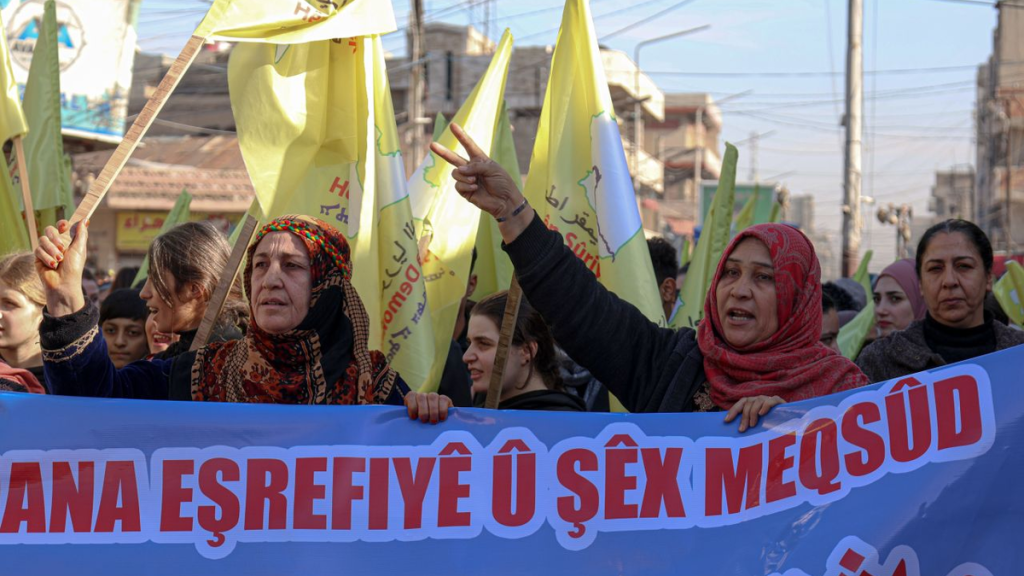
Two Kurdish neighborhoods in Aleppo are facing an armed assault by the forces of the Syrian Transitional Government (STG) aimed at seizing control of the neighborhoods. The STG and Kurdish-led Democratic Autonomous Administration of North and East Syria (DAANES) had reached a March 2025 ceasefire agreement covering the isolated Sheikh Maqsoud and Ashrafiyeh neighborhoods, but the subsequent nine months have been marked by escalating tensions culminating in the January 6 assault.
These neighborhoods had maintained their autonomy from both the Assad government and Islamist opposition factions since the start of the Syrian Civil War, becoming a safe haven for those fleeing violence, persecution and violent repression elsewhere in Aleppo and Syria. However, they have faced ongoing economic, humanitarian and military pressure from both Assad’s forces and the new authorities in Damascus. In this explainer, Rojava Information Center (RIC) provides key information on these isolated neighborhoods, their humanitarian and political significance, the ongoing attacks they have endured over the past decade, and the grave threats they now face.
What and where are Sheikh Maqsoud and Ashrafiyeh?
With a population of only around 10,000 prior to the 2011 outbreak of the Syrian revolution, these Kurdish-majority neighborhoods within Syria’s diverse second-largest city Aleppo soon swelled. While majority-Kurdish, members of the region’s Christian minorities and Arab families displaced by the war have also found a safe haven in these neighborhoods. Different sources estimate the population in these neighborhoods between 100,000 and 200,000 people.
“At first, the people who arrived had nothing, so an organization for helping the displaced people was built up. Many houses were empty because the Islamist militias had damaged them, or they had been burnt and looted. The organization found homes for those who did not have any money. Families moved into houses that had been abandoned but were still habitable and just needed to be repaired and refurbished. Organizations like the Kurdish Red Crescent also took care of the displaced and distributed blankets and clothes.” – Sheikh Maqsoud Council member
What was the situation in Sheikh Maqsoud and Ashrafiyeh prior to Assad’s fall?
In 2011 Aleppo became one of the centres of the Syrian revolution and saw some of the heaviest fighting of the civil war. Strong local assemblies and communes resisted influence from ISIS and Jabbat al-Nusra. Armed resistance pushed out Assad from eastern Aleppo and the northern neighborhoods of Sheikh Maqsoud and Ashrafiyeh which fell under the protection of the Kurdish People’s Defense Forces (YPG). These neighborhoods were among the first Kurdish regions to rise up against the Assad government, and subsequently endured successive attacks, embargoes and sieges by both Islamist armed groups and pro-Assad forces.
In 2016, Amnesty International described indiscriminate shelling of Sheikh Maqsoud by Islamist groups including Ahrar al-Sham and Jaysh al-Islam as amounting to war crimes. The rights watchdog documented the death of at least 83 civilians, including 30 children, in attacks which Amnesty reported may have involved the use of chlorine, a banned chemical weapon.
By 2016 Assad had regained control over the whole city, with the sole exception of Sheikh Maqsoud and Ashrafiyeh, which have remained under the political administration of what is now the multi-ethnic Democratic Autonomous Administration of North and East Syria (DAANES). By early 2017, a Turkish invasion targeting the Kurdish-led, multi-ethnic autonomous region had isolated Sheikh Maqsoud and Ashrafiyeh from the contiguous regions under the control of the DAANES. Since then the neighborhoods have governed themselves autonomously while retaining close political and humanitarian ties to the DAANES.
Electricity and water was allowed to enter the districts, while there was also coordination for education provision. This enabled the neighborhood administration to continue building a network of district-level communes and implementing its stated goals of women’s autonomy and ethnic minority participation, retaining political autonomy despite the close presence of hostile forces.
Following Assad’s recapture of Aleppo, the Kurdish neighborhoods were at times placed under siege by the Assad government preventing the entry of fuel and other essential supplies to exert political pressure on DAANES. These measures led to critical fuel and medicine shortages and worsening humanitarian conditions in the neighborhoods.
What has happened in Sheikh Maqsoud and Ashrafiyeh since Assad’s fall?
On November 29, 2024, HTS and Turkish-backed Syrian National Army (SNA) groups entered Aleppo on the third day of the offensive that toppled the Assad government. Fighting between the former Turkish-backed SNA factions folded into the new Syrian military and the DAANES’ Syrian Defense Forces (SDF) in early 2025 led to two agreements:
The first, known as the March 10 agreement and signed between the SDF and the new Syrian Transitional Government (STG) led by Ahmed al-Sharaa, offered a roadmap for North and East Syria (NES) to integrate into the new Syrian political and military system by the end of 2025. However, negotiations have failed to progress. A second agreement was reached in early April, attempting to bring an end to clashes around the perimeter of the neighborhoods. The neighborhoods were broadly demilitarised, with SDF fighters withdrawing and taking heavy weaponry with them. As per the terms of the agreement, the DAANES’ Asayish (Internal Security Forces) remained to police the neighborhoods with light weapons.
What violence have Sheikh Maqsoud and Ashrafiyeh faced this year?
Despite Assad’s demise, the new Syrian authorities have continued a similar approach of exerting humanitarian and economic pressure on the neighborhoods as a political tool. Residents of Sheikh Maqsoud and Ashrafiyeh have faced intermittent embargos with access to electricity, water, fuel, food and free movement to and from the neighborhood cut off periodically since July when fuel access was cut off for 14 days.
This approach escalated from late September onwards, when STG forces began constructing earth barriers at checkpoints into the neighborhoods. On October 6 all access to Sheikh Maqsoud was cut off leading to protests by residents and eventually fighting between the Asayish and STG forces, after the latter opened fire on protestors and attempted to enter the neighborhood.
On December 22, fighting once again broke out between STG forces and Asayish. Hevin Suliman, Co-Chair of the Sheikh Maqsoud Council, told RIC at the time: “This did not come from nowhere. It is connected to the visit of the Turkish delegation to Damascus, led by Hakan Fidan. These factions, though officially under the Syrian Ministry of Defense (MoD), take direct orders from Turkey. The Turkish state has significant influence over Aleppo and controls these factions.”
Meanwhile, bouts of government-led violence against minorities elsewhere in Syria saw over 1500 members of the Alawite minority killed by the STG’s forces in March 2025, and over 1000 members of the Druze minority similarly killed in July 2025. These attacks underscored the risks faced by Kurds and other minorities living in the isolated neighborhoods, particularly following the SDF’s withdrawal as per the ceasefire agreement, with DAANES officials warning that similar violence against their own populations could follow.
What is the current situation in Sheikh Maqsoud and Ashrafiyeh?
In January 2026, the latest small-scale skirmishes between the STG and Asayish that have happened for several months beforehand were taken as the pretext for the STG to launch a full-scale assault aimed at seizing control of the neighborhoods. More broadly, the operation came after a sudden breakdown in talks aimed at implementing the March 10 agreement between SDF and the STG, again reportedly as a result of Turkish pressure demanding an end to the negotiations.
The inciting incident occurred on the Deir Hafer front on January 5, 50 kilometers (40 miles) from Aleppo. The STG alleged an SDF drone hit a military police vehicle which the SDF denied. On January 5, Sheikh Maqsoud Asayish reported drone attacks from government forces killed one civilian and injured two others, leading to a rapid escalation.
Artillery bombardment rapidly escalated into a ground assault, and the neighborhoods are currently in their fifth day of siege and heavy fighting. Since then, Aleppo has seen heavy fighting on the ground as STG forces repeatedly attempted to enter the neighborhoods using tanks and armoured vehicles. Internationally sanctioned groups, formerly part of the Turkish-backed SNA, Hamzat, al-Amshat, Sultan Murad, and Nour al-Din al-Zenki – integrated into the new Syrian Army’s 76th, 62nd, 72nd, and 80th divisions – are reported to be involved in the attacks.
The government has repeatedly shelled or attacked the neighborhoods with drones, destroying or damaging over 300 homes and hitting the only operating hospital in Sheikh Maqsoud several times, leaving the Martyr Khaled Fajr hospital without power since January 8. 13 civilians have been killed and more than 64 are injured, numbers expected to rise significantly in the coming days as more casualties are reported.
Ashrafiyeh has seen particularly heavy fighting as STG forces have repeatedly entered the neighborhood and seized some territory. One person in Ashrafiyeh told RIC, “I was inside a house with some of my cousins when three armed men pointed their guns at us. They were speaking Turkish and took any money and valuables they could find. Many of the fighters who entered the Ashrafiyeh neighborhood were speaking Turkish.”
Each day, the STG forces have opened crossings to allow civilians to leave, and it is estimated that tens of thousands have fled. This includes Kurdish IDPs from Turkish-occupied Afrin who are attempting to return to the nearby region, despite the risks of returning to areas controlled by former SNA factions that have spent years committing violations against civilians with impunity.
“We left because of the constant bombing and shelling, fearing for our children. We can’t judge whether it’s safe to return or not,” one source told RIC. “We have mixed feelings, between fear and disappointment. We are not returning to Afrin because it is safe, but rather to escape death and stay alive.”
Yesterday, ambulances from the Kurdish Red Crescent attempting to cross from DAANES-held territory to the neighborhoods to retrieve the wounded and bring them to DAANES hospitals have been denied access. The Kurdish Red Crescent have put out an urgent call asking for donations and humanitarian aid.
Meanwhile, preparations were made for a convoy of civilians to make their way towards Aleppo, mirroring the actions taken last year at Tishreen Dam. Today, a convoy of hundreds of cars from Kobani, Qamislo, Raqqa and cities across NES made their way to the Deir Hafer crossing in a bid to cross and reach Aleppo.
Conclusion: An end to co-existence?
At the time of writing, fighting continues in some areas of Sheikh Maqsoud. The STG has announced full control of the neighbourhoods, a claim strongly denied by the Asayish. The future is unclear for both the civilians who remain in Sheikh Maqsoud and Ashrafiyeh and those displaced from their homes by the military operation.
A continued ceasefire and gradual development of stronger intra-communal links with the rest of Aleppo could have offered a blueprint for safe, secure, practically-realisable integration between Syria’s two remaining power blocs in the DAANES and STG. But with the STG seemingly able to use force to seize control of the neighborhoods amid muted international reaction rather than a negotiated settlement, it is unclear how negotiations over NES’ integration are supposed to progress. Rather, the STG’s assault on Sheikh Maqsoud and Ashrafiyeh has pushed Syria a step further down the path toward a renewed civil war.