Sheikh Akram Mashoush: ‘After all the martyrs, how could we suddenly ally with parties whose mentality we do not believe in?’
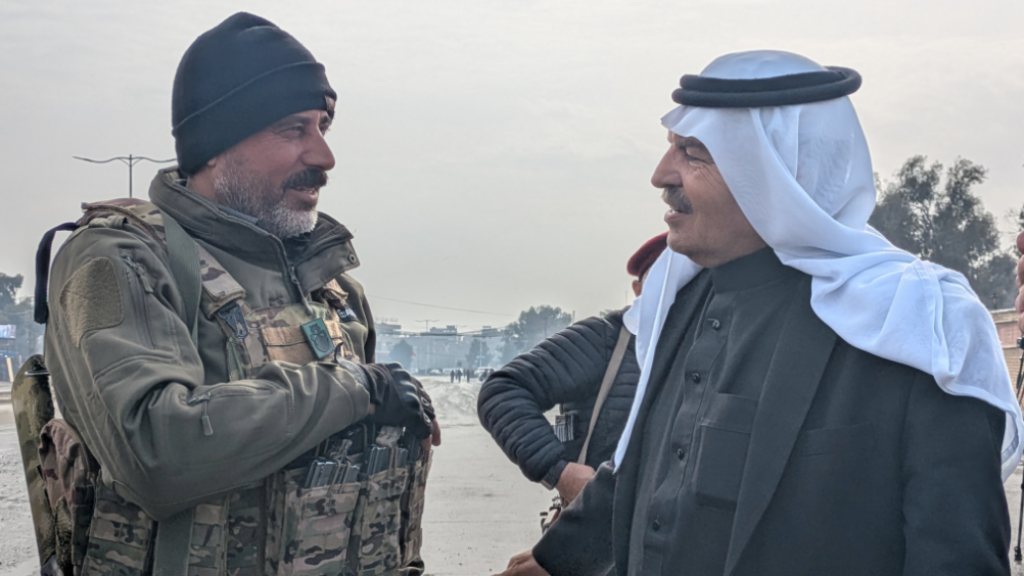
First published at Rojava Information Center.
What is the history of your tribe in this region? How was it during the Assad government?
The tribal connections between different tribes and communities go back decades, not only to the Assad era, but even to the Ottoman Empire. In particular, the links between Arab and Kurdish communities date back to Ottoman times, continued through the French mandate, and survived throughout the Assad regime. These connections endured all those eras and were never broken. After the establishment of the Autonomous Administration (AANES), these links did not disappear. For those of us who have a conscience, they cannot be ignored. We have family ties, neighborly ties, and shared village life. In our villages, Kurds and Yazidis live together with Arabs. These connections cannot be forgotten or denied. They were not created by us, but by our grandfathers. They made our communities connected and cohesive, and with time, they have only grown stronger. Today, when we see our Kurdish brothers suffering and under attack, can we abandon them? We see our Kurdish brothers being attacked by ISIS and by different forces that have taken control of parts of Syria. No, we cannot abandon these humanitarian, social, and ethical bonds. These ties force us to remain together — not only within AANES, but in all aspects of life. Even if AANES were to end, we would not separate or cut these ties. They are social bonds based on coexistence. These connections go so deep that they even exist at the level of milk kinship, a Middle Eastern tradition in which a child breastfed by a woman who is not his mother becomes her milk-son or milk-brother to her children. Such ties are never forgotten, regardless of what happens. We will continue on this path no matter what we go through.
In Hasakah, there are around one million people from the Jabour tribe. This tribe has a different and special relationship with the Kurds compared to other tribes. The Jabour tribe has a long history of ties with the communities of the region, and because we lived side by side with Kurds in mixed areas, these ties became even stronger. My own name, Akram Hajo Mashoush, comes from a Kurdish person from Tirbespiye. These ties are not new. We learned the Kurdish language through living together. It is impossible for us to abandon all of this simply because of military circumstances.
At the military level, the situation of Jabour was different. Even during the Assad era, we were marginalized. Unlike the Shammar tribe, which comes from broader regions and formed the Sanadid Forces to protect borders, we did not form a separate military entity. We preserved our tribal structure and focused on social cohesion and family ties through marriage with different communities. With full respect to other tribes, these factors gave Jabour a unique relationship with the Kurds. There are members of Jabour from Sheddadi married to Kurdish women in Darbasiye, and the same exists between Tel Brak, Qamishlo, and Derik. These ties were not invented or recently created; circumstances simply made the Jabour tribe more closely connected to the Kurds than any other tribe. What is the SDF? It is a force formed from tribes. There is a clan called Mahasin with more than 5,000 fighters within the SDF. There are more than 800 martyrs from the Jabour tribe within the SDF. We did not seek an autonomous entity or structure; we only wanted to protect ourselves. We joined the fight against ISIS because of its brutality – killings, slaughter, oppression, and harsh treatment of women. These conditions only strengthened our cohesion and unity.
What is your opinion about the most recent agreement between the SDF/DAANES and the Syrian Transitional Government (STG)?
The fundamental principle of the current agreement is the ceasefire. As people everywhere welcome such understandings, we, as people living in the area, strongly support and bless it. Government forces are only a few kilometers away, and we are surrounded. Deadlines were given for evacuating areas. Therefore, any ceasefire or agreement is something we genuinely support. All notable figures of the Jabour tribe welcome it. We have always sought a ceasefire between the Damascus government and the SDF. This agreement must lead to positive outcomes that serve the Syrian people. Fighting only brings bloodshed, displacement, and deeper divisions among communities. We want guarantors to take responsibility and ensure the agreement is implemented and not violated. We support the SDF and AANES delegations in their agreements related to security arrangements, integration, and the formation of brigades within the Syrian Army. In the end, we are Syrians. We do not want Syrian blood to be shed. All those killed are Syrians. None of the foreign states have lost their citizens; only Syrians pay the price. This agreement aims to preserve Syrian blood, and its most important pillar is the ceasefire, which can revive coexistence.
Can you explain about the recent tribal defections from the DAANES to the STG?
Turkey has worked to divide the tribes in order to destroy the social fabric. They do not see the SDF as representing Syrians, but only as representing Kurds, and they consider it an enemy, despite the SDF having over 15,000 martyrs and more than 50,000 wounded. Some tribes were influenced by this mentality, including ISIS-like thinking. Turkish intelligence (MIT) also played a role, convincing some tribes — not all — that their situation would improve if the SDF were gone. Even some figures within AANES, such as Muhbash, the head of the negotiation committee, acknowledged this. Tribes are not political organizations and lack deep political experience. They were subjected to pressure, threats, and promises of financial support. This explains why some switched sides. When cities like Tabqa, Raqqa, and parts of Deir ez-Zor fell, uprisings happened even before the Syrian army arrived, proving that there were prior plans. Weaknesses in the security experience of AANES prevented early detection of these breaches. At the same time, the SDF and AANES did not want to be dragged into cycles of violence. They did not want destruction or to kill their own brothers and sisters who rose against them. That is why these areas fell quickly. Many of my relatives and cousins are in Damascus. They offered me defection, positions, and benefits. I completely refused. This goes against my principles and conscience. After all the martyrs, sacrifices, and coexistence, how could we suddenly switch sides and ally with parties whose mentality we do not believe in? This is for those in Damascus. But unfortunately, some members of our tribe, here in the area, used extremely bad language toward me. They threatened me, sent insulting messages and videos, and attempted to intimidate me.
After the agreement is implemented, we hope bloodshed will stop and the situation will be organized. We are all Syrians, and no one should be denied their rights. The Kurdish people have a special situation and legitimate rights that must be recognized. They were among the first to fight and offer martyrs in the revolution, before the formation of the SDF, through the YPG and YPJ. They protected everyone, including Arab communities, even before the creation of the SDF and AANES.
Do you have any critiques for the DAANES?
We do acknowledge shortcomings in services and administration. These were not military or political failures, but administrative ones. Despite having agricultural land, oil, and resources, we failed to meet people’s needs. There was no water, electricity solutions were lacking, bread shortages existed despite wheat abundance, and fuel crises persisted despite oil resources.
These failures are real. However, they do not justify switching sides simply because AANES is weakening. Administrative and service failures exist, but abandoning everything because of them is not justified.