Singaporeans are not apathetic: They are overworked
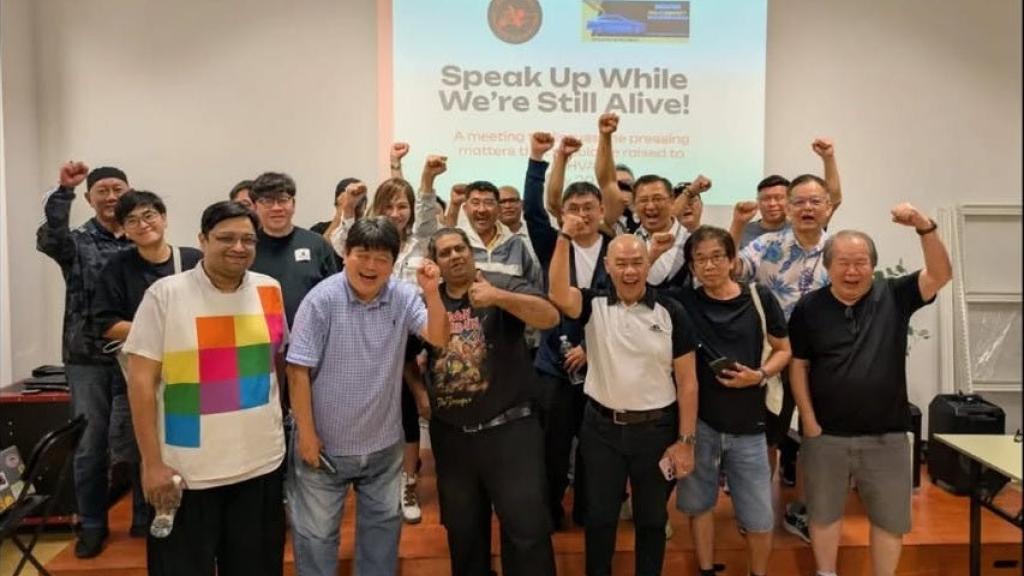
First published at Workers Make Possible.
Gavin Neo woke up every afternoon and drove until the next morning. Then he sent his daughter to school. Then he slept.Then he did it again.
He ate $3.80 chicken rice at a coffee shop in Killiney. The cheapest food he could find. He topped off his meal with a can of Red Bull and got back behind the wheel. He didn’t drink, nor did he smoke. He spent almost nothing on himself.
On 29 May 2025, Gavin Neo died of a cerebral stroke. He was 49. He left behind two teenage children. He had been working up to 15 hours a day to provide for them.
When his friend once asked him why he skimped on food despite working that many hours, Gavin replied, “It’s for my kids and their future.”
Gavin Neo was a Diamond Tier Grab driver. Diamond Tier is awarded to the top 10% of drivers on the platform who complete up to 2,0000 trips every three months. Equating to an average of 22 trips a day. He had this designation by working himself into the ground.
This is a story about time. Specifically about who owns it and who gets to keep it.
The numbers first
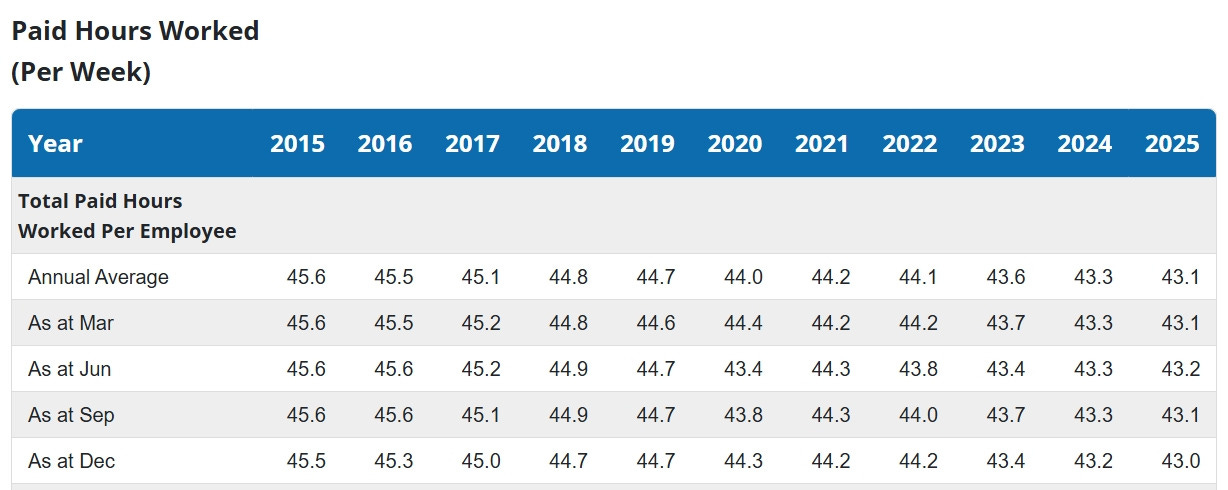
Singaporeans work an average of 43.8 hours per week. Not the worst. But not a statistic to be proud of either. Singapore is one of the exceptions to the general rule that high income countries have shorter working hours.
The Ministry of Manpower (MOM) reported that the average weekly hours worked by employed residents fell from 47.0 hours in 2017 and 45.0 in 2021. From the statistics, this decline is a long-term trend that’s also observed in other advanced economies.
So uh… MOM also notes “usual hours worked refers to the number of hours that a person usually works in a typical week, regardless of whether he is paid or not.”
So the number is already a mess. And it still sits above the global average for developed economies. And it says nothing about what happens when they get home. Cooking. Shopping. Caregiving. The elderly parents. The pre-schoolers. Pressing on each day with trepidation.
The 43.5 hours is a very forgiving average. It excludes the second job. It excludes the work done at home. It is the floor. Not the ceiling.
Full-time teachers work 47.3 hours per week. The OECD average for teachers is 41 hours. Platform workers like Gavin Neo clocked 15 hours in some days just to stay afloat.
There is a version of this story where I talk about all these numbers to hit a minimum of 2000 characters and then conclude Singapore should consider adopting flexible work hours. If you want that version I’m sure you can find that elsewhere.
The more useful version asks how we got here and who benefits from keeping us tired.
Fighting for our rights
Robert Owen coined the slogan, “Eight hours’ labour, eight hours’ recreation, eight hours’ rest” in 1817 to promote a balanced workday. The demand took about a century of strikes, blood and dead workers to become standard practice in most of the industrialised world.
On 1 May 1886, hundreds of thousands of American workers went on strike demanding an eight hour workday. The strikers’ slogan was, “eight hours for work, eight hours for rest, eight hours for what we will.” Three days later on May 4 at Haymarket Square in Chicago, a bomb went off at a labour rally. Police opened fire into the crowd. Seven officers and an unknown number of workers died. The courts hanged four labour leaders on evidence so thin that the Governor of Illinois later pardoned the remaining defendants and called the trial a travesty.
The Haymarket Affair is why we have May Day on the first of May.The Second International designated it International Worker’s Day in 1889 specifically to commemorate the workers who were killed and hanged for asking to go home at a reasonable hour. That is the origin story of a public holiday that Singapore observes every year without ever explaining what it is for.
Our rights were not given. They were taken. At a considerable cost.
1968: The year progress was reset
Singapore entered the story about 80 years later with a different approach. In 1968, PAP passed the Industrial Relations (Amendment) Act. Collective bargaining was not abolished outright but quietly defanged. The Act carved out a set of functions as exclusive management prerogatives.
Promotion. Internal transfer. Recruitment. Retrenchment. Dismissal. Reinstatement.
From 1978 onwards, there was almost no sign of industrial unrest in Singapore.
The government calls this modernisation. Foreign direct investment poured in, wages stayed low. Everybody on the right side of the arrangement called it a miracle.
While for the rest of us, it is a structural guarantee that workers would never accumulate enough power to take their time back. The legal mechanism that made collective bargaining possible was removed before most workers here were old enough to use it.
The house that PAP built
Singapore has many trade unions. The Food Drinks and Allied Workers Union. The National Transport Workers Union. The Singapore Manual and Mercantile Workers Union. Dozens more. But every single one of them are organised under National Trades Union Congress (NTUC).
Independent unions do exist. The Airline Pilots Association Singapore being one. But they represent a small fraction of the organised workforce. Over 90 percent of unionised workers sit under the NTUC umbrella . Which means there is effectively one house and the government helped design the floor plan.
The NTUC adopted a cooperative rather than confrontational posture toward employers in 1969. This was exactly one year after the government stripped workers of most of their bargaining rights. The timing is either a coincidence or a joke. An unfunny one.
The NTUC’s Secretary-General is a PAP Member of Parliament. Previous Secretary-Generals have gone on to become Cabinet ministers. The NTUC describes its relationships with the PAP as symbiotic.
In 2024 the Ministry of Home Affairs designated the NTUC as a politically significant person under the Foreign Interference (Countermeasures) Act because of its close relations with the PAP. The government classified its own union as a PAP-affiliated entity. Under a law designed to protect Singapore from foreign influence.
When Neo died the response from the NTUC-affiliated platform worker associations was a joint statement calling on operators to address fare transparency and unsafe incentive structures. A Facebook post from an assistant secretary-general. The standard machinery. What was different this time was what happened before that. Fellow drivers launched a crowdfunding campaign for Neo’s children. Comments flooded the NPHVA and Mothership Facebook pages demanding a maximum 12-hour driving limit.
Drivers organised in chat groups, united on a set of demands through an open letter, organised their own townhalls, and threatened to strike on 1 July. The open letter’s demands were released before the NPHVA, which echoed very similar points. That pressure extracted something. The government started organising townhalls with the help of NTUC and started facilitating dialogues with the platforms. By July 2025 the government had formed a Platform Workers Trilateral Group comprising MOM, the Ministry of Transport NTUC and Grab Singapore to address driver concerns.
By September the group announced ten recommendations including new principles for fair earnings and incentive schemes that all nine platform operators agreed to adopt. Significantly, Grab reversed course on an incentives scheme it was intending to roll out, which was unpopular among drivers.
Concessions. Won not given.
The difference was that workers organised and made enough noise that ignoring them became inconvenient and even costly. That is how it has always worked. That is the only way it has ever worked.
Built to fit
To be fair to the NTUC the architecture was built to constrain them long before the current leadership arrived. The management prerogatives carved out in 1968 set the ceiling on what collective bargaining could achieve.
The NTUC operates faithfully within those limits. It negotiates where it can. It proposes where it cannot compel. It almost never strikes. Not because that is against the law, but because it has almost never considered it to be an acceptable option.
Not because it legally cannot but because it has not in living memory considered it an available option.
A union that has internalised the limits of the system it was built inside is not a union that will push those limits. That is not a criticism of any individual. It is a description of what the structure produces.
The ideology doing the actual work
The genius of the Singapore model deserves to be acknowledged as an achievement of ideological engineering.
Workers here don’t ask why wages are structurally suppressed. They ask why they didn’t study harder.
Workers don’t ask why they can’t retire. They ask whether they should have started their CPF top-ups earlier.
Workers don’t ask why they are exhausted. They google burnout recovery tips.
Every structural problem becomes a personal one. The answer is always individual. The cause is individual. The solution is always individual.
This is what Antonio Gramsci calls hegemony. The process by which the ruling class makes its own worldview feel like common sense to everyone including the people it exploits. You don’t need a policeman at every door when workers have already internalised the idea that their poverty is their own personal failure.
Consider what the numbers actually say about whose efforts are rewarded. Between 2019 and 2024, the average global CEO pay rose by 50 percent, The average worker’s wages over the same period went up by 0.9 percent.
Not 50 percent. Not even 5 percent. 0.9 percent.
Meritocracy cannot explain this. Meritocracy says outcomes reflect effort.
Every hour, billionaires pocket more wealth than the average worker.
Jeff Bezos does not work harder than you. Elon Musk does not work harder than you.
The workers did not suddenly become 56 times less productive than their bosses between 2019 and 2024. The bosses became 56 times more capable of extracting value from the workers.
Got time?
The theme for Workers Make Possible and SG Climate Rally’s Labour Day 2026 rally is: Running out of time. Take back your life.
Good Slogan.
The system does not need to ban organising. Just needs to make sure everyone is too tired to show up. A teacher working 47 hour weeks doesn’t have much left in the tank by Friday. A platform driver working 15-hour shifts to hit metrics that keep him Diamond Tier has no energy for collective action. A junior doctor on a 30 hour call isn’t thinking about union membership. Rather she is thinking about how to stay awake and not get sued for medical negligence.
This isn’t accidental.
The International Workingmen’s Association took up the demand for an eight-hour day at its Congress in Geneva in 1866 declaring that “a preliminary condition, without which all further attempts at improvement and emancipation must prove abortive, is the limitation of the working day.”
That was 1866. The people who said this seemed to have foresight that Singapore’s Labour movement is structured to prevent workers from understanding something. That time is not just a quality of life issue. It’s a political resource.
You need time to read. To talk. To organise. To show up. To ask why the hell this is happening to all of us.
Gavin Neo did not have eight hours to rest. He did not have eight hours for what he would do. He had a Red bull, a $3.80 plate of chicken rice and an algorithm that rewarded him for working himself into a stroke.
Eight hours for work. Eight hours for rest. Eight hours for what you will.
They said it in 1817. We’re still asking.
Ilyas Muzaffar is an independent writer and journalist
Sources used or referenced
Wikipedia. First International. https://en.wikipedia.org/wiki/International_Workingmen%27s_Association
Wikipedia. Second International. https://en.wikipedia.org/wiki/Second_International
Wikipedia. Haymarket Affair. https://en.wikipedia.org/wiki/Haymarket_affair
Wikipedia. Geneva Congress (1866). https://en.wikipedia.org/wiki/Geneva_Congress_(1866)
Wikipedia. Eight-Hour Day Movement. https://en.wikipedia.org/wiki/Eight-hour_day_movement
Wikipedia. Robert Owen. https://en.wikipedia.org/wiki/Robert_Owen
Wikipedia. Cultural Hegemony. https://en.wikipedia.org/wiki/Cultural_hegemony
Gramsci, Antonio. Selections from the Prison Notebooks. Marxists.org. https://www.marxists.org/archive/gramsci/prison_notebooks/index.htm
Marx, Karl. Instructions for the Delegates of the Provisional General Council. Marxists.org. https://www.marxists.org/archive/marx/works/1866/08/instructions.htm
Oxfam International. Global CEO pay increased by 50 percent since 2019, 56 times more than worker wages. https://www.oxfam.org/en/press-releases/global-ceo-pay-increased-50-percent-2019-56-times-more-worker-wages
Ministry of Manpower Singapore. Hours Worked 2024. https://stats.mom.gov.sg/Pages/Hours-Worked-Tables2024.aspx
Ministry of Manpower Singapore. Hours Worked — Summary Statistics. https://stats.mom.gov.sg/Statistics/Pages/hours-worked.aspx
Ministry of Manpower Singapore. Labour Force in Singapore Advance Release 2024. https://stats.mom.gov.sg/iMAS_PdfLibrary/mrsd-labour-force-in-singapore-advance-release-2024.pdf
OECD. Results from TALIS 2024 — Singapore Country Notes. https://www.oecd.org/en/publications/results-from-talis-2024-country-notes_e127f9e2-en/singapore_8e88e29a-en.html
Ministry of Education Singapore. Singapore Teachers Embrace Digital Technologies — TALIS 2024. https://www.moe.gov.sg/news/press-releases/20251007-singapore-teachers-embrace-digital-technologies-and-benefit-from-strong-professional-development-oecd-talis-2024-study
IPS Singapore. The Gig Is Up: Understanding Platform Workers in Singapore (Working Paper No. 48). https://lkyspp.nus.edu.sg/ips/news/details/ips-working-paper-no-48-the-gig-is-up-understanding-platform-workers-in-singapore
Mothership. PHV driver, 49, who worked 15-hour days to support 2 children dies of stroke. https://mothership.sg/2025/06/phv-driver-dies-stroke-worked-15-hours/
Mothership. NTUC-affiliated associations reach out to PHV driver Gavin Neo’s family. https://mothership.sg/2025/06/unions-fair-earnings-insurance-platform-workers/
The Online Citizen. Govt urged to regulate platform operators after PHV driver dies of stroke. https://www.theonlinecitizen.com/2025/06/06/govt-urged-to-regulate-platform-operators-after-phv-driver-worked-15-hour-days-dies-of-stroke/
Ministry of Manpower Singapore. Government responds to NTUC call for formation of Platform Workers Trilateral Group. https://www.mom.gov.sg/newsroom/press-releases/2025/0704-government-responds-to-ntuc-call-for-formation-of-platform-workers-trilateral-group
TWC2. Overworked and Overlooked: The Scourge of Excess Overtime. https://twc2.org.sg/2024/12/22/excess-overtime-overworked-and-overlooked/
TWC2. 68% of Construction Workers Work Illegally Long Hours. https://twc2.org.sg/2017/04/25/68-of-construction-workers-work-illegally-long-hours/
NTUC. PAP reaffirms symbiotic relationship with NTUC at party convention. https://www.ntuc.org.sg/uportal/news/PAP-reaffirms-symbiotic-relationship-with-NTUC-at-party-convention-honours-former-labour-chief/
Wikipedia. National Trades Union Congress. https://en.wikipedia.org/wiki/National_Trades_Union_Congress
Airline Pilots Association Singapore. https://www.alpas.org/
National Library Board Singapore. Industrial Relations (Amendment) Act 1968. https://eresources.nlb.gov.sg/history/events/d7778e3e-1d07-457d-8cb4-6b27c0b8eb6d
National Library Board Singapore. Industrial Relations — Infopedia. https://www.nlb.gov.sg/main/article-detail?cmsuuid=cf25790d-a390-4a88-938c-23bb7cbb316f
Federal Reserve Bank of St. Louis. Labour Share of GDP at Current National Prices for Singapore. https://fred.stlouisfed.org/series/LABSHPSGA156NRUG
PMC. Reimagining Singapore’s Work Culture: The Four-Day Workweek Proposition. https://pmc.ncbi.nlm.nih.gov/articles/PMC11774796/