‘The people have had enough and are taking to the streets’: Interview with Venezuelan union leader Eduardo Sánchez
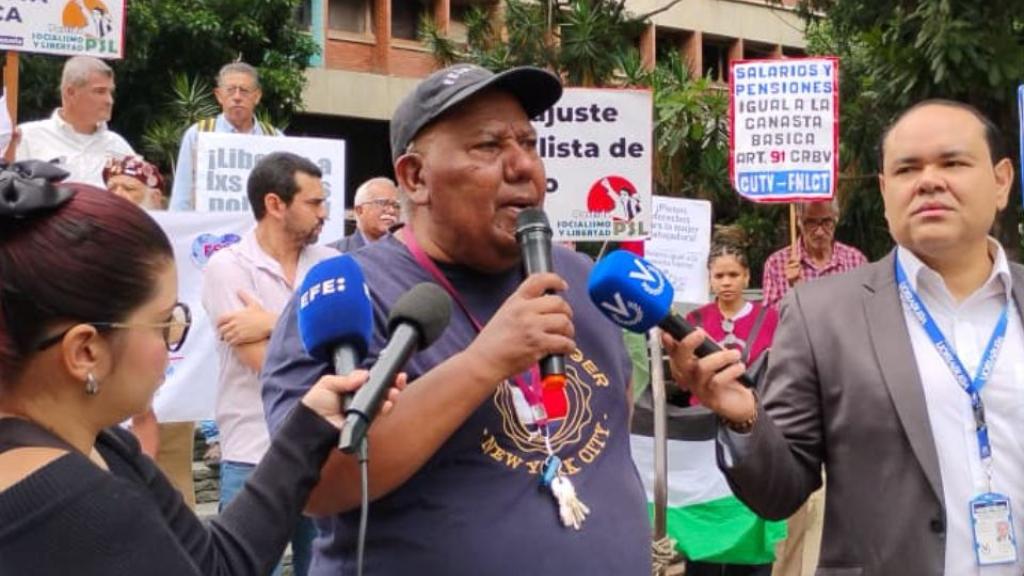
Venezuela’s Acting President Delcy Rodríguez announced several economic measures on April 8, including a minimum wage rise. Though the exact amount was not specified, she stated it would be “responsible”. The following day, workers and pensioners took to the streets in Caracas to demand a living wage and pension, among other things.
In this interview, trade union leader Eduardo Sánchez speaks to Federico Fuentes of LINKS International Journal of Socialist Renewal about these recent events. Sánchez is president of the Federation of University Workers (Fetraesuv) and of the National Union of Workers at the Central University of Venezuela (SINATRAUCV).
Before addressing the most recent events, could you describe the situation facing Venezuelan workers? Why is the issue of wages so important?
The situation facing Venezuelan workers is disastrous. Since 2018, a neoliberal economic package has been implemented, which has decimated workers’ wages. This package was accompanied by two currency reforms that removed 11 zeros from the bolívar — an unprecedented devaluation. The minimum wage was also frozen; the last increase to 130 bolivars (US$0.27) was in 2022.
At the same time, two unconstitutional instruments were introduced by the government. The first is Memorandum 2792, which paralysed collective bargaining discussions and deregulated employer-employee relations to the detriment of workers. This marked the start of the shift towards paying non-salary benefits, known as bonuses, instead of wages. This in turn led to a decline in workers’ purchasing power, bonuses are not taken into account when calculating things such as holiday pay, Christmas bonuses or redundancy/retirement payouts. The result was that worker’s income fell by 60%.
The second is the ONAPRE Directive, which deregulates pay scales, leading to a reduction in workers’ real wages by between 42–72%. This has brought us to the point where, today, to cover basic food costs a worker needs $670 and to cover basic living expenses they require $1175, yet the minimum wage stands at $0.27. Even after adding bonuses, these workers only get $160. Today we have the lowest wages in the world, despite being a country rich in oil, gas, gold, rare earths and fresh water. This has forced workers to seek other jobs, working up to 14 hours a day just to be able to buy the food they need.
As a result, levels of extreme poverty among workers have risen to 79%. Malnutrition due to a lack of adequate food and infant mortality rates have also increased. Around 7.5 million Venezuelans aged between 18 and 45 have migrated to neighbouring countries, out of a population of 32 million. And we are living in a situation where services, taxes, everything, is dollarised, except for wages, which remain in bolivars. That is the tragedy facing our people.
On top of this, we have to add the issue of repression and the imprisonment of more than 500 workers for protesting, who form part of the 12,000 political prisoners (including civilians and military personnel) held for opposing or dissenting.
Is the economic situation of workers the fault of the sanctions or of the Maduro government’s policies?
Undoubtedly, US sanctions have hit the Venezuelan economy. But the biggest problem is corruption — at all levels of the state — which has bled the country dry. This, together with repayments of foreign debt and subsidies to the private sector and transnational corporations. The reality is that they have taken everything, leaving only misery, hunger and despair for the working people.
What was the majority reaction among workers to the imperialist attack on January 3?
Unfortunately, according to some polls, 75% of the people supported Maduro’s removal. Hatred towards the government, repression, and the crisis following the electoral fraud in the July 2024 presidential elections were some of the reasons for this.
Delcy Rodríguez announced a series of measures on 8 April. How do you view these measures? Who do they benefit?
The Acting President’s address did not go down well with workers and their unions. She announced an economically “responsible” wage rise, which people interpret as more of the same. People want wages, not bonuses. And they want them now.
She also announced a commission comprising the government, the private sector and workers, in addition to the labour constituent assembly. But the truth is that rank-and-file workers are not represented there. Only the pro-government trade union federations — which are empty shells and do not represent us — will be invited. And the labour constituent assembly only includes the government’s swindlers and scabs — the very same people who have sold out and betrayed the working class.
The government’s stance clearly favours the business sectors, who live off workers and now aim to take away our redundancy/retirement payouts, which workers won through struggle and are the only achievement they have not officially stolen from us.
The following day there was a large mobilisation of workers and pensioners in Caracas. What were the main demands of the marches? Which trade union and political sectors took part?
The protest on April 9 was called by the trade unions in a united front. There were trade unionists who support the right-wing opposition, left-wing unions, and non-aligned unions. Political sectors are trying to hijack the workers’ struggle, but the workers have not allowed them to co-opt their struggle.
There were people there who identify with the right-wing opposition or who are on the left, but I believe the majority have views that align with the political centre. The march reflected the fact that the people have said ‘enough is enough’ and are taking to the streets. Even those who supported the government are defecting en masse to the social protest movement. Today, no one involved in the struggle supports the government.
The demands of the protest were: decent wages and pensions now, a minimum wage of $500 a month, end bonuses, defence of redundancy/retirement payout, repeal of Memorandum 2792 and the ONAPRE Directive, and freedom for imprisoned workers, among others.
There is a trade union demonstration planned for April 16 that will march to the US embassy to demand elections and a pay rise. What is your stance on this mobilisation?
This mobilisation is being promoted by some right-wing trade unions and pro-US parties, not the workers. It is a small segment that still believes, mistakenly, that the US came to save them. We, the bulk of the working class, do not take part in that charade, nor do we stray from the objectives we have as a class.
How important is anti-imperialist solidarity with Venezuelan workers in struggle?
International solidarity from the left and the trade union movement with the working people of Venezuela is very important. You must understand that it is not the right wing that is protesting, but ordinary people, the desperate, who have had all their rights and freedoms taken away.
Today our people are reacting against a bad government, which, in the name of the left, implemented a policy of neoliberal, capitalist and pro-business austerity. A government that betrayed the principles of socialism and installed an anti-worker dictatorship, one that is corrupt and complacent towards the business sectors.
Today, after January 3, this government faces the dilemma: to remain a republic or become a Yankee colony. The aggravating factor is that the very same government and party that yesterday claimed to be anti-imperialist is today in the pocket of the gringos and the multinationals.
We hope that positive developments will occur as a result of our protest on April 9. For example, that the government decrees a pay rise that meets workers’ expectations. But if the government continues to capitulate to the multinationals and private companies, then we will have to continue to pressure the government.