The end of the 6x1 work week: A working-class victory in Brazil
First published in Portuguese at Revista Movimento. Translation by Federico Fuentes for LINKS International Journal of Socialist Renewal.
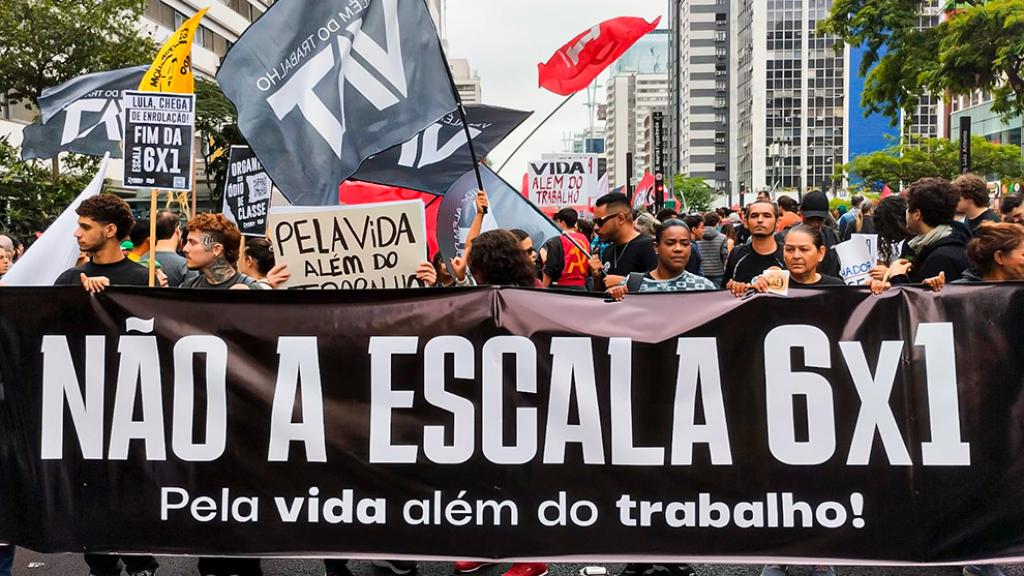
What seemed impossible a few years ago is becoming inevitable. Reflecting broad social opinion, the lower house of Brazil’s parliament has voted to end the odious “6x1” work week (six day/44-hours of work). Starting 60 days after the Senate passed it, the work week will be reduced by one day to five, and to 40 hours. This is undoubtedly an historic victory for the Brazilian working class, one that will have a political impact on the upcoming national election.
The parliamentary vote was overwhelming, with 472 in favour in the first round and only 22 against — mostly MPs from far-right parties such as Novo (New Party), Partido Liberal (Liberal Party), and Missão (Mission Party). The second round vote was 461–19.
The far-right tried all kinds of manoeuvres to obstruct the reform, even proposing a 10-year transition period. The coup plotters’ attempts to generate confusion was defeated, and the bill is now in the Senate. Vigilance and mobilisation are needed, as the bosses remain unhappy with the bill. We must also take advantage of the politicising effect this has had in the streets and on social media.
Popular support
A broad popular majority, expressed in the streets and on social media, celebrated this victory. The much-talked-about WhatsApp family groups this time were not filled with messages of support for conservatism. The proposed work week reduction resonated deeply with tens of millions of Brazilians — an impressive 70% plus of the population supporting it, an unusually high figure in such a politically fractured society.
The persistence of the VAT movement (Movimento Vida Além do Trabalho or Life Beyond Work Movement) succeeded in pushing its progressive agenda amid capitalism’s crisis, which currently offers few or no reforms. The movement helped sway Congress, which is usually aligned with the bosses’ interests and dominated by the Centrão (Big Centre, a centre-right parliamentary bloc). Up against the wall, and with about 120 days until the election, very few parliamentarians wanted to risk being listed as an enemy of the working class.
The government successfully tapped into popular sentiment, knowing this would be a crucial battle as part of its electoral strategy, where every vote matters. It ran advertising campaigns highlighting the importance of free time for all workers. President Lula da Silva spoke publicly about this too. Society became immersed in a discussion around a central issue for workers: the struggle for free time and the work week.
Despite this energy, there were no significant demonstrations in support of the proposal. Why? Leaving aside the paralysis of the main trade union leadership and the Workers Party government’s policy of avoiding actions that generate “street heat”, the new working class, mostly young and concentrated in certain sectors, instead expressed themselves via an unstoppable torrent on social networks. They did not express themselves that much in the streets, due to the lack of a tradition of struggle and a coherent strategy — there was not even a call for a united May Day event. Nevertheless, we have seen an important shift in the political pendulum, if not to the left at least towards a greater sense of class consciousness and class demands. An opening has been created.
This was a struggle with a “national political character,” which also set the agenda for the upcoming election, even if there are also important local struggles. There have been strikes by municipal teachers in state capitals such as São Paulo, and there is an ongoing strike in Belo Horizonte. There was also the strike at São Paulo state universities, which mobilised about 12–15,000 people in opposition to Governor Tarcísio Freitas.
Far-right on backfoot
As the dispute was more political than anything else, it has influenced — and, at the same time, been influenced by — the election campaign. The election campaign is coming to the end of a first period, which will likely last until the “mini-recess” for the World Cup, according to analysts such as Vinicius Torres Freire writing in Folha de São Paulo. The defeat of the 6x1 work week is part of this first period.
The Bolsomaster scandal, which links the Bolsonaro family to the Banco Master financial scandal, has also changed the dynamics of the election campaign. Directly damaging Flávio Bolsonaro, the scandal halted his upward trajectory and has left the far right at an impasse. Confidence among Flávio allies in him has plummeted, as has his voting intentions.
What seemed like the start of a favourable trend has stalled and is now going backwards. Some are even questioning the viability of his candidacy. Amid the unpredictability of our times, nothing is certain, but Flávio is clearly struggling to regain momentum.
Flávio managed to take a photo with Trump, which means a lot for him amid the crisis. He wanted Trump’s blessing to run with the same priorities as his father, Jair, did before. But the right-wing opposition is suspicious of him. Brazilian entrepreneur and Missão party presidential pre-candidate Renan Santos wants to channel the youth vote, while Partido Social Democrático (PSD, Social Democratic Party) pre-candidate Ronaldo Caiado and Novo pre-candidate Romeu Zema are trying to forge a possible alternative in case Flávio’s campaign falters.
Trump’s designation of Primeiro Comando da Capital (PCC, Capital's First Command) and Comando Vermelho (CV, Red Command) as terrorist organisations represents a very serious threat, and raises the spectre of more direct US interference in Brazil’s election.
There is logic behind taking a photo with Trump, as foreign policy will be a key issue in this campaign, and will only gain in importance as time goes on. US imperialism’s quagmire in Iran, its attacks on Cuba, and the popular rebellion in Bolivia are vying for people’s imagination just months out from the election. The far right is gambling its future on the Brazilian and Colombian elections, along with Trump's strategic bid to win the November US midterm elections.
Support for radical left
In all this, we cannot ignore the strong support shown for Partido Socialismo e Liberdade (PSOL, Socialism and Liberty Party) and its leaders on social media as a result of the 6x1 issue. This support will no doubt also express itself politically and electorally. But it is up to PSOL’s left wing to organise this support into a militant social force.
The support on social media has been incredible, especially for PSOL MPs Sâmia Bomfim and Fernanda Melchionna, but also for PSOL MP Erika Hilton and PSOL Rio city councillor Rick Azevedo, who founded the VAT Movement. Sâmia’s ironic takedown of far-right MP Nikolas Ferreira went viral. It takes a lot of nerve to deal with the sheer audacity of such far-right leaders.
We need to mobilise if the Senate threatens to weaken the bill. Trade unions, the UNE (National Union of Students) and the UBES (Brazilian Union of Secondary Students) would need to call for a plan of action and strikes.
Although the working class is not yet mobilised enough to organise a general strike in the immediate term, this option should not be ruled out if the Senate seeks to undo the victory. In that scenario, the social majority that supports ending the 6x1 work week could generate the conditions for a more decisive national action, with large marches and demonstrations. The idea of paralysing the country could serve as a demonstration of the need to go all the way in order to achieve victory, as proposed by STILASP, the trade union who led the successful Pepsico strike.
But we cannot stop there. The millions who have been discussing options for the country and workers in schools, neighbourhoods, shopping centres, universities, factories and workplaces, could become a fundamental asset for building a real instrument of the new working class, one that would vote for Lula as a containment tactic against the far right, but go much further in terms of agenda and methods of struggle.
Trump’s action the day after the significant victory indicates that the polarisation will continue, including in the election campaign. We must throw ourselves into it, taking advantage of the enormous support PSOL has received, to build a movement that guarantees Lula’s victory and the election of a parliamentary bloc committed to present and future struggles.
The Bolivian rebellion teaches us that the far right and capitalists must be defeated through the strength of the working class and the people as a whole, and its program.
Israel Dutra is a sociologist, PSOL Secretary of Social Movements, a member of the party's National Committee, and a Socialist Left Movement (MES/PSOL) leader.