Malaysia: Class, inequality and the left’s transitional program
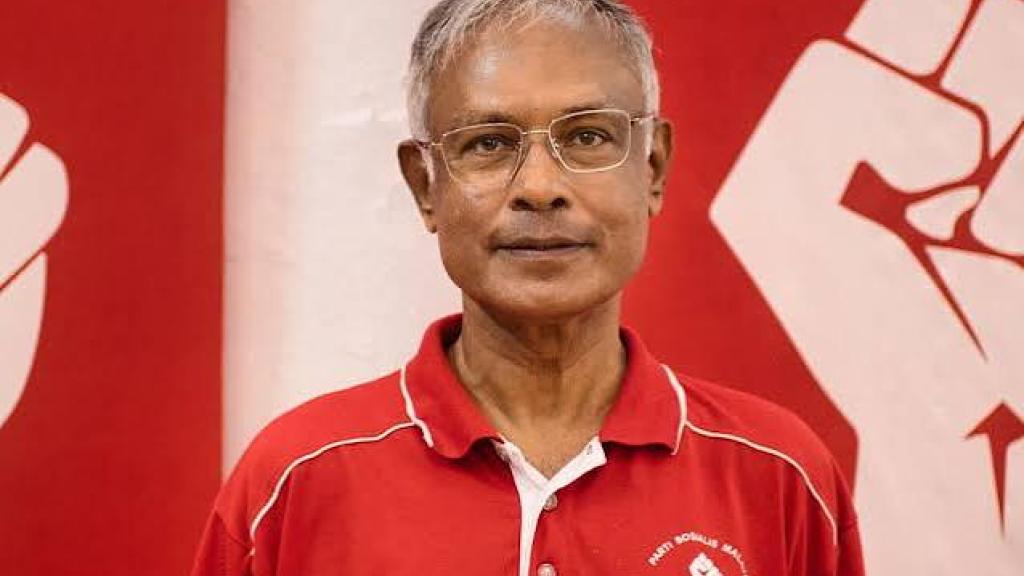
Interview original recorded for BFM 89.9 program, Beyond the Ballot Box. Transcription, introduction and footnotes by Mark Johnson for Europe Solidaire Sans Frontières.
Jeyakumar Devaraj is Chairperson of the Parti Sosialis Malaysia (PSM, Socialist Party of Malaysia). He served as Member of Parliament for Sungai Siput from 2008 to 2018. Interviewed by Dashran Yohan, a journalist and broadcaster at BFM 89.9, where he presents the program Beyond the Ballot Box, Devaraj argues that Malaysia has been economically recolonised: GDP has grown 24-fold in fifty years while wages have only doubled, because free trade agreements and capital mobility have stripped the state of the instruments — tariffs, wage legislation, taxation — needed to retain nationally produced wealth.
The ethnic polarisation that dominates Malaysian politics is, he argues, a direct consequence of the destruction of the parliamentary left in the 1960s, not an organic feature of society. The working class — 13 million wage earners plus 2 million smallholders and a million market traders, together the marhaen — does not yet see itself as a class. PSM’s answer is a 20–30 year transitional program, built from the ground up on the mass line model, aimed at developing regional South-South solidarity on the scale of the 1955 Bandung Conference.1
How would you describe the class and class interests of the founding fathers of Malaysia — Tunku Abdul Rahman, Tan Cheng Lock, Tun Sambanthan, and the Alliance Party leadership at large?
Tan Cheng Lock was a big businessman. Sambanthan was a rich Indian landowner in Sungai Siput. Tunku is from royalty — the educated faction, a lawyer. But we mustn’t forget that there was an alternative multicultural Malayan coalition. For the Indians, you had the trade union leadership — Ganapathy and Veerasenan were heading the unions. You had the MPAJA (Malayan People’s Anti-Japanese Army) group. From the Chinese side, it was diverse — from the business class right through to the working class. And you had people from the KMMM (Kesatuan Melayu Muda — Young Malay Union): people like Boestamam, Malay teachers, Malay journalists. Not the elite aristocrats you saw in UMNO (United Malay National Organisation) later, but educated people from the ground.
They came together and formed a coalition with the Malayan Democratic Union (MDU) — mainly English-educated intellectuals — and they wrote a constitution, a People’s Constitution, about ten years before our federal constitution. They were already very powerful. When ignored by the British, they carried out the Hartal, a one-day general strike in 1947, and stopped the whole country. But the British attacked them, put them under detention.
In contrast, the second group — the Alliance — was something the British actually fostered. The MCA (Malaysian Chinese Association) was formed at the behest of the British. It was a group of the economic elite coming together, given positions, and they used those positions to promote themselves politically. They won the 1955 elections because the left was completely suppressed. The British wanted to pass independence to a group aligned to their way of thinking, not anti-property, not anti-capitalism. I think it was planned.
How was the parliamentary left systematically dismantled, and what were the consequences for how Malaysia expresses itself politically?
In the 1959 federal elections, the Socialist Front had eight parliamentary seats out of 104. They were the third-largest party. What the Alliance did was refuse a peace treaty with the communist forces. The communists were prepared to come out of the jungle in 1955 — they knew the armed struggle was not taking them anywhere — but they did not want to surrender and be put in camps. The Alliance kept the communist threat alive and used it to justify arresting not just armed groups but the parliamentary left. The Labour Party had close to 1,000 people arrested through the 1960s — each time they put up a new leader, that person got arrested. They defanged the left, removed the militant leaders, and left the corrupt or self-serving ones alone.
When the Labour Party decided not to contest in 1969, it gave the DAP (Democratic Action Party) space to expand — but on an ethnicised platform. The PAP (People’s Action Party) style of “Malaysian Malaysia” became the main opposition challenge, which is a very different kind of politics from what the left was offering. Once the left was crushed, political dialogue became overwhelmingly ethnic, and we have now inherited sixty years of that.
What is the distinction between the PAP-style Malaysian Malaysia concept and what the left was proposing?
The nuance is in the class analysis. The People’s Constitution and the left’s approach would not have used ethnicity to address the obvious economic backwardness of the Malay population — they would have used class, and built affirmative programs based on socioeconomic position rather than politicised ethnicity. The Malaysian Malaysia concept says we are all completely equal — I come from India, you come from China, a third person from Indonesia, we are all immigrants equally. A lot of Malays, even progressive Malays, find this offensive. The left’s position was different: yes, equal before the law, but with recognition that this is the Nusantara Melayu, and that the Malay community’s backwardness was a product of colonial economic exclusion, not inherent incapacity. Article 153 of the Constitution, when it was introduced in 1957, was not about Ketuanan Melayu2 — that concept came later in the 1970s. It was about correcting a structural economic gap. The left would have handled this from a socioeconomic basis rather than through politicised ethnicity.3
You argue that Malaysia’s post-independence development produced mixed results. What is your assessment?
Life expectancy at independence was 57 years; it is now about 75. Infant mortality has fallen from 30–40 per 1,000 to around 7. People are living materially better than before — we should not deny that. Many assets that were in British hands — plantations, mines, banks, petroleum — have been taken back to a significant degree. The Petroleum Development Act (Petronas Act), which vested all petroleum found in Malaysia in the state and required any foreign prospector to negotiate a revenue-sharing agreement with Petronas, was a serious act of foresight. Other countries have tried to copy it. SOCSO (Social Security Organisation — the state workers’ compensation and disability insurance fund set up in 1971)4 was built after independence. The public health system, though undermined since the 1990s, had a very good initial basis.
And compared to the region, Malaysia’s management of multiculturalism has been better than most. In southern Thailand, Malay Muslims who have lived there for 1,000 to 1,500 years get no recognition of their language or culture. Under Suharto, Indonesian Chinese could not celebrate Chinese New Year or maintain Chinese schools. Burma, Sri Lanka — compared to these, Malaysia has had much more give and take. There are problems, but they should be discussed from a starting point that acknowledges what has been built.
But why, despite 24-fold GDP growth in real terms over fifty years, do wages remain so low?
In the 1970s, when Dr Lim Chong Eu pioneered export processing zones in Penang, Malaysia had leverage. Multinationals could not go to China — it was then a communist state. They could not go to Vietnam or Thailand, which was a Cold War frontier state. So we could demand certain conditions from them. That leverage is gone. After the fall of the Soviet Union, after China and Vietnam opened to capital, we lost our negotiating position. Now if we raise wages, raise taxes, or refuse their treaty terms, they say they will move to Vietnam or Thailand or Indonesia. So a rich country has been manœuvred into a situation where it cannot capture its own wealth.
GDP has grown 24-fold in fifty years, but average wages have only grown about 2.3-fold. And this figure does not capture the full picture because of commodification. In the 1970s, a rural worker coming to the city could build a small house on an unused plot with the help of family and friends, without debt. Now that is impossible. Housing has been fully commodified. When you live in a small flat, your elderly relatives cannot move in with you — so you pay for an old folks’ home. Childcare used to be handled within the extended household; now it is commercialised. So though wages have nominally doubled, the complexity and cost of life has increased enormously. The wealth is there — it is just not reaching working people.
You use the term “recolonised.” What do you mean?
We have our own flag, our own anthem, our Merdeka Day celebrations. But we have little control over our economy. If a progressive government came to power and told manufacturers to raise wages 20% a year for three years, they would face capital flight — the factories would move to Vietnam or Indonesia. And there is another dimension. Malaysian wages are about one-sixth of wages in the US and Europe. Multinationals produce their electronic components here at that cheap rate, mark them up five times in their home markets, and pocket the margin. That markup does not appear in our GDP figures — GDP records the factory-gate price, not the final sale price. So we are producing value that leaves the country unrecorded. Most of our political parties do not seem to recognise that we have been economically recolonised.
What is the key inequality that needs to be resolved — between ethnic groups, within each ethnic group, or between Malaysia and the global North?
All three aspects have to be addressed. Forbes recorded that the 50 richest Malaysians grew their net wealth by 30% in a single year. At the same time, in 2004, median formal sector income for Malays was RM 2,200 (EUR 468) per month, against RM 4,000 (EUR 850) for Chinese workers. Both dimensions — inter-ethnic and class — matter.5
The ethnic squabbles over matriculation places and university seats are ultimately squabbles over scarce resources. We produce 200,000 graduates a year but only 50,000 graduate-level jobs. Three-quarters of graduates will not get jobs that match their qualifications. But this scarcity is artificial. This country needs engineers to rehabilitate rivers and switch to solar energy, social workers for low-cost housing estates, kindergarten teachers, doctors and nurses in the public system. The jobs are there to be done. We cannot fund them because government revenue is only 16% of GDP, and government debt exceeds RM 1.3 trillion (EUR 276 billion), approaching the statutory ceiling. That is artificial scarcity — the result of 55% of national wealth going to the top 10%.6
The long-term answer lies in rebuilding the Bandung spirit.7 ASEAN has 680 million people — double the US population. If we could coordinate minimum wage increases across ASEAN in tandem, onshore production regionally, and build shared technology, we could develop ASEAN as a zone of prosperity for working people. Indonesia has the same problems. Thailand has the same problems. We need to talk to each other.
How do you describe the class composition of Malaysia today?
The biggest class is the working class. Active EPF (Employment Provident Fund — Malaysia’s mandatory retirement savings scheme) contributors number about 9 million. Add approximately 2 million government employees receiving wages — that gives about 11.5 million wage earners in the formal sector. Then there are about 1.5 million informal wage workers not paying EPF. Altogether about 13 million wage earners.
But the working class in Malaysia does not see itself as a class. It sees itself as Chinese, Indian, Malay. People do not realise they need to come together and demand better wages, social protection, healthcare, and old age pensions as a class.
Beyond the working class, there are about 2 million in the peasantry — rubber and oil palm smallholders, FELDA (Federal Land Development Authority — the state scheme that allocated agricultural land to rural Malay families from the 1950s onwards)8 settlers. Another million or more with small market stalls and owner-operated businesses. Together these form what we call the marhaen9 — not only workers but peasants, fishermen, and the urban poor. Add them up and you have 15 million or more: the majority of the population, producing the wealth but not receiving it.
What are the weaknesses of the left that have prevented it from overcoming these challenges?
The left has to be realistic. We cannot jump from where we are to a completely socialist society in one step, because we are so deeply integrated into the capitalist system. We need a transitional program — a 20 to 30 year plan that gradually transfers wealth to working people, builds people’s institutions, develops technological capacity and domestic markets, empowers workers to take over management of enterprises in stages, and protects party and union leadership from corporate capture. That is reformism, but reformism is not a bad word. AMLO [Andrés Manuel López Obrador] in Mexico is an example of moving in a left direction within a highly constrained system. Revolutionary fervour without a roadmap scares people away.
The Belgian Workers Party (PTB/PVDA) has built a mass base through community clinics, food banks, and learning centres. What do you make of that model?
The PTB (Parti du Travail de Belgique/Partij van de Arbeid van België — Belgian Workers Party)10 began as the Maoist party of Belgium. Their approach is the mass line: the primary job of the party is to go to the ground, understand people’s problems, and address them in the here and now. That is what has taken them forward. They are now winning council seats across Belgium and are one of the parties in the West that is actually growing.
PSM began as education groups in rubber estates 40 years ago. That mass line orientation is something we believe in and need to deepen. The key constraint is manpower. Running a free tuition class once a week fixes your weekend. It requires sustained commitment. But when you run programs on a solidarity basis rather than a commercial one, local communities chip in. In effect you are creating the socialist ethos, the socialist culture, within the interstices of the capitalist system. That has to be done before you can take over anything, because you need the values, the aptitudes, the capacity already built.11
What would you say to people feeling hopeless in a time of wars, genocide, and political crisis?
The political analysis most people have been given in Malaysia is no longer valid. Ethnic mobilisation has become toxic. It is time to organise for the marhaen — for the majority across all communities — and address the problems they all share. It is time to recognise that Malaysia has been economically recolonised and develop a long-term plan to rebuild the Bandung project: our own markets, our own technology, our own capacity, our own ideology.
PSM is not alone in trying this. We need to build this project regionally — can we, in 30 years, have progressive governments across Southeast Asia that come together around these goals? We need a reset: of ethnic politicking, of macro-economic policy, and of political culture so that our leaders remain free of corporate influence. With 2,000 to 3,000 members, we cannot change a nation. We need thousands more. If you want to do something, come. There is so much to be done.
- 1
On the colonial and parliamentary history of the Malaysian left, readers are referred to the companion article, Jeyakumar Devaraj, “Contemporary Challenges for the Malaysian Left,” published at LINKS and ESSF.
- 2
Ketuanan Melayu (Malay supremacy) is a political doctrine asserting the special position and rights of ethnic Malays as the indigenous people of Malaysia. The concept gained prominence in UMNO politics in the 1970s and became a contested term in Malaysian political discourse. It is distinct from Article 153 of the Constitution, which was framed as a corrective measure for economic disadvantage rather than an assertion of ethnic supremacy.
- 3
On ethnic politicking and PSM’s critique, see Jeyakumar Devaraj, “A more nuanced, balanced approach needed to build a better Malaysia”.
- 4
SOCSO (Social Security Organisation, or Pertubuhan Keselamatan Sosial) was established under the Employees’ Social Security Act 1969. It provides compensation for workplace injuries and long-term disability pensions for workers in the formal sector.
- 5
On inequality and the failure of neoliberal economic policy to address Malay youth needs, see Aziff Azuddin and Dashran Yohan, “What Do Malay Youths Want?”
- 6
On poverty measurement and the class dimensions of inequality in Malaysia, see Sivarajan Arumugam, “Much More is Needed to Eradicate Hardcore Poverty in Malaysia”, ESSF, 19 October 2025. Available at: https://www.europe-solidaire.org/spip.php?article76689
- 7
The Bandung Conference of 1955, held in Bandung, Indonesia, brought together leaders of 29 newly independent Asian and African states. It was a founding moment of the Non-Aligned Movement and articulated a vision of South-South economic and political cooperation independent of both US and Soviet blocs. For a recent discussion of the Bandung legacy in the context of Malaysian and regional socialist politics, see “Socialism 2025 Conference: Solidarity and Socialism in the Asia-Pacific”, ESSF, January 2026. Available at: https://www.greenleft.org.au/2026/1445/world/malaysias-socialism-2025-conference-solidarity-and-socialism-asia-pacific
- 8
FELDA (Lembaga Kemajuan Tanah Persekutuan — Federal Land Development Authority) was established in 1956 to open new land for settlement by landless rural Malays. It allocated approximately 10 acres of land per family for oil palm and rubber cultivation and became one of the world’s largest palm oil producers. At its peak it covered nearly half a million hectares.
- 9
Marhaen is a Malay/Indonesian political term for the marginalised majority — originally referring to the poor peasantry, later extended in Malaysian socialist usage to encompass the working class, smallholders, fishermen, and the urban poor as a collective political subject distinct from both the capitalist class and the state apparatus.
- 10
The PTB/PVDA (Belgian Workers Party) was founded in 1979 as a Maoist organisation and has since evolved into a broad socialist party. It built its base through community health clinics (médecins du peuple/dokters van de mensen), food banks, and cultural centres before entering electoral politics. By the 2020s it had become one of Belgium’s fastest-growing parties, winning seats at federal, regional, and local levels.
- 11
For a more critical assessment of the PTB/PVDA, see Daniel Tanuro, Where Is the Workers’ Party of Belgium Going? And First, Where Does It Come From?; Red Mole, From Ceaușescu to Corbyn: Why the Belgian Workers’ Party Is No Blueprint; and Adam Novak, Belgium: Tanuro Accuses PTB of Double Standards.