Canada
Toronto G20 protests: What was gained and what was lost
By John Riddell and Art Young
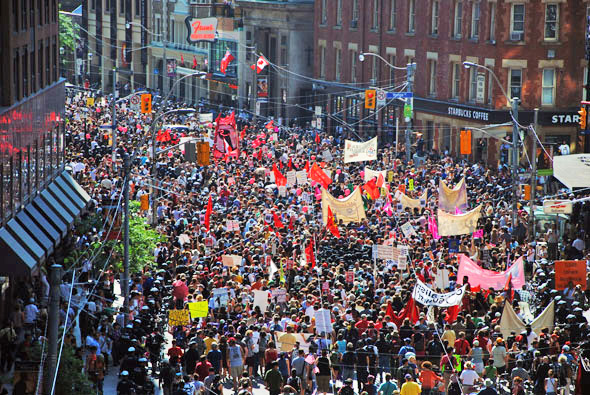
September 2, 2010 -- Socialist Voice -- Two months after the protests against the G20 summit in Toronto and the accompanying police rampage, it is time for an initial balance sheet of what was gained and lost.
Some on the left view the experience as entirely positive. In particular, the Toronto Community Mobilization Network (TCMN) declares flatly that “the people won”, citing participation by “nearly 40,000 people”, the success of the June 24 march for Indigenous sovereignty, and the involvement of a wide spectrum of social movements and “over 100 grassroots organizations”. The July 26 TCMN statement also highlights protesters’ capacity to carry on in the face of arrests and intimidation, including deployment of almost 20,000 cops and a formidable array of weaponry, at a cost of more than C$1.2 billion.
Ian Angus: What next for ecosocialists?

By Ian Angus
August 30, 2010 -- Canadian Dimension via Climate & Capitalism -- Not long ago, most socialists had little to say about environmental issues, and the environmental movement was focused on individual (change your light bulbs) and capitalist (create a market for emissions) solutions to the ecological crisis.
In 2007, immediately after the founding of the Ecosocialist International Network, I wrote a Canadian Dimension article on the challenges facing ecosocialists. In it, I discussed two parallel trends that, though in their infancy, seemed to portend a new wave of anti-capitalist and pro-ecology action.
Some socialists were moving away from the left’s abstention from the environmental movement, and attempting to develop a distinctly socialist approach to the global environmental crisis.
Ecuador: Indigenous struggle, ecology and capitalist resource extraction

Marlon Santi interviewed by Jeffery R. Webber
July 13, 2010 -- The Bullet -- On July 5, I sat down with Marlon Santi, president of the Confederation of Indigenous Nationalities of Ecuador (CONAIE), in his office in Quito. We discussed the increasing contradictions between the demands of the Indigenous people's movement, on the one hand, around water rights and anti-mining resistance, and the positions of the government of Rafael Correa, on the other, which has labelled Indigenous resistance to large-scale mining and oil exploitation as “terrorism and sabotage”.
* * *
Can you describe your political formation and personal political trajectory?
Toronto G20: `Toxic remedies' will make workers and poor pay for the crisis
By Damien Millet, Sophie Perchellet and Eric Toussaint. Translated by Christine Pagnoulle and Marie Lagatta

Canada: New openings for workers in Toronto

Participants at the Stewards' Assembly. Photo by John Maclennan.
By Herman Rosenfeld
March 2010 -- Relay (Socialist Project) -- In the context of an economic crisis where working people in Ontario, Canada, have suffered major setbacks, organised labour’s response has so far been disappointing. Apart from a few public sector strikes forced by employer concession demands, some longer-term strikes against concessions (such as the Vale-Inco struggle), a number of workplace occupations demanding severance pay and a few demonstrations calling for pension protection and Employment Insurance (EI) changes, there has been little resistance. This has forced activists in the trade union movement, and the left more widely, to confront the limits of our present organisational situation, and to begin to look for new ways to move forward.
Québec: Why the Parti Québécois expelled SPQ Libre

By Richard Fidler
March 30, 2010 -- Life on the Left -- A five-year long attempt to reform the Parti Québécois (PQ) as an independentist and “social-democratic” party ended abruptly on March 13 when the PQ’s national executive decided not to renew recognition of its left-wing “political club” as an authorised grouping with the party. The decision, which effectively expelled Syndicalistes et Progressistes pour un Québec Libre (SPQ Libre)[1] from the party, was promptly approved by the PQ’s conference of constituency presidents.
Tour builds Venezuela solidarity in Canada
By John Riddell
Israel’s apartheid: Making Palestinians pay for Hitler’s crimes
 \
By Suzanne Weiss
This speech was given by Suzanne Weiss on March 2, 2010, to a meeting of students at the University of Waterloo in Canada, held as part of the Israeli Apartheid Week. Suzanne Weiss, a holocaust survivor, is a member of Not in Our Name: Jewish Voices Against Zionism and of the Coalition Against Israeli Apartheid in Toronto.
* * *
A year after a murderous Israel’s assault, the war on the people of Gaza continues. Gaza is still under siege – still surrounded by walls and checkpoints. Its people are denied the necessities of life and the right to rebuild and shape their future.
For me, as a survivor of the holocaust, the tragic situation in Gaza awakens memories of what I and my family experienced under Hitlerism – the ghetto walls, the killings, the systematic starvation and deprivation, the daily humiliations.
Eyewitness account: Venezuela's Bolivarian Revolution -- The second decade
With Kiraz Janicke, Federico Fuentes
