Cuba
Cuba: Reversing the medical `brain drain’ – the many faces of ELAM

ELAM students.
By Don Fitz, Havana
Cuban Communist Oscar Martinez: `Our economic reforms are based on socialist principles'

"We are reorganising the workforce, not firing workers. We are directing them to other areas of work vital for the economy, mainly food production."
[For more analysis and discussion on the economic changes in Cuba, click HERE.]
November 3, 2010 -- Umsebenzi -- A South African Communist Party (SACP) delegation recently visited Cuba a part of its political interaction between South Africa and Cuba, and its quest to build socialism and strengthen ties between it and the Communist Party of Cuba.
Yunus Carrim, editor of the SACP's monthly journal, Umsebenzi, interviewed Oscar Martinez, the deputy head of the International Relations Department of the Communist Party of Cuba. Published below is the full interview, as it appeared in Umsebenzi.
* * *
Yunus Carrim: What is the nature of the economic problems Cuba is currently experiencing?

Cuban Revolution: challenges and changes
[For more analysis and discussion on the economic changes in Cuba, click HERE.]
By Dave Holmes
[This article and slideshow were presented as a talk to the Geelong branch of Socialist Alliance on October 6, 2010.]
Workers in the Russian and Cuban revolutions
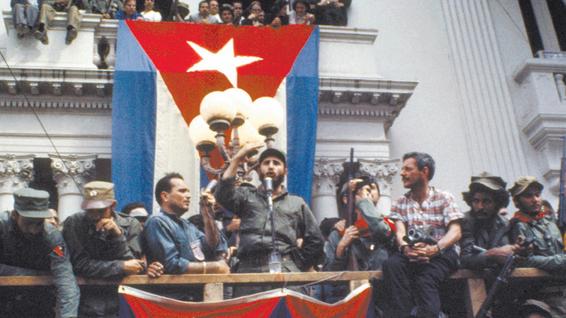
Fidel Castro addresses a huge crowd in front of the presidential palace in Ha
Pamphlet: The continuation of US terrorist plans against Cuba and Venezuela

Download the pamphlet HERE or read on screen below.
Cuba: Economic changes and the future of socialism -- interview with Cuban professor José Bell Lara

Urban organic food garden in Cuba.
Dr José Bell Lara, professor at the Latin American Faculty of Social Sciences, University of Havana (FLACSO-Cuba), interviewed by Johannes Wilm. Bell Lara has written essays such as "Globalisation and Cuban Revolution" (2002) and "Cuban socialism within Globalisation" (2007), and is part of the international advisory board of the journal Critical Sociology. This interview was conducted in Havana in September 2010.
[For more analysis and discussion on the economic changes in Cuba, click HERE.]
* * *
Johannes Wilm: The Cuban government recently announced some changes. Among other things, it will be possible for more people to work independently. What is it that Cubans expect from these changes?
The self-employment sector in Cuba
[For more analysis and discussion on the economic changes in Cuba, click HERE.]
By Leticia Martínez Hernández
September 24, 2010 -- Granma International -- On August 1 Cuba's President Raúl Castro Ruz announced to the National Assembly the decision to extend the self-employment sector and use it as an another option for workers seeking alternative jobs after the necessary reduction of the country’s inflated employment registers in the public sector. Various restrictions will be eliminated to allow the authorisation of new licences and the marketing of certain products, and greater flexibility to hire a workforce for certain activities.
Many people have been waiting a solution that, far from being improvised or ephemeral, makes it possible to increase the availability of goods and services, while assuring an income to those who decide to do this work. It will contribute to the state being relieved of the burden of excessive subsidies, while placing in non-state hands the production of goods and services which it has provided for years in spite of the difficult economic context.
Cuba: The drive for efficiency within socialism

Cuba's president, Raul Castro.
[For more analysis and discussion on the economic changes in Cuba, click HERE.]
By Helen Yaffe
Accordingly, the individual producer receives back from society – after deductions have been made – exactly what he gives to it -- Karl Marx, 1875
Wages today are clearly insufficient to satisfy all needs and have thus ceased to play a role in ensuring the socialist principle that each should contribute according to their capacity and receive according to their work…the Party and government have been studying these and other complex and difficult problems in depth, problems which must be addressed comprehensibly and through a differentiated approach in each concrete case. -- Raul Castro, 2007
[We have] the dream of everyone being able to live on their salary or on their adequate pension… -- Fidel Castro, 2005
Venezuela criticises `market totalitarianism' at UN Millennium Development Goal summit

By Tamara Pearson, Merida
Cuba: Exporting revolution, revolutionary models and historical facts
"I asked him [Fidel Castro] if he believed the Cuban model was still something worth exporting". -- Jeffrey Goldberg, the Atlantic blog, September 8, 2010
"In their ravings they pretend that Cuba is an exporter of revolutions. In their sleepless business and usurers' minds they believe that revolutions can be sold and bought, rent or lent, export or import as one more merchandise". -- Fidel Castro, February 4, 1962
`Orientalism' and Cuba: How Western media get it wrong

By Tim Anderson