Leninism
Five points in response to Pham Binh
By Paul Le Blanc
"The creation of healthy, democratic and cohesive revolutionary organisations on the Leninist model is both possible and necessary, in my opinion."
February 1, 2012 – Links International Journal of Socialist Renewal -- I am sorry that Pham Binh has chosen to respond in the way that he has to my criticism of his article ("Mangling the party: Tony Cliff's Lenin"). I will make only a few comments here to help clear up misunderstandings.
1. My critical comment about Pham’s article not providing us with anything useful for those engaged in today’s struggles was not a judgment about him as a person or about all things that he may have written about the Occupy movement or anything else. A substantial review article having to do with building the revolutionary party, however, should contain (in my opinion) something of value for those of us who are committed to such things.
Paul Le Blanc’s defence of Tony Cliff’s ‘Building the Party’ – Pham Binh replies
By Pham Binh
[Read Paul le Blanc's response HERE.]
January 31, 2012 – Links International Journal of Socialist Renewal -- When I discovered that Paul Le Blanc had responded to my review of Tony Cliff’s Building the Party I was hoping for the scholarly and thorough approach he used in writing his book Lenin and the Revolutionary Party. What I found was quite the opposite.
Le Blanc begins his response by claiming that my book review’s “obvious purpose is to persuade the reader that Tony Cliff’s book is little more than a mass of ‘egregious misrepresentations’ and ‘has so many gross factual and political errors that it is useless as a historical study of Lenin’s actions and thoughts.’ This is a demolition job. It doesn’t offer much that we can use and build on as we face the challenges of today and tomorrow.”
I drew my conclusions about Cliff’s book only after I closely studied what Lenin said and did and compared it to what Cliff claimed Lenin said and did. The more I studied, the more striking the divergences became.
Revolutionary method in the study of Lenin – A response to Pham Binh

[For more discussion about Lenin, click HERE.]
By Paul Le Blanc
[Read Pham Binh's reply HERE.]
January 31, 2012 – Submitted to Links International Journal of Socialist Renewal -- Amid a continuing crisis of capitalism, the renaissance of Lenin studies – what I once referred to as “Lenin’s return” – continues. Aspects of this find reflection in new books, new articles, symposiums and debates as we attempt to clarify the actuality of Lenin’s thought and example, and (for some of us) their relevance for the situations we face.
Lenin and the Bolshevik Party: A reply to Tony Cliff and the International Socialists (1996)
By Bruce Landau
Introduction
Published in 2002 by Resistance Books, first published 1996 -- There is no more pressing task for revolutionary Marxists today than the construction of a party capable of leading the proletariat's struggle against world capitalism. But as the record of the past decades has shown, building such a party requires more than good intentions. It requires a scientific understanding of the relationship between the proletariat and its class-conscious vanguard. No one understood that relationship better than Vladimir Ilyich Lenin; he proved that by building the strongest, most flexible, and most successful workers' party in history -- the Bolshevik Party.
Mangling the party: Tony Cliff’s Lenin

[For more discussion on how socialists organise, click HERE.]
By Pham Binh
January 24, 2012 – Submitted to Links International Journal of Socialist Renewal -- Tony Cliff's Lenin: Building the Party published in 1975 was the first book-length political biography of Lenin written by a Marxist. As a result, it shaped the approach of subsequent investigations by academics like Lars T. Lih as well as the thinking of thousands of socialists in groups like the British Socialist Workers Party (SWP, founded by Cliff), the US International Socialist Organization and Paul Le Blanc, author of Lenin and the Revolutionary Party and former member of the US SWP (no relation to Cliff's group).
Cliff begins his biography by debunking the USSR’s official state religion of Lenin-worship that “endowed [Lenin] with superhuman attributes”. Yet throughout the book Cliff refers to these “superhuman attributes”:
Lenin adapted himself perfectly to the needs of industrial agitation.
'Leaps Leaps Leaps': Lenin and politics
By Daniel Bensaid

Is democracy the enemy? A reply to Slavoj Zizek

Slavoj Zizek addresses Occupy Wall Street.
How socialists work to win mass support

By Dave Holmes
Nationality’s role in social liberation: the Soviet legacy
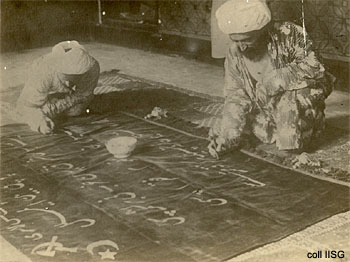
Painting slogans for the Congress of the Peoples of the East, September 1920, Baku. Photo from IISG.
By John Riddell
July 21, 2011 -- http://johnriddell.wordpress.com, posted at Links International Journal of Socialist Renewal with the author's permission -- Just under a century ago, the newly founded Soviet republic embarked on the world’s first concerted attempt to unite diverse nations in a federation that acknowledged the right to self-determination and encouraged the development of national culture, consciousness and governmental structures. Previous major national-democratic revolutions – in Britain, France, Germany, Italy, the United States – had been made in the name of a hegemonic nation and had assimilated, marginalised or crushed rival nationalities. The early Soviet regime, by contrast, sought to encourage, rather than deny, internal national distinctiveness.
Lenin and revolutionary organisation today: An exchange
Introduction
Anyone familiar with the socialist movement in the industrialized countries today must be struck by the huge gap between what’s needed — mass socialist parties with deep roots in the working class — and the reality — small groups of socialists with little influence. The following exchange contains a searching discussion of these issues between the noted Marxist scholar Paul Le Blanc and John Riddell.
The exchange opens with an article by Le Blanc and continues with an exchange between Riddell and Le Blanc. The discussion was first published in Socialist Voice in June 2008 and later appeared on John Riddell's website (with more comments).
About the authors
Paul Le Blanc, a former member of the U.S. Socialist Workers Party, has been a long-time anti-war, anti-racist, activist in Pittsburgh. He teaches History at La Roche College. He is author of Marx, Lenin, and the Revolutionary Experience (Routledge 2006).
Paul Le Blanc: Marxism and organisation
By Paul Le Blanc