Leninism
Australia: 'It's time for the DSP to merge into the Socialist Alliance'
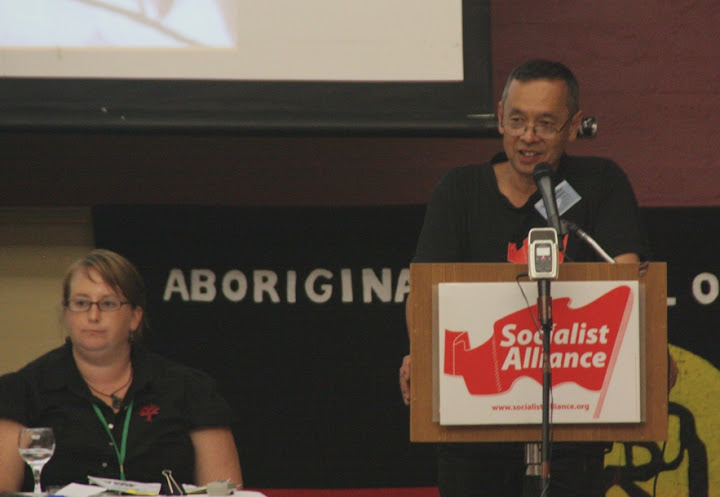
[This report, presented by Peter Boyle on behalf of the Australian Democratic Socialist Perspective (DSP) national executive was adopted, by the 24th DSP congress on January 2, 2010. See also ``Australia: New era of left unity as DSP votes to merge with the Socialist Alliance''.]
We are proposing to take an important step forward in our party building effort, an effort that has now spanned some four decades. We propose, at this 24th congress, to merge the Democratic Socialist Perspective into the Socialist Alliance, to take everything we have learned and built over these years of political struggle (organised through the DSP) into a broader political organisation, an organisation which has a majority of members who don't come from the DSP.
Leninism: It’s not what you think

By Paul Kellogg
[This article first appeared in Socialist Studies: the Journal of the Society for Socialist Studies 5(2), Fall 2009. It has been posted at Links International Journal of Socialist Renewal with the author's permission.]
Paul Le Blanc: Theories of Stalinism

The Marxism of Leon Trotsky

By Graham Milner
Australia: Towards a history of the Communist Party of Australia
[These articles were first published in Green Left Weekly in 1995 to mark the 75th anniversary of the founding of the Communist Party of Australia.]
By John Percy
September 27, 1995 -- Seventy-five years ago, under the impact and inspiration of the October 1917 Russian Revolution, the Communist Party of Australia was founded. It was a modest beginning, but an historic event. The CPA formed in 1920 finally dissolved in 1991, but for most of its life it was the dominant party on the left in Australia and an important force in the workers movement.
There are many
proud chapters in its history -- the numerous trade union struggles
led; organising the unemployed, women, Aborigines, young people;
important civil liberties fights; and solidarity with international
struggles, in Spain, Indonesia, Vietnam, South Africa and East Timor,
to name a few.
The CPA's founders had a vision of socialist
revolution in Australia, and this was the goal of most of its
rank-and-file members over the years. The party inspired dedication and
commitment from thousands of men and women, and organised the most
militant, idealistic, self-sacrificing section of the Australian
working class.
But it was also a history of mistakes, of betrayals, of lost opportunities.
To mark this important anniversary, Green Left Weekly will be carrying a series of articles on the history of the CPA.
Free pamphlet: Revolutionaries and parliament: The Bolshevik experience
By Maurice Sibelle

By Chris Slee
Proceedings of Fourth Congress of the Communist International to be published
In October, John Riddell, co-editor of Socialist Voice, completed a draft translation of the proceedings of the Fourth Congress of the Communist International. This ambitious effort (more than 500,000 words) will make all of the resolutions, speeches, and debates from that important 1922 meeting, together with full explanatory annotation, available in English for the first time. The work, which Riddell is preparing in collaboration with the London-based journal Historical Materialism, is planned for publication in 2010.
The British newspaper Socialist Worker interviewed John Riddell (below) about this project for its November 22, 2008, issue.
* * *
By Ken Olende
In 1922 socialists from around the world travelled to Russia to discuss and debate the future of the workers’ movement.
The ALP and the fight for socialism