Venezuela
Colombia must free Joaquin Perez Becerra
Statement from the Socialist Alliance in Australia
Venezuela: Socialist party seeks shake up

Rally against bureaucratism and corruption, Caracas, November 2010.
By Federico Fuentes
May 1, 2011 -- Green Left Weekly -- Since January, tens of thousands of United Socialist Party of Venezuela (PSUV) militants, together with activists from other left parties and social movements, have been debating the future of Venezuela’s revolution.
Their sights are set on the crucial 2012 presidential elections.
This years’ pro-revolution May Day march will be the platform to officially launch Venezuelan President Hugo Chavez’s re-election bid.
The US-funded right-wing opposition is yet to decide its candidate, but the election will be critical to the future of a country undergoing a profound process of change.
A clear victory for Chavez — like the 63% he won in the 2006 elections — would give a powerful mandate to deepen the revolution.
However, the revolutionary forces face two key obstacles.
The first is US imperialism and its local allies in the opposition, who are desperate to get rid of Chavez.
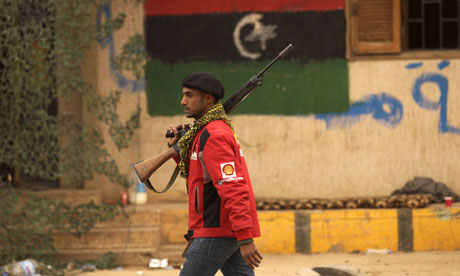
A Libyan rebel walks past a military position decorated with the rebellion flag at the souther
Australia: How Socialist Alternative misrepresents Socialist Alliance on Libya

February 22, 2011 -- Solidarity rally in Sydney with the
Libyan people in their struggle for democracy. Photo by Pip Hinman. See an article
about this action here: http://www.greenleft.org.a
[For more coverage of Libya, click HERE.]
By Nick Fredman
March 16, 2011 -- Links International Journal of Socialist Renewal -- Most interested observers of the public statements and activity of the Australian organisations Socialist Alternative (SAlt) and Socialist Alliance in regard to Libya would surely conclude that the two groups are in concord: a similar analysis of the pro-imperialist nature of the regime and enthusiastic support for the struggle of the workers and oppressed against dictatorship. Which makes it quite disappointing that Corey Oakley of SAlt has launched a swingeing polemic against Socialist Alliance about Libya[1]. [See Appendix 1 below]
Immanuel Wallerstein: Libya and the world left

By Immanuel Wallerstein
March 15, 2011 -- There is so much hypocrisy and so much confused analysis about what is going on in Libya that one hardly knows where to begin. The most neglected aspect of the situation is the deep division in the world left. Several left Latin American states, and most notably Venezuela, are fulsome in their support of Colonel Gaddafi. But the spokespersons of the world left in the Middle East, Asia, Africa, Europe and indeed North America, decidedly don’t agree.
Hugo Chavez’s analysis seems to focus primarily, indeed exclusively, on the fact that the United States and western Europe have been issuing threats and condemnations of the Gaddafi regime. Gaddafi, Chavez and some others insist that the Western world wishes to invade Libya and “steal” Libya’s oil. The whole analysis misses entirely what has been happening, and reflects badly on Chavez’s judgment – and indeed on his reputation with the rest of the world left.
First Egypt, next Venezuela? The real threat to democracy in Venezuela comes from Washington

"The Arab revolt represents both an 'economic revolt' and a 'democratic, nationalist and anti-colonial revolution', Santiago Alba Rico and Alma Allende said, that 'provides the socialist left and pan-Arabists in the region with an unexpected opportunity'. They said: 'the Arab people, who have returned to the world stage, need the support of their Latin American brothers'."
By Kiraz Janicke and Federico Fuentes
Venezuela: United Socialist Party of Venezuela defines new strategies
By Tamara Pearson, Mérida
January 24, 2011 — Venezuelanalysis.com — On Janurary 21, 2011, over one thousand members of the United Socialist Party of Venezuela (PSUV) met with President Chavez and decided on five key strategic lines for the next two years. The discussion included recognition of important weaknesses in the party and steps for activating the Patriotic Pole coalition.
Chavez, president of Venezuela and also of the governing PSUV, presented the document, Strategic Lines of Political Action of the PSUV for 2011-2012 to the “National Assembly of Socialists” in Vargas state, where around 1440 party leaders were present.
Chavez originally proposed the strategic lines in a draft document in December last year to a meeting of the national PSUV leadership.
PSUV legislator Jesus Farias, speaking to YVKE, said the idea of the “Socialist Assembly” was to “relaunch the project that the PSUV represents, in unity with other political organisations and social groups”. He said the “reflection and establishment of new lines of action for the PSUV is related to a need to strengthen the party as a great machine of agitation and propaganda”.
What if the state of the world were measured by its majority?

What real democracy looks like: a communal council in Merida votes for its electoral commission in July 2010.
Los seres humanos como centro de nuestro socialismo

[English at http://links.org.au/node/2042.]
Por Federico Fuentes, traducido por Janet Duckworth
Resena sobre libro, La alternativa socialista: el verdadero desarrollo humano, de Michael Lebowitz
Green Left Weekly/Links International Journal of Socialist Renewal -- La llegada de la crisis económica mundial a mediados de 2008, simbolizada por el colapso de algunas de las empresas más icónicas de Wall Street, condujo a un incremento vertiginoso de las ventas de El Capital, la obra maestra de Carlos Marx, porque mucha gente buscó una explicación de los acontecimientos apocalípticos que se estaban desarrollando.
Venezuela: Food sovereignty project launched
Food Sovereignty Venezuela -- Jose, a campesina leader from one of Venezuela's most prominent campesina organisations, the Ezequiel Zamora National Campesino Front (FNCEZ) tells of his work with campesinos in Portegeusa State. He describes life and land ownership possibilities before and after the revolution and the some of the surprises that are revealed in his ongoing quest of helping the poor reclaim their land. Special thanks to the great translations of Venezuelan activist Yasmin Tovar and the stunning background music of Ali Primera, renowned Venezuelan singer of revolutionary tales.
By Lisa Macdonald
Women and revolutionary transformation in Venezuela
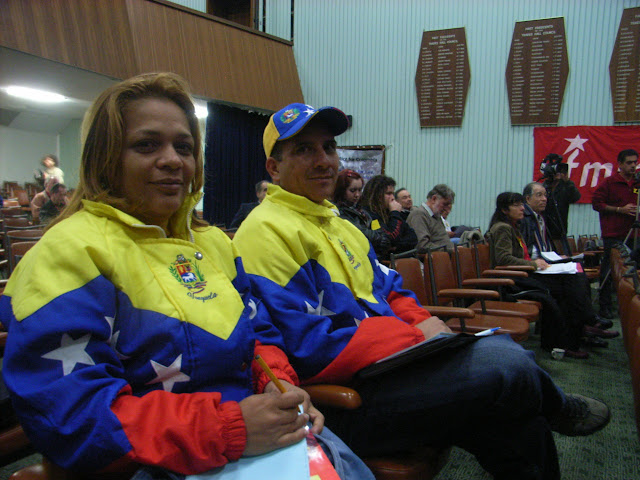
Yoly Fernandez (left) during her 2009 Australian tour, organised by the Australia-Venezuela Solidarity Network.
By Coral Wynter
Yoly Fernandez lives in a barrio in the city of Valencia in Venezuela. She has been involved in community politics all her life and is a member of the United Socialist Party of Venezuela (PSUV), headed by Venezuela's President Hugo Chavez. Fernandez works in Mission MERCAL, the government agency that sells subsidised food to the population. I interviewed her in May 2010.
* * *
How has the life of women improved over the last 10 years of the Chavez government?
Our lives have improved enormously, mainly in the area of humane values; not so much at the level of work or even at the political level. I say humane because now the role of women is valued, not as an object but as a subject, as mother, wife, daughter and sister.