Two narratives on the Hong Kong fire
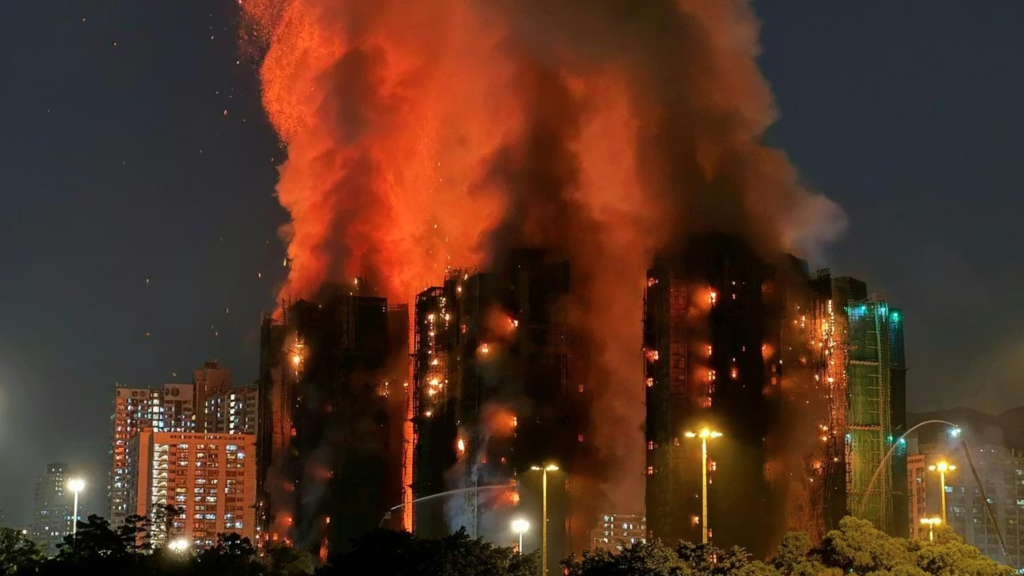
The 26 November 2025 Wang Fu Court fire has a lot of similarity with London’s 2017 Grenfell fire. In terms of scale, the former was much bigger — instead of just one building there were seven on fire, and instead of 72 deaths there have been 160 deaths as of now. However, the combustible materials used in renovating the outer walls were the direct cause of both.
At Grenfell the construction company used cheap cladding, while its counterpart at Wang Fu Court used cheap nets and foam boards to cover the scaffolding. In addition, the building company Prestige Construction replaced the fire escape windows with wooden boards to allow builders to move between scaffolding and the interior of buildings, allowing fire and smoke to easily spread when fire broke out.
Grenfell and Wang Fu – their similarities
Grenfell was a social housing project managed by the Kensington and Chelsea London Borough Council’s management company KCTMO. The Grenfell inquiry reports revealed that the building company’s greed led to profit being prioritized over safety. The tight budget of the local council provided incentive to favour cheap cladding and a willingness to go so far as to claim that the material conformed to “the relevant provisions”. This laid the ground for the building companies to use combustible materials for cladding. Multiple whistle blowers and Grenfell residents / Action Group warned about potential fire hazards. If the overseeing public institutions had done their job, they would have discovered these malpractices. However, the local council, regulators and various government departments all exhibited negligence, complacency and blame-shifting among themselves. The privatization of the construction industry standard-setting body, the Building Research Establishment (BRE), in 1997 was another underlying cause of wide-spread corruption within the industry. All these factors eventually led to systemic failure, dishonesty, greed and conflicts of interest.
In the Hong Kong case, when the Secretary of Security blamed the bamboo scaffolding it was more a distraction from investigating the root causes of the fire than a credible claim. After the fire, most of the covering netting had burned but most of the bamboo scaffolding remained standing. Bamboo is much less combustible. Using bamboo for scaffolding in Hong Kong is not because of some cultural pride or simply out of “ technological backwardness”. It has more because of the peculiarities of the city packed with high rising buildings, leaving only small spaces between them. The strength and lightness of bamboo make scaffolding there much easier than using metal ones. While some of the falling burning bamboo might have made the fire worse, it was likely proportionally a much lesser cause of spreading the fire, although one must await an independent investigation into the case before any definitive conclusion can be made. If the fire alarms had been effective more lives would have been saved as well. But they were not. And neither did the fire hose reels work.
The subcontractor was probably not acting on its own. The unholy trio of the Wang Fuk owners’ corporation, its consultant (a local councillor), and the builders/engineering consultants are now widely suspected to be involved in the so called Wei Biu (Cantonese圍標), or collusion by different players to bid for contracts handed out by owners’ corporations. To make this happen, the colluders first take control of the owners’ corporations. Mafia and councillors are often involved as well. In the case of Wang Fu Court, a pro-Beijing councillor, Peggy Wong, was the corporation’s consultant and had tried hard to persuade the corporation to accept Prestige’s bid even though the bid was the highest quotation, reaching HK$330 million (more than 30 million GBP).
As in the Grenfell case, the Wang Fu case also witnessed residents and whistle blowers filing complaints about fire hazards long before the fire, but they were ignored by both the building company and various government departments. In 2024, campaigner Jason Poon had warned about the combustible scaffolding covering net at both Sui Wo Court and Wang Fu Court multiple times but had been ignored. He was repeatedly harassed for doing this.
Last year residents also filed complaints about their buildings’ potential fire hazards with the Labour Department, but the latter either said the law did not have clauses covering the safety of covering nets, or, when finally admitting that this was wrong, they simply replied that the nets were safe (which is false). The Housing Bureau, the Building Department, the Urban Renewal Authority, and the Fire Services Department all have the responsibility to regulate and monitor the safety of such a renovation project sponsored by the government’s Mandatory Building Inspection Scheme. They all failed miserably because they all merely relied on reports submitted by the managing company of the estate, the building company, or the engineering consultant of the owners’ corporation, without ever checking onsite; or if they did, they only went through the motions.
How the Basic Law laid the ground for rampant corruption
This has happened at a time when corruption in the construction industry has become even more rampant. Instead of complying with the law, it is a common practice for building companies to buy the fire compliance certificate from the Mainland Chinese suppliers instead. After the fire, David Lam Tzit-yuen, a legislator from the “medical functional constituency”, accused the construction industry of being “corrupt to the core with fraud and exploitation at every level”, and criticized the contractor who had built metal pipes for the Health Authority as being below standard and also criticized the shoddy workmanship of the Shatin to Central Link railway project. However, he failed to point out one thing: why haven’t his six colleagues at the more related constituencies to the fire (real estate and construction, architectural & surveying, and engineering) ever publicly warned about the danger of corruption and done something about it?
In general, the unholy trio of corrupted owners’ corporation, local councillors and the builders are the lowest level of the food chain. If there is ever an independent investigation it should first and foremost investigate the top level of the Hong Kong government. Particularly the relation between Peggy Wong and Clement Woo — he helped the former to succeed him as the consultant of the owner’s corporation. Before Woo was appointed Undersecretary of the Constitutional and Mainland Affairs Bureau in 2021, he was the consultant of the Wang Foo Court Owners’ Corporation, and was reported that he helped Peggy Wong to succeed him. On top of that, the newly elected legislator representing the Engineering functional constituency, Bok Kwok Ming, is now being questioned about his role in the costly 475 million HK$ renovation of water pipes of the villa Fairview Park. Owners there complained that the decision was forced upon them, and Bok facilitated such a deal in his role of being member of a committee and a working group of the related project respectively.
The widespread corruption in the industry has its root in the Basic law imposed on Hong Kong by Beijing from the very beginning. Under its Basic Law, not only are one-third of the legislators “elected” by the above-mentioned functional constituency (before 2021 it was nearly half) but they are also given the rights to be part of the electoral committee which “elect” the Chief Executive too. Functional constituency mainly composed of business and professional sectors, designed to allow the business class to hold special power over the people and to continue to block the implementation of universal suffrage. The practice was borrowed from the fascist’s corporate state idea, where governments are composed of representatives from social sectors chosen for supposedly having made contributions to society. One cannot afford to overlook this matter if one is serious about identifying the causes of corruption there.
But Hong Kong had been well known for its anti-corruption watchdog, the Independent Commission Against Corruption (ICAC). Founded in 1973 after strong social protests against corruption, the colonial government reluctantly began weeding out corrupt officials and business people. Since then, it had been seen as the most respectable law enforcing institution among the public. Why did the ICAC not tackle the horrible scale corruption in the industry? Although the Wang Fu fire prompted the ICAC to prosecute the direct culprit Prestige directors, this is far from enough, and this inadequacy dates back some time ago. Since the pro-Beijing media has repeatedly condemned the “British influence” within and beyond the ICAC, it seems that for years the ICAC has stopped being enterprising in going after corruption. For the watchdog, going after pro-Beijing politicians and businesspeople is surely not welcomed by Beijing. With Chinese companies getting more and more dominant in the city this implies that the ICAC is increasingly having their hands tied. The case of the head of the ICAC, Timothy Tong, is particularly telling. In 2013, the Audit Commission report showed that he had misused public funds to wine and dine Beijing officials in private, however no charges were brought against him.
One global capitalism, many varieties
This leads us to a discussion about the dissimilarities between the Grenfell and Wang Fu cases. Imagine the London mayor arresting young people for handing out leaflets calling for an independent investigation into the Grenfell fire, his police force charging people who merely plan to run a press conference about the fire with breaking National Security law, his local officials chasing away volunteers who merely run a supply station to distribute daily necessaries to the survivors of the fire, and, finally announcing the founding of a non-independent inquiry committee to look at the causes of the fire. On top of this, the most senior whistle blower from a decade ago, Lam Cheuk Ting, a former pan-democrat legislator who founded the “Great Alliance of anti-corruption and anti-Wai Biu”, is now in prison (along with hundreds of democrat legislators and activists). This is exactly what has happened in Hong Kong since 2020, but not in the UK, at least not yet.
A self-exiled Hong Kong scholar Chung Kim Wah, now living in UK, commented that there is a connection between the fire and Beijing’s wiping out Hong Kong’s autonomy, rule of law, civil society, allowing government officials and their business cronies to collude not only without any fear but even further empowered by the National Security law to throw those who dare to ask questions into prison. Chung’s comment is very much shared by most people in Hong Kong.
Yet it is another matter to say that the city was always clean from corruption until the 1997 handover, and it has only worsened from then on, or to argue that while British colonialism benefited Hong Kong people in general, the Beijing regime only brought us hardship and corruption. Beijing regime is no good but as far as colonial government is concerned we need to ask what period of the colonial era we are talking about? The statement that the colonial government significantly reformed itself is only valid in the short period of 1973 (the year when the ICAC was founded) to 1997. In other words, most of the colony’s 150 years plus history was brutal and plagued with corruption. In fact, the ICAC’s relative success was only a product of a momentary alignment in the relationship of forces between the colonial government and the rise of a youth movement, and also between China, Hong Kong and the UK. Therefore, the above liberal’s statement has to be revised — the British government only outperformed Beijing during the last twenty years plus of its rule.
Owen Au wrote in the Diplomat about the Hong Kong case, arguing that “No, Hong Kong’s governance is not becoming like China’s. It’s actually worse. Hong Kong is stuck in a governance vacuum, where neither democratic nor authoritarian accountability functions effectively.” According to him, many of Hong Kong’s governance traditions and key accountability mechanisms “were designed and institutionalized during the final decades of British rule, when the colonial government sought to develop Hong Kong into a prosperous global city grounded in professionalism, public accountability, and the rule of law.” His list did not include “universal suffrage”. It couldn’t, because there was none. So why counterpose “democratic accountability” to “authoritarian accountability” in comparing the colonial government and the Beijing regime then? And why is the UK, which does have liberal democracy, still unable to stop corruption from growing like cancer?
The Grenfell case and many other similar cases have already shown that as long as representative government is based on capitalism it will never get rid of corruption. Liberal democracy allows people have more rights to resist injustice than the Chinese authoritarian capitalism. But this dissimilarity should not blind us from seeing their common ground — capitalism. Capitalism is necessarily corrupting. Capitalism means money can also buy officials who are supposed to control corruption. This is exactly why Grenfell and Wang Fu share so much common ground. The victims of the Grenfell fire are still waiting for justice eight years after the fire. This is not to mention how a great number of the victims of the Post Office scandal have not received justice 25 years after being wrongfully prosecuted.
While able to see the dissimilarities between the two cases, Owen Au’s line of argument largely overlooks their similarities of being part of the same capitalist system; instead he hinted about “democratic accountability” under the colonial government, contrast this with how bad Hong Kong has become nowadays by making exaggerated claims about how good colonial Hong Kong had been (and also exaggerated the supposed “Chinese authoritarian accountability when he mentioned how Chinese officials often stepped down when disasters occurred — forgetting that often these officials would make a comeback to the same rank in a few years although not necessarily to the same post). It is no accident that he doesn’t even mention the term capitalism at all. When one avoids the term “capitalism” along with its history in discussions on the causes of corruption one would not be able to go very far in their search for answers.
This also likely prevents us from understanding the Trump phenomenon in full — many wrongly think that this is just an anomaly which can be corrected once the Democratic Party returns to power. No, it has deep and strong roots in Western capitalism and colonialism, and if the evil forces of far right and social decay were once less rampant during the time when the welfare state still existed, they are now making a tidal wave come back. Certain Hong Kong and Mainland China liberals have always seen so called “Western civilization”, represented by the UK and the US, as their “light house” in the dark night. No wonder they were totally confused and disoriented when Trump cut all funding to the Voice of America and Radio Free Asia.
Sweeping generalisation and selective attack
In China an author called “Maoist21” wrote an indictment against both “Hong Kong and (Mainland) China’s bourgeoisie dictatorship” along this line:
The most hateful part of this fire is not the fire itself but the shameless bourgeoisie. The Hong Kong people have been repressed and exploited (by them). Li Ka Shing (the well-known local tycoon) lives in a mansion at the peak while the proletariat live in crowded small flats…The Hong Kong proletariat were antagonized by the shameless bourgeoisie and filed a lot of complaints… hoping to appeal to a government controlled by the bourgeoisie, or to adulate how democratic Taiwan or similar places are… If they do not understand how reactionary the Hong Kong government is, or do not understand the need to annihilate the bourgeois dictatorship in Hong Kong and in the whole of China, disasters like this fire will only occur time and time again there.
The above indictment of Hong Kong and Chinese capitalism and their “bourgeoisie dictatorship” is better than those leftists who while attacking Western capitalism they defend the Chinese regime by labelling it as “socialist” or “defender of our mother land against US imperialism”. However running through this and the author’s other articles is a failure to make more concrete analysis on the background of the fire — the author never acknowledged that there is a difference between a Hong Kong before 2020 and the Hong Kong since then, or more generally, a difference between capitalism where some degrees of civil and labour rights exist and those which had not. The Hong Kong people have been lamenting what have lost to them. Failing to acknowledge this loss makes the author’s appeal to the people there even more improbable.
While Owen Au sees no common socio-economic base between corruption in the West and those in Hong Kong/China, Maoist21 went to the other extreme, ignoring the dissimilarities between British/Taiwan/Hong Kong capitalism before 2020 and nowadays Hong Kong (and Mainland capitalism). Let us not glorify British capitalism or the other two — British capitalism has cracked down on the Palestine Action group and imprisoned a lot of their activists, violating the latter’s right to free speech. However awful capitalism is, the people in UK, Taiwan and Hong Kong before 2019 do/did have some rights to resist injustice. Acknowledging this does not amount to giving undeserved credit to liberal democracy. Rather it is to pay tribute to the history of their people’s heroic struggle of winning basic civil and labour rights from their ruling class, while reminding ourselves the need to fight for the rights to resist injustice under the CCP.
The problem with Maoist21’s article is that in the name of opposing reformism it pays little attention to the fight to defend or fight for basic rights. The author only wants a revolution instead. But fighting for reform does not equal reformism. Reformism means campaigners look to the ruling class to hand out reform of its own accord. Socialists always stress the need to promote the self-organisation and their autonomous struggle from below instead. Genuine socialists have always been “walking on two legs” — while defending what they have won or fighting for what they are being denied (reform), they always understand the necessity to greatly extend these rights whenever they get a chance until they can disempower the bourgeoisie and their governments (revolution). The first leg is the bridge to the second leg. In contrast, Maoist21’s article seems only to walk on one leg — the second leg of “revolutionary transformation” but without the bridge to make it possible. Conversely, socialists stress the fight for reform by their own power and means, not only to win improvements to their lives but also to allow the working people to be trained and tested during these partial struggles — without this revolution is simply impossible.
What is more worrying is that this kind of sweeping generalisation may be used by suspicious fake leftist argument. The author mentioned Li Ka Shing as an example. But quite a few Chinese leftists took one step forward by literally singling out Li as their target. Or, even if the targets are broaden to include others, they only include local tycoons. After the fire, videos were shared online attacking “the four big families”, including Li and other three real estate local tycoons (who own a lot of land reserves and newly built housing). Again, why just four? The four families are of course guilty of greed, but the above mentioned attack on them has a problem — again, it fails to mention the constitutional design as laid down by the Basic Law. It is this design about land ownership which allows such an oligopoly to exist in the first place. It stipulates that all land in Hong Kong is “state owned” but “managed by the Hong Kong government”.
But does “state owned” mean “owned by the people”? This is impossible because to have such an implication the state must have at least some form of democracy. There is none in Mainland China, and in Hong Kong’s case it is even more laughable — while Mainland China recognises universal suffrage on paper, in Hong Kong the Basic Law only gives vague promises to implement it somewhere in the future, with no timetable at all. The head and the cabinet of the Hong Kong government remain selected by Beijing after consultation with local elites. With no democratic control by the Hong Kong citizens, government officials can simply continue their collusion with all major real estate giants (Mainland and Hong Kong companies alike) to push up land and housing prices and profit from it.
Therefore, if a leftist indicts Hong Kong capitalism but only singles out one or four families and forgets to attack the constitutional arrangement of land which is nothing but in the service of the oligopoly, it is not credible. In fact, this kind of fake left argument contradicts itself in terms of methodology. When it condemned Western capitalism it always appear to be too sweepingly generalising things, but when it comes to attacking Hong Kong or Chinese capitalist forces it is surprisingly narrow — singling out Hong Kong local tycoons or Mainland private business/foreign capital. Seriously, are they the only culprits?
When some of the Mainland “leftists” joined this crusade against Li Ka Shing or the four family, it was also a time when the latter have been increasingly marginalised, politically and economically, by Mainland Chinese companies and the patrons behind them instead. The latter now account for more than 80 percent of the total value of the Hong Kong stock market because they have all the blessing from the big brother in Beijing. They have been in collusion but also compete with local tycoons and have been winning out most of the time. They are not well known for being clean from corruption either. This kind of “leftist” selective critique on Hong Kong “capitalism” carries only one purpose — to distract attention away from the rampant corruption of the most powerful capitalist collusion — the high ranking party officials and their crony business partners.
Conclusion
But we should not believe that there is an insurmountable difference between liberal capitalism and authoritarian capitalism. As mentioned above, the darkest force of barbarism has always been one of the core components of Western capitalism. Trump’s United State is converging with Chinese capitalism if the people there allow him. But right now there are still differences in degree between the two. Activists must walk on two legs — grasping the differences between two versions of capitalism in order to make the best use of the local situation while remain vigilant on how the future of varieties of capitalism may unfold.
Au Loong-Yu is a long-time Hong Kong labour rights and political activist. Author of China’s Rise: Strength and Fragility and Hong Kong in Revolt: The Protest Movement and the Future of China, Au now lives in exile.