Why is the US attacking Venezuela?
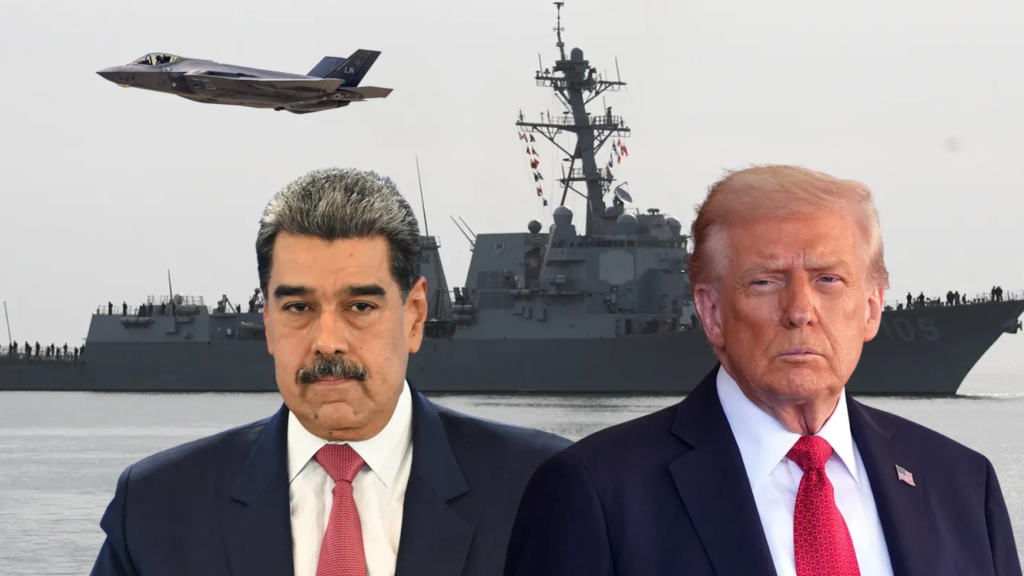
On January 3, the United States bombed Venezuela and kidnapped president Nicolas Maduro and his wife, Cilia Flores. More than 100 people were killed in the attack.
In the preceding months the US had increased its attacks and threats against Venezuela and other Latin American countries, particularly Colombia.
Warships, planes and troops were moved into the Caribbean. The Venezuelan government was accused of “narco-terrorism”. Numerous small boats were sunk in the Caribbean near Venezuela and in the Pacific near Colombia. Their crews, accused without evidence of being drug traffickers, were murdered.
The US warned passenger planes not to enter Venezuelan airspace. US warships imposed a naval blockade.
The US has long been hostile to the Venezuelan government, both under Hugo Chavez who was president from 1999 until his death in 2013 and under his successor, Maduro. US policy has included attempted coups, economic sanctions and military threats.
The sanctions aimed to restrict Venezuela's trade with other countries. The US tried to prevent companies from having any dealings with the Venezuelan government, unless granted an exemption by the US government. If a non-US company defied this edict, it was threatened with retaliation by the US. The sanctions amounted to an economic blockade.
But since this was not totally effective, the US began using its military forces to impose a naval blockade.
The purpose of the economic blockade had been to create an economic crisis and extreme hardship in Venezuela, in the hope that this would weaken popular support for the government and enable its overthrow. While succeeding in causing hardship, it failed to overthrow the government.
Now the US is using military aggression and a naval blockade to coerce the Venezuelan government into making economic concessions to US capital.
The US has also made threats against Colombia, which has been led since 2022 by leftist president Gustavo Petro.
Why is the US hostile to Venezuela?
There were several reasons for US hostility to the Maduro government.
- The US wants to control Venezuela's oil and other natural resources. In 2007 Chavez nationalised the assets of those foreign oil companies that refused to restructure in such a way as to give PDVSA (the state oil company) majority control. While Chevron agreed to comply, and was able to remain in Venezuela, some other companies such as Exxon did not. Chevron remained in Venezuela, but its joint venture with PDVSA controlled only a minority of Venezuela's oil production. Before the imposition of the naval blockade, most of Venezuela's oil exports went to China.
- The US wants to install a government that will support US foreign policy. Maduro has condemned US foreign policy, particularly its support for Israel's genocide in Gaza. Venezuela developed strong links with Russia, China and Iran. Economically, the US economic blockade made it necessary for Venezuela to find alternative trading partners. Militarily, the fear of US aggression led Venezuela to acquire Russian weapons, including anti-aircraft systems (which proved ineffective on January 3).
- Under Chavez, the Venezuelan government carried out some progressive social policies. It used oil revenue to fund programs in health care, education, housing etc. Chavez also encouraged the formation of communes. He said they should become the starting point for a new kind of state. These policies represented an alternative to the neoliberal model promoted by the US. The blockade undermined many of these gains. For example, the blockade makes it more difficult for Venezuela to get medicines, vaccines and medical equipment from the US and its allies, or companies intimidated by US threats.
Concessions to capitalism
The Maduro government, while claiming to be socialist, made many concessions to the capitalist class. These were defended as necessary in the context of the blockade.
For example, the US bans foreign companies from trading with Venezuelan state institutions, unless granted an exemption. If a Venezuelan state body, such as PDVSA, wished to import equipment or export oil, it often had to use a private company as an intermediary. Of course, the private company wants to make a profit, so the cost of imports is increased and the revenue received by the Venezuelan government from exports is reduced. In addition, the secrecy associated with such arrangements facilitates corruption.
The government also had political reasons for making concessions to the capitalist class. Maduro called for national unity against the threat of a US invasion. This implied some degree of cooperation with that section of the right-wing political opposition that is not totally subservient to US Imperialism.
As a result of these economic pressures and political considerations, there was a tendency towards privatisation of some government functions. However, some key industries remained under state ownership (PDVSA).
One aspect of the Maduro government's policy, which is often criticised, is the near-zero minimum wage. The value of the Venezuelan currency was cut to near zero by hyperinflation, but the minimum wage was not adjusted to compensate. On the other hand, many government services are subsided and low wages are supplemented by bonuses.
Maduro continued Chavez's policy of encouraging the development of communes.
Is Maduro neoliberal?
Some Venezuelan leftists describe the Maduro government as neoliberal. Others, while unhappy with what they saw as excessive concessions to capitalism, saw the government as progressive, often referring to its support for the communes as evidence.
Andreina Chavez, a former writer for Venezuelanalysis.com, wrote in 2024:
A lot of people like me are not entirely happy with the government’s liberal overtures in the name of circumventing the US blockade that moves away from the socialist alternative. We have felt ignored when making criticisms or requesting information regarding salaries, socioeconomic data, and the real state of healthcare, education and the electrical system and what investment is going (if any) into them. We don’t want to surrender our country to the US, but we also need guarantees about the next six years if Maduro wins. Will the government continue trapped in its echo chamber? Will they weed out the opportunists and corrupt? Will the socialist project be revitalized?
But while criticising the Maduro government, Chavez Alava supported Maduro's re-election. She said the right-wing opposition supported extreme neoliberal policies and would make Venezuela a “US client state”, whereas the Maduro government stood for “sovereignty” and the “construction of socialism” (however imperfectly it was pursuing this latter goal). She placed great importance on the building of communes, with government support.
Other progressive policies included the government's housing program, subsidised services such as electricity and public transport, and subsidised food distribution.
William Serafino, another Venezuelan leftist, criticises the claim Maduro was a neoliberal. He writes:
If Maduro were a full-fledged neoliberal, the Petróleos de Venezuela SA (PDVSA), the basic enterprises, the Caracas Metro, the electricity, telecommunications, and water supply companies — just to mention a few cases — would already be in the hands of the private sector.
Public banks, for example, would represent a small fraction of the national banking sector, which would be dominated almost entirely by private bankers. At the regulatory level, there would be no restrictions such as reserve requirements or public orientation of credit portfolios.
Likewise, tax collection policies would be reduced to a minimum. This pattern would be reproduced in every sector of the economy.
Clearly, none of this has happened or is close to happening in Venezuela, so the narrative that Maduro is neoliberal is flawed in its general premise....
It is an absurd contradiction to qualify a government as neoliberal if it has a wide range of taxes to strengthen its revenue collection, sustain subsidies to public services, and a massive food program: the CLAP, whose acquisition cost for the population is far below market prices. It is simply nonsense to call this neoliberalism. In fact, it is the opposite of neoliberalism.
Undemocratic?
Maduro was criticised as undemocratic. For example, left-wing parties, such as the Communist Party of Venezuela, that are critical of the Maduro government were excluded from participating in the 2024 presidential election.
The government was also accused of falsifying the results of the 2024 presidential election. I do not think this is true (and have addressed this issue elsewhere).
There are restrictions on the right to strike. This is common in wartime. The blockade is like an economic war.
Conclusion
Venezuela under Maduro presented a mixed picture. There were progressive policies, but also concessions to capitalism, and restrictions on democratic rights.
Was it socialist? Leon Trotsky argued there can be no socialism in a single country, isolated in a capitalist world. A revolutionary government can take steps in a socialist direction, but the pressures of a capitalist environment produce tendencies towards state bureaucratisation. Only the international spread of the revolution can prevent this.
The imperialist blockade is a major reason given by the Venezuelan government for its concessions to capitalism. Some leftists argue this is merely a pretext, not the real reason. In either case, ending the blockade is essential. If it is a pretext, then depriving the government of that pretext would make it easier for Venezuelan leftists to argue for socialist policies.
Today, Acting President Delcy Rodriguez is in a difficult position. Venezuela is under a naval blockade that prevents it from exporting oil without US permission. It is also threatened with renewed bombing if Rodriguez defies Trump's demands.
Under these circumstances, any agreement reached between Venezuela and the US will be extremely unfair. If Venezuela refuses to sign a bad agreement, the US will continue the blockade and Venezuela's oil industry will be shut down.
Should we condemn Rodriguez if she signs a bad agreement? For those outside Venezuela, such a condemnation would be pointless. Our task is to build a movement opposing the US blockade.
The 1918 Brest-Litovsk treaty between Germany and Russia's new Soviet government was unfair, but Lenin advised the Bolsheviks to sign it. The treaty became irrelevant later that year when the German government was overthrown by a popular uprising.
The blockade on Venezuela can only end through political change in the US. Movements opposing the Trump regime can contribute to such a change. We need a strong movement opposing US attacks on Latin America, including the blockade of Venezuela.